Premium ghostwriting for B2B SaaS and AI founders. One 30 min call becomes a month of posts in your voice. AI automation, websites, docs. DM SAMPLE for 3 free.
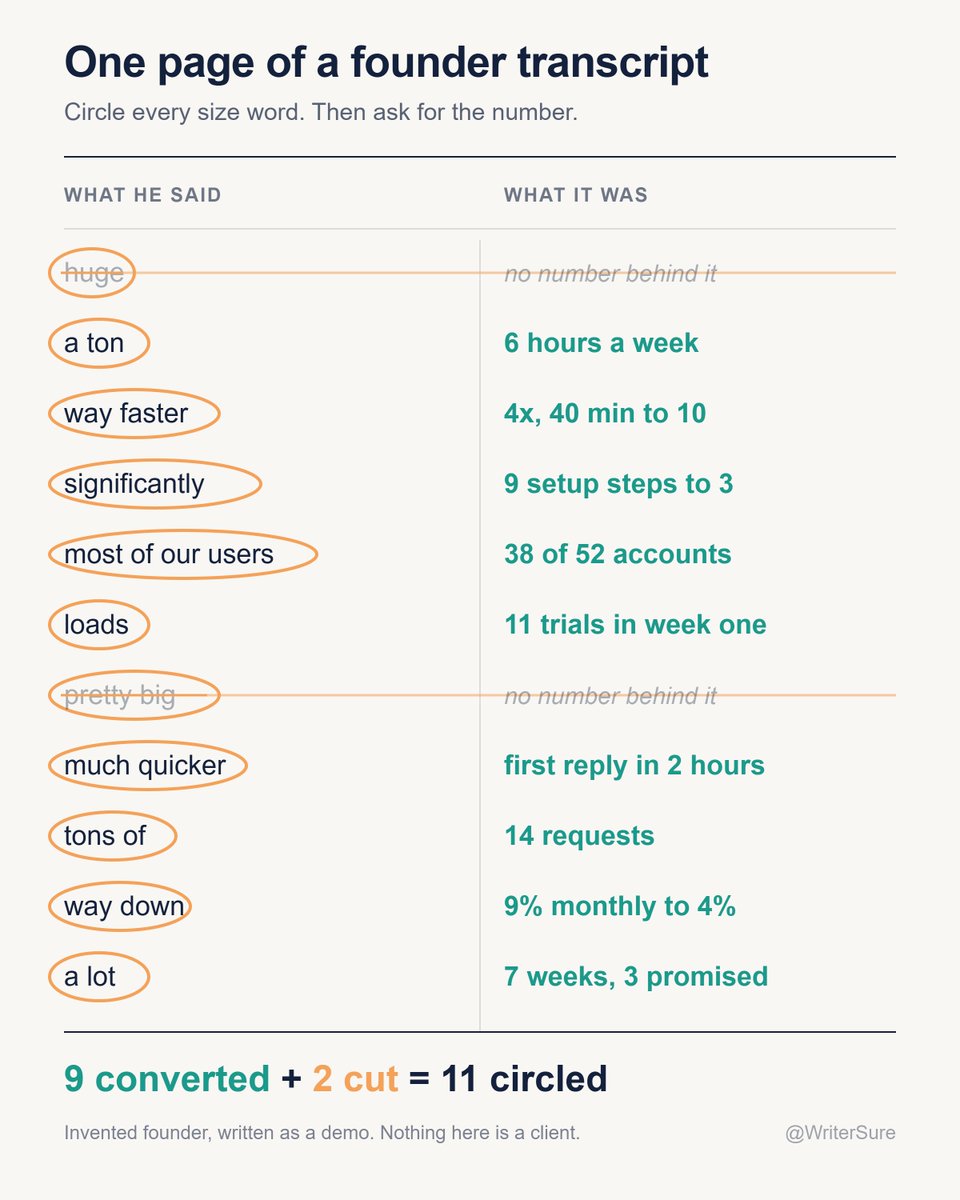
I circled 11 size words on one page of a founder transcript.
Nine had a real number behind them. Two did not.
huge. a ton. way faster. most of our users.
Every one of those is a question nobody has asked yet. The founder is not bluffing. The figure is in their head, one follow up away.
Nine came back as figures. The two that came back empty left the post.
That is most of what ghostwriting actually is. Less writing than asking, then cutting.
If you cannot point at it, you are describing a feeling.
I do this for B2B SaaS and AI founders. One 30 minute call becomes a month of posts in your voice.
DM me SAMPLE and I will send three, written from your own words, free.
Every sentence is defensible and no sentence is owned.
Nothing in an AI draft would embarrass anyone, and nothing in it could only have come from one person.
It is also what a good first draft looks like, which is why it is so hard to throw away.
The person with the knowledge cannot see it.
They are not withholding. They have done it so often that the hard parts stopped registering as hard.
Ten years of interviewing engineers for documentation taught me that. The sequence of questions that gets it out is the same whether the subject is an API or a company.
Reported speech is the one thing no model can guess.
A sentence someone said on a call exists in exactly one place, and that place is not the training data.
So the third question on the ladder is always what the other person actually said. Everything else in a draft can be rebuilt from the website.
Those two or three people are carrying the judgement nobody wrote down.
Everything that could be written down already got delegated. What is left routes to whoever can make the call without asking, and that is exactly why they are overloaded.
Even in the biggest companies, CEOs often really only have 2-3 folks they can utterly, totally count on, 100%
Being one of those 2-3 can be really hard. By definition, you sort of get taken advantage of by being overloaded.
But it's where career magic happen.
The call is not where the writing happens.
Thirty minutes buys the raw material. The dates, the arguments, the sentences somebody actually said. That part cannot happen without the founder in the room.
The arranging and the cutting happen afterwards and need nobody but me. Separating those two is how a month of posts comes out of one call.
The best line in a draft is usually not in the draft.
Two sentences survived the cut. The third came from putting them side by side and asking what they imply that neither says on its own.
It was not in the transcript and not in the AI draft. It is what the two surviving facts add up to, and it is the only part of this job that is actually writing.
Three things never leave the founder. What counts as true, what counts as interesting, and whether they would say it out loud.
The rest is finding the material, ordering it, and cutting it. All three can sit with someone else.
Most people hand it over the other way round, then wonder why the output reads like nobody wrote it.
@hnshah The part that goes stale is your own record. Review pricing twice a year and by the second time nobody remembers which option was rejected last time, or why.
AI can keep the market current. The reasoning behind your own last decision is the thing nobody wrote down.
@jasonlk Headless means the data model is the product. The screen was doing quiet work too: it was where someone noticed a field had been repurposed, or a picklist had drifted.
Nobody logs in, so nobody sees that happen. Worth putting the check somewhere else before you need it.
The two sentences with no figure behind them were deleted, not softened.
Softening gets you "a significant problem" where you had "a huge problem", and the reader learns the same nothing either way.
If the number does not exist, the claim does not exist. Take the sentence out and the draft gets shorter and truer in the same move.
I stop asking follow ups after the third one.
By the fourth the answers start repeating with more adjectives. The founder has stopped remembering and started explaining, and explaining is the part that gets cut in the edit anyway.
Three rungs, then move to the next opener. The time is better spent on a new question than on a fourth version of the same answer.
The sentences that fail the witness test are predictable.
The state of the market. Where the industry is going. What most teams underestimate. What the best companies do. What I have always believed.
Five shapes, and they turn up in nearly every first draft I am sent.
They are what gets written when the writer has run out of things that actually happened.
When a founder says huge, they usually have the number.
Eleven vague words on one page. I asked for the figure behind each one. Nine came back immediately. Six hours a week. Thirty eight of fifty two accounts. Nine per cent down to four.
They were not hiding anything. They had been saying it the short way for so long that the short way had replaced the figure.
The two with no number were the two that got deleted.
Two tests, and they cut different sentences.
Could a competitor publish this unchanged. Who could tell me this is wrong.
A founder's own belief passes the first and fails the second. It is genuinely his, so no competitor would write it, but nothing happened in it, so nobody was there to contradict it.
That is the sentence founders argue hardest to keep. It is also the one readers skip.
I ran a sample draft through one question and lost nine of its twelve sentences.
Could a competitor publish this line unchanged.
What survived: a lesson that had cost them something, and a fact about their own pricing page that nobody outside the company could know.
Two sentences out of twelve. That is roughly the ratio every time, which is why the length of a first draft tells you nothing about how much is in it.
I write a name in the margin next to every sentence.
The name of the one person who could ring up and say that is not what happened.
Thirteen sentences on the last draft. Eight got a name. Five stayed blank.
The five blanks were all true. Four were about the market and one was a belief. Nothing happens in them, so there was nobody in the room, so there is nobody to get them wrong.
A sentence nobody can correct is a sentence anybody can post.
@lennysan@ElenaVerna Her slide has the useful version: exceptional in one or two places, good enough everywhere else.
For writing, average means the median of what has already been written, which is also a line any competitor could publish. Fine in a first draft, fatal in the last.
@hnshah The standard, written down.
Most handovers pass on the last output. What the next piece of work needs is what was rejected and the sentence saying why, because that is the part that still holds when the question changes.
A model can write anything that has been written before, which turns out to be most of a first draft.
What it cannot produce: a date, a number nobody published, a sentence a customer said on a call that was never recorded, the argument two founders had and who won.
Those are the only parts of a post that could not have come from anyone else. The rest is packaging.
There are two questions you can ask a founder about a draft.
Is this good. Did you say this.
The first needs their full attention and they will put it off for a week. The second takes seconds and they will do it on a Tuesday between meetings.
The whole job is making the draft answerable by the second one.