Secured another milestone in my professional journey.
I am grateful to share that I have successfully passed the Licensed Lawyer Examination jointly administered by the Somali Bar Association and Wasaaradda Cadaaladda iyo Arrimaha Dastuurka XFS.
In 2025, SNBS achieved notable progress in advancing Somalia’s statistical infrastructure, including the enhancement of macroeconomic data systems, the modernization of the Consumer Price Index, the expansion of nationally representative surveys, and the strengthening of administrative data integration. Collectively, these developments reinforce a robust, evidence-based statistical framework that underpins the implementation of the National Transformation Plan and the monitoring of Sustainable Development Goals.
Somalia’s private sector has shown remarkable resilience despite decades of conflict, yet businesses still face challenges such as limited access to finance, poor infrastructure, and fragmented regulatory systems. Many of these businesses are largely informal, operating outside the formal regulatory and tax framework.
The Somalia Integrated Business Establishment Census (SIBEC 2024), conducted by the Somalia National Bureau of Statistics (SNBS), provides the most comprehensive picture of business activity across 16 major urban centres.
In my latest analysis, “Business Formality in Somalia: What the 2024 Business Establishment Census Reveals for Growth, Revenue, and State-Building”, I examine how formality, enterprise viability, and targeted policy interventions can unlock economic growth, expand the tax base, and strengthen the fiscal social contract.
Read the full insights and data here: https://t.co/KGqBMYy0v5
A New Year: Planning, Effort, and Meaningful Change
Time moves forward without pause. This is the nature of life. As Imam al-Shafi‘i (رحمه الله) reminded us, time is like a sword; if it is not used well, it cuts against us. The arrival of a new year is therefore not merely symbolic. It is a moment for reflection, accountability, and renewed direction.
For those who think seriously about life, the passing of time carries an expectation of progress. Each year should leave us more experienced, more knowledgeable, and more grounded than the one before. This kind of growth does not happen by chance. It is the result of deliberate thinking, thoughtful planning, and consistent effort.
The Qur’an reminds us that real change begins from within. “Indeed, Allah does not change the condition of a people until they change what is within themselves” (Qur’an 13:11). Intention is the starting point, but action is what gives intention meaning. This is why planning matters. Planning forces us to be honest about where we are, clear about where we want to go, and realistic about the steps required to move forward. Without a plan, effort becomes unfocused, and time passes without producing meaningful results.
Our future is shaped by how we think, the discipline we apply, and the consistency of our actions, alongside our relationship with Allah and our responsibilities towards family, colleagues, and the wider community. Whether we are students, professionals, entrepreneurs, or public servants, progress depends on setting priorities, defining goals, and reviewing outcomes with sincerity.
Effort alone is not enough if it is not guided by knowledge. The Qur’an cautions us, “And do not pursue that of which you have no knowledge” (Qur’an 17:36). Learning, evidence, and accurate information help us understand reality as it truly is rather than as we assume it to be. In practical terms, data and careful assessment allow us to measure progress, identify gaps, and adjust our plans when necessary. What is not measured cannot be managed, and what is not reviewed rarely improves.
The Qur’an repeatedly emphasises precision, balance, and accountability. “Indeed, all things We created with precise measure” (54:49), and “Establish weight in justice and do not make deficient the balance” (55:9). These principles apply to every area of life, personal, professional, and public. Improvement requires accuracy, fairness, and the willingness to assess ourselves honestly.
As we enter a new year, the real question is not simply what we hope for, but what we are prepared to do differently. If we think more clearly, plan more wisely, and act more consistently, then one year from now we should be able to point to real progress, however small, from where we stand today.
May the coming year be one of purposeful planning, sincere effort, and meaningful change. I wish everyone a peaceful, productive, and blessed New Year. May Allah grant us wisdom in our decisions, strength in our efforts, and barakah in the results.
📊 CFSVA 2025: Advancing Evidence on Household Vulnerability in Somalia
Yesterday, the Somali National Bureau of Statistics (SNBS), in collaboration with WFP, FAO, and the World Bank, launched the 2025 Comprehensive Food Security and Vulnerability Assessment (CFSVA), a nationally representative survey covering 8,816 households across 17 regions. This assessment adds to the growing national evidence base that SNBS has developed over the years, complementing prior initiatives such as the 2022 Integrated Household Budget Survey. The CFSVA provides a holistic view of Somali households, including food security, livelihoods, income and shocks, school enrolment, displacement, agriculture, livestock, fisheries, market and community access, living conditions, and multi-dimensional vulnerability.
📌 Key Findings:
📌 Food Insecurity Remains Structural
Nearly 29% of households are highly or extremely food insecure, with 35% experiencing high or extreme multi-dimensional deprivation, highlighting how food insecurity intersects with socio-economic and service-related vulnerabilities.
👶 Demographics and Household Pressure
Somalia’s population is overwhelmingly young (median age 16), with an average household size of six. High dependency ratios, combined with barriers to education, increase household vulnerability and constrain long-term human capital development.
🏠 Displacement Drives Vulnerability
Displacement is largely protracted: 60% of displaced households have been displaced for four years or more. Extended displacement reduces access to stable livelihoods, social networks, and services, resulting in persistently worse outcomes than non-displaced households.
💼 Fragile Livelihoods and Shocks
Most households rely on a combination of casual labour, small-scale trade, agriculture, livestock, fisheries, or remittances. Nearly 1 in 5 households reported income shocks in the three months preceding the survey — including drought, illness, rising prices, or job loss — which reduces purchasing power and access to food.
🌾 Agriculture, Livestock, and Fisheries Constraints
Agriculture and livestock remain central to rural livelihoods but face structural limitations, including limited land access, insecure tenure, poor inputs, and market barriers. Despite Somalia’s long coastline, fisheries — a critical source of income and nutrition for coastal communities — face significant constraints, including limited equipment, market access, and cold chain infrastructure, which reduces their contribution to household resilience and food security.
🚰 Unequal Access to Basic Services
Urban households generally report better access to safe drinking water, electricity, and modern lighting, while rural and displaced households rely heavily on unimproved water sources and biomass fuels, compounding vulnerability and health risks.
⚠️ Coping Strategies Signal Stress
About 32% of households adopt negative coping mechanisms — reducing food intake, selling productive assets, or withdrawing children from school — which provide short-term relief but undermine long-term resilience. Vulnerability is particularly pronounced among female-headed households, high-dependency households, and displaced populations.
🎯 Policy Implications:
The CFSVA 2025 demonstrates that food insecurity in Somalia is multi-dimensional and structural, shaped by displacement, fragile livelihoods, limited services, and socio-economic inequality. Addressing these challenges requires coordinated, multi-sectoral interventions, including strengthening livelihoods, fisheries, agriculture, social protection, and access to education and basic services. The evidence generated through this SNBS-led assessment provides a strong foundation for data-driven policy, targeted humanitarian interventions, and long-term resilience planning.
Today, we had the privilege of jointly launching with the World Bank the findings from Waves 1 and 2 of the Listening to Somalia Survey, alongside Somalia’s pre-launch of the new Mobile Phone Data for Policymaking Initiative. This milestone marks a major shift toward modern, flexible, and citizen-centred evidence systems. As traditional household surveys are conducted only every five years, mobile phone surveys now serve as a powerful alternative to fill the data gaps between these cycles and to provide timely, real-time insights.
Conducted across all 18 pre-war regions, with nearly 3,000 households interviewed in each wave—including about 1,900 repeat households—the Listening Survey has shown that high-quality national data can be collected rapidly, safely, and cost-effectively through mobile phones, reaching rural, nomadic, urban, and displaced populations. The survey captured critical issues including poverty, food insecurity, drought impacts, reductions in social assistance, satisfaction with services, taxation, climate shocks, and the education aspirations of children and youth. While the findings highlight real hardships, they also reveal something powerful—resilience, ambition, and strong hopes for better education, jobs, services, and security, especially among our youth.
Building on this momentum, SNBS is also advancing work on Mobile Phone Data (MPD) with Mobile Network Operators. This initiative represents a major leap forward for Somalia’s digital statistical ecosystem. By using anonymized and aggregated telecom data, we will generate real-time insights on population movements, vulnerability, and the impacts of shocks, strengthening disaster response, shock-responsive social protection, and evidence-based policymaking.
I extend my sincere appreciation to the World Bank, government institutions, and all our partners who joined us for this important launch. Together, we remain committed to building modern, high-quality data systems that elevate citizen voices and guide decisions shaping Somalia’s future.
Today, I was formally conferred with the degree of Doctor of Philosophy in Economics at the University of Glasgow.
Deepest gratitude to my supervisors—Dr. Arjunan Subramanian, Professor Anwen Zhang, and Dr. Alberto Ciancio—for their exceptional guidance throughout this rigorous journey.
My PhD research examined the role of remittances in fragile and conflict-affected settings, using Somalia as a case study, drawing on nationally representative household surveys, high-frequency administrative data and advanced econometric techniques.
The journey has been both challenging and transformative, marked by setbacks and breakthroughs that deepened my analytical skills and reinforced the value of evidence-informed policymaking in fragile contexts.
My sincere appreciation goes to my family, friends, and colleagues for their unwavering support.
Alxamdulillaah for this milestone—and thanks to all who contributed to it. Onward to new horizons of research, service and impact.
Pleased to unveil Somalia’s first Population Development Composite Index (PDCI) 2025, bringing together 29 indicators aligned with ICPD & SDGs into a single, standardized measure of population & development performance. With an overall score of 29.8, the Index brings into focus notable spatial & regional inequalities, identifying areas of relative progress.
Likewise, we released IDP Mortality Outlook & shared progress on the Sociodemographic Survey 2025, which has reached over 50,000 structures & 42,000 households in five districts, supported by advanced geospatial mapping & real-time validation systems. These outputs strengthen the evidence base for Somalia’s National Transformation Plan, guide targeted investments and support preparations for Population and Housing Census. I extend my appreciation to UNFPA and our other development partners for their continued collaboration in strengthening Somalia’s national statistical system.
With annual inflation at 3.9%, this month’s CPI offers a clear picture of the forces shaping price movements across sectors & FMS.
The report not only outlines the main drivers of inflation but also highlights regional disparities, providing an essential basis for understanding living conditions nationwide.
SNBS will regularly publish national CPI, a cornerstone for monitoring inflation trends & supporting evidence-based policy & planning.
Today, Somalia proudly marked African Statistics Day 2025, joining other nations in the continent in recognising the power of data to shape peace, justice and prosperity. This year’s theme speaks directly to our national journey. As we rebuild institutions and deepen stability, innovation in data becomes the prerequisite engine that guides our policies, measure our progress and strengthen public trust.
Somalia’s statistical transformation is well and truly underway. From modern digital surveys to geospatial mapping, strengthened administrative records and the rapid expansion of SDG reporting—our national data ecosystem is becoming more credible, more inclusive and more aligned with international standards. These gains are possible because of strong collaboration among Federal Government, Federal Member States, Parliament, academia, civil society and development partners, in an enduring partnership that is proving that resilient institutions are built on reliable evidence.
As I told participants today, statistics are the very compass of national development. On this African Statistics Day, I reaffirm SNBS’s commitment to excellence, innovation and public service. With continued partnership and investment, Somalia will build a statistical system that empowers decision-makers, supports accountability and delivers for every Somali citizen.
#AfricanStatisticsDay2025 #DataForSomalia
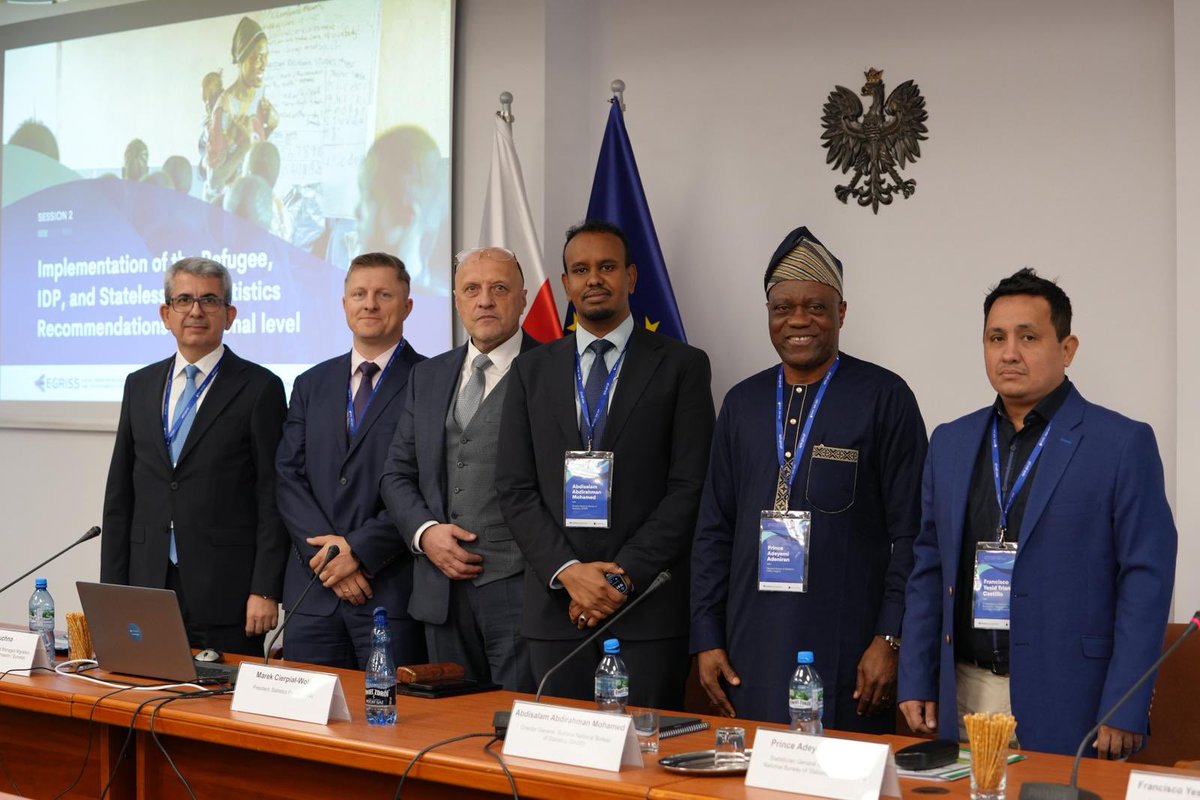
Warsaw, Poland; 28–30 Oct 2025
Somalia National Bureau of Statistics joined global statistical community at the 2025 All Members Meeting of Expert Group on Refugee, IDP and Statelessness Statistics (#EGRISS2025AMM), hosted by @StatPoland.
Our Director General, Dr. Abdisalam Mohamed, delivered presentation on “Somalia’s Approach to Collecting & Managing Refugee, IDP & Statelessness Data,” underpinning SNBS’s ongoing efforts to transform humanitarian data into official statistics. He showcased Somalia’s pioneering 2023 Survey on Nomadic Movement into IDP Camps, whose findings identified major data gaps & emphasized importance of strengthening national coordination to produce reliable, IRIS-aligned displacement statistics.
Dr. Abdisalam also participated in a panel discussion on implementing the IRRS, IRIS and IROSS frameworks at the national level, where he shared Somalia’s experience in integrating displacement data through IDP Statistical Sector Plan—one of the key sub-strategies of the National Statistical Development Strategy (NSDS2). He further noted that the upcoming Population & Housing Census will update Somalia’s population baseline & ensure comprehensive inclusion of IDP settlements. His remarks underscored national ownership, data quality & institutional collaboration as critical pillars for advancing the displacement statistics agenda.
Somalia’s engagement in #EGRISS2025AMM points to the tangible progress of national institutions like SNBS in strengthening data systems & contributing to global statistical discourse— such that every person counts & is counted. SNBS continues producing trusted, high-quality statistics that drive durable solutions & sustainable development. @AbdisalamHumbul@abdirahm_omar
Warsaw, Poland; 28–30 Oct 2025
Somalia National Bureau of Statistics joined global statistical community at the 2025 All Members Meeting of Expert Group on Refugee, IDP and Statelessness Statistics (#EGRISS2025AMM), hosted by @StatPoland.
Our Director General, Dr. Abdisalam Mohamed, delivered presentation on “Somalia’s Approach to Collecting & Managing Refugee, IDP & Statelessness Data,” underpinning SNBS’s ongoing efforts to transform humanitarian data into official statistics. He showcased Somalia’s pioneering 2023 Survey on Nomadic Movement into IDP Camps, whose findings identified major data gaps & emphasized importance of strengthening national coordination to produce reliable, IRIS-aligned displacement statistics.
Dr. Abdisalam also participated in a panel discussion on implementing the IRRS, IRIS and IROSS frameworks at the national level, where he shared Somalia’s experience in integrating displacement data through IDP Statistical Sector Plan—one of the key sub-strategies of the National Statistical Development Strategy (NSDS2). He further noted that the upcoming Population & Housing Census will update Somalia’s population baseline & ensure comprehensive inclusion of IDP settlements. His remarks underscored national ownership, data quality & institutional collaboration as critical pillars for advancing the displacement statistics agenda.
Somalia’s engagement in #EGRISS2025AMM points to the tangible progress of national institutions like SNBS in strengthening data systems & contributing to global statistical discourse— such that every person counts & is counted. SNBS continues producing trusted, high-quality statistics that drive durable solutions & sustainable development. @AbdisalamHumbul@abdirahm_omar
@AbdisalamHumbul The Commencement of the MICS-S survey represents a significant historical achievement. It provides reliable indicators. Thank you @AbdisalamHumbul for your clear and efficient leadership.
ANNOUNCEMENT
Tomorrow, August 27, 2025, is a big day for Somali Statistics as Somalia takes a historic step forward with the launch of MICS-7.
This landmark survey will provide reliable data for every child, every woman, every decision—the foundation of our nation’s transformation.
Here’s a pre-event video as we count down to the big day.
Stay tuned here for live updates. @AbdisalamHumbul@abdirahm_omar
#MICSForSomalia
SNBS congratulates our Director General, Dr. Abdisalam Mohamed, @AbdisalamHumbul on receiving a Presidential Award at the launch of Vision 2060. As a former member of the National Economic Council, Dr. Abdisalam contributed significantly to the research & strategic groundwork that shaped this transformative national agenda. We thank H.E. President, Dr. @HassanSMohamud, H.E. Prime Minister @HamzaAbdiBarre for their visionary leadership, as well as NEC Executive Director & Chief Presidential Economic Advisor @HassanAHosow.
As Somalia embarks on implementing Vision 2060 via the National Transformation Plan (2025–2029), SNBS continues delivering high-quality & timely data needed to track progress, shape policy & ensure no one is left behind. Our mission is to make data the backbone of Somalia’s development journey. @abdirahm_omar