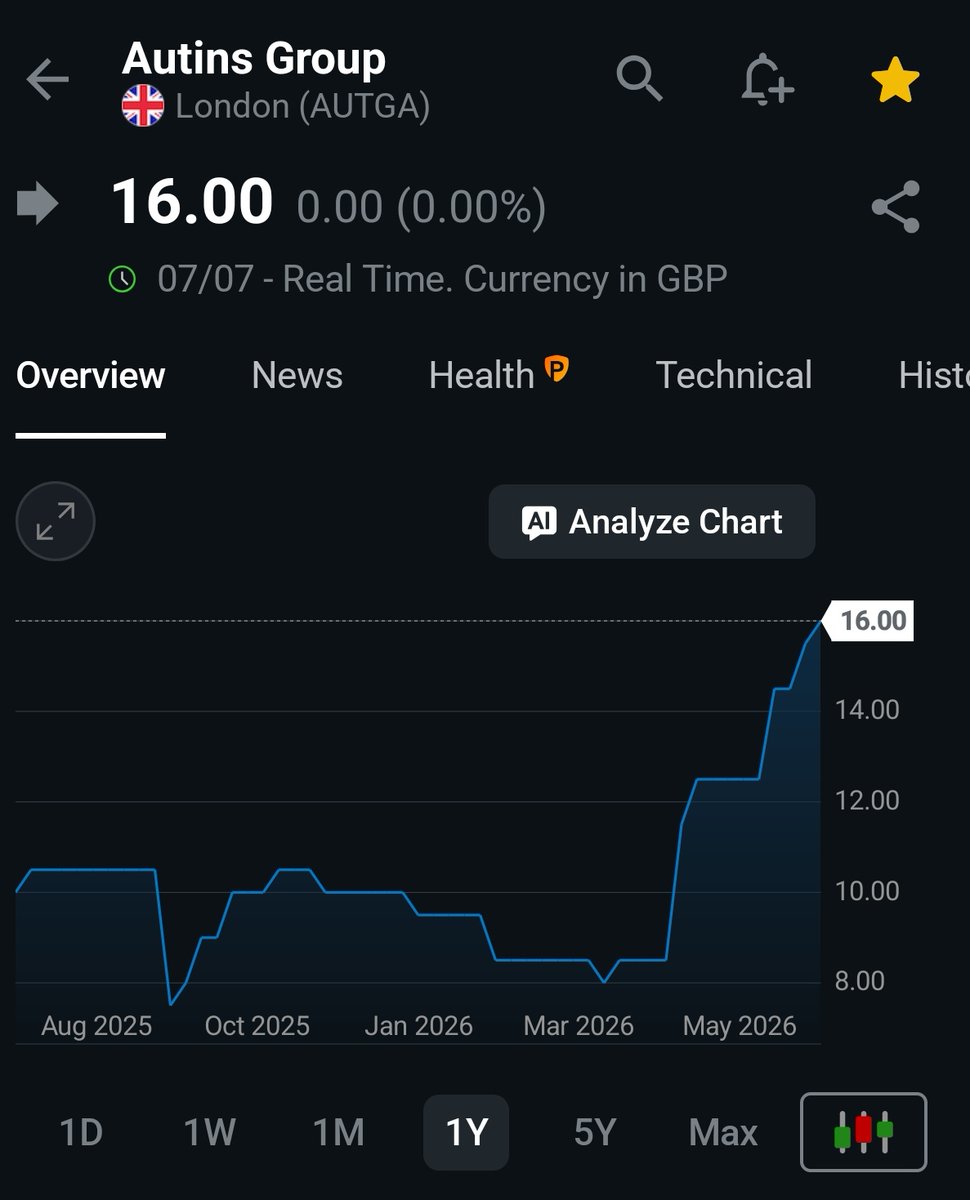
This stock has doubled since my entry point at GBP 0.08 and absolutely nobody is talking about it in X
Good for me, that means it still has more room to run
Autins Group $AUTG $AUTG.L $AUTGA
$AUTG.L $AUTG — Autins Group
Bought at GBP 0.08 in Dec 2024, when european automotive stocks were really depressed (and still are)
Now it is trading at GBP 0.15 due to the good FY26 results
First net profit since 2017
The "Survive and Thrive" turnaround is working
The story:
UK NVH specialist (acoustic + thermal management for cars) with proprietary Neptune material made in-house. Spent years in survival mode
New CEO Andy Bloomer arrived April 2024, cut costs, fixed margins, diversified the customer base from ~60% reliance on one customer down to 44%
Non-UK is now 50% of revenue. Germany is the growth engine.
New products AuDuct and AuTrim increase content per vehicle and are moving into production
Management guides FY27 £22m rev / £0.8m PAT, FY28 £26m / £1.4m, and now FY29 £27m / £1.9m
Long
NEW: 🇺🇸 Donald Trump is going to lift the ban on mailing handguns directly to homes, per Reuters
That helps GrabAGun, the online gun store his son has a stake in.
He is about to earn billions.
$AUTG.L $AUTG — Autins Group
Bought at GBP 0.08 in Dec 2024, when european automotive stocks were really depressed (and still are)
Now it is trading at GBP 0.15 due to the good FY26 results
First net profit since 2017
The "Survive and Thrive" turnaround is working
The story:
UK NVH specialist (acoustic + thermal management for cars) with proprietary Neptune material made in-house. Spent years in survival mode
New CEO Andy Bloomer arrived April 2024, cut costs, fixed margins, diversified the customer base from ~60% reliance on one customer down to 44%
Non-UK is now 50% of revenue. Germany is the growth engine.
New products AuDuct and AuTrim increase content per vehicle and are moving into production
Management guides FY27 £22m rev / £0.8m PAT, FY28 £26m / £1.4m, and now FY29 £27m / £1.9m
Long
$AUTG.L $AUTG Autins Group plc
Ignored and iliquid.
Market cap ~£4m
Stock price: £0.07
BV per share: £0.175
Negative earnings, but FCF positive.
EV/FCF: 2.67
New CEO, new strategy to return to profitability.
Cost reduction, debt amortization.
Investment in R&D.
👇
$0327.HK
$PAX
New lows for PAX as the market keeps ignoring it
I'll keep buying; it's the top holding in my portfolio
Net-net
P/BV 0.4
No debt
Negative EV
Positive FCF
$AKW $AKW.PA Akwel is on my watchlist
French auto-parts supplier, family-controlled, trading at 0.3x P/BV
•~€100M net cash vs ~€182M market cap
•0.69x P/NCAV
•FCF positive
•4%+ dividend yield
No investment advice
I don't like that they're looking to sell the business; that wasn't my thesis. Why would you want to sell a business that you're trying to turn around?
$BMBL
One of the biggest mistakes investors make is confusing a great business with a great investment. They are not the same thing. A great business can absolutely become a terrible investment if you pay far more than it is worth.
$PLTR is an incredible company with outstanding economics, visionary founder, and a long runway ahead, etc etc... But let’s be honest, at this stage of the business it had no business trading at $200 per share. Every business has a price, and every business has a value. Those two numbers are rarely the same.
The irony is that the better the company, the more willing investors become to ignore valuation altogether. They convince themselves that “this time is different” and that exceptional businesses deserve unlimited multiples. History has shown that almost every market eventually disagrees.
The biggest determinant of your future return is often not the quality of the business, but the price you paid for it. Buying a wonderful company is only half of the equation. Paying a sensible price is what allows compounding to work in your favor.
Nothing about this means $PLTR is a bad business. Quite the contrary, it’s a good business. Just simply means that even the greatest companies are not worth an unlimited amount. Great businesses deserve great valuations, but not infinite ones. 🌹
Why?
Because a stock’s price is merely a barometer of EXPECTATIONS
That’s it, that's the market, expectations
That's why psychology is an important part of this game
If you figure out what the market expects about a stock and discover a flaw in that reasoning, you'll make money in the long run
It doesn’t matter how much the company earns or has earned in the past, but rather how much it will earn in the future and how much of that will be returned to shareholders. Take $ADBE as an example
It doesn’t matter how much cash it has on its balance sheet, but rather what it will do with it and how much of that will reach shareholders
That’s why there are companies with more cash than market capitalization—because the market expects that cash to be burned through or squandered and never returned to shareholders, like $PEW
Nothing is expected from net-nets with negative earnings; expectations are very negative, so any slight piece of good news that leads the market to believe more money will be received than is paid per share will cause the stock price to rise to the moon
Regardless of what type of investor you are (growth, value, or momentum), your task is to figure out what the market expects from a company and, if you think the market is wrong, assess the odds and bet accordingly (long or short)
Of course, you can buy a stock that appears to be overvalued but that you believe can rise further because market is not pricing in an expectaction that you have
However, that’s more complicated than simply buying worthless junk at a low price and hoping for any good news that might cause the stock to triple in value
Some will fail, but the ones that succeed will more than make up for it
While going through the literature on net-nets, there was one insight that stood out to me the most.
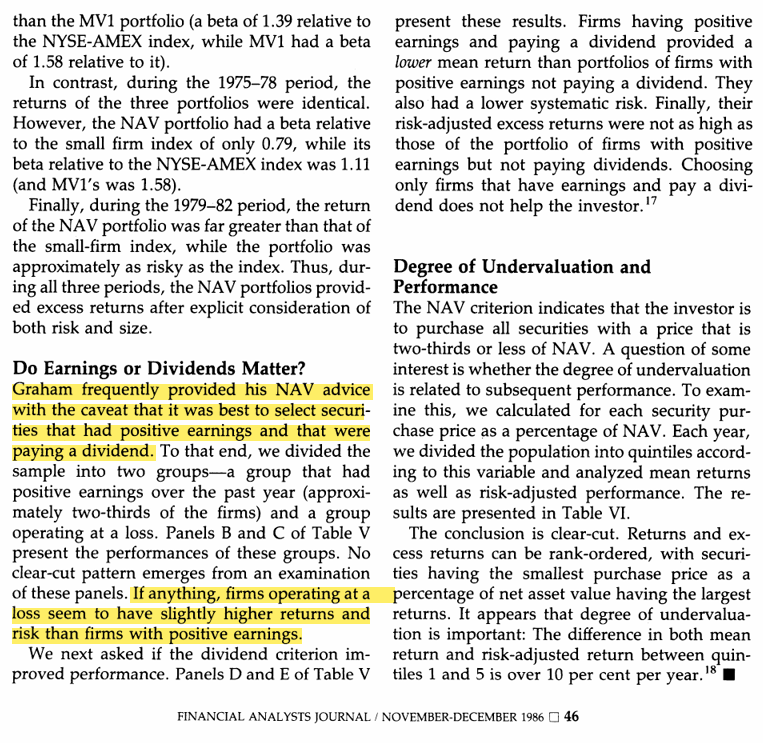
Money-losing net-nets outperform net-nets that are earning a profit.
Oppenheimer was the first to discover this in his pioneering 1986 net-net study. And many others have confirmed it since.
It may seem counterintuitive.
You might think that when buying a depressed stock below liquidation value, it would help if the business were at least earning a profit.
But the opposite is actually the case.
And the reason probably comes down to behavioral psychology.
Net-nets are already sold down to unreasonably low prices. No business should be selling for less than its liquidation value. There is no argument to be made that it makes sense for an operationally functional business to be worth more dead than alive.
But net-nets that are also losing money are likely pushed even further into irrational territory by the additional negative sentiment, beyond where their profitable counterparts end up.
The higher returns from money-losing net-nets are therefore not the result of any special business improvement, but rather a correction of an irrationally large sell-off, one that goes deeper than what profitable net-nets experience.
The only empirical exception to this finding comes from a 1981 study by Joel Greenblatt. Yes, THAT Joel Greenblatt.
He found that net-nets which are also profitable and trade below a P/E of 5 actually outperform money-losing net-nets.
An interesting finding, and one that goes against Graham's own recommendation to buy businesses that are earning a profit.
How many investors actually have the stomach to hold money-losing net-nets, though, is a different question entirely.