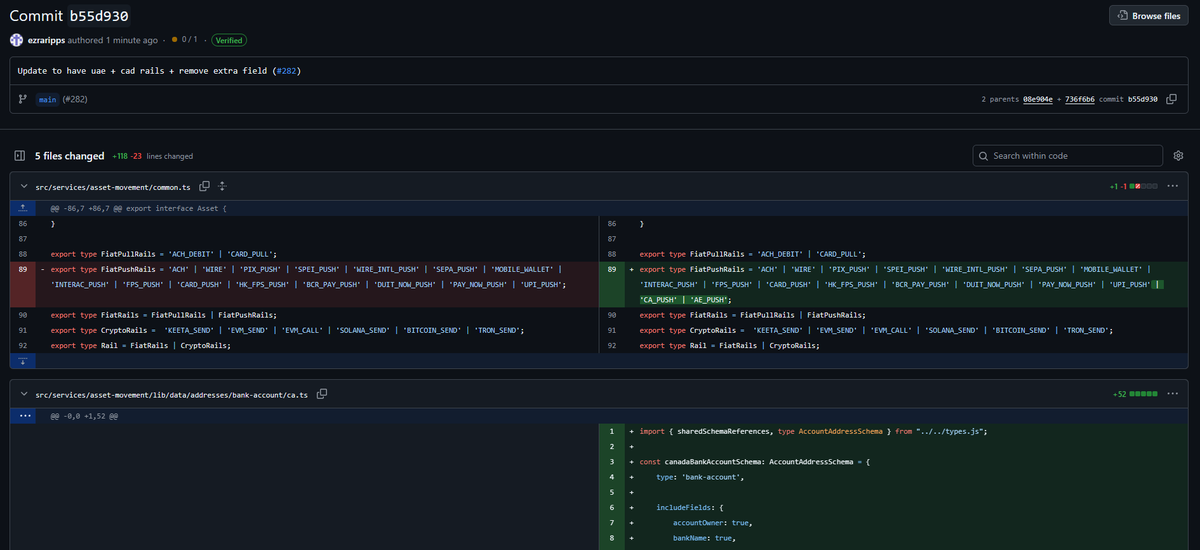
Keeta $KTA Network has added support for UAE and Canadian rails in the Anchor GitHub repository
Alongside the rail expansion, this includes full bank account schema implementations for both regions.
psa, in line with what i’ve been sharing over the past few weeks, including my march 31 piece on @KeetaNetwork and agentic use cases, i’ve built an agentic system. more to come soon. $KTA
https://t.co/adWHsiTb4X
Swap KTA, USDC, EURC, and other tokens directly in Keeta Web Wallet.
No traditional exchanges. No delays.
Fund your wallet from your bank, make purchases, and move funds back out quickly.
As more tokens and rails are added, this only gets better.
Bridge just made a major move and it matters for $KTA more than most people realize.
Two days ago Fortune reported that Visa and Bridge are expanding their stablecoin backed card partnership to over 100 countries across Europe, Asia, and Africa. The cards are already live in 18 countries right now. This isn't a roadmap bullet. This is operational infrastructure that's scaling globally as we speak.
Here's how it works. Companies come to Bridge to create their own branded stablecoin backed debit cards. Visa acts as the payments network. Users take stablecoin balances in their wallets and spend them at any merchant that accepts Visa. Clothing stores, delis, anywhere.
Now connect that to Keeta.
Bridge isn't just adjacent to Keeta's roadmap. Bridge is already live on Keeta right now. On December 11, 2025, Keeta launched its first Fiat Anchor and Bridge was it. USD to USDC via ACH and wire. EUR to EURC via SEPA. USDC bridging to and from Ethereum. That's not a partnership announcement. That's a live product that's already running.
Keeta's roadmap includes a KUSD debit card that lets users spend their KUSD balance anywhere Visa or Mastercard is accepted. The fiat anchoring behind that card is being built through Keeta's bank acquisition. Bridge is what makes the card spendable at 175 million merchants globally. These aren't competing pieces. They're different layers of the same stack.
But it goes deeper than cards.
Bridge is also joining Visa's pilot program exploring whether charges can be settled with stablecoins on blockchains instead of traditional bank transfers. Visa's head of crypto said publicly that if they can move billions on chain they believe they can move trillions. That's the head of crypto at Visa talking about on chain settlement at a trillion dollar scale.
I want to be straight with you about something here. Keeta is not currently named among Visa's supported settlement chains. Visa publicly enumerates which chains it uses for settlement and right now that's Ethereum, Solana, Stellar, and Avalanche. Keeta isn't on that list today. That's not the point of this post.
The point is this. Bridge is Keeta's live fiat anchor partner. Bridge is now scaling to 100 plus countries through Visa. That directly expands the regulated infrastructure that Keeta's card roadmap depends on. Whether Keeta eventually becomes a named Visa settlement chain is a future catalyst. What's happening right now is that the partner already embedded in Keeta's network is building the global rails Keeta needs to deliver its own roadmap. That matters regardless of what Visa's settlement list looks like today.
Keeta's architecture is built for exactly the direction this is heading. Anchors that connect to payment rails. Two stage settlement designed for institutional finality. Ten million transactions per second with 400ms confirmation. Native compliance through X.509 certificates. This is what a stablecoin to Visa pipeline needs on the settlement end when it's ready to scale.
And here's the part that ties it all together. Bridge CEO Zach Abrams told Fortune that the next frontier is agentic commerce, where AI agents make purchases on behalf of humans at a velocity the card networks weren't built for. His framing was that agents want to transact with an incrementality and velocity that is very unique from how card networks were designed.
Sound familiar? Three days ago I posted about Keeta's ecosystem building an MCP server that makes the entire protocol AI readable. The infrastructure for AI agents to understand and interact with Keeta is already being built. Bridge is saying the future needs exactly that kind of architecture. Keeta is building it.
Here's how the stack breaks down across what's confirmed today.
Bridge is live as Keeta's first Fiat Anchor. ACH, wire, SEPA, and Ethereum bridging already running since December 2025. Bridge is scaling its Visa card infrastructure to 100 plus countries. The same rails Keeta's debit card roadmap depends on. Agora and VanEck back the stablecoins. KUSD and AUSD with institutional grade reserves. The bank acquisition provides direct fiat access. ACH, SWIFT, and wire rails without third party dependency, pending regulatory approval. Visa provides the merchant network. 175 million locations globally.
What isn't confirmed yet. Keeta as a named Visa settlement chain. That's a future milestone to watch, not a current fact.
The thesis isn't that Visa has already chosen Keeta. The thesis is that Keeta's own partner is building the global regulated infrastructure that Keeta's roadmap requires, and that partner is scaling fast. When the roadmap items ship, the rails will already be there.
This isn't speculation. This is supply chain logic. Follow the partnerships, follow the infrastructure, follow the code, connect the dots.
The Fastest Universal L1. $KTA
I have added $Edel in my portfolio! very insteresting project, chart looks very good. Very small market cap, high risk but with a potential of 10-100x.
Looking ahead to the next few weeks and months for Keeta $KTA and it looks insanely promising, I’ve been hearing rumors and little bits and pieces from all sides of the Keeta sphere about what might be coming and I think I have a hunch about what it could be (a GoogleCloud rep would be nothing compared to this, by the way).
Some of these potential announcements would genuinely blow everything out of proportion and, let’s just say, “get the party started.”
@schenkty and the entire Keeta engineering team have been quiet building and working for a while, and I think everyone who has been patient and kept working during this period will be greatly rewarded.
While the publicly shareable ''alpha'' that I and others used to put out almost every week has slowed down a bit, that doesn’t mean things have slowed behind the scenes. There is so much under the Keeta iceberg that you’ll simply have to see it to believe it.
The hardest thing in crypto is patience and not losing confidence due to macro conditions, price action and what others tell you. It’s all noise if you stick to the fundamentals, your research, and, at the end of the day, your gut.
My gut tells me it will all be worth it ;)
$KTA
Hi Jesse, Tom here,
I would like to point out a couple of the statements you made, and discuss those to give you a better insight in the situation. This is no attack against you or XRP.
You claimed that XRP/Ripple is leading in tokenization and stablecoins:
Real‑world assets tokenization and stablecoins is largely dominated by Ethereum, Polygon, Solana, and several enterprise (focussed) chains. RLUSD is only a fraction of the entire market. The idea that it leads the entire sector is simply false.
You also claimed that XRP has no competitors (in that field).
That is is like saying Apple has no competitors in smartphones, it sounds good in a bubble, but it falls apart the moment you look outside it. Payments, tokenization, and stablecoins are some of the most competitive sectors in crypto.
Thinking $KTA is meant to replace/compete $XRP to become a global bridge asset completely misunderstands the design. The $KTA token isn’t meant to solve liquidity, their FX anchors for example do. Keeta’s model uses a network of fiat‑backed stablecoins (recently announced that there will be 26 of those native to Keeta network) and anchors that let anyone swap any currency to any other directly in a compliant way. The more anchors that launch, the deeper and cheaper the liquidity becomes. That’s the opposite of relying on one token to fix a "global liquidity crisis".
@KeetaNetwork isn’t trying to replace XRPL (Even though i'm of the opinion that it could), it’s designed to be a network‑of‑networks. Any chain/rail, including XRPL, can anchor into Keeta Network to operate on a unified, compliant, high‑performance settlement layer. The goal isn’t to compete with existing chains but to connect them, giving every ecosystem access to shared liquidity, stablecoins, and cross‑chain interoperability.
You said that XRPL is the only blockchain with a built-in DEX/orderbook.
That is not accurate, Keeta has (and will continue to expand) all of that functionality:
- An on‑chain orderbook DEX,
- FX anchors with AMM‑style liquidity, or other models if required. (with resolvers you can access those, and automaticly route through the best option)
- Upcoming smart‑contract support for building custom AMMs and advanced trading models.
None of the above is unique to XRPL.
Ripple claimed to be adding 2–3 customers per week in 2018, not necessarily banks, and most never touched XRP. The idea that this adds up to 1,200+ banks using XRP is just made‑up math. And also, SWIFT has never used the XRP Ledger, that claim is not based on anything factual I could find.
Also worth mentioning is that the DTCC never published any statements regarding them working with ripple, so I definitly have to check your deep dive on that to see what the claim is based upon. Also worth mentioning that the DTCC is working/testing on multiple chains, so it wouldn't be exlusive to XRPL.
Keeta isn’t missing anything in regards to private ledgers. It has subnets that can function as private CBDC ledgers, complete with rule‑engines, compliance controls, and the ability to connect to mainnet for interoperability. Central banks aren’t tied to XRP, they test multiple chains, and nothing shows they’ve chosen XRPL as their CBDC platform.
If you’re genuinely interested in the future of the financial system, I’d really encourage you to do an actual deep dive into the projects that are around, instead of treating it like threats to your XRP investment. I suggest you research Keeta Network, using the documentation, the GitHub repos, the Discord server, and the official X account, they all lay out exactly how the network works, including: subnets, rule‑engines, anchors, compliance, cross‑chain/rail interoperability.
Personally i'm happy to provide more information if requested.