Not every API experiment should start with a token bill.
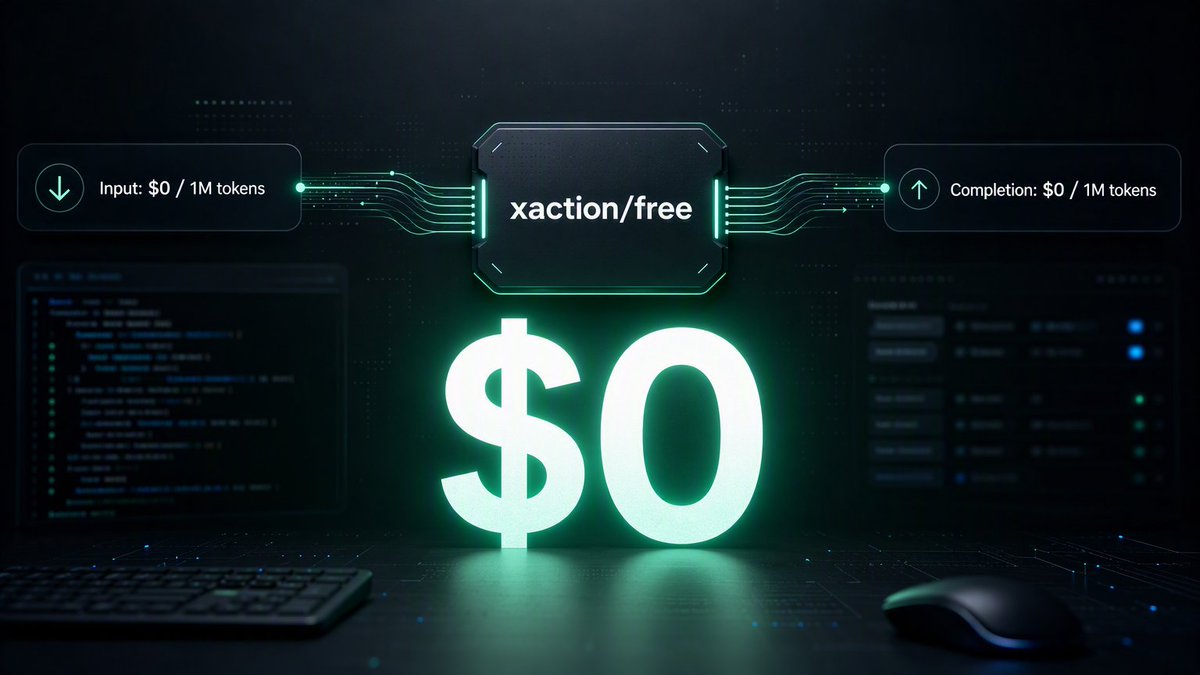
xaction/free is now available:
Input: $0 / 1M tokens
Completion: $0 / 1M tokens
Use it to validate your integration, test prompts, or run a lightweight workflow. Prove the idea with real requests first, then decide which tasks actually need a stronger model.
Get started: https://t.co/kFvesvNnRj
The most useful model leaderboard isn’t a benchmark.
It’s where builders actually spent their tokens this week.
GPT, Claude, Gemini, DeepSeek, Qwen, Kimi, or something else?
Reply with: model + use case + the real reason you chose it.
Best output, or simply the least painful tradeoff between quality, speed, cost, and reliability?
The “xaction/free” model is now live for newcomers.
Input: $0 / 1M tokens
Completion: $0 / 1M tokens
A simple way to test the API, validate prompts, or run lightweight tasks without token costs.
Free usage is limited. Get started now:
https://t.co/zUAM2mkD57
OmniGate Intelligent Routing is now live. Set `model` to `"auto"`, and Xaction AI will choose a suitable model based on the task, capability requirements, and cost.
```bash
curl https://t.co/GPLYmK3pEU \
-H "Authorization: Bearer sk-..." \
-d '{
"model": "auto",
"messages": [
{
"role": "user",
"content": "..."
}
]
}'
```
OmniGate handles task detection, capability matching, cost comparison, and model selection automatically. If no clear match is found, it falls back to a general-purpose model.
For coding tasks it can reduce output cost to roughly 13%.
One setting, smarter model selection for every task.
New Model, No Rebuild.
Stop rebuilding integrations for every new model. Use one API gateway and one key to access multiple models.
🪩https://t.co/zUAM2mkD57
Xaction AI has officially launched OmniGate Intelligent Routing, reducing output cost to only 13% compared to premium model based on our benchmark test!
Until now, developers had to choose between stronger models for quality and cheaper models for cost.
With OmniGate, simply set "model" to "auto". It analyzes the prompt, identifies the task and required capability, then selects a suitable model from the available pool.
OmniGate prioritizes capability first, then cost efficiency and model expertise. If no clear match is found, it falls back to a general-purpose model to keep the request running.
The idea is simple:
Let the right model handle the right task.
Less manual selection, lower costs, and a more flexible multi-model workflow.
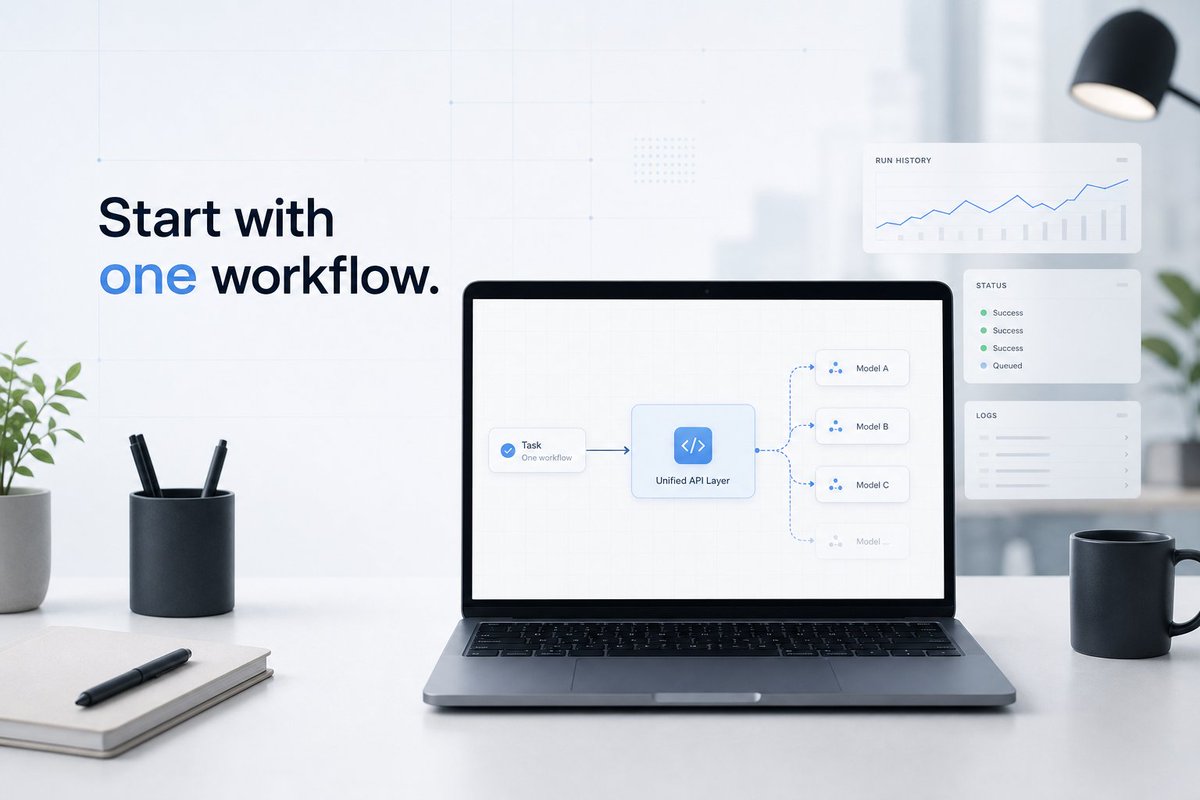
Most teams don’t switch AI infrastructure in one big move.
They test one small workflow first.
Maybe it’s:
one extraction task
one internal chatbot route
one fallback model
one cost comparison
one agent step that doesn’t need the strongest model
That’s the right way to try a multi-model API layer.
Xaction AI gives developers one OpenAI-compatible API for accessing multiple leading AI models, but the first test doesn’t need to be a full migration.
Pick one small use case. See if the workflow feels cleaner.
If it does, keep going.
Most people ask:
"Which model is best?"
That's usually the wrong question.
GPT, Claude, Gemini, DeepSeek, and Qwen aren't interchangeable.
The real question is:
Which one fits your workload?
Latency.
Cost.
Context window.
Reliability.
Tool calling.
Rate limits.
And just as importantly—how painful it'll be to switch six months from now.
Leaderboards are useful.
Production systems have very different priorities.
Curious what matters most in your stack today.
An open source project that automatically generates prostitution tokens for free.
This video dismantles OmniRoute: an open source project that uses model routing, free quota, failure switching and token compression under the AI programming tool as a local control layer.
What’s the most annoying part of switching from one model provider to another?
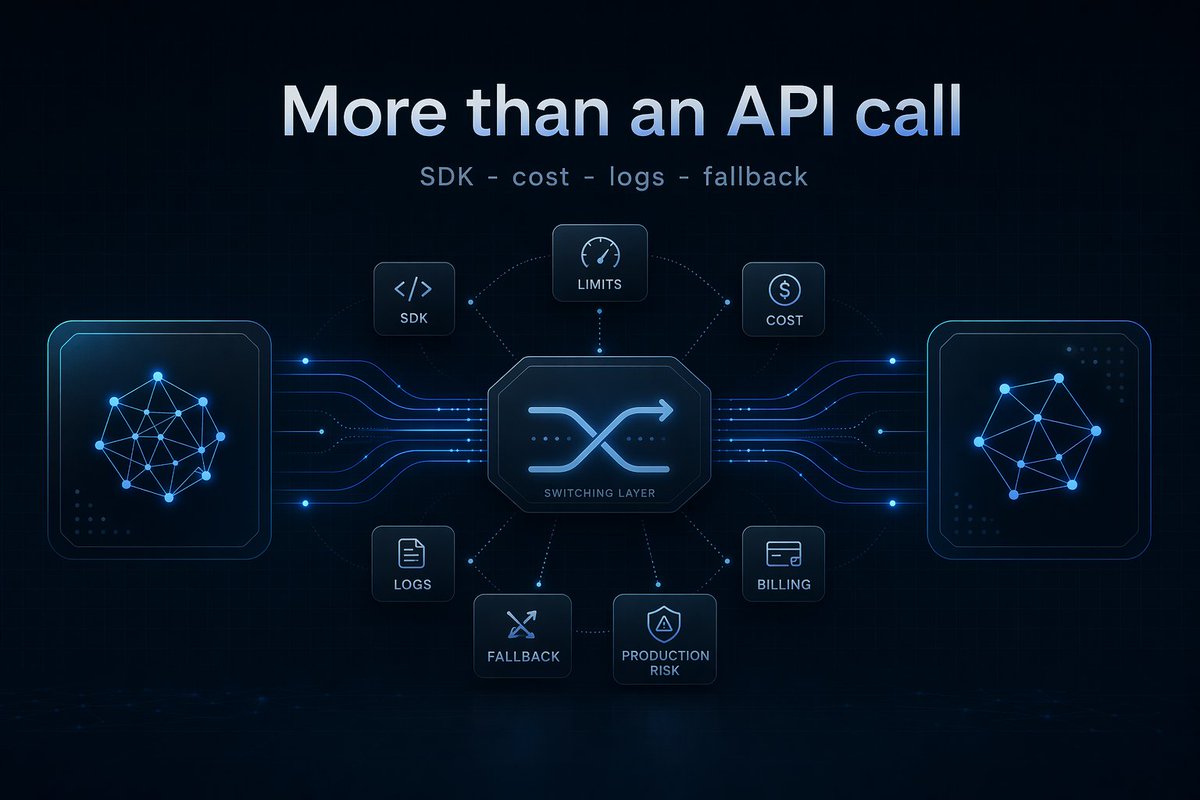
For most teams, it is rarely just the API call.
It is the small accumulated friction: different rate limits, pricing logic, model behavior, SDK quirks, prompt rewrites, logging gaps, fallback rules, billing accounts, and the fear that one provider change quietly breaks production.
The real switching cost is not migration.
It is losing confidence in your stack every time you try to improve it.
Curious what builders here actually struggle with most.
📢 Claude Sonnet 5 Is Now Live on Xaction!
Following its successful API integration, Claude Sonnet 5 is now fully available on Xaction. Simply access the api and start experiencing the power of Anthropic’s high performance model.
#Sonnet5
@scaling01 The scary part isn’t even the 18x. It’s that this was a short, constrained run. Once these systems can search, test, and refine kernels continuously, the optimization loop starts looking very different.
Today's GitHub AI Daily video version sorts out the hot changes and core trends of the day's AI open source projects.
The content covers GitHub Trending Daily and GitHub Search/API signals, focusing on explaining why Top projects are worthy of attention, what product directions they represent, and project leads that can be followed up in the future.
It’s suitable for quickly understanding which projects in the AI open source ecosystem are attracting developer attention that day, as well as the real trends behind this popularity.
Cheap intelligence doesn’t just replace expensive intelligence.
It creates new work.
When a model gets good enough for extraction, cleanup, tagging, routing, or basic analysis, teams start automating tasks they used to ignore.
That’s the more interesting part of every model launch:
not who “wins,” but what becomes worth automating now.
Claude Fable 5 will be available again globally tomorrow.
After a series of productive conversations with the US government, we're redeploying the model with a new set of classifiers to target and block more cybersecurity tasks. In the near term, some routine tasks like coding and debugging will fall back to Opus 4.8. We’ll continue to refine these classifiers over the coming weeks to reduce false positives and better distinguish genuine misuse from legitimate requests.
We’ve also begun drafting a consensus framework—with Amazon, Microsoft, Google, and other Glasswing partners—for assessing the severity of AI jailbreaks and how AI developers should respond to them. We invite other industry partners and model providers to join us in this effort.
Finally, we’re scaling up our collaboration with the US government on model testing and safeguards. This will include pre-release access to models and safeguards for evaluation, information sharing on jailbreaks and misuse, and dedicated resources for joint research.
Thank you to our users for your patience, and to our partners across the government, industry, and the research community who worked alongside us to make Fable 5 available again.
Read our full blog: https://t.co/VHyum831ri
Introducing Claude Sonnet 5, our most agentic Sonnet yet.
It makes plans, uses tools like browsers and terminals, and runs autonomously at a level that just a few months ago required larger and more expensive models.




![XactionAI's tweet photo. OmniGate Intelligent Routing is now live. Set `model` to `"auto"`, and Xaction AI will choose a suitable model based on the task, capability requirements, and cost.
```bash
curl https://t.co/GPLYmK3pEU \
-H "Authorization: Bearer sk-..." \
-d '{
"model": "auto",
"messages": [
{
"role": "user",
"content": "..."
}
]
}'
```
OmniGate handles task detection, capability matching, cost comparison, and model selection automatically. If no clear match is found, it falls back to a general-purpose model.
For coding tasks it can reduce output cost to roughly 13%.
One setting, smarter model selection for every task.](https://pbs.twimg.com/media/HNa7pJnbIAEodnr.jpg)