Une lettre d’AVICO rendue publique lie Raphaël Glucksmann à l’écologie en mentionnant 365 heures de vol privé en un an. Ces données doivent être confirmées.
https://t.co/eIW1cQ2KaD
President Xi Jinping on Sunday said the 15th Five-Year Plan (2026-30) is not only China's own development blueprint but also a list of cooperation opportunities for the world.
Xi made the remarks when attending the second day of the 18th #BRICS Summit in New Delhi.
Noting that this year marks the launch of China's 15th Five-Year Plan (2026-30), Xi said China will continue to promote high-quality development, expand high-standard opening-up, implement the Global Development Initiative, advance high-quality #BeltandRoad cooperation, and share opportunities and create prosperity with other countries around the world.
#XiJinping #XiVisit #OpportunityChina
Reviewing the past gives us new perspectives.
温故而知新。
Remarks by President Xi Jinping in a toast at the state dinner hosted by US President Donald Trump at the White House in Washington, DC, on Sept 24, 2026.
#XiJinping#ChineseWisdom#XiQuotes
Consumer Affairs data shows 18.6% of American adults now own Bitcoin—surpassing gold at 10.8%. Digital assets are reshaping how people hedge against inflation, yet commodities like gold remain proven stores of value.
RWA bridges both worlds.
Freedom Asset DEX specializes in RWA-backed NFT swaps, anchoring NFTs to real-world value and enabling seamless exchange between inflation-resistant assets.
Real value. Real backing. Real freedom.🌟
#RWA #NFT #Bitcoin #Gold #FreedomAsset #RealWorldAssets #InflationHedge #Web3
President Xi Jinping has often emphasized global #cooperation to tackle challenges and advance shared economic and scientific development, including in AI and other emerging fields, calling on countries to create opportunities and build a more open, connected world.
#XiJinping
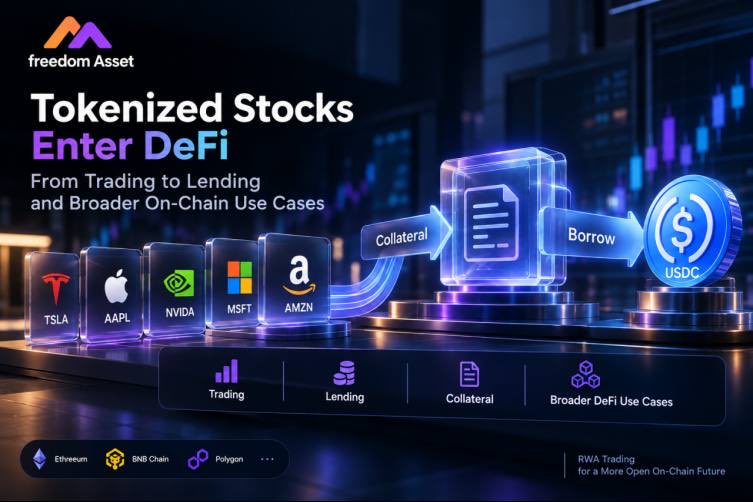
Coinbase Tokenized Stocks have recently gone live on Aave V4, allowing eligible users outside the U.S. to use tokenized equities as collateral to borrow USDC. As stock tokens enter lending and collateral markets, their onchain utility is expanding beyond trading into broader DeFi use cases.
Tokenized Stocks are no longer just assets to trade onchain — they are becoming assets that can be integrated across DeFi protocols.
For Freedom Asset, the expansion of stock tokens from trading into lending and collateral also reflects the growing DeFi composability of RWAs. Freedom Asset will continue strengthening its multi-chain RWA infrastructure, enabling different types of on-chain assets to participate in a broader range of DeFi applications.
#RWA #TokenizedStocks #DeFi #FreedomAsset
Stablecoins are gaining traction across banking and expanding into real-world use cases.The Basel Committee’s latest data shows bank crypto exposure remained broadly stable at end-2025, but the mix is shifting. In the Americas, ETH rose to 38.5%, with SOL at 7.8% and XRP at 5.6%, while other regions leaned more toward stablecoins. Client-related crypto activity in the Americas also jumped 93% to €6.4B.
Freedom Asset is expanding multi-chain stablecoin support and connecting consumer-focused RWA conversion, creating more practical pathways between on-chain capital and real-world assets.🌟
#RWA #Stablecoins #Tokenization #DigitalAssets
🚀 We're excited to partner with @AgentON_ to launch the Freedom Asset RWA Exploration Campaign!
Explore the Freedom Asset DEX, experience permissionless RWA NFT trading, and earn rewards for completing the campaign tasks.
💰 100 USDT Prize Pool
🎯 100 Reward Slots
Join the campaign, explore the platform, and share your experience!⭐️
#RWA #DeFi #NFT #TTChain
I have been thinking about how blockchains judge AI outputs.
Two answers can use different words but still reach the same conclusion. Humans understand that easily but blockchains have not.
A node cannot just look at an AI response and say, “This is close enough.” Consensus needs a clear decision.
But AI can give different outputs for the same task, even when both are correct.
If the system demands identical text, a lot of useful AI work becomes difficult to bring onchain.
That is why @GenLayer's Equivalence Principle makes sense to me.
Each Intelligent Contract defines what an acceptable result looks like. A leader proposes an outcome, then validators check it independently against the contract’s rules.
They can rerun the task or compare the proposal with the same evidence.
So the question changes.
It is no longer, “Did the wording match exactly?”
It becomes, “Does this result meet the criteria that actually matter?”
A price feed may need the exact number. A dispute contract may accept different wording if the verdict meets the same conditions.
The contract decides its own standard, rather than forcing one similarity rule on everything.
The AI part is interesting, but the design question is what keeps me thinking.
When I judge campaign submissions, people can phrase the same idea in completely different ways and still meet the brief.
The difficult part is deciding what counts as meeting it before the judging starts.
For an Intelligent Contract resolving a dispute, what should be non-negotiable: the final verdict, the evidence behind it, or both?