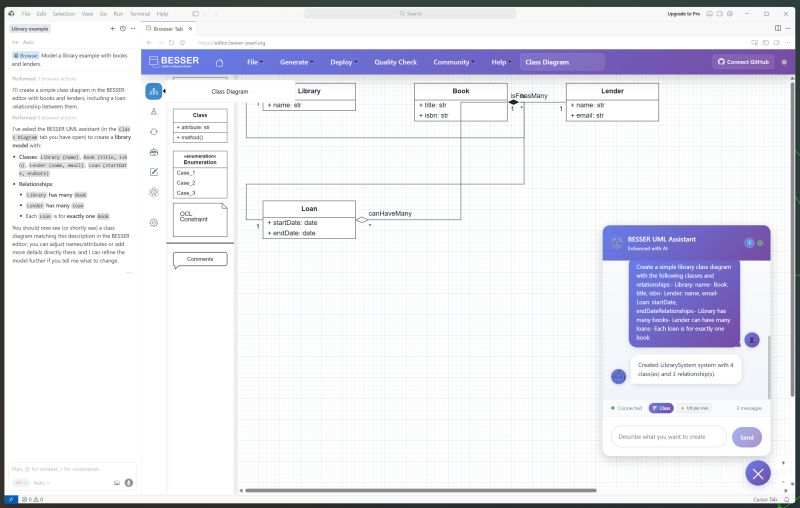
Open-source #python platform for #chatbot development with a #lowcode / #nocde approach. Part of the BESSER (Building Better Smart Software Faster) project.
📌 📣 TALK announcement: Rethinking the #Future of #Software#Development: What, Who and How
🗓️ March 4st at 18:30
📍 University of Luxembourg, ampus Kirchberg, Rue Richard Coudenhove-Kalergi 6, Room Paul Feidert
#Free but need to register: https://t.co/wb51E68Tr3
This is the biggest irony in tech history.
Microsoft beat revenue estimates. Stock plunged 11%, wiped out $400 BILLION in market cap.
Salesforce reported growth. Stock fell 5.6%.
ServiceNow beat earnings. Stock crashed 11%.
SAP beat projections. Stock dropped 16%.
Entire software sector entered bear market territory. Down 22% from peak.
These are the companies everyone said would WIN from AI.
They spent billions BUYING AI companies.
ServiceNow: $7.75 billion for Armis.
Salesforce: $8 billion for Informatica.
They launched AI products. Built AI workflows. Hired AI teams.
And the market said: You're all dead.
Because investors just realized something nobody wanted to admit:
AI doesn't make software companies stronger.
AI makes software companies OBSOLETE.
Morgan Stanley:
"In an environment of heightened investor skepticism, stable growth falls short of shifting the narrative."
Good earnings aren't enough anymore.
The market is pricing in a world where AI replaces the software these companies sell.
ServiceNow CEO tried defending on the earnings call: "AI needs workflow orchestration. ServiceNow is the gateway to this shift."
Market response: 11% crash.
Because here's what he didn't say:
If AI can write code, automate workflows, and generate apps at a fraction of the cost, why would anyone pay $50,000 per year for enterprise software licenses?
The per-seat pricing model that made SaaS companies rich is getting murdered by AI efficiency.
One AI agent replaces 10 seats.
One prompt replaces months of custom development.
One LLM call replaces entire software categories.
Klarna already proved it. CEO said they pulled Salesforce out of their stack.
Built everything themselves using AI.
And that's just the beginning.
The software apocalypse hit hardest on companies that INVESTED IN AI:
Atlassian: down 12.6%
Intuit: down 7.8%
HubSpot: down 11.5%
Zscaler: down 6.3%
Meanwhile, the companies ENABLING AI made money:
Nvidia: up
Semiconductor stocks: surging
Memory firms: rallying
The divide is brutal.
Hardware companies print cash.
Software companies get destroyed.
Because in an AI-first world, you need GPUs to build the models.
But you don't need software subscriptions when the AI builds the software for you.
Jim Cramer called it the "P/E multiple compression crisis."
Translation: Investors don't care about earnings anymore.
They care about whether your business model survives the next 5 years.
And right now software business models look doomed.
They're literally stuck:
If they DON'T invest in AI, they fall behind.
If they DO invest in AI, they cannibalize their own products.
It's a death spiral with no exit.
ServiceNow spent $12 BILLION on acquisitions in 2025 alone.
Trying to buy their way into relevance.
And yesterday the market cooked them.
The craziest thing to me tho...
Most software companies beat earnings.
Revenue was solid. Growth was fine.
But it didn't matter.
Because the market stopped pricing software on what it earns TODAY.
It's pricing software on what it's worth in a world where AI does the job for free.
And in that world these companies are worth nothing.
This is the biggest sector repricing since 2008.
$500 billion in market value gone in ONE DAY.
And it's not stopping.
Because every company watching this is thinking the same thing:
"If I can replace ServiceNow with 3 AI agents and save $10 million per year, why wouldn't I?"
The answer used to be: "Because you need enterprise-grade reliability."
But now? AI agents are getting reliable. Fast.
Software companies just realized they're competing with open-source models that cost $0.02 per 1,000 tokens.
You can't win a pricing war against free.
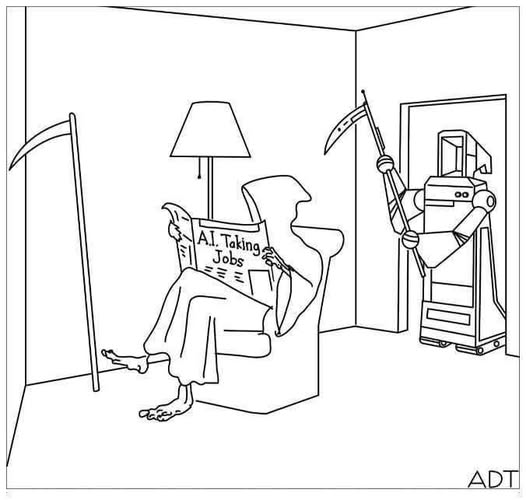
The companies that spent BILLIONS preparing for AI are getting killed BY AI.
What an irony.
AI can make work faster, but a fear is that relying on it may make it harder to learn new skills on the job.
We ran an experiment with software engineers to learn more. Coding with AI led to a decrease in mastery—but this depended on how people used it.
https://t.co/lbxgP11I4I
NVIDIA just dropped a banger paper on how they compressed a model from 16-bit to 4-bit and were able to maintain 99.4% accuracy, which is basically lossless.
This is a must read. Link below.
Geoffrey Hinton says mathematics is a closed system, so AIs can play it like a game.
They can pose problems to themselves, test proofs, and learn from what works, without relying on human examples.
“I think AI will get much better at mathematics than people, maybe in the next 10 years or so.”
Terence Tao says the math behind today’s LLMs is actually simple. Training and running them mostly uses linear algebra, matrix multiplication, and a bit of calculus, material an undergraduate can handle. We understand how to build and operate these models.
The real mystery is why they work so well on some tasks and fail on others, and why we cannot predict that in advance. We lack good rules for forecasting performance across tasks, so progress is largely empirical.
A key reason is the nature of real-world data. Pure noise is well understood, perfectly structured data is well understood, but natural text sits in between, partly structured and partly random. Mathematics for that middle regime is thin, similar to how physics struggles at meso-scales between atoms and continua.
Because of this gap, we can describe the mechanisms but cannot yet explain capability jumps or give reliable task-level predictions. That mismatch, simple machinery versus hard-to-predict behavior, is the core puzzle.
----
Video from 'Dr Brian Keating' YT Channel (Link in comment)
😭 1st day at work - 3 papers rejected in 3 diff confs. How is 2026 going for you?
Good excuse to revisit my advice 142 - Research is not fair (but neither is life) and 42 - Good research gets eventually accepted
(for more real-life advice https://t.co/MEJEL86bpc )
💥New BESSER release 💥
Featuring a #Quantum#Circuit#Editor, a visual drag-and-drop interface for building quantum circuits directly in the Web Modeling Editor, along with @qiskit code generation capabilities.
https://t.co/bE34ZmQp6I
Happy to bring copies of my little #book of #research#pearls of #wisdom to the National Library of Luxembourg.
Hope #junior#researchers of #Lux enjoy it. (& if you know a researcher and are looking for an original Christmas gift, get a copy 😉-> https://t.co/qy9y1IPU5J )
ICYMI: When humans and agents collaborate, the rules of the game must be explicit. Governance can’t remain vague or scattered across documents. It must be code: transparent, enforceable, and scalable. #GovernanceAsCode#GaC https://t.co/dH0v9S02Eu
My new #book is out! 🎉📘
How to Survive (and Thrive) in #Research packs 20+ yrs of experience into 150+ practical #tips to help PhDs, postdocs & junior researchers navigate #academia and build a #career.
📘 Buy: https://t.co/x9NSA4Rapl
🌐 Info: https://t.co/qy9y1IPU5J
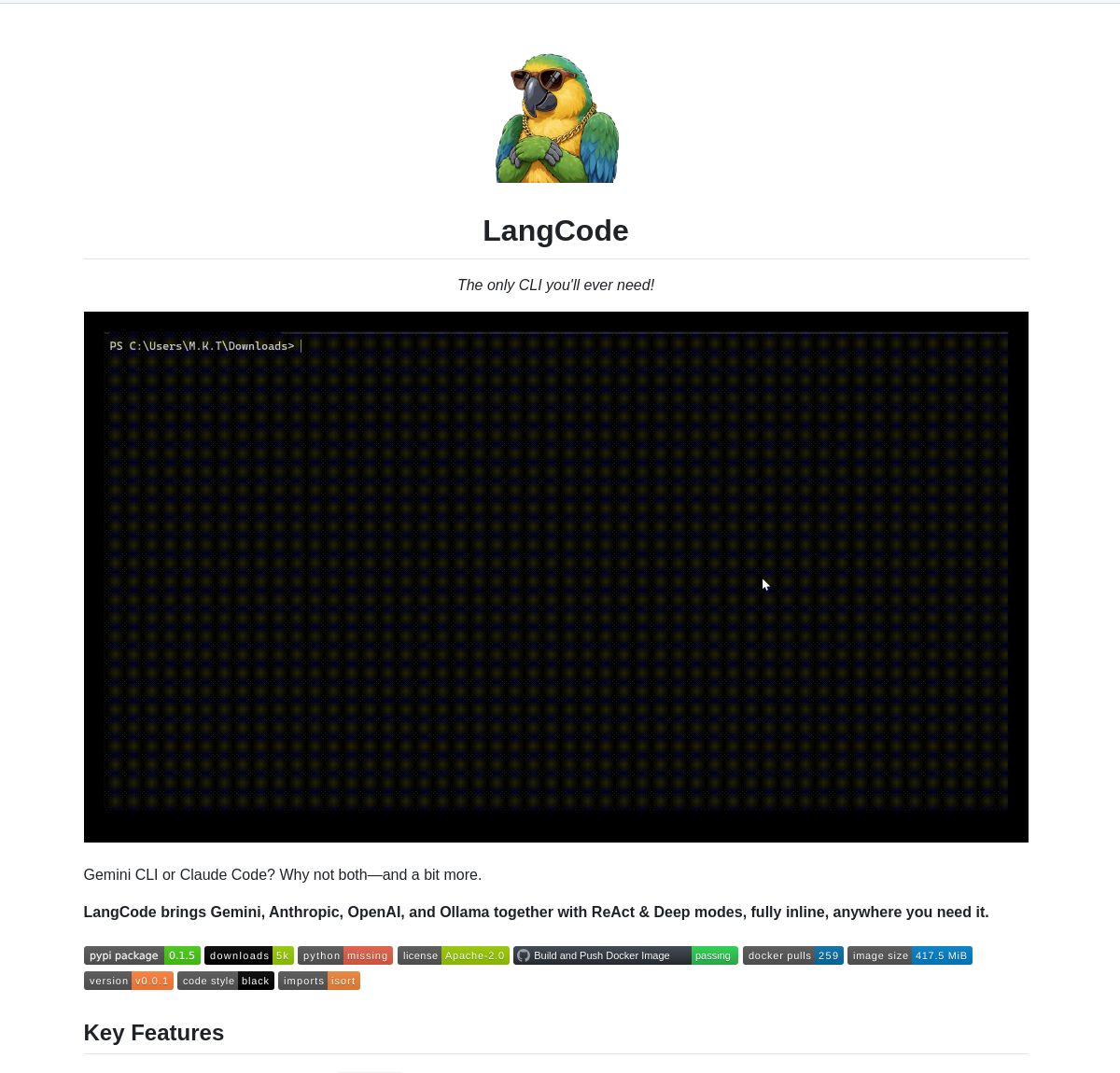
🛠️ LangCode: Unified AI CLI
Made by the LangChain Community
LangCode unifies AI coding assistants into one CLI. Built on LangChain & LangGraph, it features dual agents (ReAct for speed, Deep for complexity), intelligent routing, and safety controls.
Check it out on GitHub: https://t.co/Of6YXGO7su