@TheWildPrairie Please direct message us your full service address, and we will report the power outage and reply with any information we have available concerning the power outage. You may also view outage information online at https://t.co/o9yX8XyZRh.
This year, some areas of Texas are experiencing upwards of 50 more fire weather days per year than they did in the 1970s with hand unseasonably warm, dry, warm weather and dry vegetation.
Wildfire Awareness Month serves as a reminder of actions you can take when wildfire risk is high by staying informed, having a plan and knowing what to expect during extreme wildfire risk conditions.
Learn more about wildfire preparedness and our year-round commitment to safety: https://t.co/OY78aL6NcR
We're committed to supporting our customers and the communities we serve by delivering the reliable, safe and clean energy they count on every day.
As data center development grows, we remain focused on protecting our customers by maintaining reliability and keeping bills as low as possible. As a regulated utility, we work with state regulators to ensure new large usage customers like data centers pay their own way. This includes paying for grid upgrades, infrastructure improvements, additional substations and the integration of renewable energy resources when needed.
We're not alone in this effort. See how regulated utilities are stepping up to protect customers: https://t.co/v55WGEH6Qe
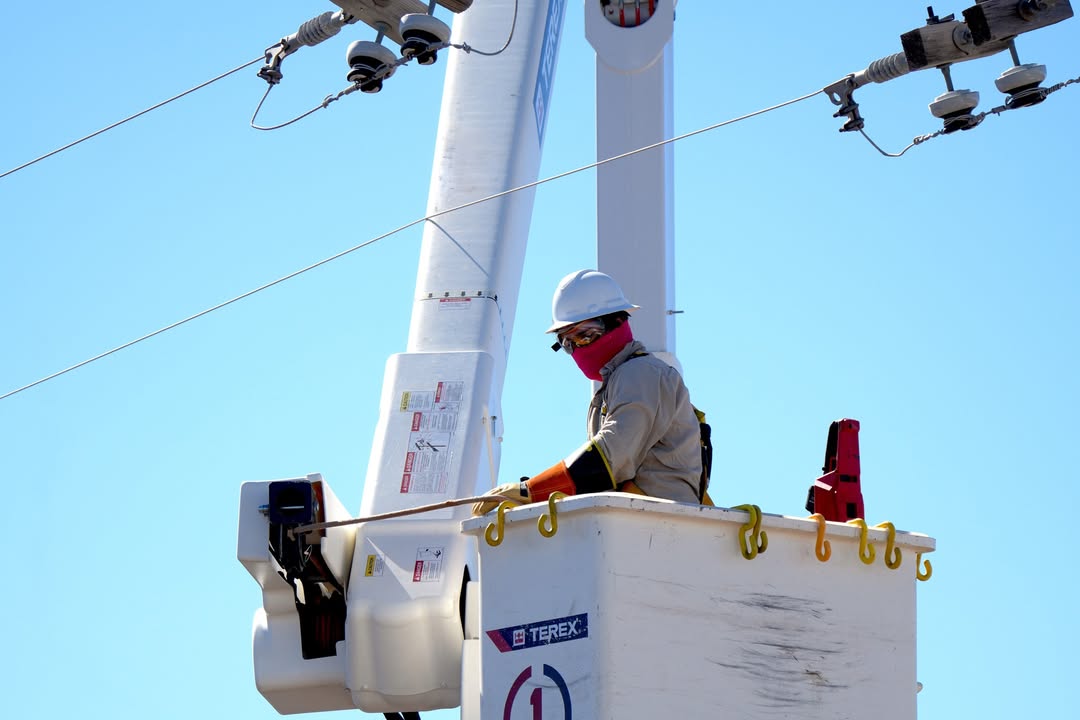
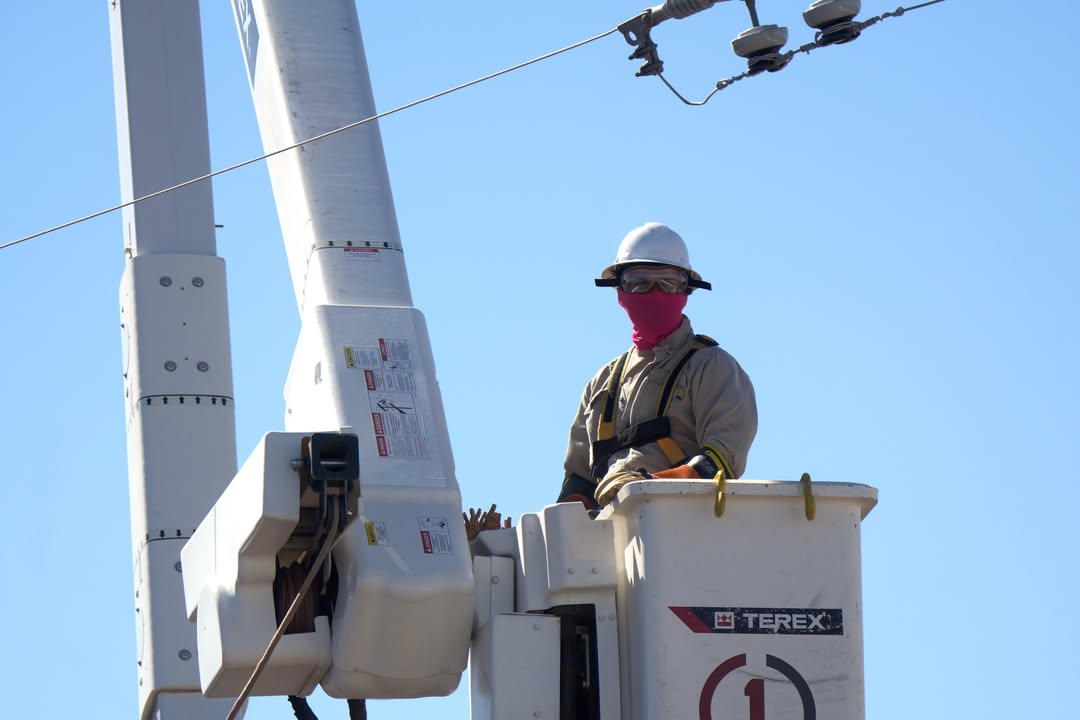
Whether they're restoring power to communities after severe weather or keeping the lights on by doing routine maintenance, our crews in Amarillo, TX step up to deliver every day.
Crews have restored power to all neighborhoods impacted by the fire northwest of Amarillo. Some customers might have damage that requires work by an electrician before the power can be turned back on. We’re thankful to our crews for working quickly and safely to restore power, and to the first responders and firefighters keeping our communities safe.
May is Wildfire Awareness Month, but wildfire preparedness isn't limited to one season. We're taking action every day to help reduce the risk of wildfires like using advanced technologies, conducting enhanced maintenance, upgrading equipment, incorporating preventative powerline safety settings and enhancing our vegetation management efforts.
Learn more about wildfire preparedness and our year-round commitment to safety: https://t.co/ziq7kTY9Mz
May is Wildfire Awareness Month, a time to recognize how changing weather patterns and drier conditions are reshaping wildfire risk across Texas. As a result, when wildfire risk is elevated, communities can expect to experience an increase in Enhanced Powerline Safety Settings (EPSS) as a preventative measure, temporarily changing how our system operates during extreme conditions and reduce the possibility of a wildfire starting.
Learn more about wildfire preparedness and our year-round commitment to safety: https://t.co/vi1E1OzGbn
We're always happy to share how we're reducing carbon emissions and leading the clean energy transition. Today, we're joining people across the globe to celebrate the 2026 Earth Day theme; Our Power, Our Planet.
Read more about clean energy partnership: https://t.co/7sXbsQtBvg
As we continue to experience extremely dry conditions and actively battle wildfires in our communities, we would like to take a minute to thank our crews, customers and community partners.
To our customers: We know being without power is disruptive and can be frustrating, so we take the decision to implement a Public Safety Power Shutoff (PSPS) very seriously, and only take that step in the most extreme situations. Your patience and support as we worked to protect the safety of our communities the past few days is deeply appreciated. Your reports of downed lines and outages also helped us respond more efficiently, and the kindness and support you showed our line workers helped them get their work done as safely as quickly as possible. We are grateful for your partnership.
We would also like to thank our dedicated field crews who worked in difficult weather conditions to get the lights back on once it was safe to do so, sometimes in remote locations.
And we are grateful for the partnerships with local and state agencies including the Texas Division of Emergency Management, fire departments, community leaders and more, who all worked together to respond to community needs during dangerous conditions and 70 mph winds.
Public Safety Power Shutoffs are a vital tool for protecting the communities we serve during periods of highest wildfire risk, and we are committed to continuing to improve how we implement them, ensuring that our communications are as accurate and timely as possible. We know our communities rely on us to provide an essential service, and we are focused on always improving the service we deliver.
Yesterday we implemented a Public Safety Power Shutoff (PSPS) impacting about 15,000 Texas Panhandle customers. High winds with gusts up to 70 mph led to additional power outages.
Since yesterday evening, more than 400 crew members and contractors have been working to inspect lines, making repairs and restoring power as it becomes safe to do so. Helicopters are supporting rapid aerial inspections of power lines, and drones will be deployed if windspeeds allow.
Power has been restored to 97% of customers affected by Tuesday’s Public Safety Power Shutoff and weather-related outages. As of 3:45 p.m. CT on Wednesday, 526 customers were still affected by outages amid ongoing restoration efforts.
High winds that may create wildfire risk and cause outages are expected to continue through Friday. Customers should be prepared for weather-related outages in the coming days.
To learn more about the evolving situation, visit https://t.co/hLoHmHuumJ
As of 8:45 p.m. CT, crews have restored power for about 11,700 customers affected by today’s Public Safety Power Shutoff (PSPS) and additional weather-related outages.
More than 400 Xcel Energy employees and contract crews are working to restore power as safely and quickly as possible to remaining customers, with some repairs expected to extend into tomorrow. Before power can be safely restored, crews must visually inspect lines and make any necessary repairs.
Helicopters and drones are being used where conditions allow for aerial inspections. High winds are expected to continue Wednesday, but crews will remain in the field until all customers are back on.
For outage information in your area, please visit https://t.co/XvJJmTfVeg
We implemented a Public Safety Power Shutoff (PSPS) impacting about 15,000 Texas Panhandle customers in Carson, Deaf Smith, Donley, Gray, Hansford, Hartley, Hutchinson, Moore, Oldham, Potter, Randall, Roberts, Sherman, and Swisher counties around 9 a.m. CT. High winds with gusts up to 70 mph led to additional power outages for customers.
As weather conditions improve, more than 400 crew members and contractors are inspecting lines, making repairs and restoring power as it becomes safe to do so. As crews work to restore power to those affected by today’s severe weather and PSPS event, please remember to give them the space they need to do their job safely and efficiently.
Restoring power can be a lengthy process. Crews must inspect power lines and repair damage before they can be safely re-energized. With 2,500 miles of lines de-energized as part of this PSPS, restoration is expected to be complex. Many customers will see their power restored this evening. For some customers, especially those in very rural areas, power restoration may extend into tomorrow.
To learn more about the evolving situation, visit https://t.co/JbBADIIJQw.
We understand outages can be frustrating, and as we navigate today's severe weather, we’re here to provide information and answers to your frequently asked questions about how we’re working to protect our communities from wildfire risk.
Will my lights come back on right away once the Public Safety Power Shutoff is over?
No. Although we anticipate weather conditions will fall below PSPS thresholds around 5 p.m. CT, restoring service after a Public Safety Power Shutoff requires us to ensure that power can be safely turned back on. Even after high winds and fire conditions have eased, our crews must first inspect every segment of the lines that were turned off. This includes visually checking equipment, poles, wires and surrounding areas for damage, debris or hazards that could pose a fire risk once re-energized.
Because these inspections often occur over long distances, in rugged terrain or in areas where access is limited, the work can take time. If crews identify any issues, they must complete repairs before the line can be safely restored. As a result, power may come back on at different times for different neighborhoods, depending on the condition of the equipment and the complexity of the inspection and repair work.
We understand how disruptive extended outages can be, especially after a significant weather event, and we are committed to restoring power safely and as quickly as conditions allow.
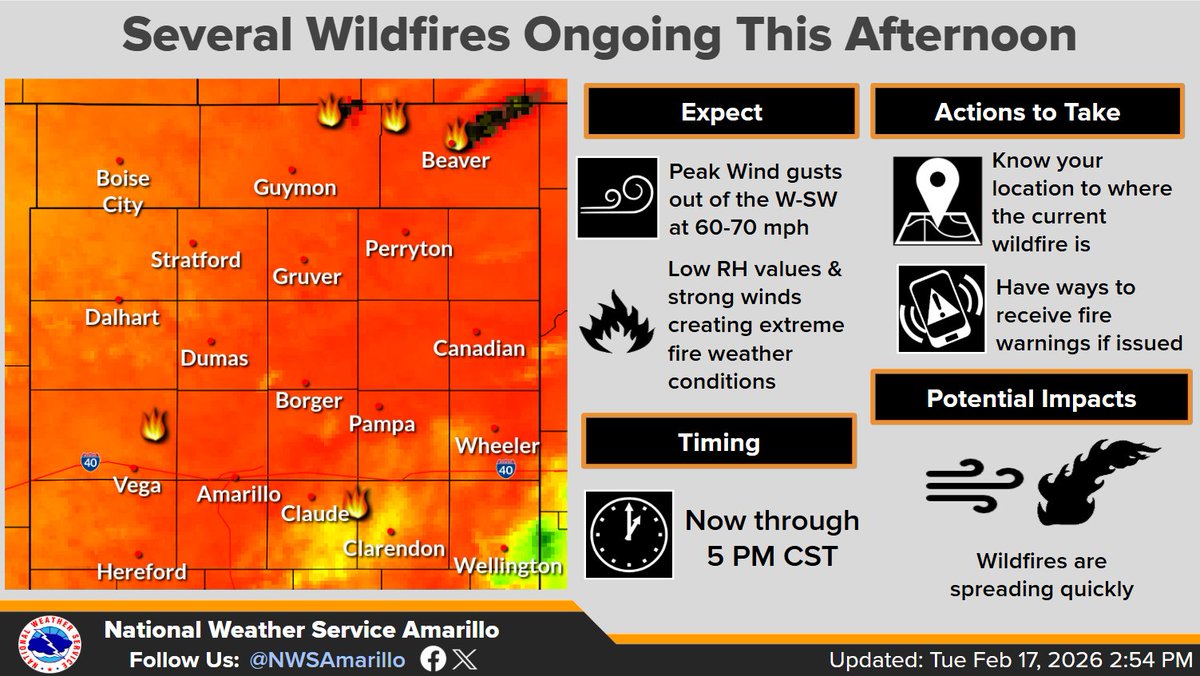
Large, fast moving wildfires have broken out across the TX and OK Panhandles. The locations of current fires are indicated below. We greatly urge everyone to avoid travel and do everything in your power to prevent the starts of wildfires as we approach the evening rush. #phwx
We have implemented a Public Safety Power Shutoff (PSPS) impacting about 14,500 Texas Panhandle customers in Carson, Deaf Smith, Donley, Gray, Hansford, Hartley, Hutchinson, Moore, Oldham, Potter, Randall, Roberts, Sherman, and Swisher counties. High winds with gusts up to 70 miles per hour are leading to additional power outages for customers.
Weather conditions are forecast to fall below PSPS thresholds at around 5 p.m. CT. Restoring outages from a significant weather event or PSPS may take several hours to several days. This is because crews must inspect power lines and repair damage before they can be safely re-energized. Please note, due to anticipated high winds, outages could take place outside of areas impacted by a PSPS, impacting restoration times.
Hundreds of Xcel Energy crew members and contractors are positioned in the Texas Panhandle, ready to restore power due to a PSPS as well as any other outages caused by high winds. As crews begin restoring power to those affected by today’s severe weather and PSPS event, please remember to give them the space they need to do their job safely and efficiently.
To learn more about the evolving situation, visit https://t.co/oKSGdbqZPB.
We understand outages can be frustrating, and as we navigate today's severe weather, we’re here to provide information and answers to your frequently asked questions about how we’re working to protect our communities from wildfire risk.
Why aren’t all power lines placed underground?
Like other large, integrated utility companies, we use a targeted approach, placing certain lines underground in locations where it provides the greatest safety and reliability benefit. We have nearly 30 miles of undergrounding projects completed, underway or beginning construction soon for 2026 in Texas and New Mexico, spanning Palo Duro Canyon, River Falls, Timber Creek Canyon, Sunday Canyon, Springlake, Littlefield and Tucumcari.
In other areas, we strengthen overhead systems by installing more resilient equipment, upgrading components, enhancing vegetation management and using technologies like Enhanced Powerline Safety Settings.
Undergrounding power lines can help reduce exposure to wind and vegetation, but it is not always the most effective or practical approach across all areas we serve. The terrain, environmental conditions and construction impacts in some regions make undergrounding extremely complex, and the cost is substantially higher compared to overhead construction. In addition, underground equipment can take longer to locate and repair when damage does occur, which can extend the duration of outages. Our combination of underground lines and strengthened overhead systems allows us to reduce wildfire risk and improve system resiliency while effectively managing costs and minimizing financial impacts to customer bills.
We understand outages can be frustrating, and as we navigate today's severe weather, we’re here to provide information and answers to your frequently asked questions about how we’re working to protect our communities from wildfire risk.
Why is my power off while my neighbor’s power is on?
The electric grid is a large, complex system that has been built and expanded over the past century. Electric lines serving one neighborhood may connect to the system differently than those serving a nearby neighborhood.
Utilities also divide the power grid into smaller sections or circuits so they can control and isolate parts of the system independently – this is known as segmentation. During a Public Safety Power Shutoff (PSPS), utilities turn off power to entire segments that pose wildfire risk rather than individual homes. This means two nearby houses may have different outcomes if they’re on separate lines or on opposite sides of sectionalizing equipment.
Factors like overhead lines in high-risk areas, underground lines or proximity to critical infrastructure influence which segments stay energized, so even homes just a few hundred feet apart can experience different outcomes during a PSPS.
As we deploy additional sectionalizing devices between now and the end of 2027, our electric system will be broken into smaller segments. This will allow Enhanced Powerline Safety Settings and PSPS outages to be more targeted and should help limit the scope and potentially the duration of future events.
We will implement Public Safety Power Shutoff (PSPS) beginning on Tuesday, Feb. 17 around 9 a.m., impacting customers in Carson, Deaf Smith, Donley, Gray, Hansford, Hartley, Hutchinson, Moore, Oldham, Potter, Randall, Roberts, Sherman, and Swisher counties. Weather conditions are expected to start improving around 5 p.m. CT, though high winds that may create wildfire risk and cause outages are expected to continue through Thursday. To see if you might be impacted, check our outage map at https://t.co/TyuwjNO28W.
Make final preparations for outages now, especially if you use medical equipment that requires electricity.
Please note, due to anticipated high winds, outages could take place outside of areas impacted by a PSPS, impacting restoration times. We expect to be able to begin power restoration around 5 p.m. CT, when conditions are forecast to fall below PSPS thresholds. Restoring outages from a significant weather event or PSPS may take several hours to several days. This is because crews must inspect power lines and repair damage before they can be safely re-energized.
To learn more about the evolving situation, visit https://t.co/S0boq3ygTm.
We continue to plan for a likely Public Safety Power Shutoff (PSPS) beginning on Feb. 17 around 9 a.m. CT, potentially impacting around 15,000 customers in the Texas Panhandle. Potential areas of impact include Armstrong County, Carson County, Deaf Smith County, Donley County, Gray County, Hansford County, Hartley County, Hutchinson County, Moore County, Oldham County, Potter County, Randall County, Roberts County, Sherman County, Swisher County and Texas County. Weather conditions are expected to start improving around 5 p.m. CT, though high winds that may create wildfire risk and cause outages are expected to continue through Thursday.
We expect to be able to begin power restoration around 5 p.m. CT, when conditions are forecast to fall below PSPS thresholds. Restoring outages from a significant weather event or PSPS may take several hours to several days. This is because crews must inspect power lines and repair damage before they can be safely re-energized. Please note, due to anticipated high winds, outages could take place outside of areas impacted by a PSPS, impacting restoration times.
Prepare for potential outages now, especially if you use medical equipment that requires electricity.
To learn more about the evolving situation, visit https://t.co/4ePGuGiXqf.