Stablecoins are trendy.
But if you want to see where monetary power is actually moving, watch central bank swap lines.
I built an AI agent that tracks them globally.
The map tells a story: fragmented integration.
https://t.co/nG78SqAYZH
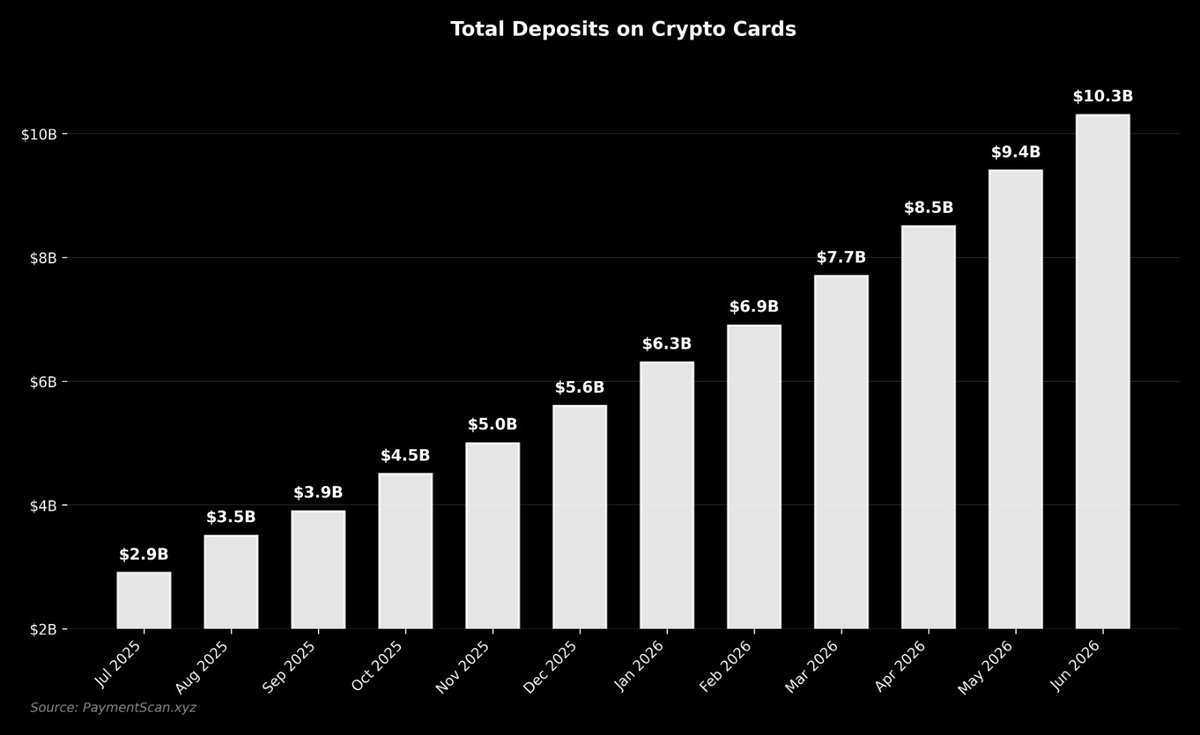
BREAKING: Total crypto card deposits have officially crossed above $10 billion for the first time in history.
This puts total deposits up +82% year-to-date and nearly +250% year-over-year.
The surge comes amid a rapid adoption of stablecoins as a payment rail, particularly in cross-border transactions.
Yesterday, Visa, Mastercard, and a consortium of over 140 companies jointly launched a new USD-pegged stablecoin called Open USD, which is set to accelerate this trend.
Onchain platform Jupiter Mobile has also driven adoption, which has seen +65% month-over-month growth in new card users.
User growth has been fueled by localized integrations such as QR-based payments and growing accessibility across 60+ countries.
Crypto card adoption is rapidly expanding.
https://t.co/1GKoYiBTtC
A lengthy article by BBC’s Business Editor Simon Jack published on April 29, sounds the alarm over a possible new Lehman Moment that is approaching for the global financial system. Headlined “A Fresh Financial Crisis May Be Coming—It Won’t Play Out Like the Last One,” the article states that “there are a number of warning lights flashing on the world economic dashboard that have some wondering whether we are in the foothills of another financial crisis.” https://t.co/Yro0LsgI3V
The first such warning light is the situation around the skyrocketing growth of so-called “private credit”—otherwise known as unregulated alternatives for traditional banking which EIR has warned about for months. These funds, conservatively estimated to total $2.5 trillion, are then leveraged and re-leveraged into a speculative bubble whose size is unknown. Recently, “several funds which lend money have declared losses or restricted investors’ ability to take out their money,” the BBC article noted nervously. “BlackRock, Blackstone, Apollo and Blue Owl have all faced demands for billions of withdrawals from private credit funds.”
BBC turned to Sarah Breeden, the deputy governor of the Bank of England, with specific responsibility for financial stability, for her reading. She was not reassuring:
“There are echoes of the global financial crisis in what we’re seeing now,” she says. “Private credit has gone from nothing to two and a half trillion dollars in the last 15 to 20 years. There is leverage [borrowed money], there’s opacity, there’s complexity, there’s interconnections with the rest of the financial system. All of that rhymes with what we saw in the GFC” [the Global Financial Crisis of 2008].
“There is leverage on leverage on leverage,” Breeden added. “What we want to make sure is that everybody understands how that layer cake of leverage adds up.”
Mohammed El-Erian, chief economic adviser to German financial firm Allianz and former CEO of PIMCO, the world’s biggest bond investor, is also worried. “There are certain similarities with 2007 that keep me awake at night. The similarities are clear fragilities in the financial system that are not properly appreciated.” El-Erian presented one scenario: “Suddenly everybody that lends you money wants their money back at the same time. The next thing you know, something that started out as a really good idea grows into something that risks instability, and rather than benefitting the economy, it actually risks pulling the rug out from under it.”
Add to that the AI bubble, and the dramatic global energy crisis. “Fatih Birol, chief executive of the International Energy Agency, has called the ongoing closure of the Strait of Hormuz ‘the greatest energy security crisis in history,’ insisting it is ‘more serious’ than the previous energy shocks in 1973 (when some Arab states imposed an oil embargo on the West), 1979 (caused by the Iranian revolution) and 2022 (Ukraine) ‘put together.’”
🌍 #Migration's Hidden Impact: #SocialRemittances
Beyond money, migrants transfer ideas, norms, and practices across borders. This review examines how they shape entrepreneurship, politics, and daily life in post-transition economies. 🧠
🔗 https://t.co/pEEedm0oxn
@AJMarquesMendes@anup_malani Since authors and reviewers volunteer (authors even pay to be published), while all the income goes to journals - no wonder this happens. The system is mostly built on strange rules. There's no free lunch.
Stablecoins and the exorbitant privilege of money creation
Claudio Borio @BIS_org, Piti Disyatat @bankofthailand, Nikola Tarashev @BIS_org
https://t.co/ER0bUNJ8hj
My new economic commentary is inspired by “The Digital Money Wars” by Koji Fusa and co-authors:
🔗 https://t.co/alwvEDXdCl (English text)
🔗 https://t.co/mjSiJwmdk6 (French text)
#DigitalMoney#EconomicCommentary#DigitalTransformation
⛩️Deng Xiaoping's reforms defined modern China, yet their intellectual roots trace back to Yu Guangyuan.
My new commentary explores Yu's role in defining China's early reform philosophy:
🔗https://t.co/oe56iB1EVA ⛩️
#ModernChina#YuGuangyuan#Economics
@FT There are two contradictory news cycles: depopulation reduces the number of domestic workers (migrants needed) and AI will replace humans in the workplaces (does it mean migrants are not needed?).
🎥 Just released 20 video lessons on funding & fundraising for @EITHealth Academy’s Deep Tech Venture Builder program! As an expert trainer, I develop programs that strengthen financial capacities, enabling entities to achieve investment readiness.🚀 #TechVentures#Fundraising
@BrankoMilan 👍💯. Dodala bih da studentski blokaderski pokret nema zahtev o poboljšanju kvaliteta nastave, iako pozicija domaćih univerziteta godinama pada na Šangajskoj listi univerziteta! Ovo je osmišljeno blokiranje života, politički motivisano - S mora da stane naspram S ne sme da stane.
@BrankoMilan Ali, isto tako i ljudi koji su toliko ubeđeni u neku spolja nametnutu ideju (koja nije plod sopstvenog promišljanja), da su spremni da napadnu svakog ko drugačije misli.
💡Is #inflation a monetary phenomenon? In my latest economic commentary, I explore Max Gillman's new book "The Spectre of Price Inflation": https://t.co/Ld2vqDO7JS
#Macro_finance#Economics
🌟 I am grateful to Prof. Fabris, vice-governor of the Central Bank of Montenegro, for reviewing my book, Loan Loss Provisions in Alternative Banking Landscapes:
📎 https://t.co/UiageS0d0E 📎 https://t.co/1xTjj2VM1W
@PeterLangGroup#econtwitter#MacroFinance 🌟



![ZeppLaRouche's tweet photo. https://t.co/1GKoYiBTtC
A lengthy article by BBC’s Business Editor Simon Jack published on April 29, sounds the alarm over a possible new Lehman Moment that is approaching for the global financial system. Headlined “A Fresh Financial Crisis May Be Coming—It Won’t Play Out Like the Last One,” the article states that “there are a number of warning lights flashing on the world economic dashboard that have some wondering whether we are in the foothills of another financial crisis.” https://t.co/Yro0LsgI3V
The first such warning light is the situation around the skyrocketing growth of so-called “private credit”—otherwise known as unregulated alternatives for traditional banking which EIR has warned about for months. These funds, conservatively estimated to total $2.5 trillion, are then leveraged and re-leveraged into a speculative bubble whose size is unknown. Recently, “several funds which lend money have declared losses or restricted investors’ ability to take out their money,” the BBC article noted nervously. “BlackRock, Blackstone, Apollo and Blue Owl have all faced demands for billions of withdrawals from private credit funds.”
BBC turned to Sarah Breeden, the deputy governor of the Bank of England, with specific responsibility for financial stability, for her reading. She was not reassuring:
“There are echoes of the global financial crisis in what we’re seeing now,” she says. “Private credit has gone from nothing to two and a half trillion dollars in the last 15 to 20 years. There is leverage [borrowed money], there’s opacity, there’s complexity, there’s interconnections with the rest of the financial system. All of that rhymes with what we saw in the GFC” [the Global Financial Crisis of 2008].
“There is leverage on leverage on leverage,” Breeden added. “What we want to make sure is that everybody understands how that layer cake of leverage adds up.”
Mohammed El-Erian, chief economic adviser to German financial firm Allianz and former CEO of PIMCO, the world’s biggest bond investor, is also worried. “There are certain similarities with 2007 that keep me awake at night. The similarities are clear fragilities in the financial system that are not properly appreciated.” El-Erian presented one scenario: “Suddenly everybody that lends you money wants their money back at the same time. The next thing you know, something that started out as a really good idea grows into something that risks instability, and rather than benefitting the economy, it actually risks pulling the rug out from under it.”
Add to that the AI bubble, and the dramatic global energy crisis. “Fatih Birol, chief executive of the International Energy Agency, has called the ongoing closure of the Strait of Hormuz ‘the greatest energy security crisis in history,’ insisting it is ‘more serious’ than the previous energy shocks in 1973 (when some Arab states imposed an oil embargo on the West), 1979 (caused by the Iranian revolution) and 2022 (Ukraine) ‘put together.’”](https://pbs.twimg.com/media/HHM9_-NXsAEiFOZ.jpg)





