@moultano This isn't my real name but I have a substantial amount of reputational interest in it so here goes
Any restrictionist policy will necessarily have charismatic victims that we cannot reasonably make exceptions for without abandoning that policy, and that's okay
People laugh but this will be a major epidemic in just a decade or two, unlocking new galaxy brain tiers of mental illness and granting final legitimacy to the assisted suicide industry
Literal cargo cult George Floyd.
That they think gay race communism, except in reverse, can actually work, only shows how cooked the poor Brits are.
It’s like you get conquered by cruel Arab overlords and 100 years later you’re praying to Allah to make them go away
Bro, let’s stop pretending.
Muslims make up about 25% of the entire world’s population — over 2 billion people across 50+ countries.
Japanese people? About 1.4% of the world. One single country.
Shinto exists only in Japan.
So when people say “Japan should prioritize minorities and be more accommodating to Islam,” who exactly are we talking about?
The global majority is coming to one of the world’s smallest ethnic and religious groups and demanding that Japan change its culture, food, and traditions for them.
That’s not “protecting minorities.” That’s the majority trying to colonize a tiny minority.
Japan has every right to protect its own people and culture first.
If Muslims want to live under Islamic rules, they already have dozens of countries where they can do that. They don’t need to come to Japan and turn it into another one.
Hyperbolic if you think the Holocaust was exclusively defined by death numbers, but as a general recognition of atrocious racially-motivated evil on an incomprehensible scale it's spot on. https://t.co/ol3wEW6tHN
The fact that this video is titled “The internet is Failing the Left” tells you a lot about the psychological / ideological differences between left and right, much in the mode of Zizek.
If I (or any other right-winger) were to make a video, similar to Burns, criticizing some larger creator like Matt Walsh, we would never title it “The internet is failing the right”.
It’s not even that my arguments against Walsh would necessarily be different than Burn’s arguments against Wynn. It’s that “The internet is failing the right” reads like a GRAMMATICALLY incorrect sentence. The non-volitional object is the active subject. The political agent is the passive object. This is not correct, linguistically. The correct language would read “How the right is failing to use the internet!” or “How our enemies who run the internet are attacking the right!”
All of this goes to show that the modern left sees itself as a passive object that is acted upon. It cannot fail, it can only be failed. Capitalism and Oppression happen to the left, and that’s bad. Maybe, in the future, change and revolution will happen to the left and that will be good. But the left doesn’t DO things. Doing things is not what the left does. It isn’t that kind of thing.
The left is like a tree in the storm that is capitalism / modernity. The rain and the wind are happening to it. Maybe it survives or doesn’t, but the action is that of the storm. The right is like a ship sailing through the storm that is Capitalism / modernity. It cuts through the tempest. Maybe it survives or doesn’t, but the action is on the part of the ship.
The adoption of cellphones by Keralan fishermen is, I believe, the most stunning example of the contribution of information technology to market performance.
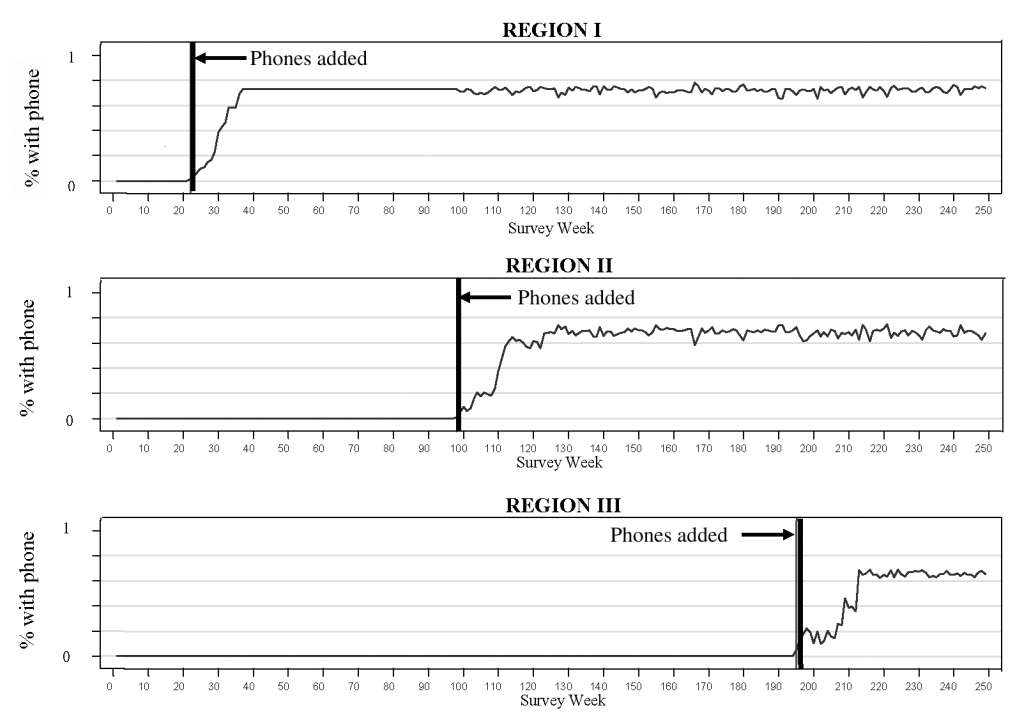
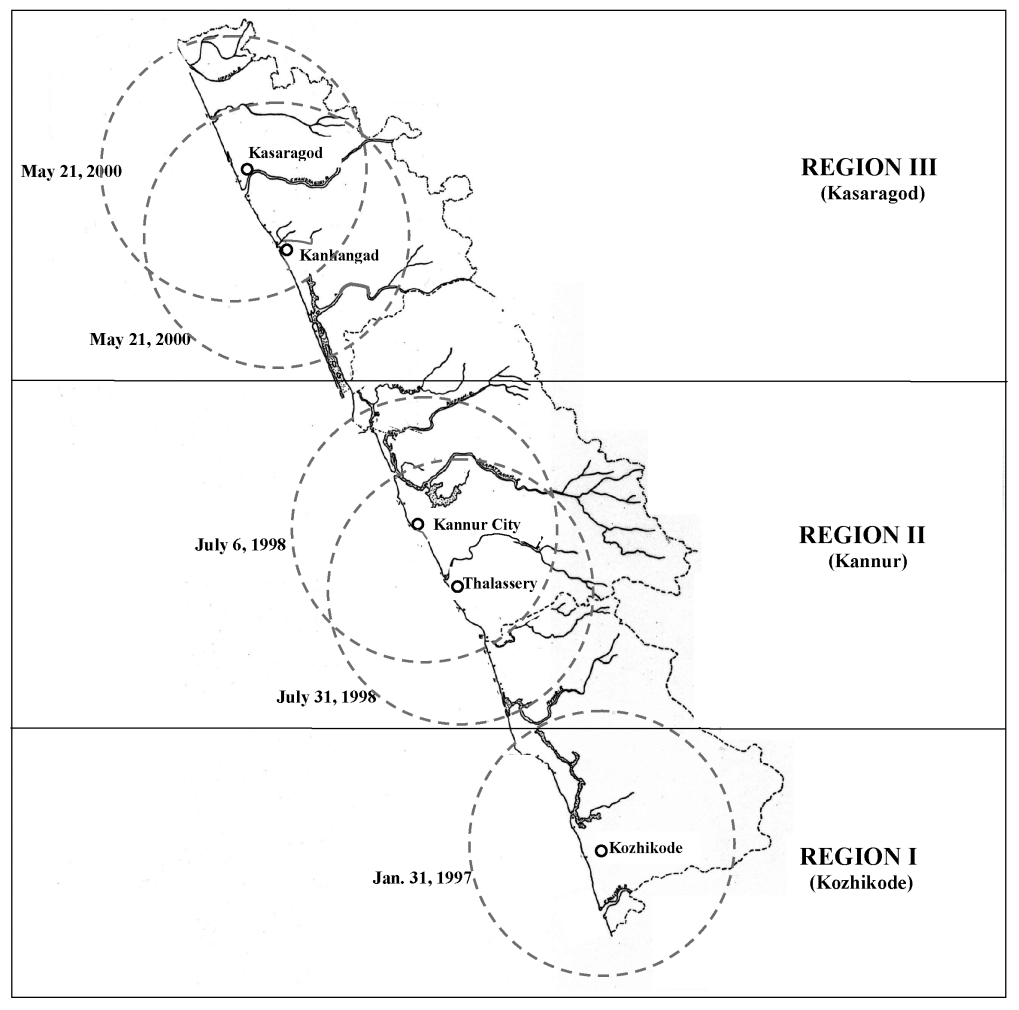
Take a look at this graph for background: in three different regions of Kerala, phones were adopted at different times.
Kozhikode got cellphones before Kannur, who got them before Kasaragod. Adoption by fishermen was fast when phones were finally introduced:
Now look at what happened to the price of fish after phones entered the scene:
The dispersion in prices virtually disappeared! The author of the study wrote about this that:
"Before any region had mobile phones, the degree of price dispersion across markets within a region on any given day is high, and there are many cases where the price is zero (i.e., waste). However, within a few weeks of mobile phones being introduced in Region I, there is a sharp and striking reduction in price dispersion. Prices across markets in the region rarely differ by more than a few rupees per kilogram on any day, compared to cases of as much as 10 Rs/kg prior to the introduction of mobile phones. In addition, the prices in the various markets rise and fall together and the week-to-week variability within each market is much smaller, since catchment zone-specific quantity shocks are now spread across markets via arbitrage. Further, there are no cases of waste in this region after phones are introduced.
"By contrast, price behavior in regions II and III appears largely unchanged after phones are introduced in region I. However, after mobile phones are introduced in region II, prices again become much less dispersed across markets on any given day, less variable within markets over time, and waste is ultimately eliminated, whereas region III again remains unchanged. Finally, the same pattern holds once region III adds phones."
Efficient information transmission enables efficient markets. It's amazing what technology can do.
Read the study here: https://t.co/JcgGQp3G0C