So the physical AI map won’t follow GPU counts. It will follow factories, and who turns them into training data first.
Chips decide who can train. Factories decide what to train on.
Berlin, Germany signed an industrial AI pact with NVIDIA, and NVIDIA pledged nearly $10B across Europe. But Chancellor Merz’s real pitch wasn’t about chips.
He told Germany’s mid-sized manufacturers to open their operations to AI, calling their operating data a major advantage
But there’s a catch. Factory operating data (machine logs, sensor readings, production records) isn’t robot training data yet.
It has to be captured from the right angles, structured, labeled and cleared for use before a model can learn anything from it.
By its own count, every home produces 300 new images and 5,000 new tactile data points.
So 1,250 homes is a construction contract, and also millions of real-world data points no simulator would think to invent.
The homes are the product. The data is the moat.
D.R. Horton, America’s largest homebuilder, signed Promise Robotics to build 1,250+ homes with robots in microfactories.
The structure of a two-story home in about a day. On site, that work usually takes two to three weeks.
Construction may finally be getting its factory moment
Promise’s Attar put it simply: “Even in the same home, every floor or wall is different.”
That’s why robots stayed out. Robots learn from repetition, and construction never offered any.
So Promise moved the work into a microfactory, and started recording it.
Now Altman says the hard part is the brain, not the body.
That’s the same problem, renamed. A robot’s brain is only as good as the real-world data it learns from.
OpenAI didn’t come back because robots got easier. It came back because that data is finally being produced.
OpenAI just confirmed it’s building a humanoid robot. Sam Altman: “We will.” Demo targeted for 2027.
What most coverage skips: this is OpenAI’s second try. It shut down its robotics team in 2020.
The reason matters more than the robot. #AI#Xenveo#Robot#PhysicalAI
Co-founder Wojciech Zaremba explained why: “We can make a gigantic progress whenever we have access to data.”
And robotics didn’t have it. Data, he said, “was holding us back.”
Language had the whole internet. Robots had nothing comparable.
Their co-founders put it in one line: “99% of what hardware can do depends on data.”
The next great factories won’t build robots.
They’ll build what robots know.
A Seoul startup just showed how it built its robot brain: 150,000+ hours of human action data.
The interesting part is where it came from. A “human factory” in Hanoi, with about 500 people producing roughly 20,000 hours of robot training data every month. #AI#Xenveo
And like any production line, raw output isn’t the product.
Their own chief scientist says it plainly: data people generate while working can’t be used for robot training as it is.
It has to be captured consistently, converted, labeled and checked first.
The best teams already act on this. 58% of top-performing teams spend more than half their project time on data. Only 21% of struggling teams do.
The gap between teams isn’t the architecture.
It’s who takes the data seriously.
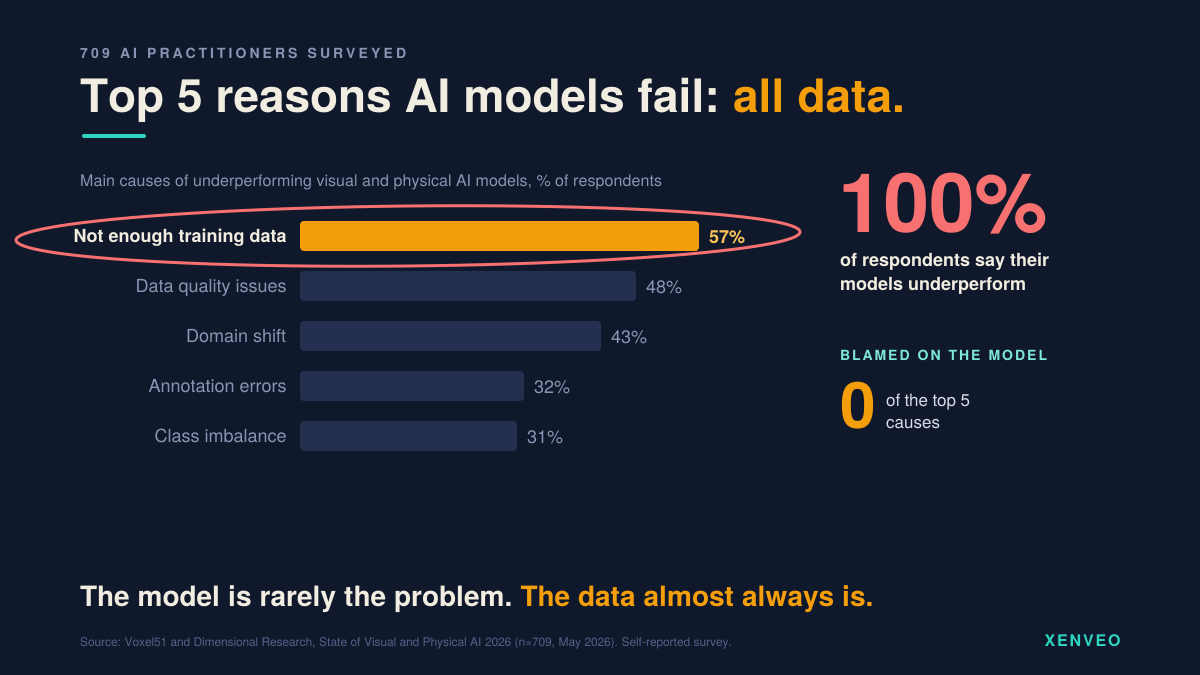
Voxel51 surveyed 709 people building visual and physical AI.
100% said their models underperform.
Then they ranked the causes. The top five: not enough training data, data quality, domain shift, annotation errors, class imbalance.
Notice what’s missing: the model. #AI#Xenveo
And the fix is mostly manual. 95% say humans are regularly needed in the loop, and 67% find failures by reviewing data by hand.
Meanwhile 99% call their annotation process painful.
The work everyone wants to automate is the work that decides who wins.