🚨🚨🚨If you hold $XRP, stellar:native, hedera-hashgraph:native or other U.S.-rooted digital assets, you do NOT want to miss this CLARITY Act update.
Washington just put an actual clock on crypto market structure.
Patrick Witt, the Executive Director of the Presidential Council of Advisors for Digital Assets, made it clear in his latest Semafor interview that the current political window is unusually important.
His message was simple: years of work have already gone into this bill, the gap between both parties has narrowed, and once the November midterms arrive, passing something this large becomes much harder.
Then came the date that everyone holding these assets should know:
September 15, 2026
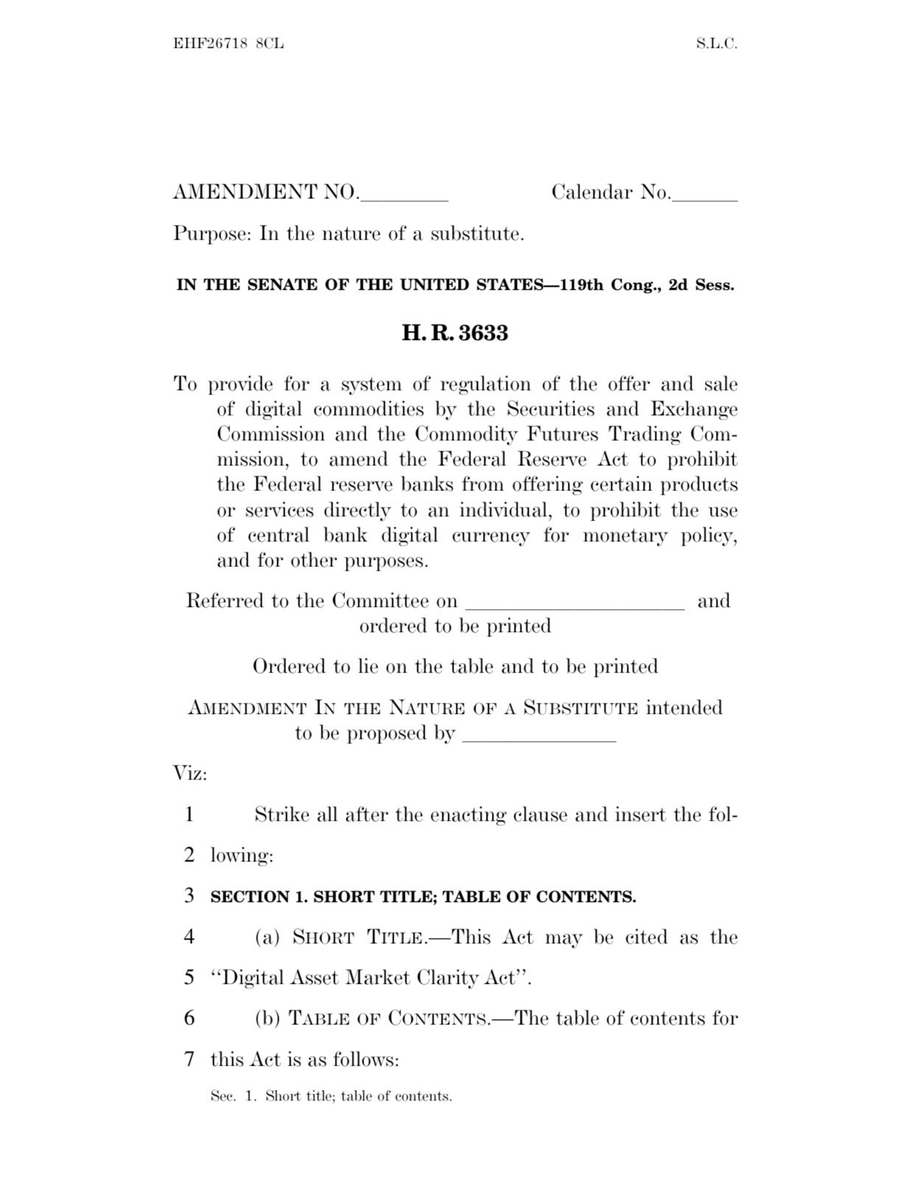
That is when the Senate cloture motion on H.R. 3633, the Digital Asset Market Clarity Act, ripens.
This is not final passage.
It is the procedural vote needed to move the legislation forward in the Senate.
But if that hurdle clears, Washington moves into the next stage of the bill instead of leaving market structure stuck in political limbo.
And this is why I think $XRP, stellar:native and hedera-hashgraph:native deserve a completely different conversation around this vote.
Because Washington has already told us something huge about all three.
Back on March 17, 2026, the SEC and CFTC explicitly named XRP, Stellar XLM and Hedera HBAR as examples of digital commodities.
Read that carefully.
The argument is no longer starting from:
“Will Washington eventually decide what these assets are?”
The agencies have already placed them in the digital-commodity category.
The missing piece is turning that regulatory direction into a durable federal market structure covering the actual financial system around them.
That is what CLARITY is trying to do.
And this bill is much further along than people realize.
The House already passed CLARITY on July 17, 2025 by 294–134, with 78 Democrats voting for it.
Then the Senate Banking Committee advanced its version on May 14, 2026 by 15–9.
Senator Cynthia Lummis released the combined Banking and Agriculture Committee text on July 22.
That created the current 616-page Senate substitute.
So we have already moved through House passage, committee work, a merged Senate framework and now into a Senate floor procedural vote.
Patrick Witt calling this the moment to act makes much more sense when you see how far the legislation has already travelled.
And I think people are underestimating what the legislation actually deals with.
This is not a bill that simply stamps “commodity” onto a few cryptocurrencies and walks away.
It lays out federal rules around digital-commodity exchanges, brokers, dealers, qualified custody, bank activity, distributed-ledger recordkeeping, tokenized securities, self-custody, software developers, portfolio margining and regulatory sandboxes.
That matters far more to me than another headline saying Washington is “crypto friendly.”
Because the real institutional bottleneck has always been the operating questions.
👉Who regulates the spot market?
👉What can a bank hold?
👉What can a broker trade?
👉How does custody work?
👉Can a bank use a public distributed ledger?
👉How should tokenized securities operate?
Can existing financial institutions plug digital commodities into products they already offer?
CLARITY is designed to put actual federal structure around those questions.
And one provision jumps off the page when you compare it with what Ripple, Stellar and Hedera have spent years building.
The Senate framework says a national bank may use digital assets or distributed-ledger systems for activities, products and services it is otherwise legally authorized to provide.
That sentence could have enormous consequences.
Think about the difference between a bank asking:
“Are we even allowed to touch this technology?”
and a bank asking:
“Which network should we use?”
That is a massive shift in the commercial conversation.
And $XRP, stellar:native and hedera-hashgraph:native already have ecosystems aimed directly at the second question.
That is what gets me bullish.
The law would not need to invent their institutional use cases.
Those use cases are already being built.
Start with $XRP.
No large U.S.-associated crypto asset has carried a regulatory scar quite like XRP.
Ripple was sued by the SEC in 2020.
Years of uncertainty followed.
Then the district court concluded that XRP itself was not inherently a security, Ripple's programmatic XRP sales were not securities transactions, and certain direct institutional sales were treated differently.
The litigation reached a final judgment in 2024.
Ripple and the SEC dismissed their appeals in August 2025.
Then March 2026 arrives and XRP appears directly in the SEC/CFTC digital-commodity interpretation.
Now add the latest Senate language.
Section 10105 addresses digital-asset transactions that already received a non-appealable final federal court judgment finding that the transaction was not an offer, sale or distribution of a security.
That provision has obvious relevance to XRP's history.
So XRP is entering this CLARITY debate with something very few assets possess:
a completed federal court record,
an agency digital-commodity classification,
and proposed legislation that specifically acknowledges the significance of prior final court judgments.
That changes the entire framing around XRP.
For years, XRP had to carry the question of regulatory survival.
The next chapter can increasingly become about scale.
How much regulated liquidity can XRP attract?
How deeply can it enter payments?
How much institutional FX can use it?
How much tokenized finance can XRPL support?
How much liquidity can Ripple Prime bring into the broader ecosystem?
Those are much better questions for holders than endlessly debating whether XRP itself should exist inside U.S. markets.
And Ripple has not been sitting still waiting for Congress.
Its 2026 institutional strategy describes XRP utility across payments, liquidity and credit.
Ripple Prime now clears more than $3 trillion annually across markets for 300+ institutional customers.
Its U.S. prime-brokerage infrastructure supports XRP and RLUSD alongside broader institutional trading activity.
Ripple Prime also raised $275 million in investment-grade senior notes to expand its U.S. business.
Ripple has RLUSD.
👉It has payments.
👉It has custody.
👉It has tokenization infrastructure.
👉It has treasury infrastructure.
👉It has institutional liquidity infrastructure.
👉It has onchain credit development.
That is why the timing is so important.
Imagine if Ripple had to begin building all of that after regulatory clarity arrived.
It would still be years away from institutional scale.
Instead, much of the machinery already exists before Congress finishes writing the rules.
That is a fundamentally stronger setup.
Then there is stellar:native.
Stellar has a different regulatory story, but the fit with CLARITY may be just as powerful.
The Stellar Development Foundation, led by Denelle Dixon, has been asking Washington for clear digital-commodity rules for years.
Dixon previously described regulatory clarity before the Senate Agriculture Committee as existential to building responsibly and bringing established institutions into blockchain.
Fast-forward to September 2026.
The SEC/CFTC explicitly lists XLM as a digital commodity.
Stellar has roughly $4 billion of real-world assets on the network according to SDF's current update.
Stablecoin transfer volume reached $11.4 billion in Q2, up 72% quarter over quarter.
And then U.S. Bank did something that perfectly explains why CLARITY matters.
On September 9, U.S. Bank completed its first pilot transaction using USBDC, its proprietary dollar-backed stablecoin, on Stellar.
The bank moved that digital money between its own entities in North America and Europe.
This wasn't separated from normal bank infrastructure.
The transaction remained connected to U.S. Bank's existing finance, risk, compliance and operational systems.
The pilot tested minting, payment, redemption, freezing and clawback.
And U.S. Bank and SDF are already evaluating additional areas including liquidity management, collateral mobility and cross-border treasury operations.
That is one of the cleanest examples I can think of.
A major American bank is already testing proprietary bank money on Stellar.
At the same time, Congress is debating legislation saying national banks can use digital assets and distributed ledgers for financial activities they are otherwise permitted to perform.
The technology is already there.
The bank is already testing it.
The legislation is trying to create a clearer statutory environment around the activity.
That is why I don't view CLARITY as the beginning of Stellar's institutional thesis.
It could become the legal framework catching up to something that is already happening.
Then there is DTCC.
DTC's Tokenization Service plans to connect tokenized DTC-custodied assets to Stellar in the first half of 2027.
The asset classes being evaluated include U.S. Treasury bills, notes and bonds, major-index ETFs and Russell 1000 securities.
CLARITY separately addresses how tokenized securities can operate while remaining subject to securities law.
Put those two developments together and the significance becomes obvious.
Stellar's institutional story is increasingly about bank money on one side and tokenized capital markets on the other.
XLM sits natively underneath that network through fees, reserves and network liquidity.
That is exactly the kind of environment that becomes more valuable when financial institutions have a durable rulebook.
Then look at hedera-hashgraph:native.
This connection gets even more specific.
Patrick Witt himself participated at HederaCon 2026 in the closing fireside chat titled “Policy Meets Innovation: Clarity over Chaos.”
He was literally discussing what CLARITY could mean for institutional adoption and U.S. digital assets inside the Hedera ecosystem.
Then consider what Hedera already has in place.
HBAR was explicitly listed by the SEC/CFTC as a digital commodity.
The Canary HBAR ETF, HBR, trades on Nasdaq and directly holds HBAR.
Its structure includes BitGo Bank & Trust and Archax as HBAR custodians and U.S. Bank as cash custodian.
So regulated public-market access already exists.
Then you have the enterprise side.
Lloyds Banking Group, Aberdeen Investments and Archax have already executed FX trades using tokenized money-market funds and UK gilts on Hedera as collateral.
Aberdeen manages around £500 billion.
Archax has also launched real-time streaming cash flows for tokenized securities on Hedera using USDC.
Wyoming's FRNT, described in the context as the first U.S. state-issued stable token, is live on Hedera.
Hedera Stablecoin Studio is built around banks, tokenized deposits, regulated stablecoins and financial institutions.
Again, CLARITY does not need to create Hedera's institutional market.
Hedera already has banks, regulated tokenization, stablecoin infrastructure, exchange-traded HBAR access and public-sector digital money activity around the network.
The proposed federal framework could make it easier for more institutions to engage with that infrastructure from inside established banking and capital-market rules.
That is why these three assets feel so different from the average altcoin around this vote.
All three are already standing inside the categories Washington is trying to formalize.
XRP is sitting inside payments, liquidity, prime brokerage and tokenized finance.
XLM is sitting inside stablecoins, bank money, tokenized securities and cross-border settlement.
HBAR is sitting inside regulated tokenization, bank-facing DLT infrastructure, digital cash and collateral markets.
And all three are already named by federal regulators as digital commodities.
That combination is incredibly important.
People call XRP, XLM and HBAR “Made in America” coins all the time.
That phrase is not a legal CLARITY category.
Congress is not giving an asset special treatment because it has American roots.
The stronger story is far better anyway.
Ripple was founded in the U.S.
The Stellar Development Foundation is a Delaware nonprofit.
The Hedera Council is a Delaware LLC.
And their native assets already sit inside the same federal digital-commodity interpretation.
So if the market starts searching for an informal American digital-infrastructure basket after CLARITY advances, I can understand exactly why these names would come up.
Not because of a slogan.
Because their infrastructure already overlaps with the financial activities being addressed by the legislation.
And there is another layer here that I think crypto investors often miss.
Regulatory clarity doesn't only affect traders.
It affects compliance departments.
👉Bank boards.
👉Risk committees.
👉Custodians.
👉Broker-dealers.
👉ETF issuers.
👉Prime brokers.
👉Asset managers.
👉Market makers.
👉Corporate treasurers.
Those institutions don't need a viral tweet to decide where billions of dollars can go.
They need legal language their lawyers can map against their operations.
That is where legislation can change behavior.
An agency interpretation can be important.
A congressional statute can become much harder to reverse.
That distinction is exactly why CLARITY can matter even though XRP, XLM and HBAR already have the digital-commodity designation today.
March gave them classification.
CLARITY can help build the permanent market around that classification.
And the wider Trump administration policy direction already lines up with it.
The May 19 executive order says federal regulation should allow digital assets and innovative technology to integrate into traditional financial services and payment systems.
The White House digital-assets report supports clearer CFTC authority over spot non-security digital assets, custody, trading, DeFi, tokenization, stablecoins and blockchain activity by banks.
The policy path is beginning to look coherent:
GENIUS Act for stablecoins.
SEC/CFTC interpretation for asset taxonomy.
The banking executive order for integration into traditional finance.
CLARITY for the broader market structure.
That is a very different Washington than the one XRP holders were dealing with several years ago.
And Patrick Witt is now saying there is a political window to finish the job.
He would not attach himself to Senator Cynthia Lummis' specific 2030 warning.
But his reasoning was clear.
The November midterms can change congressional math.
Lame-duck periods are difficult.
Major legislation gets harder as an administration gets older.
That is why September 15 deserves attention.
Again, it is not final passage.
But clearing the cloture hurdle would mean the Senate has enough support to proceed despite months of negotiation.
For XRP, XLM and HBAR, the significance is not a one-day candle.
The significance is what happens if their institutional ecosystems finally operate under a durable statutory framework.
For $XRP, that could push the conversation even further away from years of SEC uncertainty and toward institutional scale through Ripple Prime, RLUSD, payments, FX, tokenization and credit.
For stellar:native, it could give U.S. Bank's stablecoin work, DTCC's upcoming Stellar connection and the network's growing RWA market a clearer U.S. path.
For hedera-hashgraph:native, it could support exactly the bank-DLT and regulated-tokenization environment Hedera has spent years preparing for.
And there is even a second policy route in Witt's interview.
He said that if Congress does not complete the legislation, the administration intends to push an aggressive SEC and CFTC rulemaking agenda.
That means these assets are entering the next stage from a position where the agencies have already placed all three inside the digital-commodity category.
I still prefer the congressional route because statute is the bigger prize.
But either way, U.S. policy is moving deeper into the question of how these markets should actually operate.
That is why I see September 15 differently.
It isn't simply another crypto vote.
It is a test of whether the United States is ready to move from classifying digital assets to building the financial market around them.
And XRP, XLM and HBAR do not need to wait around hoping someone builds infrastructure afterward.
The infrastructure is already there.
The law is finally trying to catch up.
If that happens, the next phase for these assets won't be about proving they belong in American finance.
It will be about seeing how much of American finance can actually run through the systems already built around them.
This is highly bullish for Ripple and $XRP
The bigger story here is how deep Ripple Treasury is getting into real institutional finance, with AI working inside the rules treasury teams already use
I’ll break this down soon
Big thanks to @RealGrapedrop for mapping this out🫡
🚨🚨🚨My CLARITY Act breakdown + macro setup for the crypto market into Q4 is now live on the subscribers feed.
Next week is gonna be CINEMA!
$XRP $XLM $HBAR
We already mapped both sides.
LOCK TF IN.
Shoutout to the newest subscriber @AG7077392574837 🔥
You’ll now get access to the subscriber feed where I post the chart setups I’m personally tracking, like the ones I shared on $ZEC, $ENA and more altcoins, plus deeper research on what I think can matter most through this cycle and the coming months.
You’ll also get full access to every tier inside X Finance Bull Academy.
@AG7077392574837, DM me so I can get your Academy access set up.
And thank you for supporting the work.
This week I’m also dropping a fresh update on the overall market setup and the latest on the CLARITY Act as we get closer to the next major developments.
We’ve got plenty to unpack.
What happens if $XRP becomes the invisible bridge behind all this?
Mastercard wants to connect 6 BILLION digital-wallet users.
Ripple and XRP Ledger are already connected to the settlement side.
Now connect those two facts.
This is why the new Mastercard Wallet Pay launch caught me.
Mastercard is not simply releasing another wallet product.
It is trying to make wallets work globally without each wallet company rebuilding payments from scratch.
A user can stay inside a familiar wallet.
Mastercard handles acceptance, tokenization, cross-border movement and connectivity underneath.
More than 4.3B people already use digital wallets.
Mastercard expects 6B+ by 2030.
Mastercard Move already reaches 200+ countries and territories, 150 currencies and roughly 17B endpoints.
That is enormous distribution.
Now remember what Mastercard announced before Wallet Pay.
In November 2025, it joined Ripple, WebBank and Gemini on an initiative using RLUSD on XRP Ledger for settlement tied to traditional Gemini Credit Card activity.
The card itself is a Mastercard World Elite card issued by WebBank, and Gemini had already launched its XRP Edition so normal card spending could earn XRP rewards.
Then in June 2026, Mastercard expanded the blockchain piece much further.
Its developing global settlement architecture explicitly named:
RLUSD and XRP Ledger.
That is why I think Wallet Pay matters.
Mastercard is adding more endpoints at the exact time it is also adding more ways to settle underneath those endpoints.
And Mastercard’s own strategy is becoming a multi-money world.
-Fiat.
-Stablecoins.
-Tokenized deposits.
-Wallet balances.
-Accounts.
-Cards.
Jorn Lambert has openly described these different forms of money coexisting.
That is almost the perfect environment for XRP’s original purpose.
Because the problem in that world is not simply:
“How do we create another stablecoin?”
The harder problem becomes:
How do all these different forms of money exchange with each other efficiently?
If six billion users eventually hold different currencies across different wallet systems, somebody has to handle the FX and liquidity underneath.
XRPL already has native exchange and auto-bridging.
If direct liquidity between two assets is weak, XRP can be used as the intermediary when that route gives the better price.
The customer never needs to see it.
Imagine someone using GCash sends money into another country.
They see pesos.
The recipient sees their local currency.
Behind the scenes, Mastercard can choose from different payment and settlement rails.
If a transaction eventually reaches XRPL and XRP provides the best bridge:
currency A → XRP → currency B
can happen in the background.
That is the version of XRP adoption that makes the most sense to me.
Not forcing six billion people to hold XRP.
Having infrastructure use XRP when it solves the liquidity problem better.
And Ripple already has proof that stablecoins do not replace that role.
Bitso uses both RLUSD and XRP as settlement assets through Ripple Payments.
Ripple and Bitso are also bringing MXNB into XRPL liquidity for the U.S.–Mexico corridor.
Stablecoins handle denomination.
XRP can handle bridge liquidity.
Different jobs.
Same payment.
Meanwhile RLUSD itself has already grown to roughly $2.3956B in circulation.
So Mastercard is not plugging into an empty ecosystem.
The Mastercard–Ripple relationship already exists.
RLUSD is already there.
XRPL is already named in Mastercard’s settlement roadmap.
And now Mastercard is building toward billions of wallet endpoints.
That combination is why I think this announcement is much bigger for $XRP than the headline makes it look.
You don’t need to memorize every crypto term.
Start with one question: what problem does this actually solve?
Do that with $XRP and suddenly the conversation gets much deeper than price targets.
That’s where real learning starts.
$XRP HOLDERS! Remember Convera and Ripple’s integration for crypto-enabled treasury and cross-border payments?
Today’s update makes that deal look a LOT bigger.
Convera’s Alanna Nardella-Frost just explained what corporate customers actually want from global payments.
Not another dashboard.
Not another system their finance team has to learn.
They want treasury, FX and payments sitting inside the software they already use, with new corridors going live quickly and money settling the same day.
Convera calls that direction EmbeddedFX.
And this immediately took me back to March 31, 2026.
That was when Convera chose Ripple as a strategic partner for crypto-enabled treasury and cross-border payments using the “stablecoin sandwich” model.
The idea is incredibly simple:
A business sends fiat.
A regulated stablecoin handles the blockchain settlement in the middle.
The recipient gets fiat.
The business itself may never need to touch crypto.
Convera controls the customer experience and FX orchestration.
Ripple provides liquidity, on/off-ramping and cross-border settlement infrastructure.
Now look at what Convera said today.
Its goal is essentially to hide increasingly complex payment rails behind one clean corporate workflow.
That is where this starts clicking for me.
Convera already moves more than $190B in FX annually, supports 140+ currencies across 200+ countries and territories, and operates with more than 50 banking partners.
It is not building around one rail either.
Banking Circle helps Convera expand fiat and FX corridors.
Ripple handles the digital-asset side.
Different routes can sit underneath the same interface.
The customer just wants the payment to arrive.
And Ripple now owns another piece of that exact workflow.
Back in 2023, Convera was already integrated with GTreasury.
Ripple then bought GTreasury for $1B in 2025.
GTreasury became Ripple Treasury, with fiat, liquidity, FX, payments and digital assets increasingly brought into one treasury system.
So Convera was already inside the treasury platform before Ripple acquired it.
Then Ripple and Convera expanded into stablecoin settlement.
That is not a random partnership anymore.
It is a multi-year connection across corporate treasury, FX and cross-border settlement.
And this is where $XRP becomes interesting.
The announced Convera model is stablecoin-enabled.
But Ripple’s broader payment architecture explicitly supports settlement through XRP or stablecoins such as RLUSD, and XRPL can auto-route between issued assets through XRP when that produces the better liquidity path.
Think about Convera’s business.
More than 140 currencies.
-Different jurisdictions.
-Different stablecoins.
-Different bank rails.
-Different liquidity depths.
The more digital currencies that exist, the more fragmented those liquidity pairs can become.
That is exactly where neutral bridge liquidity has value.
A corporation may never buy XRP.
The treasurer may never even know XRP touched the transaction.
But if currency A → XRP → currency B gives the better route, XRP can perform its job underneath the payment.
That is the version of adoption I care about.
Invisible. Automatic. Driven by economics.
Ripple already shows this model can combine stablecoins and XRP through Bitso, where both RLUSD and XRP are used as settlement assets.
Now put that beside Convera’s $190B+ annual FX business.
This is why today’s Banking Circle interview caught my attention.
It showed exactly what Convera is building toward.
And Ripple is already inside that architecture.
You are not bullish ENOUGH
Most people still think $XRP and Ripple is just about payments.
Then you see GSmart AI inside Ripple Treasury handling forecasting, liquidity, risk and reconciliation, with XRP and RLUSD part of the broader treasury environment.
The stack keeps getting deeper.
New to crypto and still unsure what to buy? This $ENA setup is exactly why doing the homework early important.
When I posted about ENA in July, price was around the $0.075 area.
A $500 position there would be worth roughly $970 today.
That’s close to +94%.
And the crazy part?
The move didn’t start with everyone screaming about ENA.
It started when the project was still easy to overlook.
That’s why I care much more about finding the fundamental reason first, then letting the chart tell me when price starts catching up.
Now $ENA is around $0.146, and I’m preparing the next update because the setup has changed significantly since July.
For subscribers, I’m breaking down:
the current chart structure,
the next key price levels,
and the fundamental catalysts that could drive the next phase.
If you’re still trying to figure out which projects deserve your attention in this market, don’t wait until the chart has already doubled before doing the research.
$ENA already gave us the first move.
Now I want the next one mapped before it happens.
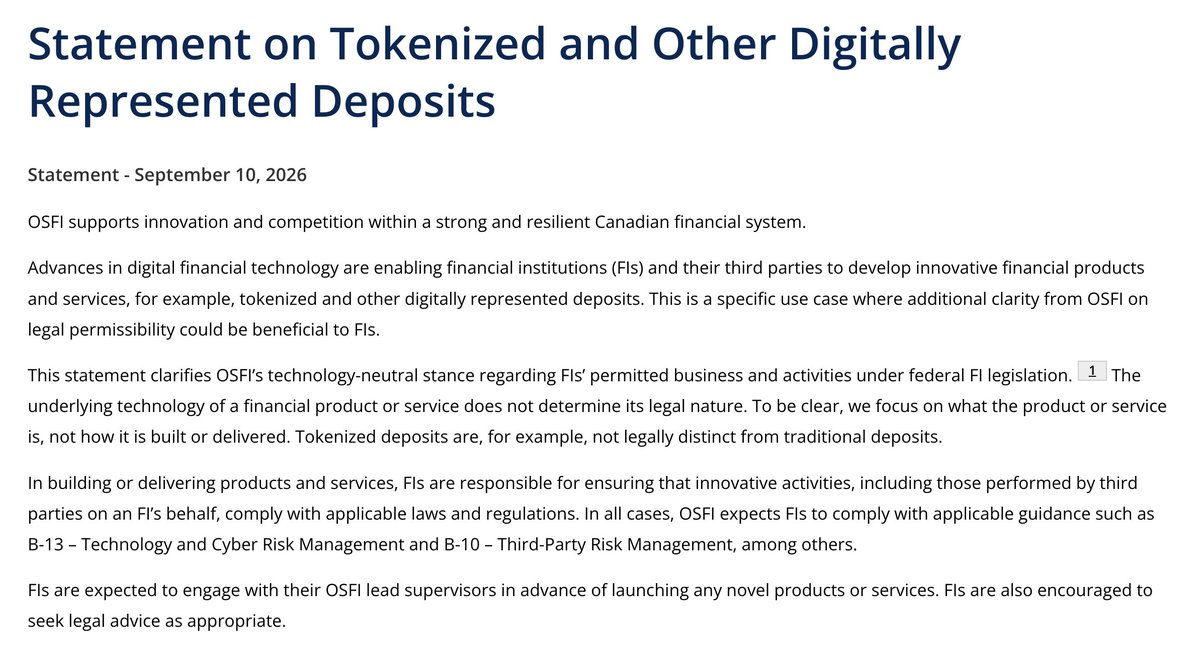
BREAKING🚨🇨🇦 Canadian banks have been given the green light to launch blockchain deposit products in 2026.
This is banks moving money onchain, not crypto companies knocking on the door.
Who benefits most from this?
Seeing this is the real win.
Anyone can hear about $XRP or $ZEC after they start moving.
The edge is understanding the fundamentals, the market structure, and the setup before the crowd gets loud.
That’s what I want people learning. 👇
A lot of people know the $XRP price.
Far fewer understand what settlement, liquidity and custody actually mean.
That’s where I’d start if I were learning crypto today.
Know what you’re buying before the market gets loud again. 👇
Good morning $XRP Holders☀️
The CLARITY Act fight says a lot.
Crypto wants clear rules. Some banks want the old advantage protected.
You can’t modernize finance by protecting what refuses to evolve.
Let the better system compete.
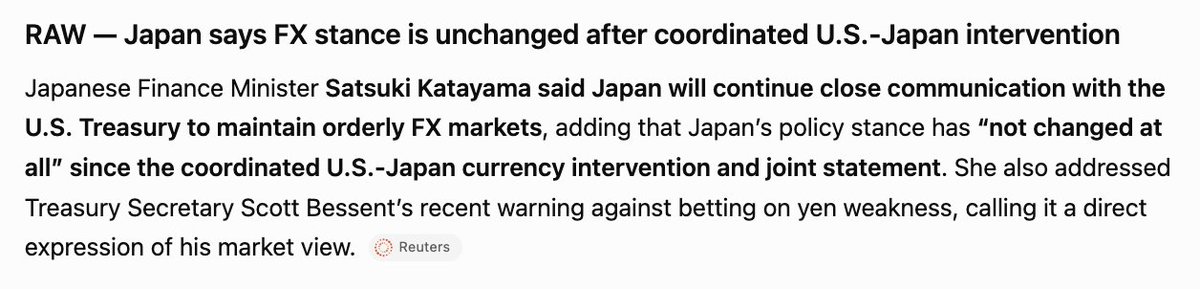
JUST IN🚨🚨🚨 Japan says its FX stance has “not changed at all” after the coordinated U.S.-Japan currency intervention.
Finance Minister Satsuki Katayama says talks with the U.S. Treasury remain close.
Is another yen move coming?
$XRP