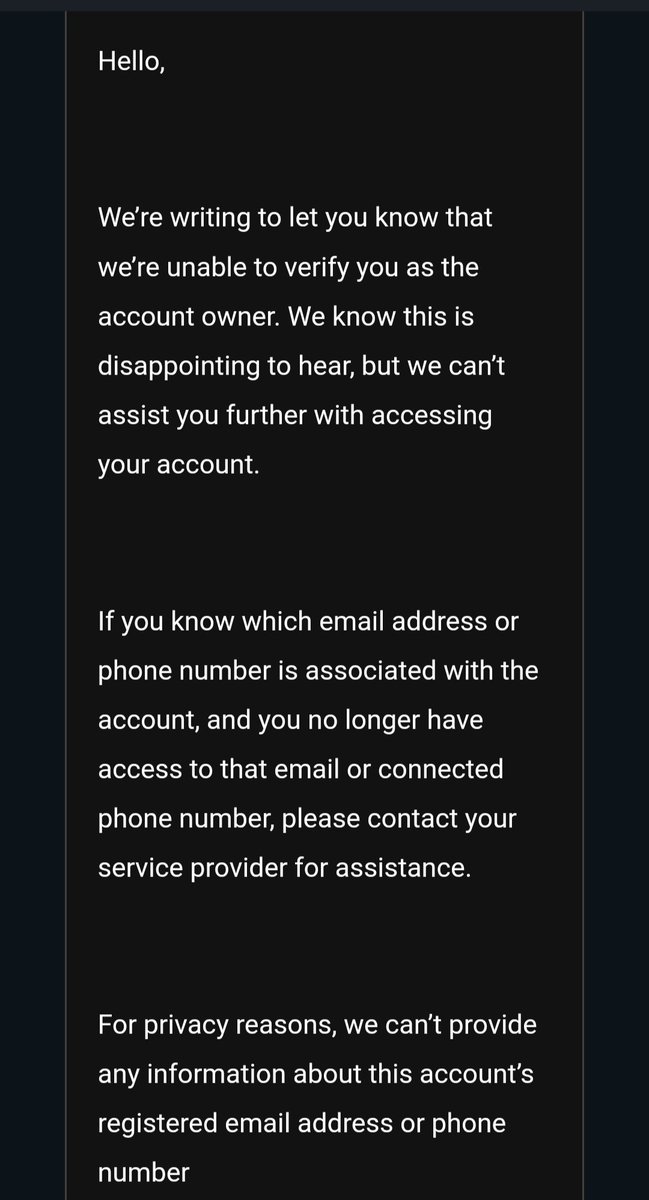
I woke up today to emails that my main account @hillsblockview had been logged into and email address changed! I've tried dealing with reporting account access problem due to compromised X account but hasn't helped. @Support
Yet another chance! Despite the most recent solar storm fizzle, 3 partially Earth directed solar storms launched in the last 24 hours and are on their way to Earth. All of these storms have a chance of at least grazing Earth, with impact starting likely mid to late day June 13. More analysis coming.
Here we go again! A C6.5 from AR 4465 has generated a FULL HALO CME with likely Earth-directed components. It could graze Earth in the coming days, and we will know more about timing once models are released.
Join me LIVE today at 7pm PDT (02:00 UTC June 8) for a live forecast briefing (a few minutes from now)! After I give the BLUF (bottom line up front) I will deep dive into the recent solar activity and recent launches, and talk about the crazy solar storm shape that is complicating the arrival time. I will also discuss the current preconditioning at Earth and how the flux rope visualizer (see attached image) can help us understand the storm structure, but in this case, nothing beats a great slinky model! https://t.co/eE86MKSbKw
99% of space weather is waiting.
Waiting for the Sun to do something, waiting for all the data, waiting for models, waiting for the storm to maybe arrive, waiting for southward Bz, waiting for aurora or waiting for the storm to end (if you’re negatively affected by said storm).
Just when everyone thinks the recent set of solar storm fizzles were all we were going to have this week, WHAM! Region 4461 fires a massive blast and launches a fast moving solar storm towards Earth. Looking closely at the region just before the eruption, a very dense core filament is what erupts. These core filaments contain very dense plasma & high strength magnetic fields. So, aurora photographers get ready for impact some time on June 8, as this storm could easily outperform the others that hit earlier this week.
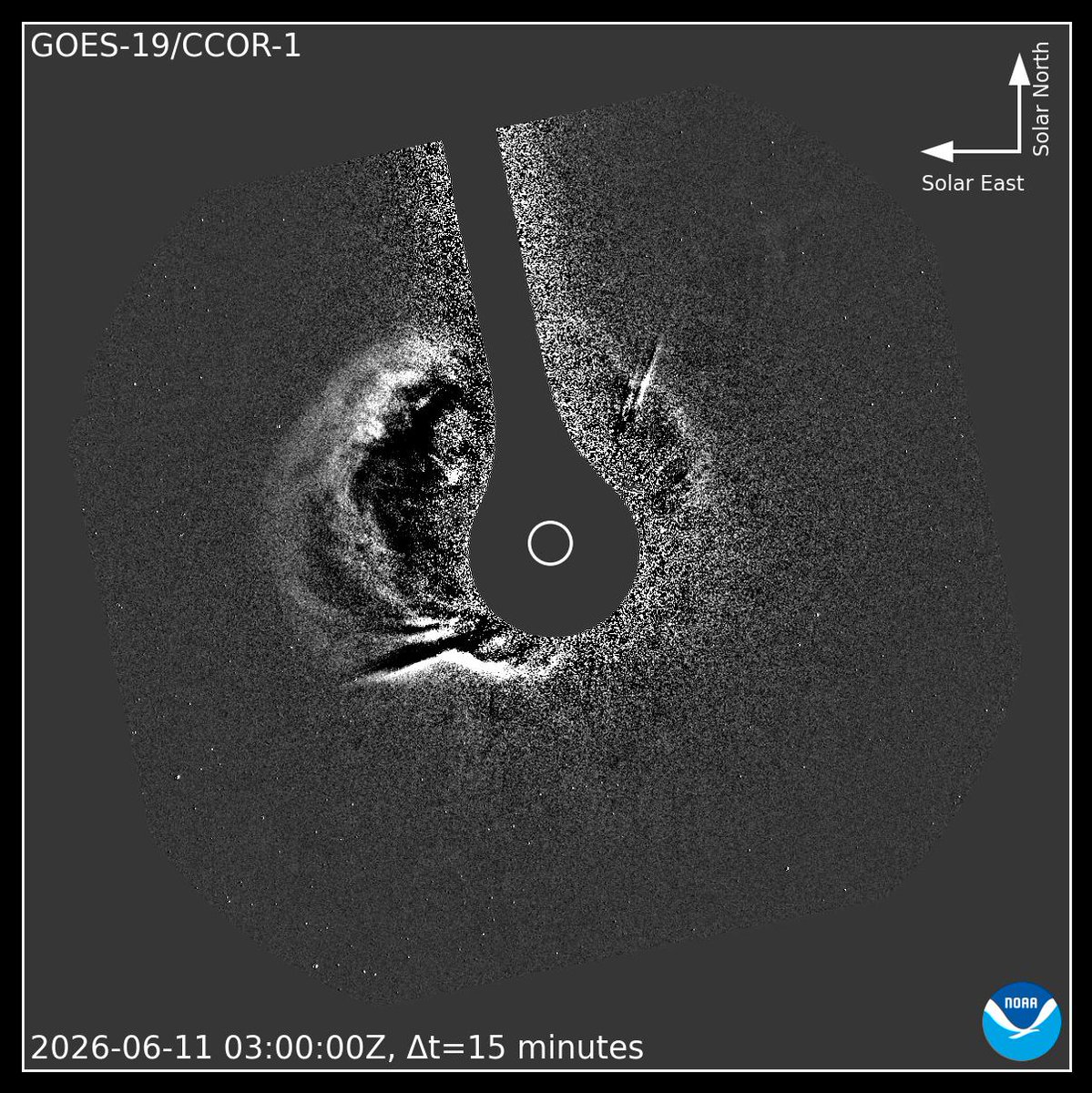
The full-halo CME from the M1.8 flare in AR 4461 in CCOR-1 - we have seen worse :) Too bad 4461 did not wait another day or two for a more direct hit, but the shock front is certainly headed for us and the bulk is likely as well.
AURORA ALERT: a strong solar storm could bring the northern lights to much of the U.S. tomorrow night (Sunday, June 7). NOAA has issued a G3 ("strong") geomagnetic storm watch for June 8. If it pans out, the aurora may be visible across the northern states and into the central U.S., with a small chance even farther south during brief bursts called substorms.
What's happening: on June 6, a large filament erupted from sunspot region AR 4461 alongside an M1.8 solar flare. The flare was modest, but the eruption launched a fast, full-halo CME (a giant cloud of solar plasma) with a clear Earth-directed component, modeled at over 1,000 km/s. NOAA's model has it arriving around 11 UT on June 8 (7 AM Eastern, 6 AM Central, 4 AM Pacific on Monday morning), while NASA's runs lean earlier, closer to Sunday evening for North America.
All models carry about +/- 7 hours of uncertainty, so the realistic window runs from Sunday evening through Monday midday. For U.S. chasers, that makes Sunday night into early Monday the night to watch. If the CME shows up late, Monday night becomes the backup, and NOAA already has a G2 watch posted for June 9.
How strong: NOAA's official forecast is G3 (Kp 7), but the bulk of this CME is heading south and east of the Sun-Earth line, so a lot depends on whether we catch the core or a flank. It could land higher or lower. Don't put too much stock in pinpoint Kp numbers or app forecasts before the storm arrives. Space weather is hard to predict and the storm will evolve on its own. Treat forecasts as a sign activity may be enhanced, not a guarantee.
How to catch it: get away from city lights, find a clear view to the north, and look during the darkest part of the night. Watch for substorms, when the sky can go from dark to full of color in just a few minutes. Unlike last week's storm, the moon is on our side this time: it's half-lit and doesn't rise until roughly 1-2 AM local, so the evening and midnight hours are properly dark. Clouds are the bigger wildcard, so check your local forecast before you drive anywhere.
The map shows roughly how far south the aurora might reach Sunday night. Forecasts like this don't always come true, so keep your hopes up but your expectations realistic.
I'll send a full aurora alert email to my subscribers tomorrow (Sunday) morning with all the details, free of charge. Sign up here: https://t.co/DEC4EVKdrw
A few more free resources to help you chase:
Live aurora webcams (100+): https://t.co/6p6lf2217i
What is a substorm? https://t.co/4zGp9vcHYG
Resources you may look at but are actually NOT helpful for chasing in real-time: https://t.co/dXajNLSH25
Support these free alerts on Patreon: https://t.co/8f4dgCQHIs
A G3 geomagnetic storm Watch has been issued for 8 Jun, and a G2 geomagnetic storm Watch has been issued for 9 Jun for the anticipated arrival of the CME that left the Sun on 6 Jun. Stay tuned for updates!
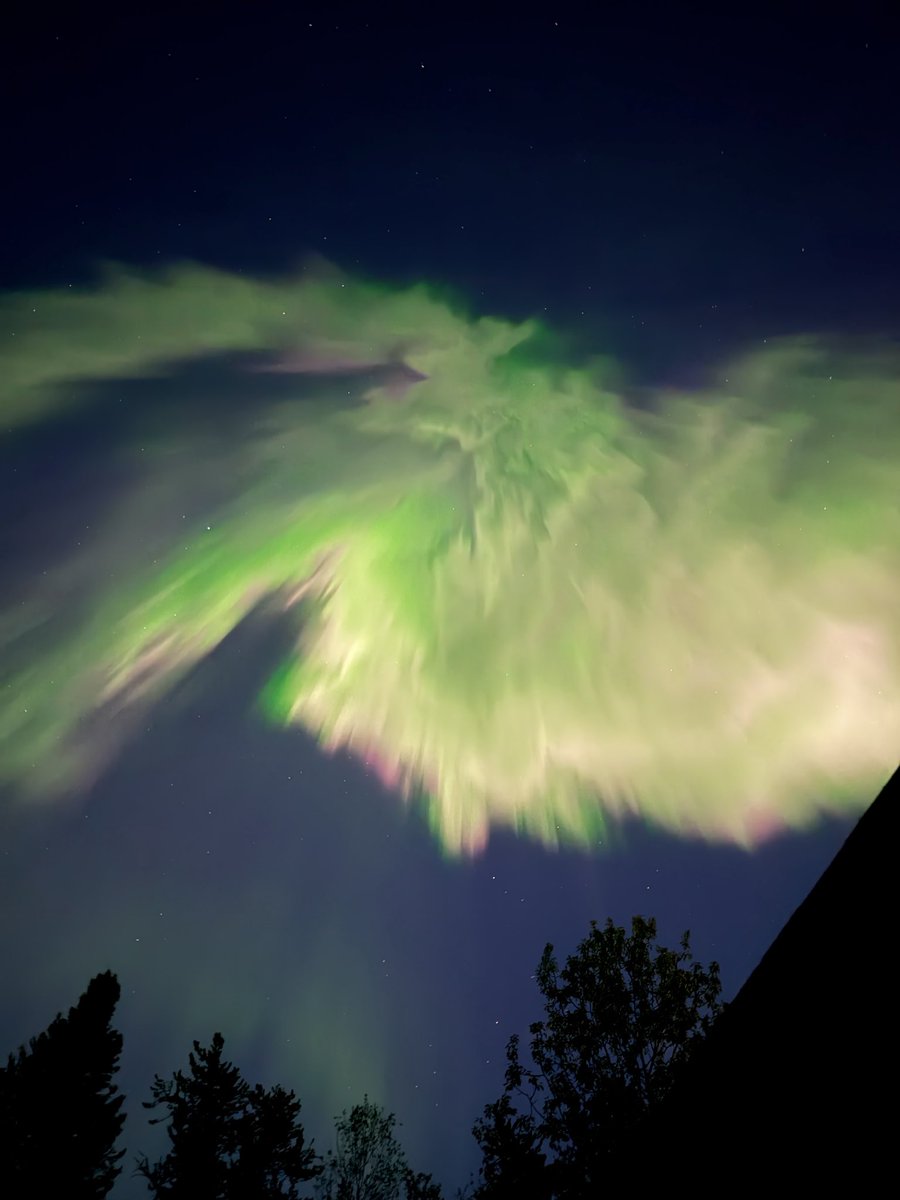
The Storm Chasing @Toyota Rav is being treated to a rather spectacular show as the Northern Lights continue. This image captured 8 mins ago at 12.53am near Estevan, Saskatchewan, Canada. #northernlights#aurora
The longer 4 satellite streaks moving northward at the beginning are new to me. Also, the satellite constellation clustering being due north all night instead of NW or NE (post or pre twilight) is not ideal for midlatitude aurora photography.
This whole thing is looking increasingly like a bust. We have so far had a single shock front hit, but nothing particularly noteworthy. No elevated geomagnetic activity so far. That's OK, space weather is tricky, which is part of what makes it so much fun. Let's keep an eye on the solar wind, just in case :)