More context: existing training-free samplers usually decide commitments token by token. CLAD instead groups adjacent high-confidence positions into confidence-induced clusters, then uses self-attention from the same forward pass to choose mutually compatible clusters.
Glad to share our another new paper CLAD!
CLAD is a training-free decoder for masked diffusion LMs. It commits reliable span-level clusters rather than individual tokens, with attention-guided selection.
Paper: https://t.co/fJ1Zv0frej
Code: https://t.co/gC3nnV70Ry
A bit more context: in parallel decoding, committing multiple high-confidence tokens at once can still be redundant if they attend to similar visual regions. VRCD uses token-to-image attention to reduce such overlap during decoding, without extra training or model changes.
Glad to share our new paper! We study visual redundancy in parallel decoding for diffusion-based multimodal LLMs and propose VRCD, a lightweight training-free decoding method.
Paper: https://t.co/Yi72e3jQYi
Code: https://t.co/e6LvMl0m7B
Not a news to many, but I will be starting as a professor (W3) at TU Darmstadt in June 2026 and setup another branch of our Adaptive Intelligence group.
Also, I am hiring! Please share!
4 PhD positions https://t.co/6uN6pt5gQe
2 post-doc positions https://t.co/6uN6pt5gQe
Applications change, but the principles are enduring. After a year's hard work led by @JCJesseLai, we are really excited to share this deep, systematic dive into the mathematical principles of diffusion models. This is a monograph we always wished we had.
I finally created my blog with first post on one of my earlier work on message passing algorithms. Specifically, we provide a very concise and general derivation of the famous GAMP algorithm from the EP perspective. Your comments are appreciated!
https://t.co/2ctK8aRsHA
Our DMPS paper has won the 16th Asian Conference on Machine Learning #ACML Best Paper Runner-Up ward! Many thanks to the ACML 2024 conference committee.
DMPS https://t.co/QwraBUhq26 got accepted by ACML2024, where we proposed a simple and fast method to approximate the likelihood score for solving inverse problems using diffusion models. Moreover, a unified approach for both diffusion and flow-based models is illustrated.
The long-awaited collection of lecture notes from the Summer School on Statistical Physics & Machine Learning, Les Houches 2022, is now published in JStatMech https://t.co/V8tzeimEJB . I am particularly proud of the works the school inspired; see section 3 of the editorial.
DMPS https://t.co/QwraBUhq26 got accepted by ACML2024, where we proposed a simple and fast method to approximate the likelihood score for solving inverse problems using diffusion models. Moreover, a unified approach for both diffusion and flow-based models is illustrated.
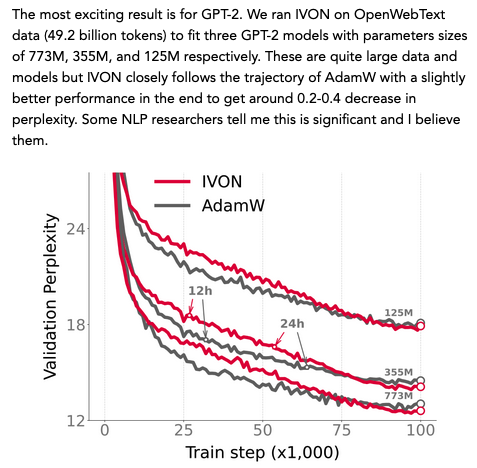
We don't expect Bayesian methods to do so well at large scale, but we can now get decent improvements with variational learning to GPT-2. I wrote a blog about this (first one in a long time). Check it out!
https://t.co/c7ftgBol2x
Paper: https://t.co/GUFi1br9av
A thread below.
Our new course, "From Deep Learning Foundations to Stable Diffusion", is finally done after 8 months of work!!!
With >30 hours of video content (all free, no ads!), you'll learn how to create and train a Stable Diffusion model starting from pure Python 🧵
https://t.co/bK0PSIzFww
The call for papers for our #ICML2023 workshop on "duality principles for modern ML" are now out.
Webpage: https://t.co/SVv3XYsOBp
Deadline: May 22, 2023, AOE
Help us spread the word! Hope many will participate.
@ZeldaMariet @mblondel_ml@tmoellenhoff@BachFrancis@optiML