Global Capability Centres earn about a quarter of India's services exports. GCCs boomed worldwide after 2020, fastest in India. @megonomista shows multinationals expanded the centres they already ran, as remote work cut coordination costs and lower wages favoured India.
In Big Ideas Ep. 84, Manyank Manish (eGov Foundation) discusses how fragmented data and limited visibility leave governments making reactive, ad hoc decisions, and how better data infrastructure could help shift resource allocation towards actual need.
https://t.co/YAiXtXt3aI
How fast is Pune growing, compared with Nagpur? We built an open, district-level dataset for India from satellite data: monthly nighttime lights since 2014 and annual building volume from 2016 to 2023.
https://t.co/WbrDviZ3gN
@ayushpatnaik97
“Why is it tricky for the Indian state to implement IT projects? In their new paper, @PalsAshok@karthikssays Susan Thomas point to two reasons: the state’s lack of capacity to take over once the vendor’s service period ends, and difficulty accommodating change requests.
Is India’s energy transition a capital problem, a cost-of-capital problem, or a bankable-projects problem?
Join us for Emerging Markets Dialogues with Jayant Sinha, former Union Minister for Finance and Minister for Civil Aviation on Financing India’s Energy Transition.
🚨 Tomorrow at XKDR Forum: Book talk on “Fiscal Fables” with authors @psarthak19 & @pranaykotas
Public finance shapes every headline — Centre-state fights over GST, freebie debates, cities starved of funds — but rarely explained simply. This book fixes that.
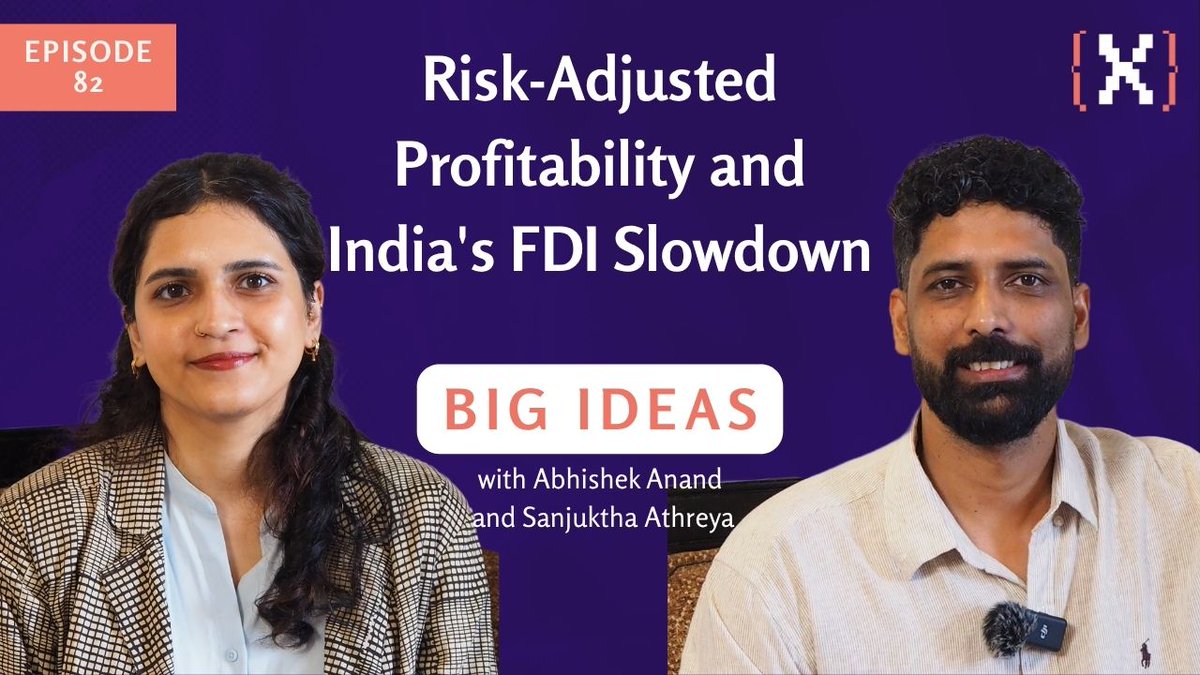
India is growing at 7 to 7.5%. So why is FDI falling? In Big Ideas Ep. 82, @abhishekecon discusses why risk-adjusted profitability, not headline growth, may explain India's weak trade performance and FDI slowdown, and what could help rebuild investor trust.
🧵
📢 Call for Papers | Finance for the Clean Energy
Transition XKDR Forum invites researchers working at the frontiers of economics, finance, law, public policy, and political economy to examine how finance and institutions shape the clean energy transition.
For most of history, trust has been a substitute for verification. The customer could not check, so markets built regulators, ombudsmen and ratings to vouch on her behalf. This held because verification was expensive.
With AI, it no longer is. What does this do to trust?
We have released the India Air Quality Database — hourly readings of 15 pollutants from 553 CPCB monitoring stations and the five US Embassy and Consulate monitors, from 2009 onwards.
Link to the dataset and API in the comment section. Write to us to know more.