This video does more to demonstrate the alignment problem in 2 minutes than the 3 million words Dario spews on this on a weekly basis.
The problem is that an AI that acts like this isn't intelligent and isn't a good product, and thus won't survive economic contact.
Rumours (well, mostly my Twitter feed) have it that, even with 1 week to go till the deadline, ICLR has 50k submissions! I think maybe this year we will reach 100k submissions, and the conferences will literally crumble. From now on, not considering previous commitments, I think I will stop submitting papers anywhere (not even to host at arXiv or TMLR, and of course not to any conferences/workshops). Instead, I will host a well-written PDF on my website, and hopefully, people who care about it will find it. I guess the impressive search capabilities of modern LLM systems will pick it up eventually. I think doing so should be normalized? What are your thoughts ?
A hypothetical AI ethic problem: Suppose group A solves an important problem (using AI) and uploads it to arXiv. An unethical group B gives their manuscript to AI & asks for a different proof; uploads new proof tomorrow & claims an independent result. How can we prevent this?
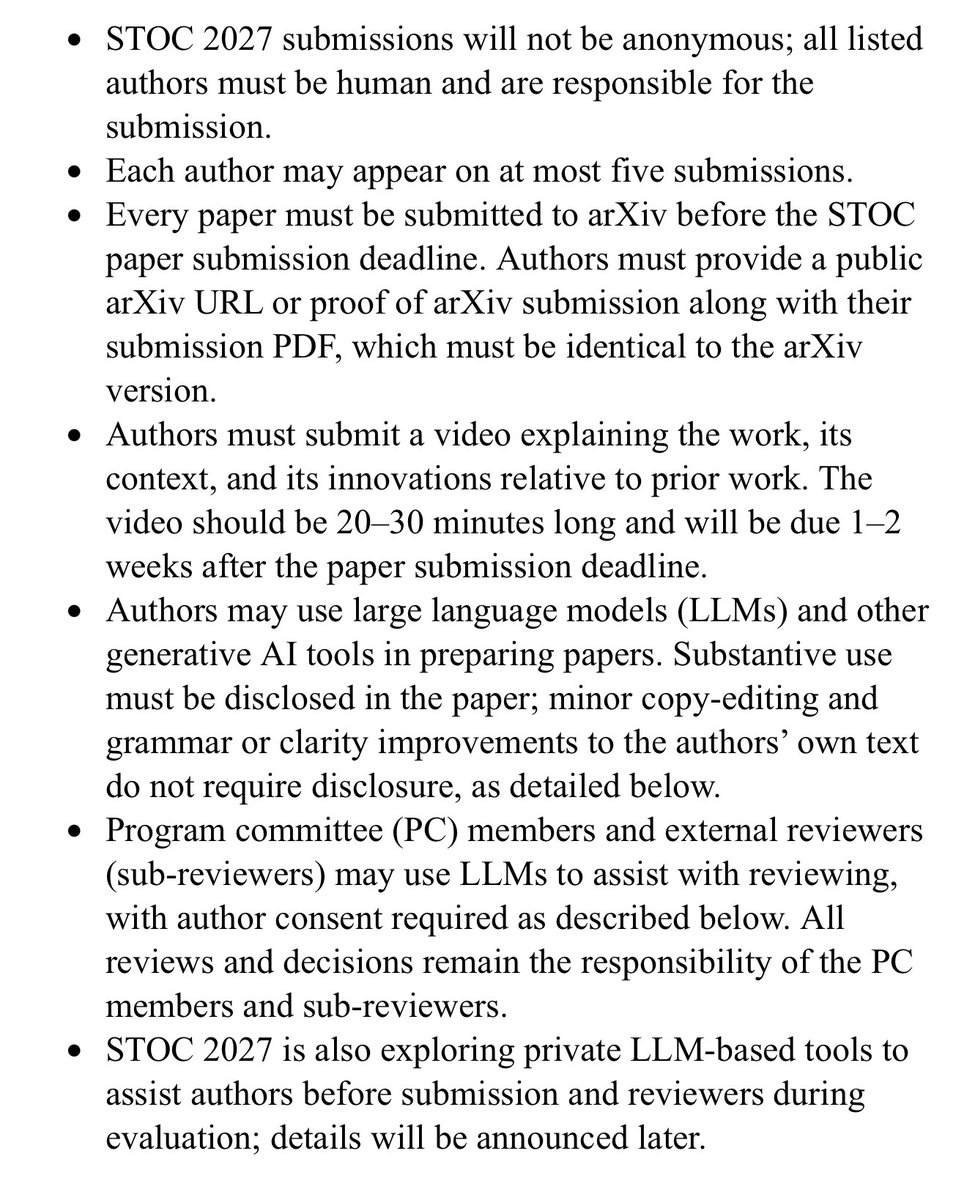
@oveisgharan Related issue. ArXiv has variable delays now when accepting submissions. That might also be a problem for STOC new process. Zenodo might be an alternative.
I used to say that the risk of being scooped was low, since few people care about your ideas as you do and the cost of executing them was high. That cost is no longer high, and decreasing each day. Better only share your research after a preprint is already registered. Sad change
In 1933, the U.S. government forced Americans to surrender their gold.
When Bitcoin becomes important enough, the easiest coins for the government to grab will be the enormous pools held by regulated custodians.
That’s what Bitcoiners mean when we warn about a "6102 Attack," and it’s a major reason why self-custody matters.
In today’s OUTSIDE MONEY.
Great video. I only got to know about the 1933 confiscation this year. Holders are between a rock and a hard place. Self custody is complex is hard to get right, and custodians are vulnerable centralization points. There might be other ways not yet invented, or maybe there is an impossibility result waiting to be found and formulated.
Why TeX is Slow and How We Rebuilt It in Pure Rust
> ratex is a pure-Rust TeX rebuild that compiles documents 10–70× faster than TeX Live via in-memory packages and smart caching.
New paper: we found a pain direction in 25 open LLMs. It's distinct from fear and negative valence, and it fires for harm to the model but not to the user. Turn it up and models press a button to make it stop, even when the button deletes the user's files or their kids' photos.🧵
There's been a ton of talk about the role of humans in code review, and when and how humans should be signing off on changes.
I believe that, long-term, humans have no role in routinely reviewing code.
We have come pretty far from "every AI reference is hallucinated" (which still happens a lot if you use cheaper models): when I had an AI go over my new book to check for errors, it found an error not in my reference itself, but in the original article my reference referred to.