4 research sites to help improve your #product
It’s always reassuring to trust your own experience, but research has often been the backbone of the first steps in #productdevelopment. That’s why we’ve put together a list of resources that keep you from feeling like you’re guessing features blindly.
This isn’t about replacing your own #research and testing. It’s about complementing it. Use ready-made data where it helps you save time and money.
And scroll through the cards.
Uber and Microsoft are cutting their AI budgets
Big tech has realized that AI is becoming more expensive than human workers, prompting major corporations to reduce their spending on AI subscriptions.
1. Microsoft
First, they had programmers use Claude Code, but developers worked so intensively with the tool that the rate of token consumption became unsustainable for the company. Programmers are now being urgently migrated to the internal tool GitHub Copilot CLI, with plans to complete the process by June 2026.
2. Uber
The ride-hailing company has exhausted its entire AI budget. The CTO stated that the annual limits were used up in just 4 months – amounting to $3.4 billion.
3. Nvidia
Bryan Catanzaro, Vice President of Applied Deep Learning, said outright: AI costs more than human workers.
More on where the global development market may be headed – in Denis Polevik’s next post.
The best thing you can do for a product is to grow its community from the first day
Stay in touch with users, gather feedback. Show the product more often to those who might be potentially interested in it. And for that, you need #marketing.
And this brings us to a point where marketing efficiency can be greatly enhanced with AI. For example, through #ClaudeCode.
#Anthropic has just released a guide on how their growth team uses #Claude in marketing. Save it and put it to work.
1. #GoogleAds automation. Claude analyzes CSVs with hundreds of ads, independently identifies weak creatives, and generates new variations that comply with Google Ads' constraints. Creating ad copy is reduced from ~2 hours to 15 minutes.
2. #Figma plugin for mass creative production. The plugin automatically changes texts in frames and generates up to 100 variations at a time.
3. Connecting #MetaAds API to Claude. The team built an MCP server that lets you view spend, campaign analytics, and ad effectiveness without switching between services.
4. Self-improving testing system. Claude saves past hypotheses and experiment results, then uses them when generating new ads.
With this toolkit, one person using Claude Code starts working like a mini-team consisting of a marketer, analyst, and automation engineer.
Full guide's here: https://t.co/MRcITCy13j
Now inside #FlutterFlow, there's an agent that builds screens, components, and entire pages for you based on a text description. Prompt to Page, Prompt to Component, #AI Agent Builder. The marketing sounds great: "Describe your product and get it without development." But…
If the agent can build an app on FlutterFlow, then the exact same agent can build on regular #Flutter, #React #Native, and #Swift, essentially on anything. #Cursor, #Lovable, #Bolt, #Replit are already doing this, without being tied to a specific platform.
So here's the paradox: FlutterFlow integrates AI to help you work faster inside FlutterFlow. Meanwhile, AI itself makes FlutterFlow unnecessary.
Before, the value of a no-code builder was that non-technical people couldn't write code, but they could drag and drop a button with a mouse. The visual editor was a bridge between an idea and a product. But now that bridge is being built differently: you simply describe in words what you want, and you get working code with no builder, no subscription, no pricing restrictions.
We've been through this ourselves. We used to build projects for clients on FlutterFlow, but now we're switching to regular #Flutter because the agent builds on either platform. Only without the builder, you end up with clean code that you fully control, you can edit it, scale it, move it anywhere.
So how will FlutterFlow retain its audience? In my opinion, only through infrastructure: ready-made deployment, hosting, built-in Firebase and Supabase, Stripe with just an API key, analytics, and page templates.
This model is effective for rapid MVPs, hypothesis testing, and internal tools where speed to launch is the priority, not total control over the code. But that positioning is fundamentally different from that of a visual app builder.
And for those building a serious product, the question remains open: why pay for a layer between you and the code if AI writes that code directly anyway?
#AEO tools: a billion-dollar market for a problem that doesn’t exist
AEO, #GEO, AI visibility – behind all these acronyms’s the desire to get #ChatGPT, #Claude, and #Perplexity to recommend you. It sounds like a whole new discipline, but if you dig deeper, it’s just #SEO in a new wrapper.
Think about it, 75% of the citations #LLMs serve to users are just the standard Google top 10. Another ~20% comes down to brand reputation, reviews, and competitor comparisons, factors that have always influenced classic SEO. In other words, if you have solid SEO, you already have decent AEO.
And here’s the most telling thing: who isn’t building an AEO service right now? #HubSpot bought an entire company for it. #Adobe launched its LLM Optimizer. #Ahrefs, #SimilarWeb, #Semrush – they all already have an AI visibility tab. Startups are popping up by the dozen.
I personally know three people in my circle who, without consulting each other, are building the exact same product. Now #Webflow is jumping in too. When everyone rushes into one niche at the same time, it usually says more about hype than real value.
The problem is, all these services show you graphs and numbers, but they don’t tell you exactly what to do. At best, you get a checklist along the lines of “write five articles about your company’s strengths”, stuff you’d know without a special tool.
And then there’s the whole `llms.txt` story. Remember how everyone was obsessed with this file? We added it to our own sites and to our clients’ sites. Then it turned out that LLM bots have no instruction in their code to look for this file. At all. Where that advice came from and who started pushing it – no idea. And right now, there’s a flood of lifehacks like this around AEO, with everyone pushing their own narrative from every direction.
AEO isn’t a new era, but an evolution. Create solid content around your product, build expertise, gather reviews, keep your SEO in order and the LLMs’ll pick it up on their own. Specialized services can still be useful: at the very least for monitoring, and at best over time they may mature to offer concrete, actionable recommendations instead of just dashboards. But treat them as tools, not as a silver bullet, and certainly not as a revolution. The foundation remains a strong product and strong content.
And yet, no matter what new features #Webflow releases, we’re still moving our agency’s website from Webflow to custom code. And honestly, this step was long overdue.
Hi! This is Dennis Polevik again. At some point, Webflow became a limitation for us. Even the smallest change on the site had to go through someone familiar with that stack. Updating a block, tweaking a page, quickly testing a new hypothesis depended on who was free at the moment.
That’s why we switched to #vibecoding.
Before, the Webflow subscription felt like a fair price for convenience, you can quickly build a site, launch it, and maintain it with almost no code. That worked until we found a way to do the same thing faster, cheaper, and more flexibly.
Recently we estimated a client site. Under the old logic, this would have been a $5,000 Webflow project. Then we recalculated the cost of building the same site with vibe-coding:
1. About 20 hours of work instead of several weeks.
2. Roughly three times cheaper.
3. The same quality of output.
The result is a proper custom-built site. It’s easier to control, easier to iterate on, and easier to integrate into the team’s workflows. Changes are no longer tied to a single tool and a single person. That’s great.
And no, I’m not saying Webflow is dead. The inertia is huge, millions of sites're already built, and they need maintenance. But in my opinion, there’s only one scenario where Webflow still makes sense: take a good ready-made template from it and customize it.
But building from scratch on Webflow? I don't see the point anymore.
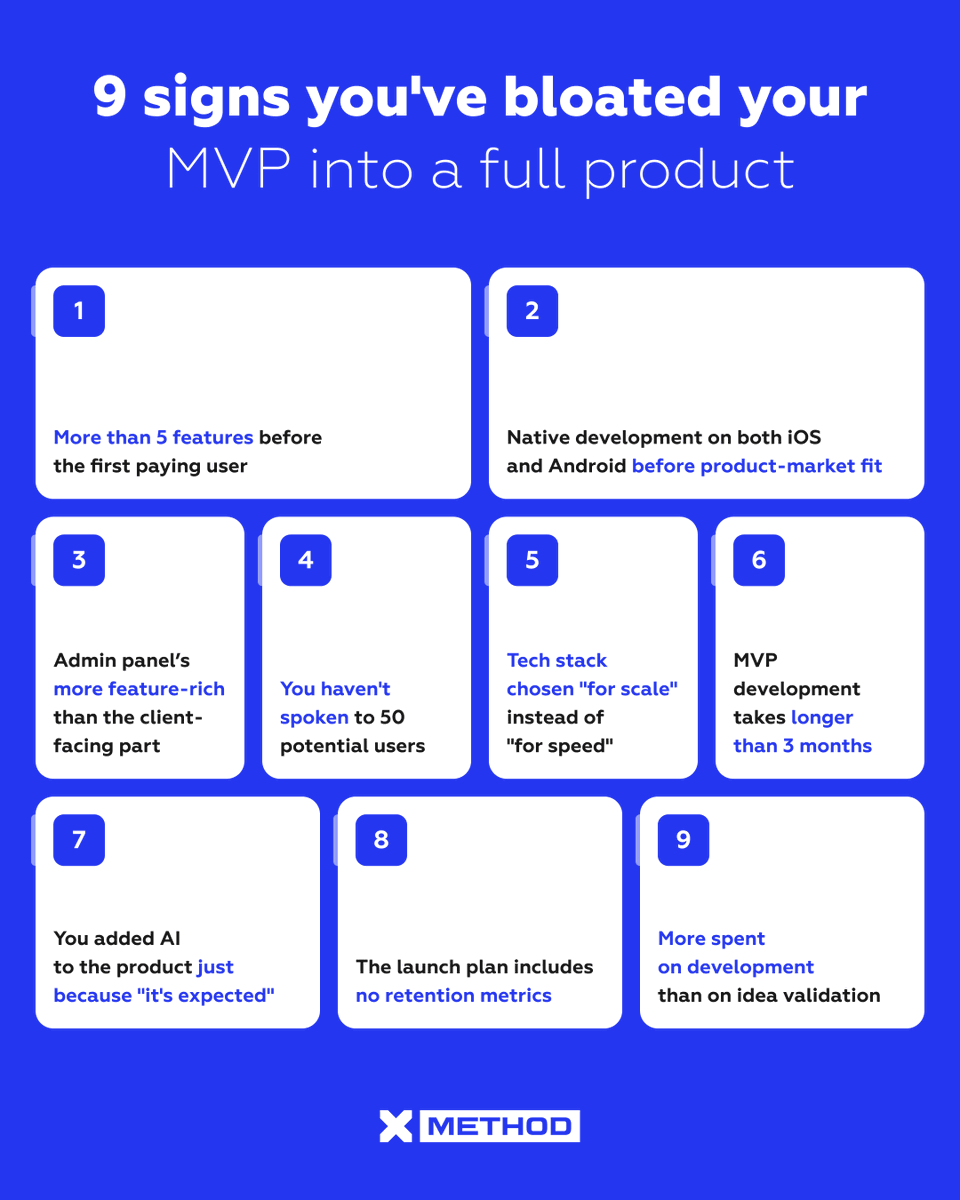
9 Signs You've Bloated Your MVP into a Full Product
According to #Softermii data for 2024-2025, 67% of startups fail because they built a product the market doesn't need. Meanwhile, developing a full product without a validation phase costs an average of $800K, and in 72% of cases, that investment never pays off.
Here are 9 signs that your #MVP's long stopped being minimal. If you recognize yourself in three or more points, you're no longer testing a hypothesis, you're just wasting resources.
Imagine texting by thinking. That's #Sabi coming by the end of 2026. A simple cap with 100k sensors reads your scalp's brain activity, #AI decodes inner speech — goal: 30 WPM. No implants, no #Neuralink fear. Xmethod CEO Denis Polevik shares his take in the carousel (part 1)
In one year we replaced 12 familiar tools with specialised AI, and there's no going back. Google, Excel, Photoshop, Premiere, PowerPoint, Canva — all in the past.
The question is no longer whether to switch. It's whether you'll adapt before everyone else does.
#AI#AITools
If you've spent hours watching YouTube guides on vibe coding, chances are you've just been watching the wrong videos.
The creator of #ClaudeCode recorded a workshop where he explains in 30 minutes how his product actually works.
Must watch.
https://t.co/BH2PsjTuNx
The recent leak of Claude Code’s source code due to #vibecoding is the best confirmation of the thesis from Simón Muñoz’s article on the Irony of Automation: the more complex the automation, the more critical human control becomes. Completely agree.
https://t.co/QBFMJcpRN9
Paywall design is secondary – placement matters most. If the user has already seen value before reaching it, they won't haggle – they'll want to get into the app. The ideal paywall is a trial with no extra screens, where the product speaks for itself.
Successful onboarding closes the gap between "downloaded" and "started getting value" sometimes in just 2-3 screens. Focus on buttons & tooltips instead of user benefit? You lose up to 50% of potential retention.
And here's how we implemented onboarding in the Breakletics app.
Over years of work we've become experts in sport/wellness, improving lives.
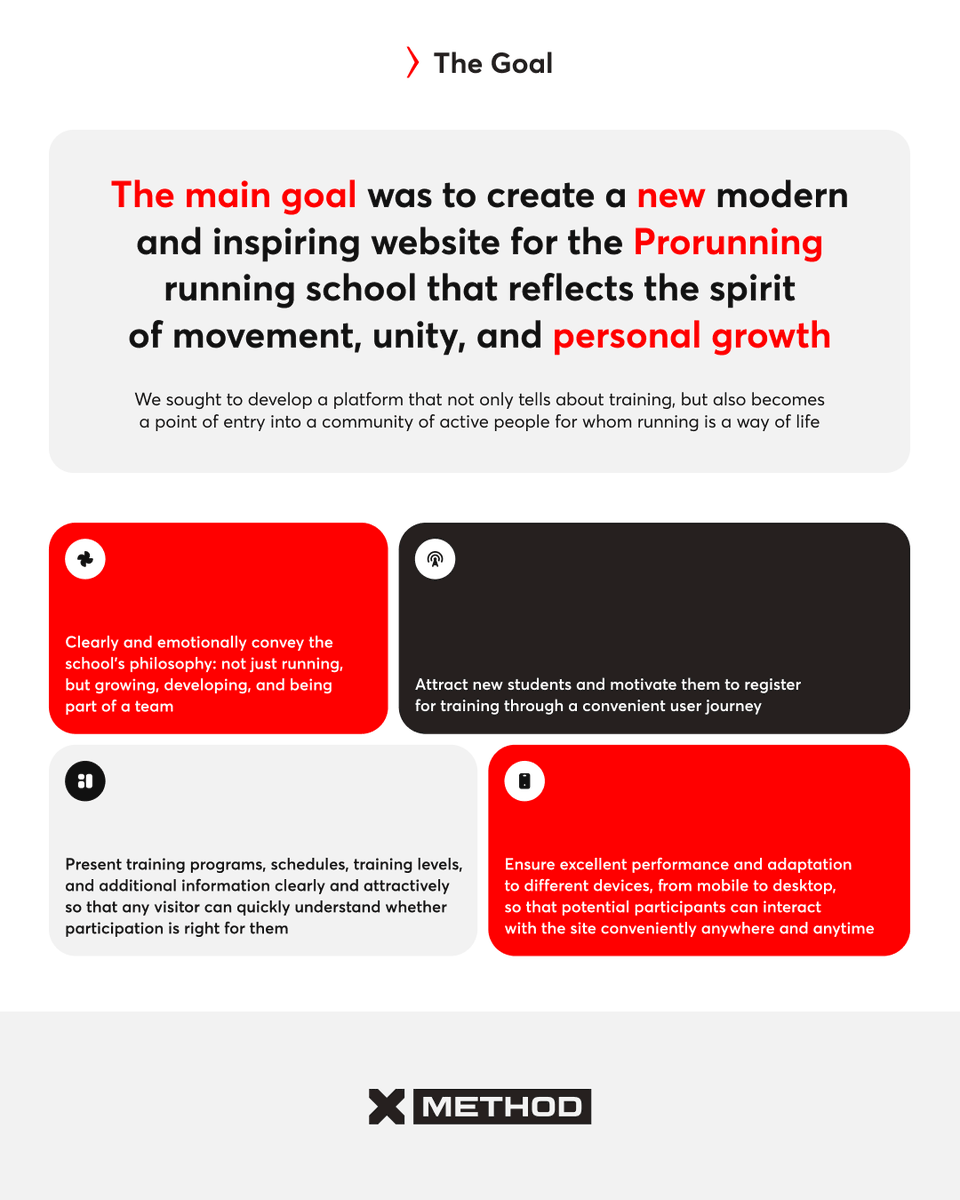
Latest: Prorunning School – turned site into community hub, converting cold traffic to sign-ups. Simplified program choice, UX for quick decisions, mobile-first. More:
https://t.co/8yn4nTwjkc
Nebius Group, led by the former head of Yandex, has signed a five-year contract with Meta worth $27 billion for AI cloud infrastructure based on NVIDIA. Meta'll gain access to computing power to strengthen its competition with OpenAI.
#NebiusGroup#Meta#OpenAI#NVIDIA#AI
Research shows: 90% of users abandon an app within a month
What to do about it, and what does industry-specific data look like? Breaking it down here.
https://t.co/PsD0ZSV5CL
#startup#growthhacking#saas#apps#ux#churnrate
You want your own analytics, admin panel, or custom player "for future growth." But instead of building your core product, you end up creating infrastructure that takes months to build and years to maintain.
Don't build what you can buy.
#ProductDevelopment#Startup#MVP
Lost leads, broken spreadsheets, docs with errors. Stop paying millions for "space software" to fix it. You just need a solid toolbox. Low-code is smart: fast, cheap, built to last. Don’t buy a rocket when you need a reliable cart.
#BusinessProcesses#LowCode#Optimization