For those who haven’t seen it - Signet Therapeutics, which XtalPi incubated and partnered with on SIGX1094, was nominated for the Prix Galien USA Best Biotechnology Award for the program.
Full write-up: https://t.co/2bXxjBlYBZ
A better disease model matters as much as a bigger AI model.
With Signet, we paired AI with cancer organoids (lab-grown 3D tumor models), reaching PCC in just 6 months after making ~200 molecules, rather than thousands.
SIGX1094 is now in the clinic. What did the organoids add?
The images show one readout: organoids shifted from grape-like clusters toward a more rounded shape with FAK/SRC inhibition. Alongside growth and signaling measurements, results from these experiments informed XtalPi’s next round of molecular designs.
The organoid work supported targeting FAK and SRC together: blocking FAK alone could leave tumor-driving signals active. XtalPi’s AI molecular design focused on compounds that could inhibit both, with their effects tested in Signet’s gastric cancer organoids.
XtalPi's VAST is a multi-billion compound library with >85% synthesis success rate.
Miroslav (Deep MedChem) just put it on a zoomable map so you can actually see the space.
Explore the library: https://t.co/FBIm8tghEN
Introducing SynthonMap: a zoomable map of billion-to-trillion-scale chemical spaces, using factorized synthons and parametric UMAP density estimation.
Try at: https://t.co/FUkU3GVydu
Demo on @XtalPi VAST 👇
@DeSciValidator Thanks for the note. Work with him is through the DoveTree collaboration on historically challenging targets (oncology, immunology, neuro, metabolic). One oncology program is already in IND-enabling studies.
Few people have shaped #DrugDiscovery like Greg Verdine. The Harvard professor emeritus and DoveTree founder helped drug the cancer targets RAS(ON) and β-catenin, long considered “undruggable,” and founded more than a dozen biotech companies. We recently welcomed him to XtalPi.
These conversations mean more when there’s work to do together. Professor Verdine highlighted XtalPi’s combination of AI and automated labs - capabilities we’re putting to work in our DoveTree collaboration, launched last year. Until next time!
For Professor Verdine, #AI’s promise goes beyond speed: more candidates explored in parallel, cheaper tests of biological hypotheses and fewer costly failures. But realizing this takes more than adding AI to existing workflows - it means rethinking how R&D is organized.
The next gains in AI drug discovery will come from tighter design-to-experiment loops, not bigger models alone.
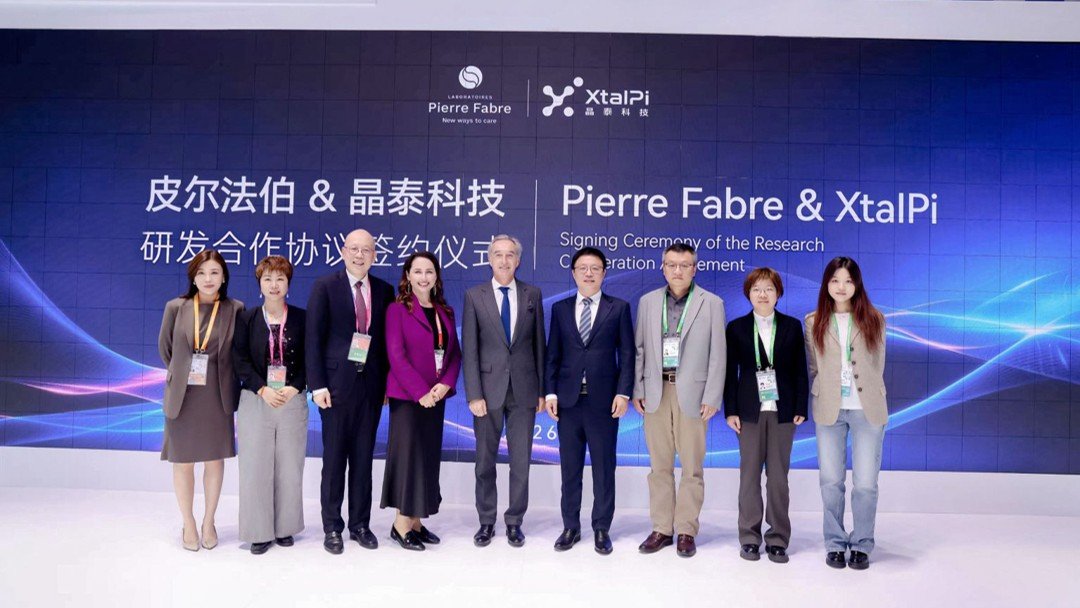
Our new collaboration with @PierreFabre puts this into action: de novo small-molecule design, tightly coupled with robotic lab feedback in multiple #Oncology programs.
The focus is difficult-to-drug targets, with scope to expand into dermatology and rare diseases. XtalPi will design and deliver molecules using its AI- and robotics-driven platform; Pierre Fabre will advance them. Terms include upfront, milestones, and downstream participation.
@jtcera Check out @ASTARsg’s high-throughput alloy screening: up to 470 unique samples screened and tested a day, >400x conventional throughput. Its MARVEL-AI initiative, which we recently joined, brings AI-driven materials design together with automated labs.
AI now generates molecules far faster than the wet lab can test them.
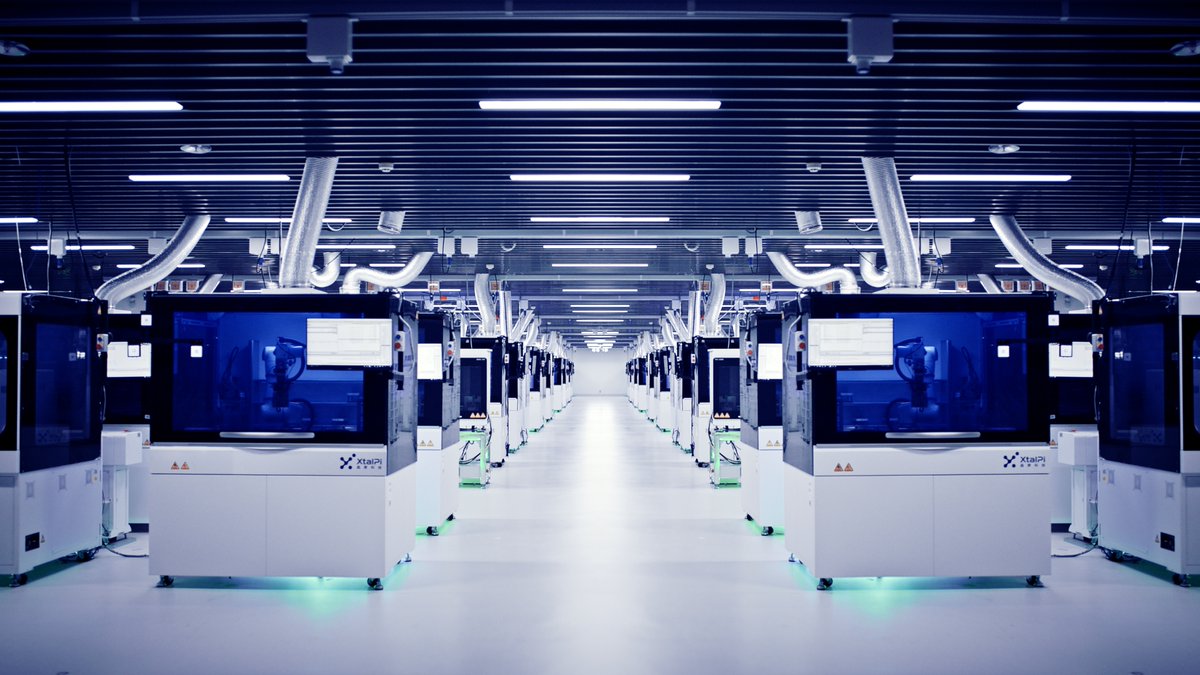
The bottleneck in #AIxBio has shifted. That’s why we've built one of the world’s largest self-driving lab fleets: 300+ workstations running 24/7, generating data 40x more efficiently.
@Imfulao Hi, that’s correct - it refers to data collection efficiency, driven by higher data throughput from the automated workstations plus faster extraction of key results enabled by AI. For experimental efficiency, we see a jump of 5-8x vs. conventional workflows.