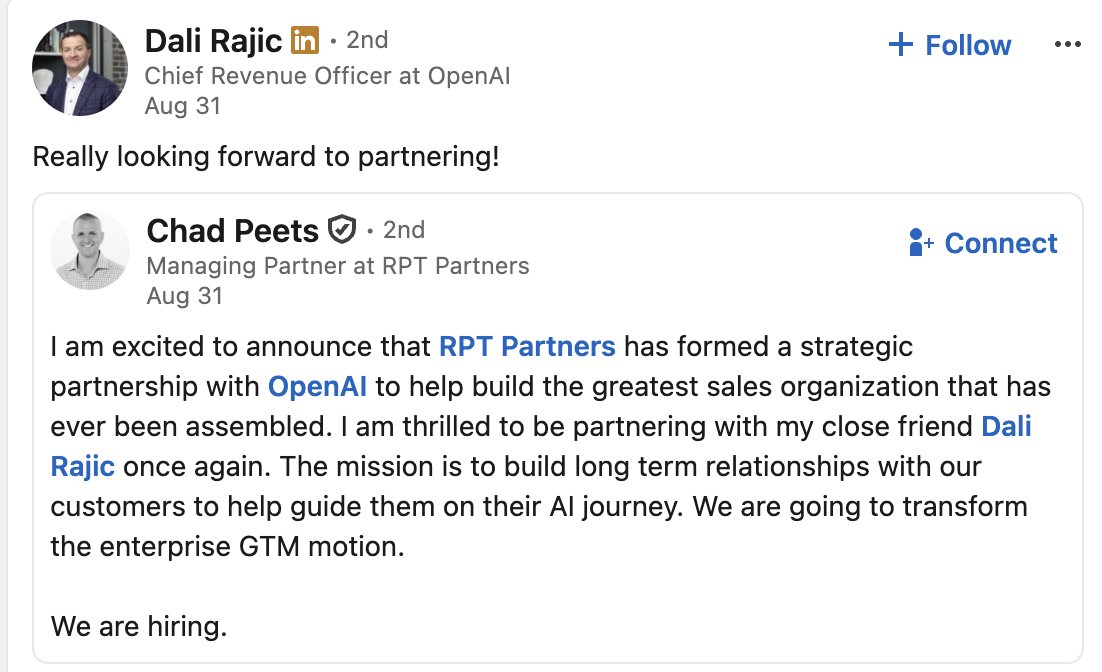
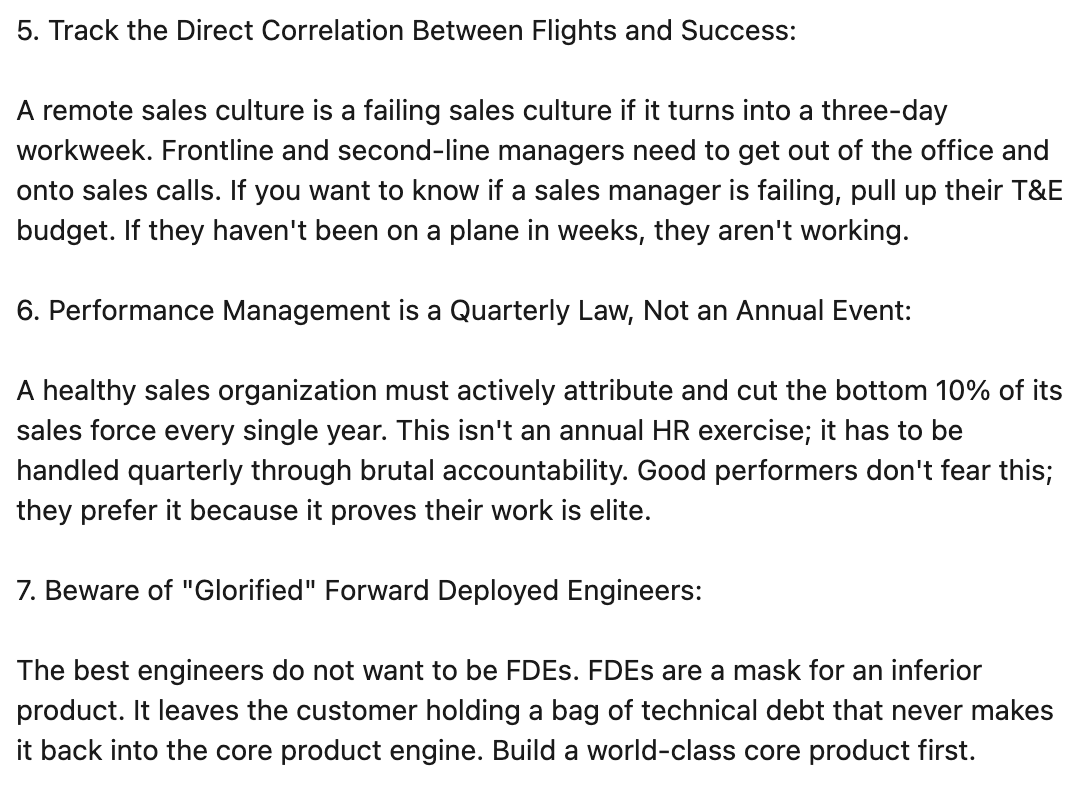
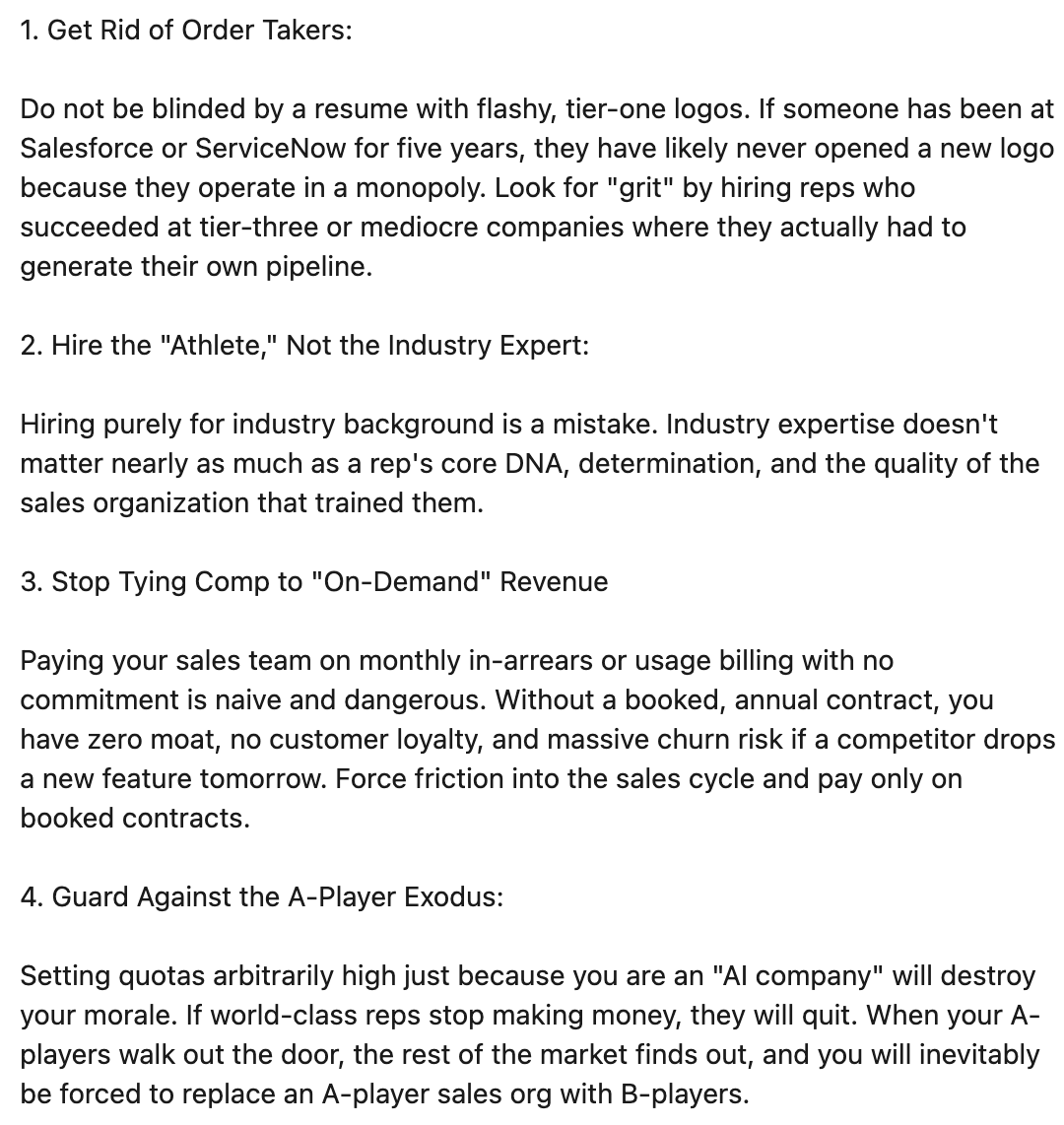
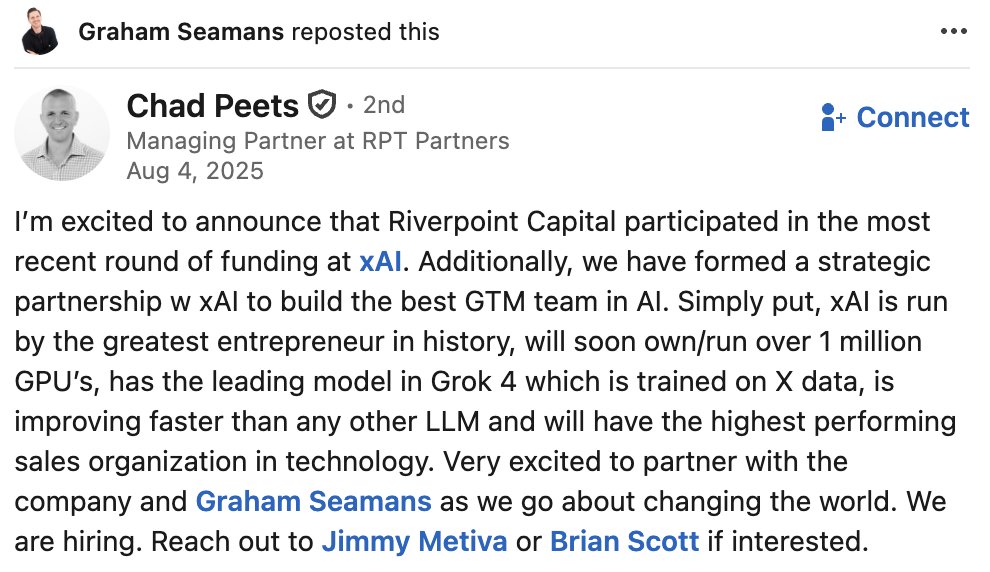
OpenAI, SpaceXAI and Cognition all claim to be building "the best GTM team in the world," yet the same sourcing company is doing the hiring for all three.
Why do the new sales leaders at these AI natives all come from the same background: Snowflake, Grafana, MongoDB, Zscaler, Rubrik, Datadog? Why do they only seem to hire reps referred from one of these companies?
It's called the playbook mafia, and it's part of the underbelly of tech sales today. The high-level story is simple. PTC was one of the moderately successful enterprise tech companies of the 1990s, and one of its sales leaders, John McMahon, popularized a qualification framework called MEDDPICC.
The team that worked directly for John went on to different parts of the industry, notably companies like MongoDB and Snowflake. They created sales cultures built on high pressure to generate new pipeline and a big focus on following a single process in their daily work. Those who played along were paid handsomely, and those who didn't were kicked out quickly.
Are these bad things? Not in isolation. We want mission-driven individuals in tech sales, and we want them to hold themselves accountable to a high standard.
The catch with playbook companies is that nobody has rethought what the "playbook" looks like since its heyday at the peak of the ZIRP era. The profile for success is changing, and a heavy focus on personal drive and quality of execution is now table stakes.
When they say "we will build the most successful GTM team in the world," the obvious question is: have you done it before?
Microsoft Azure has built exceptional account teams, closing billions of dollars with single customers, and has $124B ARR.
Anthropic reached $64B ARR while asking every employee to swear on the Claude Constitution.
Databricks reached a $7B run-rate, outplaying Snowflake, which had a massive early lead.
Yet for some reason, none of the best-performing sales reps at these companies are a "fit" for a playbook company. In fact, if you listen to a recent interview with Chris Degnan, their profile is undesirable. Sales reps who are industry experts, have technical insight and thrive at building successful long-term sales cycles (consumption contracts) are frowned upon.
The goal is to only hire people who show "grit" and want to work for YOU. And if they do well, we will push the company to PAY AS HIGH AS POSSIBLE to retain them. There is no interest in what the best strategy is for the company or its customers. It's about MY team and MY people.
So what we're seeing now is the same group of leaders, and the sales reps loyal to them, moving into AI-native companies. If you want a shot at working for those companies, you need to go back to the "training factories" like Snowflake or MongoDB first.
In the ugly situation with Factory and Cognition, the tribal lines became obvious. The shocking part wasn't just the breach of trust of advising one company and then becoming CRO of its competitor. It was that the most important thing to mention in the announcement was "I'm bringing my friend and business partner to hire all the reps at the new company."
What played out is no surprise to those who have seen firsthand how the playbook mafia behaves when things go sideways. Take a look at Lacework, and how Andy Byron (the CEO who famously got caught at a Coldplay concert cheating with his HR leader) got pushed into a leadership role at Astronomer.
Something similar is playing out at OpenAI, where the current crop of sales leaders has been cleared out, even though the company had a great last quarter and pushed past Anthropic's ARR.
If you're a sales rep at a playbook company, it's important to remember that you're just a product, to be upsold to the next employer as long as you keep your mouth shut and nod along.
Every day, my timeline is so full of incredible people doing such innovative things that would have blown peoples' minds before 2023 and now we just keep scrolling.
@abishekv 1. With partners, they won't have the tight loop the FDAEs do, and they may each solve the same ask in different ways. Together, those one-offs could point to PMF in new segments so how do you see keeping that loop tight?
@abishekv 2. While this may vary across orgs, I'd heard at Rippling FDE's charge ARR on custom builds and own the maintenance - would you consider that or does it go against principle 3?
@abishekv Not a perfect comparison but asking because SAP feels closer to the "now go build whatever you need" side with Joule. They ship some prebuilt agents, but a lot of the value sits in Joule Studio, and it's largely on the customer and their SAP partner to build what they need
@abishekv Love this! Question on the first two guiding principles - I'm guessing they come from your choice to own the deployment as well. Do you plan to keep doing that with the FDAE motion as you scale to more users and different segments?
@keerthivasanck@a1zhang really well articulated! I'd learned about LangChain's Deep Agents, but great to know they've added RLM support to it. Just read the RLM blog after this post
@BrianLaManna_ I also set up a weekly sync with a leader or seasoned rep where I’d demo the platform as if I were presenting to a customer, answer real questions that test my understanding of the product and the problems we uniquely solve. Could probably use Gong AI trainer here!
@BrianLaManna_ 100%. When starting off at Freshworks, I planned my days and weeks around how many demos and discovery calls I could shadow across different use cases. Whenever possible, I’d also spend time with the reps before calls to understand the customer/opp context
Something the market will always mis price is that the harder it is to acquire revenue, the harder it is to lose that revenue
If a company doesn’t have a gritty FDE motion, your revenue is probably garbage tier (unless you’re selling a high volume commodity / are a monopoly)
@tanayj this is really cool, he spoke about this on TBPN recently. I wonder if the new wave of AI observability tools enabled this or they decided to build that in-house. Either way it is a big shift!
@nrmehta i’m a sucker for hopecore.
looked up this quote by george bernard shaw i got reminded of -
“the reasonable man adapts himself to the world; the unreasonable one persists in trying to adapt the world to himself. therefore all progress depends on the unreasonable man”
Time to value was one of our key value props at Freshworks. But as software becomes more capable, I’ve noticed the rise of deployment strategists and customer activation roles, making TTV table stakes. I wrote about this on my Substack as I try to understand it better. Link below
@rohitdotmittal my read on this is that as servicenow moves into security this is panw moving into ITSM. But, with this acquisition and companies like Serval do you think that there is a real opp for an ai-native servicenow? I sold Freshservice so I get how hard it is to rip out but still wonder