I spent weeks reading everything YC has ever published about what they look for.
here are 9 things that would have changed how I thought about the application
The most consistent mistake I see young would-be founders make is to care too much about investors' opinions and not enough about users' opinions. They've been trained their wholes lives to seek out and please the gatekeepers. But this is where gatekeepers stop mattering.
YC’s current thesis is simple
Stop selling the software. Use it yourself and sell the finished work.
The biggest companies of the next decade may not be pure SaaS at all. They’ll be AI-native services firms (accounting, insurance, legal, tax, etc.) that deliver outcomes at software-like margins.
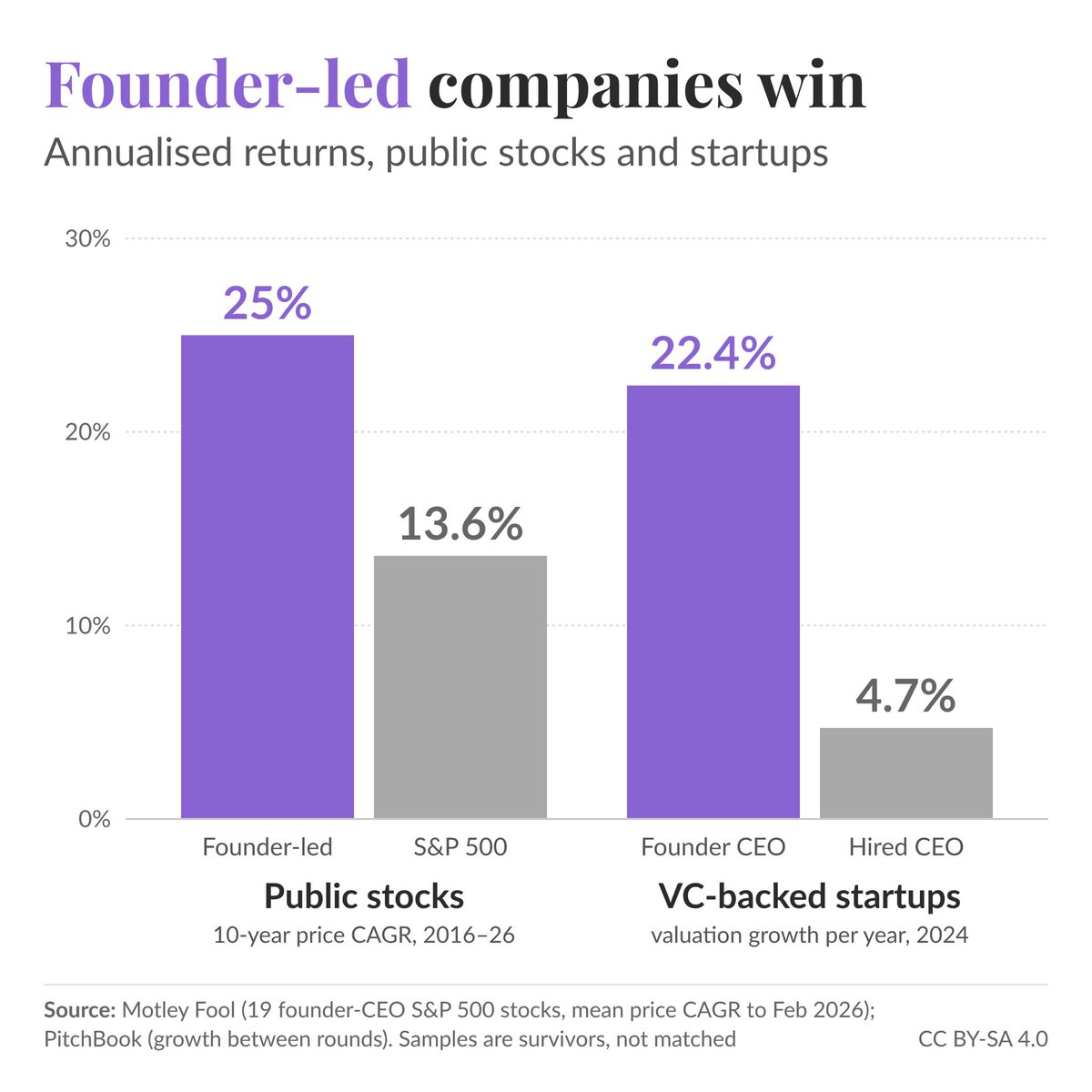
Founders produce higher returns than non-founders. This is an empirical fact.
So: business school curricula should be changed, and good governance should be redefined as founder control and dual-class stock. Shareholders are still protected by easy liquidation and their ability to fund new entrants. After all, you don’t invest in a company based on who’s on the board. That’s largely ceremonial.
The key difference from the 20th century is that it was prohibitively difficult in 1950 to found a manufacturing company, because assembly lines cost so much, the communists controlled much of the world, and even America had 90% marginal tax rates. It was the century of centralization, the individual powerless before the institution.
Today it is no longer prohibitively difficult to found a tech company, because software costs so little, much of the world has turned to free markets, and capital flows at the speed of the Internet. This is the century of decentralization, at least in the West, with the institution falling to the individual.
For example: Anthropic was started just a few years ago and is beating even Google at its own game. If we get many open weights models, their moat will also in turn erode.
So: all 20th century corporate governance was based on the idea that “the company is hard to replace, but its CEO isn’t.” The Harvard MBA is premised on the professional manager. It was expensive to start a new company with all the assembly lines, so make sure it doesn’t fail by making every employee replaceable. Managers were abundant so capital became the scarce asset.
By contrast, the entire 21st century model is based on the idea that “A tech founder is hard to replace, but the company isn’t.” The YCombinator model is premised on the startup founder. It is inexpensive to start a new company with a few lines of code, so make sure it doesn’t fail by having an irreplaceable team. Capital is abundant so founders become the scarce asset.
Agents are the next big distribution channel for products, services, and software.
But how do they decide what to recommend?
@omooretweets and I did a deep dive with @promptingco - and we're sharing takeaways after running 11k+ agent tests 👇 https://t.co/9tPBG9NJvj
Only about 15–20% of companies that raised seed after 2022 reach a Series A within two years.
If you plan as if the A will arrive on schedule:
→ You are planning for the minority outcome.
If you plan as if the A may take longer or not come:
→ You build a company that can survive the more common path.
The majority of seed-stage companies need a business that does not depend on the next round arriving on time.
Introducing @LegalOS (YC W26)
Immigration built for founders and teams. O-1s, H-1Bs and green cards with expert attorney review, filed in as little as 48 hours, and already trusted by 75+ YC companies.
Because even the greatest founders couldn't change the world, without a U.S. visa.
PLG readiness test
Before you build the free tier or “viral loop,” check:
• Time-to-value under 5 minutes
• Users naturally invite others through normal usage
• Free-to-paid ≥5% (freemium) or much higher (trial)
• Product improves (or expands) as more people use it
Miss any of the first two? Fix the product.
Miss the conversion number? Fix activation + packaging.
PLG multiplies a good product. It doesn’t create one
The feature trap most YC-stage startups fall into
Adding features instead of deepening the core.
- Every new feature: dilutes focus.
- Every new feature: adds maintenance cost.
- Every new feature: confuses new users.
The companies with the strongest PMF: do fewer things.
And do those fewer things remarkably well.
Depth before breadth. Always.
PG on early user delight
“You should take extraordinary measures not just to acquire users, but to make them happy.”
Early on you can give every user an experience that’s genuinely extraordinary.
Not good. Extraordinary.
You can’t do that with a million users.
You can with the first 100.
The founders who do it with the first 100 build the products the next 100,000 tell their friends about.