Staying married, a happy household, evidence of the parents working hard, childhood sports and watch all competitions, lots of hugs, reward merit, punish only egregious misbehavior, don't yell, restrict social media, monitor messages through 8th grade, the real expectation is college and academic excellence without pressure from parents, get children reading books early, no pacifiers, respond to needs not wants, babies sleep on their own through the night by 6 months, identify develop and support any talent or aptiude, one sport after age 10 is ok, communicate openly and easily with kids through grade 12, allow mistakes, and leave them alone in college. And then hope.
$MU Earnings may have put the top into semis and memory.
All I heard was:
‘Best earnings ever
'1000% EPS, 80% margins, P/E so low'
Where were these words when @GavinSBaker@citrini were buying them late 2024 and early 2025 when the EPS/Revs hadn't shown up yet.
Cyclical stocks top on the best news and numbers.
The best time to buy cyclical names is when everything looks bad and the outlook is turning around.
The best sales for cyclical stocks are when everything is rosy and the future outlook is worsening.
Long post, but some thoughts on what happened in the market today…
Today was a particularly weird storm of price action because the logic going into the open was as follows:
- $MU crushed, saved the AI trade
- AI stocks should go higher due to MU proving its not cyclical, this should help the broader market get a lift
Instead, what we got right before the open…
- $AAPL announces massive price hikes and effectively uses MU earnings to be like, “See! It’s not us, but if memory gets 86% margins, then we have to raise prices!”
- This happens right after the hottest PCE in 3 years is reported, even with oil (the biggest proponent of inflation the past few months) still coming down
- Microsoft then joins the party and raises prices across all XBOX products, once again citing memory costs
Market then proceeds to take a nasty dip in every sector…except Memory.
I think what is happening here will be studied for a long time. The hyperscalers, the companies that are RESPONSIBLE for $MU and $SNDK being multibaggers, are getting destroyed because…well they can’t buy back stock, they can’t get FCF positive, and they don’t have memory’s pricing power.
In fact, this is what Melius Research came out today and said:
“Why bother owning a hyperscaler who can't buy back stock any time soon? Micron can start buying over $25B/quarter in stock during CY27. Memory will go down as THE BOTTLENECK of ALL BOTTLENECKS for this AI era. MU said that current conditions last after calendar 2027, basically guaranteeing buybacks of epic proportions, especially next calendar year.”
We are at the point where the sell-side is saying that owning the best companies in the world makes no sense when you can own the bottleneck of all bottlenecks.
Here’s the thing: I don’t know if Melius is actually wrong.
My gut tells me that 86% gross margins will not last forever, but as long as the hyperscalers are willing to pay, then the structural logic for market participants comes down to a simple question: why own the companies paying the capex over the companies benefiting from it?
The problem is obvious: if memory inflation continues to be intense, it will affect every part of the market. From automotive to datacenters to PCs. $NVDA gets to have a tax because it’s building very IP-heavy products. Will the market allow something like memory, that is not IP-heavy, to force consumers globally to pay significantly more for the products? Also, do the memory makers even care because as long as they control supply, they can control pricing?
I’d imagine the big tech companies either lower capex to stop paying the cost, keep paying the cost, or try to innovate. They likely won’t lower capex and will most likely continue paying the cost, so there probably are some elements of them trying to focus on innovating in this area…but if there won’t be any menaingful cutoff in capex, the memory story continues.
The market fell today because higher inflation means more of a chance for rate hikes. I mean, NVDA went below 200 as MU hit all time highs. NVDA’s suppliers are more valuable than NVDA’s biggest customers. As a result, it’s creating a type of AI-flation that basically led the market to sell off everything else.
Not sure how this plays out, retail continues to buy the dip and today’s red probably gets bought…especially as earnings continue to grow…but we are in a new paradigm for how this market gives a premium to a stock and if you have pricing power over a component that matters to build AI vs being a companies that actually uses AI, you get a premium.
Very bullish piece on Malaysia by Bloomberg
Malaysia = safe heaven
1. Foreign central banks now own a record 36% of Malaysia's sovereign bonds, from 29.4% a year ago.
2. These bonds returned nearly 12% to dollar investors over the last year.
3. The ringgit has surged over 14% against the dollar since early 2025.
4. Malaysia's status as a net energy exporter protects it from global oil shocks.
5. Local bond yields moved only 15 bps during recent Middle East volatility.
6. The government raised its 2026 growth forecast after the economy beat expectations.
7. The World Bank now views the nation as a regional safe haven.
8. Fuel subsidy costs hit $1.8 billion in April due to regional conflict.
9. The central bank maintained interest rates at 2.75% during its last meeting.
10. Global funds bought $947 million in local notes during the month of April.
Huat ah
Can the S&P 500 compound at 10 percent annualized for another 17 years?
Mostly an arithmetic question, and the arithmetic says probably not. Half of that 17-year run came from things the next 17 won't get for free. Multiple expansion off post-GFC trough valuations added 2 to 3 percentage points a year. Margin expansion from globalization, low labor costs, and the TCJA tax cut added another point. Buybacks compounded on top, funded by historically cheap debt. None of those tailwinds repeat from here.
What you can still get for free: a 1.1 percent dividend yield (a 50-year low driven by buyback substitution) and nominal earnings growth in the mid-single digits. The starting Shiller P/E is near 40, a reading exceeded only at the dot-com peak. From that level the historical record is mean reversion drag, not a tailwind. Forward 10 to 15 year academic estimates cluster around 5 to 7 percent nominal, with the CAPE regression closer to 2 percent real. Repeating 10 percent annualized over the next 17 years has never been delivered from this starting valuation in U.S. equity history.
Practical for my book: I don't size positions against an assumed 10 percent market return. I size against a mid-single-digit index baseline, with alpha coming from holdings where the bottom-up math has to beat that baseline by a meaningful margin, name by name. The chart only repeats if the regime does. Reading the math, not the chart.
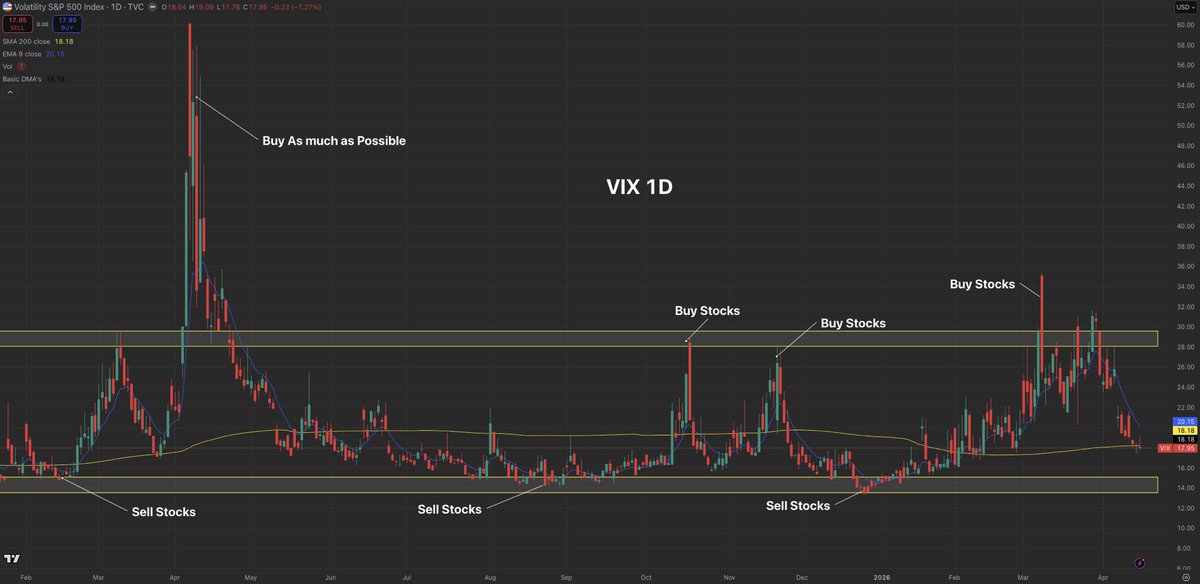
This simple rule has proven success, & guarantees your portfolio to outperform the S&P 500 year after year…
Buy stocks when $VIX is $30.
Buy ever more stocks when $VIX is above $45+
Sell stocks when $VIX hits $14.
& repeat endlessly!!
Macrohard or Digital Optimus is a joint xAI-Tesla project, coming as part of Tesla’s investment agreement with xAI.
Grok is the master conductor/navigator with deep understanding of the world to direct digital Optimus, which is processing and actioning the past 5 secs of real-time computer screen video and keyboard/mouse actions. Grok is like a much more advanced and sophisticated version of turn-by-turn navigation software.
You can think of it as Digital Optimus AI being System 1 (instinctive part of the mind) and Grok being System 2. (thinking part of the mind).
This will run very competitively on the super low cost Tesla AI4 ($650) paired with relatively frugal use of the much more expensive xAI Nvidia hardware. And it will be the only real-time smart AI system. This is a big deal.
In principle, it is capable of emulating the function of entire companies. That is why the program is called MACROHARD, a funny reference to Microsoft.
No other company can yet do this.