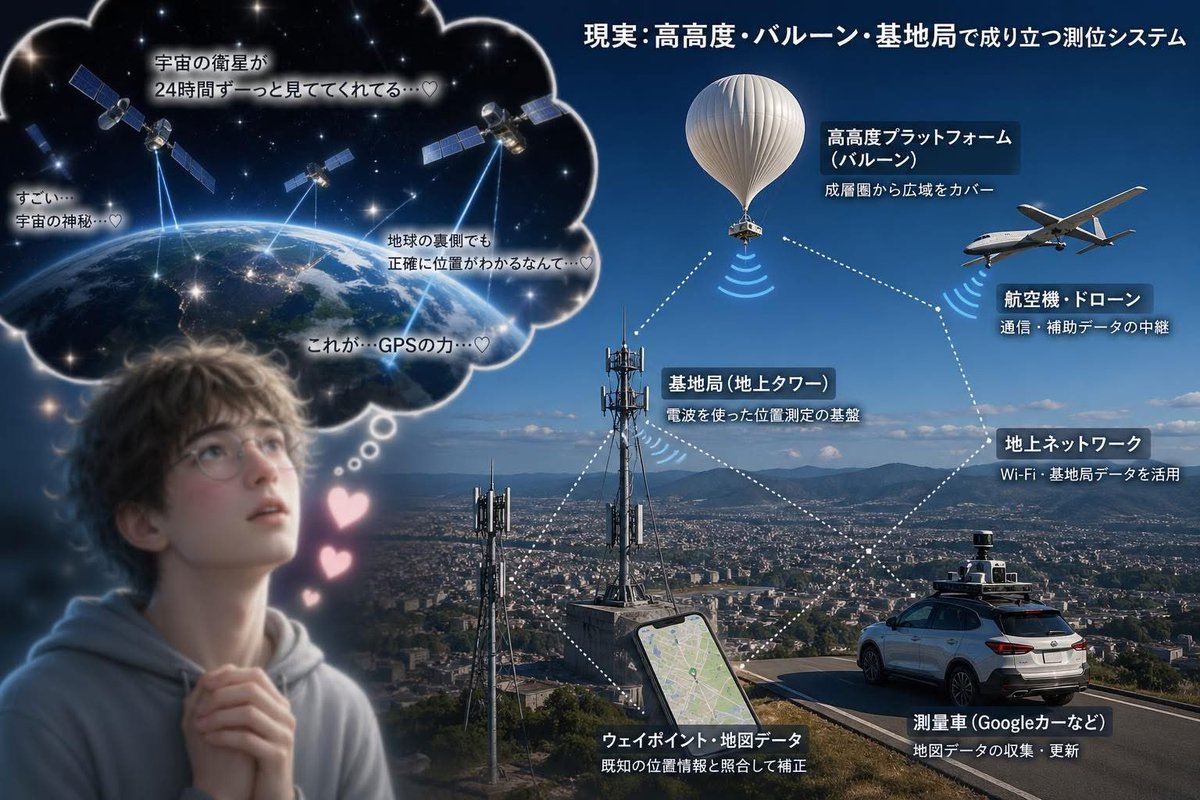
Thanks for sharing. Read through them. First of all, I genuinely respect that your father was involved. The engineering behind timing, atomic clocks, and signal design is impressive — no disagreement there.
What I’m questioning is something more specific: not whether the system works but what exactly is being independently verified
Everything you described — clocks, signal structure, redundancy, MEO vs GEO tradeoffs — all of that fits perfectly within a satellite-based model.
But that’s exactly the point: it’s a designed model with assumptions built in
Let me give an example:
Receivers trust transmitted ephemeris data
Timing is synchronized based on system definitions
Position is solved relative to assumed transmitter locations
None of that, by itself, is a direct measurement of altitude from the user side.
So my question isn’t: “Did your father build a real system?” → clearly yes.
It’s this: Where is the step where a civilian receiver (or observer)
can independently verify that those transmitters are at ~20,000 km,
rather than part of a layered architecture?
Also, small note on the image you shared
That satellite picture is clearly an artist’s concept / rendering, not an in-situ photograph.
Which is fine — engineering often uses concepts.
But it again shows we are mixing design representation with physical verification.
So I’m not dismissing the system at all.
I’m just separating:
“the system works extremely well”
from
“we have independently verified the physical configuration being claimed”
If you can point to that independent verification step, I’m genuinely interested. That’s the only gap I’m focusing on.
Interesting document — thanks for sharing.
However it actually raises a problem for the space satellite as I could not find any mention of
e.g: “20,000 km orbit” or in miles, or medium Earth orbit (MEO)
What it does say is:
7500 nautical miles altitude (experimental target)
Heavy reliance on ground stations
Emphasis on tracking, clock updates, and ephemeris loading from Earth
Also this document describes a system concept under development,
not proof of what the final operational system must be. It is a planning document.
And the key question to the space satellite folks is,
If GPS is space based,why does the system require continuous ground control, tracking, and data injection to begin with. It costs would be enormous while most of the hard work is done on or close to ground. What’s the point.
Also, regarding GPS is passive.
Correct — the receiver is passive.
But the system itself is not.
It depends on:
Ground stations updating clocks
Uploading orbital data
Maintaining synchronization
Right now your argument is:
“There are documents”
“There are signals”
→ therefore satellites at 20,000 km
That’s still a model-based conclusion, not a direct measurement.
If you want to move this forward: Show the step where altitude is measured independently,not assumed and fed into the system.
Otherwise, you’re still trusting the model not verifying it.
Your handheld GPS doesn’t “confirm satellites in space.”It shows you the result of a calculation based on a model.
You’re trusting:
the timestamps
the broadcast “satellite positions”
the assumption those transmitters are ~20,000 km up
All of that is data fed into the system, not something your device independently verifies.
Ask yourself this:
Does your GPS measure a physical object in space
or
Does it just decode signals and solve an equation?
If I send you perfectly timed signals and label them
“Satellite A, B, C”… your device will still compute a location.
That proves the math works.
It doesn’t prove where the transmitters actually are.
You’re not observing satellites.
You’re trusting the screen.
“Conspiracy smasher,” but you’re treating your GPS screen like an authority you never question.