There has been a lot of discussion about the sharp closing moves since the new Closing Auction Session went live.
CAS itself is not a bad idea. Most large global markets have some form of closing auction. A large amount of institutional activity, especially from passive funds and other benchmark-tracking investors, happens near the close. Instead of the closing price being determined based on the average traded price during the final 30 minutes, CAS brings these orders together in an auction to discover one closing price.
The goal of CAS is to enable better price discovery and make it easier to execute large orders without moving prices abruptly. But the price dislocations we have seen over the last few days highlight some of the structural problems that are specific to the Indian markets.
Closing auctions work well when there is deep liquidity and a large and diverse ecosystem of market participants, including market makers and arbitrageurs. Whenever prices diverge between the cash market, futures, ETFs, or different exchanges, participants step in and arbitrage the differences away.
This ability to arbitrage is much more limited in India.
For one, it is impossible to express a short view in the cash market. We have a securities lending and borrowing mechanism, but it isn’t deep or easy enough to use. Unless borrowing stocks and shorting them becomes easy, there is bound to be structural upward pressure in the markets.
Then there is the difference in the cost of trading an option versus a futures contract. In April 2026, STT on futures was increased to 0.05% of the entire contract value, while STT on options is charged on the premium. So even though the STT rate on options is higher, trading futures is more expensive.
Once you add STT, exchange charges, spreads, and impact costs, the trading opportunity has to be quite attractive before a futures arbitrage trade is worth doing. The same directional view can often be expressed more cheaply through options. This leads to traders preferring options over futures.
India has over 13 crore registered investors, but only about 20–30 lakh traders trade actively on any given day. That’s it. We don’t have a large enough committed ecosystem providing two-sided liquidity across the cash market, futures, ETFs, and closing auctions.
CAS is not the reason for these structural limitations, but it makes them more apparent. The timing of its rollout is also unfortunate, because the RBI’s new norms on capital-market exposure, which limit banks’ exposure to capital-market activities, are going live at the same time.
When one instrument is more attractive than another, or when participants cannot express both bullish and bearish views easily, distortions are inevitable.
There might be tweaks required in how CAS itself works. But the larger issue of our markets being shallow is a complicated problem to solve. It requires building an ecosystem that encourages all kinds of traders and investors, with different time horizons, to participate easily.
Making shorting and securities lending easier, reducing distortions between instruments, and encouraging genuine market-making would be a good place to start.
"You aren't competing with AI; you're competing with the people who know how to use it." Empower yourself and your business to lead in the AI era with our future-ready training and practical consulting solutions.
🌐 Explore our programs: https://t.co/wFfUdymTdE
#AITraining
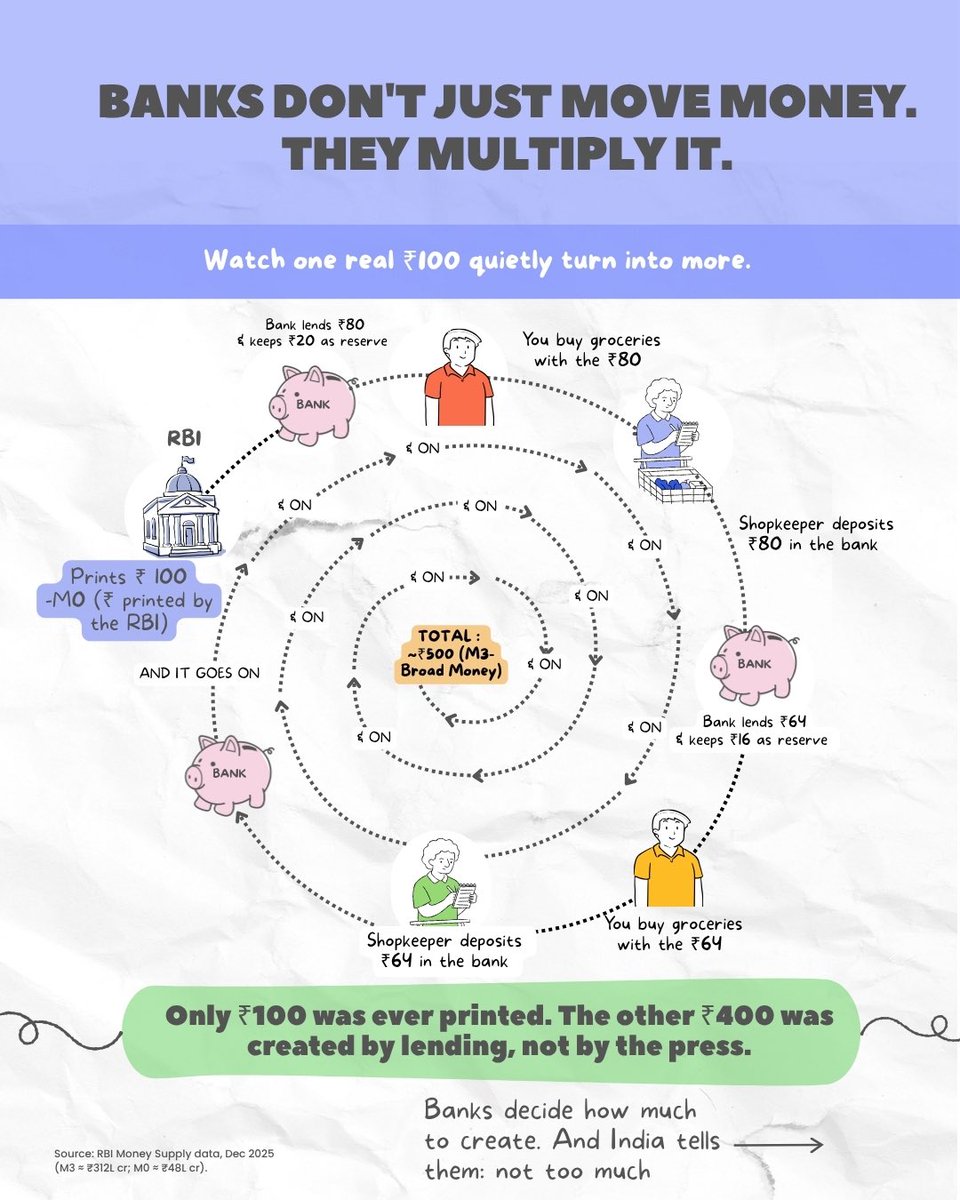
Did you know your ₹100 in the bank isn’t sitting in a vault?
It’s lent, spent, and re-deposited within hours. One printed ₹100 turns into ₹500 across the economy. Banks decide how much.
India runs this slower than the rest of the world. 50% credit-to-GDP against a global 148%. On purpose.
The instinct was built in 1969 and never left. It’s the shield that kept India out of 2008. It’s also the ceiling.
You can’t fully have one without the other..
BREAKING: Iran has declared that ships cannot cross the Strait of Hormuz without its permission, setting the stage for future tolling arrangements by saying it could introduce “insurance fees," per Bloomberg.
Details include:
1. All vessels that transit the Strait of Hormuz will have to secure a mandatory insurance policy
2. This policy is currently free for the next 60 days but could involve charges in the future
3. Iran also said ships must follow its prescribed route and that alternatives are prohibited
The MoU signed with the US only says that transit through the Strait of Hormuz would be free for the duration of its 60 day term.
It appears Iran is preparing for long-term control of Hormuz.
Food, nuclear, pharma, data centres.
India’s four biggest growth bets are all water-intensive, being built in states that are already running out of it. The resource isn’t priced. The metering is just starting.
Somewhere in that gap is a company worth building…
In INR you lose 12.5% in debasement every year by staying in Cash.. yet people are happy to get 5% on thier money. That money is about $200B in Indian banks.
India's future in EVs, batteries, solar energy, green hydrogen and energy storage will not be decided only by demand, capital or policy. It will also be decided by who controls the underlying supply chains.
Today, a significant part of the global ecosystem for critical minerals, battery materials, refining, manufacturing equipment and process know how is concentrated in China.
This is not a criticism. It is a recognition of decades of planning, investment and execution that have made China the dominant player in several strategic industries.
For India, the lesson is clear. Strategic industries cannot depend indefinitely on external supply chains. We must accelerate domestic capabilities in mining, refining, advanced materials, manufacturing equipment, technology and R&D with urgency and consistency.
In the 21st century, strategic influence is exercised not only at borders but also through technology, supply chains, critical minerals and manufacturing ecosystems.
Excessive dependence in any of these areas can become a strategic vulnerability.
Energy security, economic security and national security are increasingly becoming one and the same.
The goal is not isolation. The goal is resilience.
India does not need to replace the world. But India must build sufficient domestic capability so that its growth story is never hostage to external dependencies.
The sooner we do it, the stronger India will be. 🇮🇳
When millions of educated youngsters remain unemployed, perhaps the issue is not their attitude alone.
Unemployment is a painful reality for millions of sincere young Indians. They need opportunities, skills, direction and encouragement , not labels that hurt their dignity.
More worrying is that several reports suggest educated youth unemployment is far higher than among the uneducated, reflecting a deeper mismatch between education quality, industry needs, policy execution and job creation.
Instead of blaming frustrated youngsters, perhaps all stakeholders -governments, industry, academia and society - must introspect more deeply on why so many capable young Indians still struggle to find meaningful opportunities.
India’s youth should become the country’s greatest strength and demographic dividend - not its biggest frustration or disappointment. ✌️
Simply ❤️ this, nails perfectly🎯
Time management is just another word for 'focus'.
Zero-in on your goals, that's what separates winners from the ones who are aimless & distracted. 💯
Le Grand Fromage piece in Business Standard today: The Algebra of the Calculus of the War.
Don't fall for the crocodile tears. US has Venezuela and needs higher Oil prices to boost production from old Infra.
So do ME, Russia, Iran.
ROW can go €¥$¢ itself
The new GDP revision admits what two-wheeler sales, small-car demand, railway traffic and a host of other indicators had been saying for years: the consumption story was weaker than advertised.
✍️@kaul_vivek
https://t.co/bfTfsWkDyW
Yesterday Goldman Sachs said India will grow at 6.5%.
Today Fitch Ratings says 7.5%.
Even the world’s smartest institutions are still trying to understand India…
So we investors shouldn’t expect to get it right every time. 🇮🇳🙂✌️