Head Google Research. VP Google. Gödel Prize. Kanellakis Award. working on the magic cycle of research; advancing AI as an amplifier of human ingenuity
A pleasure to launch ✨ The Google Research Podcast series, hosted by @sineadbovell.
This series will feature scientists and researchers discussing breakthroughs we are working on: from foundational machine learning, algorithms, and computing systems to AI for societal impact in health, education and planetary intelligence; to advancements in generative AI to quantum computing, and accelerating scientific discovery.
I hope you enjoy watching our first episode.
Our latest research pushes the frontiers of interactive learning: allows educators to create custom, interactive, and guided educational simulations. Learning interactives are tailored to the teacher’s objectives and curriculum, and are generated dynamically, leveraging a novel application of generative UI that we’ve optimized for learning.
https://t.co/08qgVmUCg8
Great pleasure discussing with Turing Award laureate Shafi Goldwasser how AI is accelerating scientific discovery and is helping crack previously unsolvable problems.
See our discussion on @WSJ:
https://t.co/kmQX7ZTTLA
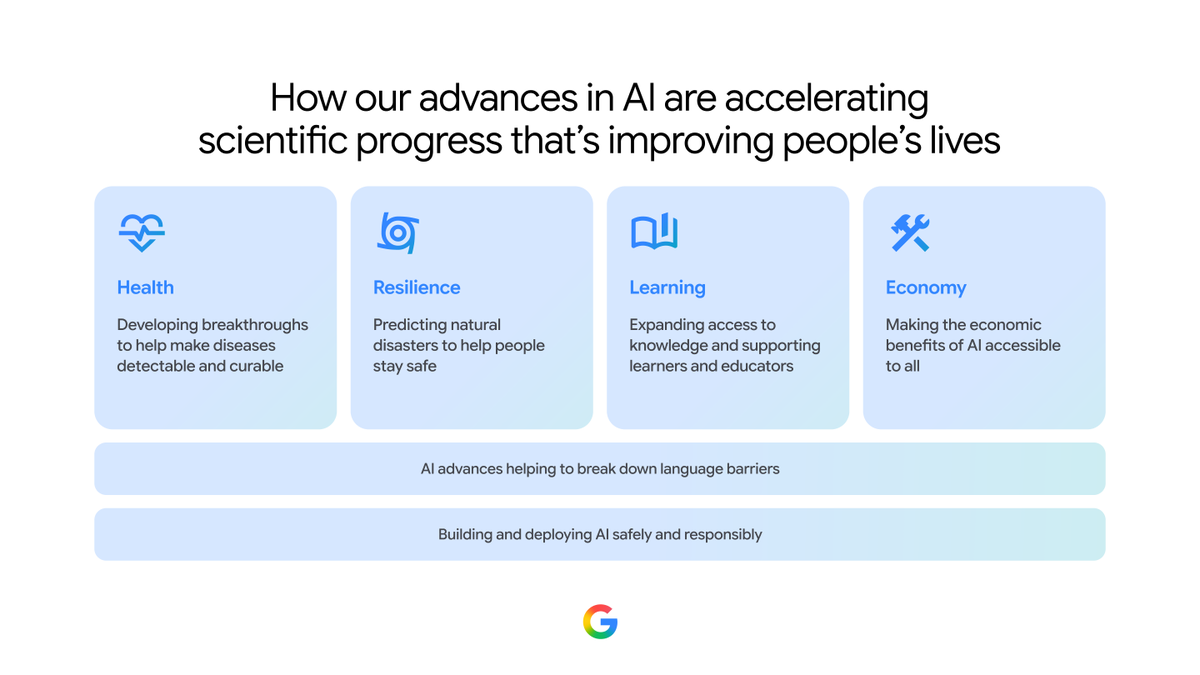
Today we have set out how we’re building AI to accelerate science and improve people’s lives. Just some examples in the last week or so:
- Mapped all 9B possible single letter genetic changes across the human genome with AlphaGenome Atlas and made it openly available to researchers.
- Billions of decisions depend on weather predictions so we introduced WeatherNext 3, our most accurate and capable global weather AI model to date.
- We published AI & Economy ATLAS, a comprehensive open-access look at how people are using AI globally.
- AI has enabled extraordinary advances in language translation. Today our services are available in nearly 300 languages, spoken by 7B people
We’re focusing our efforts on four key areas: health, natural disaster and weather resilience, learning, and economic opportunity. https://t.co/DDKcUTYj54
We'll continue to work closely with local communities to build technology that helps more people communicate, participate, and be understood on their own terms.
Read the overview by James Manyika: https://t.co/cyounE3Ds7
Google’s work in language research spans over 20 years, beginning in 2006 with Google Translate. Today, these technologies power interactions in over 300 languages, reaching more than 7 billion people—86% of the global population.
However, translation and text processing alone are insufficient; systems must reflect how people communicate in the real world across diverse cultural nuances.
Highlights on the latest projects in AI language research👇🧵
🌐 On-device efficiency: Lightweight open models like TranslateGemma operate on-device without cloud connectivity.
📱 Low-resource connectivity: Voice AI assistants like AVA deliver Gemini capabilities to standard feature phones.
🧰 Open science: Language Explorer maps LinguaMeta, an open repository visualising data across more than 7,000 languages.
♿ Accessibility: Sign Language-to-Text (SL2T) expands expression for non-verbal communities.
Language Explorer site: https://t.co/wJEudUSJyB
TranslateGemma: https://t.co/1lp540ltwR
Prospective evidence for conversational medical AI is hard, but non-negotiable.
Our team together with collaborators just published a new viewpoint in @NatureMedicine, sharing critical lessons learned from moving our research with AMIE (Articulate Medical Intelligence Explorer) beyond in-silico simulations and patient-actor studies into real-world prospective clinical trials.
More in Nature Medicine: https://t.co/fKx7v23sEg
Full-text link: https://t.co/WyMQJIaT0z
Our team is at the European Conference on Computer Vision (ECCV 2026), hosted in Malmö, Sweden. A lot of interesting innovation - more about the sessions and papers at the conference: https://t.co/oU4J6yHiiP #ECCV2026
Welcome to #ECCV2026! 🌟 Google is proud to be a Diamond Sponsor at @eccvconf in Malmö, Sweden (Sept 10–12). Visit us at booth #2 to explore our latest research, connect with our team, and see live demos! Learn more: https://t.co/Nc9cY2L2ic #GoogleResearch
More updates on our ✈️ Contrails project: We are expanding our partnership with Cathay Pacific—our first commercial airline partner in Asia—to test and scale our AI-powered contrail mitigation technology across ultra-long-haul and transpacific routes👇🧵
➡️ Contrail mitigation represents one of the most immediately scalable and cost-effective climate solutions available today, working with existing aircraft without requiring new propulsion infrastructure.
➡️ Our system integrates AI predictions, satellite imagery, and weather intelligence to identify cold, humid atmospheric zones where warming contrails form.
➡️ Through Cathay Pacific's proprietary Electronic Flight Folder (EFF) connected via in-flight Wi-Fi, pilots receive dynamic forecasts directly in the cockpit to execute minor, safe altitude adjustments—much like navigating around turbulence.
➡️ Building on our earlier trials, an initial operational phase of over 80 flights achieved an estimated 40% reduction in contrail warming impact, with interventions on the Hong Kong–Singapore corridor alone accounting for over 50% of total emissions reductions.
We are now scaling this into a second phase of trials with Cathay Pacific alongside https://t.co/kCTXhOBg7X to evaluate operational feasibility across diverse operating environments.
Understanding the genome is like understanding the language of life🧬. New AlphaGenome Atlas by
@GoogleDeepMind contains predictions for the effects of 9 billion single-nucleotide variants (every single-letter change possible) in the human genome.
Looking forward to seeing how researchers around the world will use it for understanding unsolved rare diseases, mapping rare variants associated with protein levels and complex traits and in general for accelerating genomics discovery!
Read more below from my colleague @pushmeet.
1/5 🧬 Today, our team @GoogleDeepMind is taking another step on our mission of deciphering the genome. We are releasing AlphaGenome Atlas, a massive (petabyte-scale) resource containing AlphaGenome predictions for every possible single-letter DNA change in the human genome — 9 billion in total.
https://t.co/Lf9DWRfWCu
A significant connectomics milestone 🧠 Our team and collaborators have released a complete wiring diagram of the male fruit fly’s brain and central nervous system, published in Cell. Featuring over 166,000 neurons and 125 million synaptic connections, this is the largest brain map to date.
Congrats to the teams at @GoogleResearch and at @HHMIJanelia!
Read more here: https://t.co/1thfGN3tCe
Announcement blog: https://t.co/RzVrWsRSjw
Build with WeatherNext 3: https://t.co/v091Oc3xI6
Learn more about Google Earth AI for planetary intelligence: https://t.co/6T2CNRhtmo
Today @GoogleDeepMind and @GoogleResearch are introducing WeatherNext 3 ✨ Our most advanced and accurate AI weather model now learns directly from real-time observations, enabling it to provide timely and more localized predictions for the weather events that impact people the most.
WeatherNext 3 now includes real-time satellite data, hourly refreshes, higher resolution, precise precipitation forecasting, and clean energy variables.
Some of the key aspects of this release in 🧵👇
→ The model learns from global geostationary satellite data and thus bypasses the typical six-hour data lag of traditional numerical weather prediction models. This allows it to generate a new forecast every hour, each one grounded in the most recent satellite observations available, at up to 5-kilometer resolution.
This is particularly important for critical weather that develops fast.
→ Precipitation accuracy improvement: we train our model on two exceptionally high-quality sources of precipitation data: NASA’s satellite-based Integrated Multi-satellite Retrievals for GPM (IMERG) and our own global precipitation reanalysis based on satellite radar.
As a result, WeatherNext 3 achieves a Continuous Ranked Probability Score (CRPS) improvement of up to 60% against IMERG.
→ Higher Resolution & Frequency: WeatherNext 3 generates hourly forecasts at multiple spatial resolutions, providing a global picture roughly five times sharper than its predecessor.
→ Clean Energy Variables: The model introduces specific forecasts for 100-meter wind speeds, cloud cover, and sun radiation to assist global clean energy planning and grid operations.