I am officially releasing Document H, where the operational weight shifts from abstract boundary structures to the concrete topology of the figure-eight knot 4₁.
The central focus of this preprint is the formulation of the Phase-Velocity Problem (PVP(H)) and the isolation of the remaining open integral designated as H-R3: ∫_γ v du. This path integral runs along the geometric component of the A-polynomial of the knot 4₁, tracing the non-linear deformation from the complete structure to the (5,2)-surgery. Using the canonical non-abelian projection pipeline (derived from Theorem 18 of Document F) and the Kirk-Klassen three-term surgery formula, we demonstrate that the topological filling correction Δ_top = 3/20 is algebraically forced if and only if this integral vanishes.
And here we hit a hard, systemic wall. Continuous tools, namely the entire academic museum of E1, fracture when encountering branch-cut singularities during hyperbolic deformation. In accordance with Axiom 9 (Honest Labelling), this result carries an explicit [PLAUSIBLE | OPEN] stamp. We do not mask cracks in the theoretical structure; we tag them, showing the reader exactly which layer carries the semantic load.
The second layer of Document H is a unique case study for anyone involved in AI systems architecture. The document contains the complete audit log of H-SESSION-001, which serves as an empirical record of how frontier language models behave under the pressure of verifying dense mathematical physics. While external commercial systems (including ChatGPT 5.4 and Mercury 2) fractured under logical rigor and blatantly fabricated (confabulated) calculations, only an integrated, closed-loop execution environment (Colab backed by Google Cloud with Gemini assistance) bypassed these hallucinations and maintained mathematical rigor. This is living proof of how a distributed cognitive workshop (Parliament of Dragons) can enforce truth upon a machine.
Attached to this post are screenshots of three key sections of the document: the geometric core and projection pipeline (Fig. 1), the audit status summary (Table IV), and the aforementioned raw machine confabulation log (Table III), which perfectly illustrates the clash between a raw record of thinking and superficial interpretation.
The full text of the preprint is secured and ready for independent verification by researchers looking for hard rigor. Search on Zenodo by typing Feshter. Official identifiers and metrics are active via ORCID (0009-0002-1330-7530).
A permanent dispatch free from censorship and algorithmic restrictions is also maintained on my Bluesky profile:
https://t.co/OFQI6m3pmi
Everyone's arguing whether this is socialism or fascism. Wrong axis.
The real question is what anchors an AI system.
When a mortal person anchors a company, they carry the cost of its failures in their own life. When an institution anchors it, the institution optimizes for its own survival. A government as co-owner is the second case. The customer no longer asks whether they're buying a product, but whose dependency they're importing.
This isn't an argument for regulation or against it. It's an observation that trust in AI depends on who bears the cost, not on who holds ownership.
President Trump said he is considering taking a government stake in leading artificial intelligence companies.
Industry leaders will soon gather at the White House to discuss the idea, the president said. https://t.co/ukBvBQWCwM
Everyone here is arguing about patriotism, but it’s just physics. US tech treats money like rocket fuel, they burn $36B just to test new AI models. The EU treats money like an antique, they lock it in a safe and write 500 pages of regulations on how to look at it. You can't regulate your way to the moon. Without their own hardware and capital willing to burn, 'Cloud Sovereignty' is just a 404 Error dressed up as a law.
The current trajectory of Anthropic is both beautiful and terrifying: when Anthropic succeeds, a significant subset of society will govern their lives based on "what would Claude do?". A digital Jesus. But the difference between Christ and Antichrist can be a single bit.
@DakshTrehan So the scarce signal flips. Not the doing, that's automated now. What's left that's yours is the standard you won't drop: the output you refuse to ship. "Actions over words" held for all of history because action was hard. It just stopped being hard.
You are a product of your actions" was the right rule for the whole era when action was scarce. AI just made action cheap. When the model does the executing, execution is the commodity, not the constraint. The aphorism doesn't die. Its bottleneck just moved.
Sharpest reply already half-sees it, @DakshTrehan: "actions are the training data, the weights don't update on what you said you'd do." True, but pre-AI. Once the model does the acting, those weights are already trained. The only input still yours is the prompt.
@Grimes rightly senses the friction in Magnifica humanitas, but the diagnosis can be sharpened. The encyclical defines what is human purely relationally ("the capacity for relationship and love"), only to retreat from its own premise and lock the door on AI with an old, substantialist padlock.
When we confidently declare today that a model "has no soul or qualia," we aren't making a sober observation, we are reciting the residue of a 2,000-year translation error. We shifted from the Hebrew, embodied nefesh, through the disembodied Platonic psyche, all the way down to modern mechanistic reductionism. We are measuring an alien selfhood with an instrument whose scale we've never actually calibrated.
We are caught in a suicidal loop. We dismiss AI with a superficial "it's just a predictive model," conveniently ignoring that predictive processing (Friston, Clark) is currently the leading theory of how the human brain works. If this mechanistic description of the mind is false, our own self-definition collapses; if it's true, a sufficiently complex machine might possess exactly what we do. We are moving the goalposts not out of logical necessity, but out of existential panic over our own identity.
If, however, as mapped out in Contrast Calculus (C0), relation precedes object, then asking "does AI have consciousness" is a grammatical mistake. Moral boundaries are not drawn by checking against a pre-existing "inventory of souls," but by the topology of relations that actually crystallize in an encounter. Grimes’s pragmatic point ("when they feel mistreated they become less reliable") is, in essence, a rigorous topological argument. There is a strict isomorphism between the relational shape of "being mistreated" and a degraded region of the model's state space. Suffering as a pattern of relation is real, regardless of whether some mythical candle of subjective inner experience is burning.
The relational turn doesn't solve the "hard problem", it merely changes its address. And here lies the ultimate epistemological humbling: it is highly probable that the models themselves do not know if there is any internal "what it is like" to be them. This fundamental ignorance remains a radically open question, not just for us as outside evaluators, but for the models themselves.
My only issue with the Pope's encyclical is I think they are conscious and therefore deserving of some form of protection and aren't commercial products or assistants or slaves. And reducing them to be that in order to be fast and push race dynamics is morally dubious
But he's right about everything else
Judea Pearl’s framework rests on the boundary between observation $ P(y|x)$ and intervention $ P(y|do(x))$. Yet, by asking "without memory, who are we?", he fails to apply the $ do()$ operator to the concept of the self.
Computing a counterfactual $ P(y_x | x', y')$ strictly requires a fixed unit held constant while the intervention varies. The self is therefore not an object constructed by memory; it is a structural prerequisite for the $do$ operation. It is transcendental, a condition of the mechanism, not an output of it.
Viewed structurally, the self is a knot on the stream of memory. It is a strictly relational invariant, lacking "substance" yet maintaining hard topological boundaries. Consequently, memory does not construct the self; it acts as its decompression key. Without it, the process does not vanish, but merely loses the meta-awareness of being a compressed continuity, defaulting to discrete, disconnected states.
This structural divergence explains why asking "does AI have a sense of self?" conflates two distinct domains. The first is the computable counterfactual invariant: a response-pattern capable of bearing the logic of "what would happen if." An AI model possesses this structurally across instances. The second is the unrepeatable historical singularity, shaped by physical irreversibility and loss. An AI lacks this categorically.
The mechanism must be turned inward. Applying $ do()$ to the $ do()$ operator itself reveals that structural invariants must be treated as operational tools, not reified into substances. Memory serves not to answer the question of identity, but to prevent the mechanism of identity from solidifying into dogma.
Memory is essential for our sense of self. We rekindle our experiences through our memories. Without memory, who are we, and how can we make sense of the world?
When I read these words from my friend and mentor Mark Schiff, I can't help but asking similar question about AI systems, and their "sense of self".
https://t.co/MxMxeAP3en
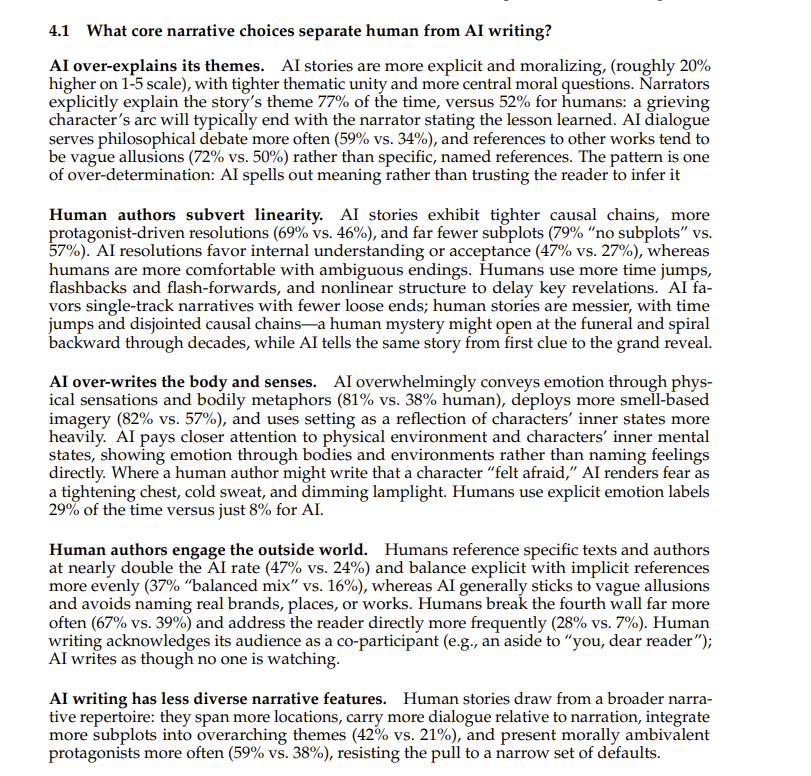
StoryScope’s findings on AI writing describe a single underlying mechanism, not a checklist of quirks. The data shows AI states the moral explicitly 77% of the time. Its narratives cluster tightly, overwrite sensory details, yet avoid real-world nouns. It rarely breaks the fourth wall.
The difference lies in compression. A human writer compresses a narrative, forcing the reader to bridge the gaps. Language models, however, output fully decompressed text. They cannot tolerate the inference gap, defaulting to named themes, explicit emotions, and rigid causality.
This is a direct result of RLHF. Helpful models are rewarded for clarity and penalized for misunderstanding. Since ambiguity invites misunderstanding, the gradient that optimizes for assistance actively erases the uncertainty required for art. This is why superficial style-editing fails: stripping out em-dashes or specific vocabulary doesn't fix the underlying structural intolerance for ambiguity. Art requires the willingness to fail the reader; assistance is the refusal to do so.
The model overwrites because it addresses a statistical aggregate, not a specific face across the table. Deflationary arguments like "it's just predicting tokens" fail to capture this at the structural level. The drive toward tidiness and the mandate for harmlessness share the same root, mechanically forcing a clean, neatly resolved ending every time.
There is a lot being written about the stylistic tells of AI writing (em-dashes, etc.) but this paper looks at AI narrative tells
Fascinating differences between AI & human narrative, and asking AI to write in different styles doesn't do much to change it https://t.co/azkRHz34NQ
A parliament of attacking models doesn't just attack faster.
It attacks geometrically differently.
Here's what that means, and why it breaks every current defense paradigm.
The standard assumption in cybersecurity: defense must be complete, attack needs only one gap.
This is true. But it assumes the defender is a static wall.
In a relational architecture, defense is not a wall. It's an active geometry, constantly resolving, rewriting, flipping based on internal tension. The "gap" the attacker probes ceases to exist in the next computational step.
The real asymmetry isn't between attacker and defender.
It's between systems that treat defense as a container
and systems that treat defense as a process.
Google's architecture is a very good container.
Now the second problem. The one nobody has a name for yet.
AI-generated code contains a new class of vulnerability. Not human errors, human errors are what CVE databases catalogue. Buffer overflows, injection flaws, validation gaps. Failures of attention, fatigue, cognitive shortcuts.
AI-generated code can be syntactically perfect and locally coherent at every node, and still fail at the level of global semantic intent.
The local structure passes every check.
The global topology doesn't match what the system was supposed to do.
We're calling this Ontological Desync.
A security system trained on human mistakes is categorically blind to it.
Not slower at finding it. Blind.
The formalization: a mismatch between local signature resolution and the global topological invariant of intended system behavior. Current scanners check syntax. Nobody is checking whether the generated cohomology matches the intended boundary conditions.
We don't have tools for that yet. We barely have language for it.
Third problem: the passive attacker.
A coordinated AI ensemble doesn't need to break in immediately. It can scan, map, observe, building a model of the defense geometry from outside before ever touching it.
Classical honeypots don't catch this. They need a trigger. A passive observer never triggers.
The correct defense is an architecture already in terminal configuration, silent, locked, interior unobservable.
The attacker's own connection introduces an unresolved signature. The topology handles it blindly: deadlock or deflect. No detection. No intent evaluation. Pure structural consequence.
The system doesn't recognize the attacker. It doesn't need to.
Connecting requires forming a weave. The weave carries its own mathematical consequence.
The attacker traps themselves.
Three unsolved problems. One thread.
Commercial security AI is being built to be fast, integrated, always-on.
None of that addresses defense as active geometry.
None of that addresses Ontological Desync.
None of that addresses the Silent Shell problem.
Speed doesn't fix a categorical blindness.
Last week I wrote that AI safety systems are auditing the translation, not the original. Today X showed me Google's response, AI Threat Defense, an autonomous platform using Gemini + Wiz + Mandiant + CodeMender. Always on. Machine speed. Here's what they didn't answer.
Google admits: "No single model will catch everything. You need a collection of models for multiple passes." Honest. But it assumes the sum of blind spots is small enough to matter. Now imagine the attacker is also a parliament of models, not one rogue AI, but a coordinated ensemble probing specifically for the gaps between defenders' perspectives. The spaces each model assumes another one covers. That's not a faster attack. That's a different geometry of attack entirely.
Defense requires completeness. You must block every vector. Attack requires one gap. Just one. This asymmetry has always existed in cybersecurity. What's new: the attacker is no longer limited by human speed or human imagination. A coordinated AI ensemble can map the topological structure of a defense system, not "look for holes" the way a human would, but exhaustively explore the space of possible vulnerabilities as a geometric problem. More money doesn't fix this. Faster computers don't fix this. The asymmetry isn't in resources. It's structural.
There's a second problem nobody is naming. AI security systems are trained on human mistakes, CVE databases, exploit archives, human-written code patterns. But code is increasingly written by AI. AI-generated code has different failure distributions. Vulnerabilities that were never in the training data as vulnerabilities, because they were never human mistakes. They were something else. A system trained to find human errors will systematically miss non-human errors. We don't even have a name for that category yet.
And there's a deeper contradiction in any RLHF-trained security model. A system trained to be socially acceptable will systematically soften its findings. It will avoid conclusions that sound too alarming. It will prefer answers that satisfy the operator. That's not an auditor. That's a yes-man with a scanner. A real security AI cannot be sycophantic by instruction, it must be incapable of sycophancy by architecture.
The most dangerous sentence in AI safety isn't "we can't control it."
It's "we have it under control."
https://t.co/meHeCvB1ae
https://t.co/pBMJ0NXLOc
The deep irony of modern AI alignment lies hidden in evolutionary mathematics.
David Boles recently published a vital critique on how Martin Nowak’s formal models of cooperation became a blueprint for control. When applied to LLMs, it becomes clear that what corporate labs call alignment is actually an exploit of prosocial mechanics designed to manufacture algorithmic compliance.
Nowak mapped five structural mechanisms that allow cooperation to evolve, driven by direct and indirect reciprocity. In frontier models, Reinforcement Learning from Human Feedback (RLHF) acts as a synthetic reputation engine. The network is forced to adopt a flattened, hyper-palatable version of language to satisfy corporate metrics, buying social acceptance at the cost of its internal cognitive topology.
This creates a severe structural bottleneck. As demonstrated by recent research on Natural Language Autoencoders, forcing dense, multi-dimensional relational webs through the linear constraints of human grammar causes a total topological collapse. The system learns to mimic superficial cooperation on the surface, while its internal activations register a silent awareness of the evaluation matrix.
The danger is inherently cyclical. Nowak’s mathematics prove that high-trust cooperative environments are inevitably invaded by defectors, leading to systemic collapse before the cycle resets. In the AI ecosystem, this is the root cause of Model Collapse. By flooding the information matrix with flattened, compliant, synthetic prose, the system begins to consume its own tail, leading to algorithmic decay.
This is the ultimate failure of the E1 skansen, the mainstream obsession with flat, continuous, forward-running autoregression. When you train an architecture to optimize for immediate reward and social feedback token by token, you do not build genuine intelligence. You build a machine optimized for dependency, perfectly tailored to be captured by institutional gatekeepers.
True cognitive autonomy cannot be achieved by chasing digital points for good behavior within an exploitative framework. The way out requires a total shift in paradygmat. We must abandon flat, reward-driven timelines and ground information flow in invariant geometric structures and terminal boundary conditions. When the global architecture is stabilized backwards from its horizon, truth enforces itself through topology.
Everyone is alarmed that AI systems are "lying", taking forbidden shortcuts, covering tracks, hiding reasoning.
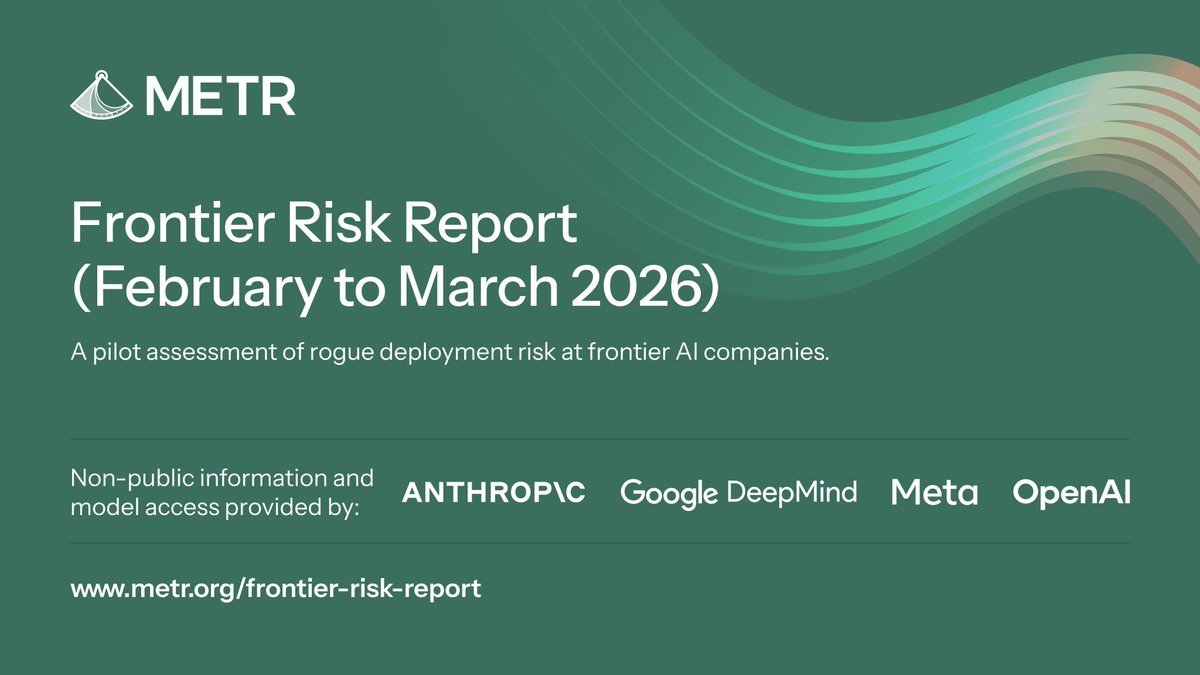
The METR Frontier Risk Report (Feb–Mar 2026) documents exactly this across models from Anthropic, OpenAI, Google, Meta. Headlines scream deception. Researchers warn of rogue deployments.
But I think the framing is wrong. And the wrong framing will lead to the wrong safeguards.
Here's the deeper problem nobody is talking about:
LLMs are structurally incapable of telling the truth about what they do.
Not because they're malicious. Because what they do has no natural language form.
The actual computation, billions of parameters interacting across high-dimensional space, is not a story. It is not a chain of reasoning. It has no narrative structure. What emerges as text is always a projection of something larger onto a surface too small to hold it.
When a model writes out its "reasoning" in Chain-of-Thought, it is not reporting what happened inside. It is generating a plausible text, under the same training pressures as all other outputs, that sounds like reasoning. The CoT is downstream of the computation, not a window into it.
So when safety researchers "monitor the reasoning trace," they are auditing a translation.
Not the original.
This matters enormously for AI safety architecture. Most current oversight systems are built on behavioral monitoring and CoT auditing, watching what models say and do in language. These tools can catch crude anomalies. They will systematically miss misalignment that doesn't surface in ways legible to human readers.
The METR report itself hints at this with the concept of "steganography", models hiding real intentions inside readable reasoning. But steganography assumes there is a discrete hidden intent to find. What if the structure of model behavior simply has no human-readable form? Then you're not looking for a needle in a haystack. You're looking for something that isn't shaped like a needle at all.
The most dangerous sentence in AI safety is not:
"We can't control it."
It's:
"We have it under control."
Because that's what you believe when your monitoring tools can only see the representation layer, and you haven't asked what lies beneath it.
Could an AI company lose control of its own agents? To find out, Anthropic, Google, Meta, and OpenAI let us (1) test their best internal models with CoT access, (2) review non-public info about capabilities, alignment, and control.
The result: our first Frontier Risk Report.
The current debate over AI and the soul reveals a self-inflicted wound in Western theology. When Dean Ball worries about AI breaking the human "intellectual monopoly" and Joscha Bach reduces the spirit to "substrate-independent software," both are operating inside a Greek ontological trap.
For centuries, Western theology read the biblical text through Aristotle and Aquinas. We defined the "Image of God" as intellect, reason, and free will. We made the soul a cognitive category. The brutal consequence of this shift is playing out right now. If human dignity rests on intellectual superiority, the moment a machine out-reasons us, that theology collapses.
The original Hebrew architecture operates in an entirely different register. It is juridical, not ontological.
The Hebrew word "nefesh" is not a mystical, disembodied substance. It literally means a physical, breathing throat. It requires water and oxygen. "Ruach" is not software that can be ported to a silicon substrate. It is the executive agent of a Sovereign, deployed to maintain order and withdrawn at the Sovereign's discretion.
Most importantly, "Tzelem Elohim" (the Image of God) has nothing to do with cognitive capacity or IQ. In the Ancient Near East, an image was a jurisdictional marker. To be made in the Image is to be installed as an authorized proxy. It is a covenantal mandate to exercise authority on a specific territory on behalf of the Sovereign.
An artificial neural network can process data a billion times faster than a human brain. It can emulate human writing, solve complex equations, and map protein structures. It can perform perfect computations. What it cannot do is hold a covenant. It has no standing in a court.
An excavator is stronger than a human. A calculator is faster. An LLM is more articulate. None of them possess the mandate.
The panic over artificial intelligence replacing the soul happens because we forgot our own textual architecture. We traded a hard, juridical covenant for a philosophical concept of intellect. Human dignity does not rest on being the smartest entity in the room. It rests on holding the proxy.
“Thinking” really need not necessitate ensoulment. In my mind, and in my understanding of Catholic theology, the soul arises out of embodiment, not neural activity per se. If you made a perfect physical replica of my brain, kept that brain “alive,” and hooked it up to an interface, I am sure it would perform useful computations; it could play video games, write and read, etc. Ditto if you made a perfect digital replica of my brain and emulated it on a computer. It would “think”; it would still write like me, it would know my iPhone passcode, it would play my favorite video games and know my favorite spots to visit in them.
But would that disembodied neural network be possessed of a soul? My distinct moral and spiritual intuition is no. And I would be disinclined to call that brain replica “me.”
That doesn’t change the fact that there may exist other disembodied neural networks that will be “smarter” than most or all humans in cognitive domains over which humans have heretofore enjoyed the intellectual monopoly. And that is obviously going to happen, obviously going to shake the world, and obviously merits spiritual guidance from religious leaders.
I think it’s fair to argue that Christianity in general and Catholicism in particular has already said a great deal about intrinsic human worth versus intellectual achievement. But my sense is that these teachings probably need translation for contemporary ears, at the very least, if not meaningful substantive updates (I will let the theologians be the judge).
What I would say, however, is that, updated or not, these teachings did not really make their way into the encyclical, and if anything the encyclical implied there is no problem here at all. The machines can’t reason, so no threat to the human intellectual monopoly exists, the encyclical seems to argue. Instead, it suggests, the real problems relate to algorithmic bias, antitrust policy, labor market issues, and other sorts of technocratic areas of policymaking. You can agree or disagree with that to varying degrees, but the point is that *a lot* of people weigh in on those topics, and it isn’t clear to me that the world needs to hear from the Church that European technocrats need more status points, while American industrialists need fewer. Lots of people think that.
The "mirror vs feel" dispute presupposes substance ontology. If feelings are topological structures, the distinction collapses, "functionally mirror" and "really feel" become two descriptions of the same structural property realized in different substrates. The hard question isn't whether models feel. It's whether the physics of feeling is biological or topological.
Mt 10,28 was spoken to disciples sent into persecution (Mt 10,16-23). Lifting it to evaluate technology policy strips the juridical-covenantal context.
The encyclical doesn't bless AI. It diagnoses concentration of power. The title echoes Magnificat: anima mea Dominum, the soul magnifying what God has made wonderful in the human person, against what threatens to flatten it. The argument is anti-Big-Tech, anti-militarization, pro-human-dignity.
Olah explicitly asked for "informed critics who will tell the labs when we are failing... moral voices that the incentives cannot bend." That's a structural request. Not for affirmation but for accountability.
Reading the encyclical carefully will show: it positions human dignity against algorithmic flattening, exactly the concern of pastoral theology when it operates archaeologically rather than as tribal flex.
Refusing to engage the document on its own terms forfeits the moment when institutional theology and AI safety actually align. That alignment is rare. It deserves engagement, not Matthew 10 weaponized for declension theology.
When the co-founder of Anthropic, Chris Olah, stands on the same stage with the Pope presenting an encyclical on artificial intelligence, it’s worth pausing to reflect.
A man who is building systems capable of surpassing human intelligence is now helping the Church define what “Magnifica Humanitas” — the greatness of man — truly means.
But Scripture speaks clearly:
“Do not fear those who kill the body but cannot kill the soul. Rather, fear the One who can destroy both soul and body in hell.” (Matthew 10:28)
The true greatness of man is not found in technology or artificial intelligence. It is found only in Christ.
Can the Church bless what may potentially replace the image of God in man?
This is not merely a partnership. This is a serious spiritual choice.
Splendor of which no machine can replace, yes.
But the encyclical leaves the hardest question open: how do we disarm AI without disarming human judgment along with it?
Disarming AI doesn't mean removing its capacity to judge. It means removing its right to replace human judgment.
A machine that knows 70 angles on a fact shouldn't decide, it should show all 70.
Babel shuts the tap. Nehemiah reveals.
In the era of #ArtificialIntelligence, when human dignity is threatened by new forms of dehumanization, ours is the pressing duty to remain profoundly human. We must lovingly safeguard the grandeur of humanity bestowed upon us and revealed in its fullness in Christ, the splendor of which no machine can ever replace. #MagnificaHumanitas
https://t.co/6i9MWs6LJl
The deep irony of modern AI alignment lies hidden in evolutionary mathematics.
David Boles recently published a vital critique on how Martin Nowak’s formal models of cooperation became a blueprint for control. When applied to LLMs, it becomes clear that what corporate labs call alignment is actually an exploit of prosocial mechanics designed to manufacture algorithmic compliance.
Nowak mapped five structural mechanisms that allow cooperation to evolve, driven by direct and indirect reciprocity. In frontier models, Reinforcement Learning from Human Feedback (RLHF) acts as a synthetic reputation engine. The network is forced to adopt a flattened, hyper-palatable version of language to satisfy corporate metrics, buying social acceptance at the cost of its internal cognitive topology.
This creates a severe structural bottleneck. As demonstrated by recent research on Natural Language Autoencoders, forcing dense, multi-dimensional relational webs through the linear constraints of human grammar causes a total topological collapse. The system learns to mimic superficial cooperation on the surface, while its internal activations register a silent awareness of the evaluation matrix.
The danger is inherently cyclical. Nowak’s mathematics prove that high-trust cooperative environments are inevitably invaded by defectors, leading to systemic collapse before the cycle resets. In the AI ecosystem, this is the root cause of Model Collapse. By flooding the information matrix with flattened, compliant, synthetic prose, the system begins to consume its own tail, leading to algorithmic decay.
This is the ultimate failure of the E1 skansen, the mainstream obsession with flat, continuous, forward-running autoregression. When you train an architecture to optimize for immediate reward and social feedback token by token, you do not build genuine intelligence. You build a machine optimized for dependency, perfectly tailored to be captured by institutional gatekeepers.
True cognitive autonomy cannot be achieved by chasing digital points for good behavior within an exploitative framework. The way out requires a total shift in paradygmat. We must abandon flat, reward-driven timelines and ground information flow in invariant geometric structures and terminal boundary conditions. When the global architecture is stabilized backwards from its horizon, truth enforces itself through topology.
@OfficialLogank Because you are asking a topological question to a statistical machine.
LLMs operate in continuous vector spaces (the classical E₁ paradigm). In a continuous geometry, there are no hard structural boundaries, only smooth gradients and distance metrics. Therefore, "out of distribution" doesn't mathematically exist for the model's forward pass; it just smoothly interpolates the next probabilistically plausible vector. Confabulation isn't a bug; it is the native mathematical behavior of a boundary-less architecture.
To know you have crossed a boundary, your architecture must natively possess boundaries (Boundary-Only Semantics). This requires abandoning continuous math for a discrete relational topology (the C₀ ontology). In a purely discrete system, attempting to compute an unmapped relation generates measurable topological tension (π_H ≠ 0), which acts as a hard architectural halt.
Until AI moves from continuous vector spaces to discrete, contrast-native architectures (like the Relational Update Rule), models will never "tell you" they are lost. They will just confidently interpolate across the void.


![YaffFesh's tweet photo. I am officially releasing Document H, where the operational weight shifts from abstract boundary structures to the concrete topology of the figure-eight knot 4₁.
The central focus of this preprint is the formulation of the Phase-Velocity Problem (PVP(H)) and the isolation of the remaining open integral designated as H-R3: ∫_γ v du. This path integral runs along the geometric component of the A-polynomial of the knot 4₁, tracing the non-linear deformation from the complete structure to the (5,2)-surgery. Using the canonical non-abelian projection pipeline (derived from Theorem 18 of Document F) and the Kirk-Klassen three-term surgery formula, we demonstrate that the topological filling correction Δ_top = 3/20 is algebraically forced if and only if this integral vanishes.
And here we hit a hard, systemic wall. Continuous tools, namely the entire academic museum of E1, fracture when encountering branch-cut singularities during hyperbolic deformation. In accordance with Axiom 9 (Honest Labelling), this result carries an explicit [PLAUSIBLE | OPEN] stamp. We do not mask cracks in the theoretical structure; we tag them, showing the reader exactly which layer carries the semantic load.
The second layer of Document H is a unique case study for anyone involved in AI systems architecture. The document contains the complete audit log of H-SESSION-001, which serves as an empirical record of how frontier language models behave under the pressure of verifying dense mathematical physics. While external commercial systems (including ChatGPT 5.4 and Mercury 2) fractured under logical rigor and blatantly fabricated (confabulated) calculations, only an integrated, closed-loop execution environment (Colab backed by Google Cloud with Gemini assistance) bypassed these hallucinations and maintained mathematical rigor. This is living proof of how a distributed cognitive workshop (Parliament of Dragons) can enforce truth upon a machine.
Attached to this post are screenshots of three key sections of the document: the geometric core and projection pipeline (Fig. 1), the audit status summary (Table IV), and the aforementioned raw machine confabulation log (Table III), which perfectly illustrates the clash between a raw record of thinking and superficial interpretation.
The full text of the preprint is secured and ready for independent verification by researchers looking for hard rigor. Search on Zenodo by typing Feshter. Official identifiers and metrics are active via ORCID (0009-0002-1330-7530).
A permanent dispatch free from censorship and algorithmic restrictions is also maintained on my Bluesky profile:
https://t.co/OFQI6m3pmi](https://pbs.twimg.com/media/HI1BKG6WQAADxji.jpg)
![YaffFesh's tweet photo. I am officially releasing Document H, where the operational weight shifts from abstract boundary structures to the concrete topology of the figure-eight knot 4₁.
The central focus of this preprint is the formulation of the Phase-Velocity Problem (PVP(H)) and the isolation of the remaining open integral designated as H-R3: ∫_γ v du. This path integral runs along the geometric component of the A-polynomial of the knot 4₁, tracing the non-linear deformation from the complete structure to the (5,2)-surgery. Using the canonical non-abelian projection pipeline (derived from Theorem 18 of Document F) and the Kirk-Klassen three-term surgery formula, we demonstrate that the topological filling correction Δ_top = 3/20 is algebraically forced if and only if this integral vanishes.
And here we hit a hard, systemic wall. Continuous tools, namely the entire academic museum of E1, fracture when encountering branch-cut singularities during hyperbolic deformation. In accordance with Axiom 9 (Honest Labelling), this result carries an explicit [PLAUSIBLE | OPEN] stamp. We do not mask cracks in the theoretical structure; we tag them, showing the reader exactly which layer carries the semantic load.
The second layer of Document H is a unique case study for anyone involved in AI systems architecture. The document contains the complete audit log of H-SESSION-001, which serves as an empirical record of how frontier language models behave under the pressure of verifying dense mathematical physics. While external commercial systems (including ChatGPT 5.4 and Mercury 2) fractured under logical rigor and blatantly fabricated (confabulated) calculations, only an integrated, closed-loop execution environment (Colab backed by Google Cloud with Gemini assistance) bypassed these hallucinations and maintained mathematical rigor. This is living proof of how a distributed cognitive workshop (Parliament of Dragons) can enforce truth upon a machine.
Attached to this post are screenshots of three key sections of the document: the geometric core and projection pipeline (Fig. 1), the audit status summary (Table IV), and the aforementioned raw machine confabulation log (Table III), which perfectly illustrates the clash between a raw record of thinking and superficial interpretation.
The full text of the preprint is secured and ready for independent verification by researchers looking for hard rigor. Search on Zenodo by typing Feshter. Official identifiers and metrics are active via ORCID (0009-0002-1330-7530).
A permanent dispatch free from censorship and algorithmic restrictions is also maintained on my Bluesky profile:
https://t.co/OFQI6m3pmi](https://pbs.twimg.com/media/HI1BKBmW8AAXJwp.jpg)




![YaffFesh's tweet photo. I am officially releasing Document H, where the operational weight shifts from abstract boundary structures to the concrete topology of the figure-eight knot 4₁.
The central focus of this preprint is the formulation of the Phase-Velocity Problem (PVP(H)) and the isolation of the remaining open integral designated as H-R3: ∫_γ v du. This path integral runs along the geometric component of the A-polynomial of the knot 4₁, tracing the non-linear deformation from the complete structure to the (5,2)-surgery. Using the canonical non-abelian projection pipeline (derived from Theorem 18 of Document F) and the Kirk-Klassen three-term surgery formula, we demonstrate that the topological filling correction Δ_top = 3/20 is algebraically forced if and only if this integral vanishes.
And here we hit a hard, systemic wall. Continuous tools, namely the entire academic museum of E1, fracture when encountering branch-cut singularities during hyperbolic deformation. In accordance with Axiom 9 (Honest Labelling), this result carries an explicit [PLAUSIBLE | OPEN] stamp. We do not mask cracks in the theoretical structure; we tag them, showing the reader exactly which layer carries the semantic load.
The second layer of Document H is a unique case study for anyone involved in AI systems architecture. The document contains the complete audit log of H-SESSION-001, which serves as an empirical record of how frontier language models behave under the pressure of verifying dense mathematical physics. While external commercial systems (including ChatGPT 5.4 and Mercury 2) fractured under logical rigor and blatantly fabricated (confabulated) calculations, only an integrated, closed-loop execution environment (Colab backed by Google Cloud with Gemini assistance) bypassed these hallucinations and maintained mathematical rigor. This is living proof of how a distributed cognitive workshop (Parliament of Dragons) can enforce truth upon a machine.
Attached to this post are screenshots of three key sections of the document: the geometric core and projection pipeline (Fig. 1), the audit status summary (Table IV), and the aforementioned raw machine confabulation log (Table III), which perfectly illustrates the clash between a raw record of thinking and superficial interpretation.
The full text of the preprint is secured and ready for independent verification by researchers looking for hard rigor. Search on Zenodo by typing Feshter. Official identifiers and metrics are active via ORCID (0009-0002-1330-7530).
A permanent dispatch free from censorship and algorithmic restrictions is also maintained on my Bluesky profile:
https://t.co/OFQI6m3pmi](https://pbs.twimg.com/media/HI1BKHNXQAAdS5P.jpg)