Tucker Carlson Exposed the Church’s Fear
A frightened church is very easy to lead.
Tucker Carlson recently said that many Christians wanted a protector in Donald Trump. Whatever one thinks of Carlson, that line might be exposing something revealing in the American church.
Fear has a way of making believers reach for protection before they ask what faithfulness requires.
That is why this moment in America is so dangerous for Christians. Under fear, a man excuses what once disgusted him. Once fear gets into the bloodstream, almost any kind of harshness starts to look like strength.
And that is where Jesus stands in our way.
When our Lord opens His mouth in Matthew 5, He does not give His disciples a strategy for preserving influence or a playbook for cultural retaliation.
Jesus does not give His disciples a strategy for controlling their enemies. He teaches them how to live when wronged and how to walk through a world that will misunderstand them, mock them, pressure them and sometimes hate them.
“Ye have heard that it hath been said, An eye for an eye, and a tooth for a tooth” (Matthew 5:38).
That line had been twisted by the religious teachers of the day. What God gave as a principle of public justice, they turned into a private license for revenge. They took the measured scales of justice and traded them for the hot pleasure of getting even.
Jesus pulls the knife out of that lie.
“But I say unto you, That ye resist not evil” (Matthew 5:39).
Christ is not setting justice aside. He is forbidding the bitter instinct for personal vengeance and teaching His people to live without the craving to strike back.
That word lands right in the middle of American Christianity.
A great many believers say they are standing for righteousness and some of them are. Yet somewhere in all the noise, a different spirit has started moving through the church. It is a spirit of quick contempt. It is rude, suspicious, easily provoked, hungry for humiliation, eager to crush an opponent rather than win a soul.
Fear dressed up as conviction is still fear.
The church in America is tempted to believe that survival depends on finding a protector powerful enough to guard our place. The New Testament keeps pulling our eyes elsewhere. Christ does not teach His people to panic when the world turns hostile. He calls them to holiness and teaches them to bear witness to another kingdom.
“Whosoever shall smite thee on thy right cheek, turn to him the other also” (Matthew 5:39). “Whosoever shall compel thee to go a mile, go with him twain” (Matthew 5:41).
These are not words for cowards. They are words for people so anchored in God that they do not need revenge. Christ is describing a soul that cannot be baited into becoming worldly in the very act of denouncing worldliness. He is describing a people who would rather suffer wrong than stain their witness with spite.
That is where many of us have lost our footing.
We have watched the country change. We have seen laws shift, morals erode, speech coarsen, and hostility toward Christian conviction grow bolder. Those dangers are real. Christians do not have to pretend otherwise.
Justice still matters. Truth in public life still matters. What children are taught and what a nation honors still matter. Public justice and law matter. The state has real responsibilities before God.
Yet the Christian heart must never confuse justice with personal malice. The believer may stand firm, speak plainly, vote carefully and contend earnestly, but a man who borrows the world’s sneer will soon start looking like the world.
Jesus presses further.
“Ye have heard that it hath been said, Thou shalt love thy neighbour, and hate thine enemy” (Matthew 5:43).
Then He says what no frightened tribe wants to hear: “But I say unto you, Love your enemies, bless them that curse you, do good to them that hate you, and pray for them which despitefully use you, and persecute you” (Matthew 5:44).
That command tears through every politics-first version of Christianity.
Love your enemies.
Not surrender truth. Love your enemies. Pray for the people who would gladly push your faith to the margins. Do good to those who despise your convictions. Bless those who curse you. Speak truthfully, stand cleanly and leave behind the sour thrill of treating opponents like prey.
Why?
“For he maketh his sun to rise on the evil and on the good, and sendeth rain on the just and on the unjust” (Matthew 5:45).
Picture that. Morning light spilling across the porch of a man who mocks Christ. Rain settling into the fields of people who use God’s name as profanity. Bread on the table of families who never bow their heads in gratitude. Breath in lungs that will spend the day denying the One who gave it.
And still the sun rises and the rain falls. Still God is kind.
Jesus says that God is your Father. Then this is the family likeness He expects from His children.
The church loses her beauty when she forgets that. A church can keep its slogans and lose its witness. It can cling to its tribe and lose the tone of Christ. It can preserve a political identity while its spiritual aroma turns sharp and cold.
The world already knows how to hate…how to curse, mock, caricature and strike back. When the church does the same thing with a cross around its neck, she has not become bold. She has become ordinary.
There is a reason Jesus closes this section with words that tower over the whole chapter: “Be ye therefore perfect, even as your Father which is in heaven is perfect” (Matthew 5:48).
That is the mark before us. We are meant to look like our Father.
And here is where every honest Christian has to stop and lower his eyes. Who has loved enemies like this? Who has prayed for persecutors with a clean heart? Who has kept his tongue from the acid of contempt and moved through this angry age with steady holiness and no mixture of fear?
Few of us have.
That is why the end of this article cannot be a command to try harder and do better. The end must be Christ.
Because the One who said, “Love your enemies,” did exactly that. He was reviled and did not revile in return. He was struck, mocked, falsely accused, spat upon, crowned with thorns, nailed to wood outside the city walls, and in that hour He prayed, “Father, forgive them” (Luke 23:34).
The world gave Him hatred. He answered with mercy. The guilty drove in the nails. He opened the door of pardon with His blood.
This is the gospel for a frightened church.
Our hope is not finally in a protector who can preserve our rights. Our hope is in a Savior who forgives our sins, kills our fear and remakes our hearts. Jesus did not come merely to improve our tone. He came to rescue rebels, cleanse the bitter, humble the proud and give new hearts to people who have loved power more than holiness.
At the cross, fearful sinners can be forgiven. At the empty tomb, fearful sinners can be changed.
The church in America needs less panic and more holiness.
The church must come back to Christ, repent of fear and hatred, repent of looking so much like the world while claiming to oppose it and feel the steadying power of the gospel again.
Because when a man knows that Christ has loved him at his worst, he can stop grasping for a worldly protector.
He has already found his refuge.
The Cochin Jews of India are one of the oldest Jewish communities east of Persia. Their written history reaches back to about 1000 CE, while their oral traditions claim descent from Jews who came to the Malabar coast after the destruction of the Second Temple in 70 CE.
Whether that early date can be proven or not, they are a people who lived for two millennia on the spice coast of Kerala. Today they stand at the edge of disappearance in India, their synagogues quiet, their last elders waiting in the narrow lanes of Jew Town while the majority of their people have rebuilt their lives in Israel.
They were never a single body. Like the society around them, they developed internal divisions shaped by migration and history. At the top were the "Paradesi Jews," "White Jews" or "foreigners," descendants of Sephardic and Middle Eastern traders who arrived from the 16th century onward, especially after the Spanish and Portuguese expulsions.
Below them were the "Malabari Jews," "Black Jews," the descendants of the original settlers. They were the majority, spoke Malayalam, and absorbed many local customs. At the bottom were the "Meshuchrarim" "freedmen," descendants of freed slaves and converts who were long barred from full religious participation. These barriers began to break in the early 20th century, notably through the activism of Abraham Barak Salem, a Meshuchrar who fought for equal rights.
The Paradesi Synagogue, built in 1568 on land granted by the Raja of Cochin, became the spiritual center of the Paradesi Jews. The Malabari Jews had their own synagogues in Cochin, Parur, and nearby villages. The community developed a distinctive religious culture at the crossroads of Jewish and Indian life.
Torah scrolls were kept in wooden tik cases, and the crowns and rimmonim were often carved with lotus motifs. Prayers were sung in Malayalam in a unique form called kolas. Purim was celebrated with particular energy, and for that day the usual social divisions were set aside.
The creation of the State of Israel in 1948 marked both fulfillment and loss. As one member put it, "to immigrate to Israel was our goal." Between 1949 and 1954, about 2,800 Cochin Jews left for Israel, only a few dozen elderly remain in Kochi.
The Paradesi Synagogue still stands in Mattancherry, maintained by a caretaker and visited as a museum. The other synagogues are empty.
The Cochin Jews survived two millennia by adapting without disappearing. They preserved Torah, language, and custom on the Malabar coast, and then carried that identity to a new homeland. In India their story is nearly finished. In Israel it continues.
#archaeohistories
Surgeons cling to a patient on the operating table mid-surgery as a powerful 7.1 magnitude earthquake violently shakes a Japanese hospital.
Surveillance video shows equipment rattling and staff scrambling to keep items from falling while the surgical team works to protect the patient as the room moves around them.
The earthquake struck southwestern Japan, killing at least 39 people and forcing thousands into evacuation centers.
Three women sat down for a photograph in Philadelphia in 1885. At first glance, it looks like a formal Victorian portrait, dark dresses, composed expressions, nothing particularly revolutionary.
But look again.
The women were Anandibai Joshi of India, Kei Okami of Japan, and Sabat Islambouli of Syria. All three had traveled thousands of miles to study medicine at the Woman’s Medical College of Pennsylvania, one of the few places willing to train women as physicians.
And each had crossed boundaries far larger than geography.
Joshi had been married at nine. After losing her infant son when she was still a teenager, she became determined to study medicine so other Indian women could receive care from female doctors. Her decision to travel alone to America provoked fierce criticism at home.
Okami arrived from Japan, earned her medical degree, and later treated patients in Tokyo. According to a widely repeated account, when Emperor Meiji visited her hospital, he refused to receive her professionally because she was a woman.
Then there was Islambouli, a Kurdish Jewish woman from Damascus whose life after medical school has become tantalizingly difficult to trace. Even her name appears in historical records in several different forms.
The famous photograph is often described online as showing the first licensed female doctors of India, Japan, and Syria. The truth requires a little more care: their precise "firsts" differ depending on how nationality and medical licensing are defined. But their achievement needs no embellishment.
In 1885, when enormous parts of the world still regarded women practicing medicine as improper or impossible, three women from three very different cultures found themselves in the same American medical school.
Someone had the good sense to photograph them together.
Nearly 140 years later, that quiet portrait looks less like a class photograph than evidence that the future had already arrived.
#archaeohistories
Seashells… more than 5,000 feet above sea level, in the mountains of Ararat.
This layer of sedimentary rock is packed with marine fossils, including beautifully preserved shells and what are known as sand dollars, or “sea biscuits.”
And this isn't a single shell sitting on the surface.
They're embedded throughout the rock layer, stretching across the mountains.
The nearest modern ocean is hundreds of miles away.
And this isn't somewhere thousands of miles from the Ark site.
These fossils are found in the mountains surrounding the Durupınar formation, the very site currently being investigated as a possible resting place of Noah's Ark.
The evidence is right there in the mountains.
🇨🇴 The moment the Cathedral Basilica of Our Lady of the Rosary in Manizales, Colombia, partially collapsed during the powerful 7.4-magnitude earthquake.
It doesn't get more terrifying than this. The death toll so far is 20 but looking at the videos, It'll be many more :(
This is in Manizales during the M7.4 earthquake that hit Colombia earlier.
The powerful 7.4-magnitude earthquake that struck western Colombia on Monday, August 10, 2026, has caused widespread destruction and at least 47 deaths national-wide, including casualties and structural damage in Manizales.
Jesus washed the feet of a man He knew was about to betray Him.
The silver has not changed hands yet and the kiss has not been given. Still, Jesus knows where those feet are going and He washes them anyway.
Water runs into the basin as a towel hangs from His waist. The King of heaven kneels before a man already carrying betrayal in his heart.
Forgiveness sounds beautiful until the wound has a face. Maybe you know that feeling…you hear their name and your chest tightens. One sentence they spoke still comes back with the same sting. Trust feels fragile. Part of you wants them to understand exactly what they did.
Then Jesus kneels.
Paul writes, “Be kind to one another, tenderhearted, forgiving each other, just as God in Christ also has forgiven you” (Ephesians 4:32).
Christ knew every ugly word I would speak, every promise I would break and every time I would choose myself over Him. He went to the cross knowing all of it. You see, grace releases vengeance into God’s hands and refuses to let another person’s sin become the ruler of your heart.
So before you decide someone is beyond your mercy, picture Jesus on His knees.
Hear the water move and watch Him wash Judas’s feet.
Then look toward the cross and remember this: The Savior who calls you to forgive is the same Savior who bore your judgment and loved you all the way home.
"Just in Time" (Justo a tiempo) es una de las obras más dramáticas e impactantes del pintor marino británico Thomas Rose Miles, reconocido por su maestría para retratar el peligro del mar decimonónico…
La obra encapsula a la perfección el romanticismo y el realismo marítimo de la época a través de los siguientes elementos clave:
La pintura captura un momento de máxima tensión donde un bote salvavidas tripulado rema a contrarreloj en medio de un mar embravecido para auxiliar a un navío que está a punto de zozobrar de fondo.
Miles destaca por su capacidad para pintar la violencia del agua. El uso de tonos amarillentos, verdosos y espuma blanca en las olas transmite una atmósfera asfixiante y de peligro inminente.
Las líneas del mástil destruido del barco y la inclinación del bote salvavidas guían la mirada del espectador, acentuando la inestabilidad y el caos de la tormenta.
The Spanish Conquest of Mexico is probably the closest that real history gets to science fiction or fantasy.
For the Spaniards it was like landing on another planet.
Everything was different - the colours, the smells, the plants, the animals. The culture they encountered was so far away from Renaissance Europe it may as well have been aliens.
Read Bernal Diaz del Castillo's description of the Spanish first entering Tenochtitlan:
"We came to a broad causeway and continued our march towards Mexico, and when we saw all those cities and villages built in the water, and other great towns on dry land, and that straight causeway leading to Mexico, we were astounded. These great towns and shrines and buildings rising from the water, all made of stone, seemed like an enchanted vision from the tale of Amadis. Indeed, some of our soldiers asked whether the things we saw were not a dream? It is not to be wondered at, for their eyes had never beheld the like. Some of our soldiers even said that if we could only explain to the Emperor Charles V what we had seen, he would send many armies and be happy to die a thousand deaths to conquer such great riches. I say all this because I am not a courtier and do not know how to flatter, but only to tell the truth."
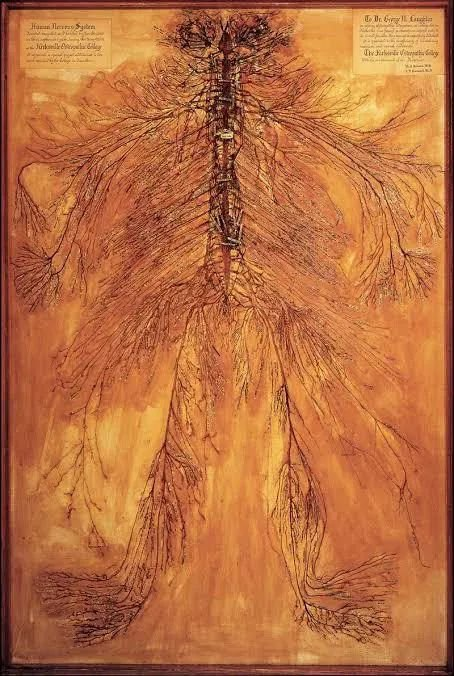
1925 年,两名医学生花费 1500 小时手工解剖了一个完整的人体神经系统。这是世界上仅有的四个之一。
这个标本由M. A. Schalck和L. P. Ramsdell在堪萨斯大学医学院解剖学家Rufus B. Weaver博士的指导下制作而成。他们使用放大镜、手术刀以及非凡的耐心,小心翼翼地移除每一块肌肉、器官和组织层,同时保留连接大脑和脊髓到身体每个部位的精致神经网络。
完成的解剖揭示了超过 45 英里的周围神经,其中许多比一根线还要细。它成为一个无价的教学工具,让几代医学生能够以三维形式研究身体的沟通系统,而不仅仅依赖插图。
如今,这个标本仍是解剖科学中最令人印象深刻的成就之一。现代成像技术,如MRI和CT扫描,在很大程度上取代了这种费力的工作,使得像这样的创作不太可能再被重复。
Rufus B. Weaver博士后来成为内布拉斯加大学的校长,但这个费力的神经系统解剖仍是与他早期职业生涯相关的最持久的教育项目之一。