What would make you finally clean up your camera roll?
I'm building Sivo around a simple deal:
150 photos free.
€3.99 once for unlimited sorting.
No subscription, account or ads.
Try it on iPhone and tell me what you'd improve:
https://t.co/bFFwk33zEq
You don't have to sort your whole camera roll today.
Start with 10 photos.
Keep the good ones. Set the rest aside. Review before deleting.
That's Sivo.
150 photos free. €3.99 once for unlimited sorting.
https://t.co/bFFwk33zEq
Your camera roll doesn't need another account.
Sivo keeps your sorting history on your iPhone. No account. No ads. No subscription.
Try 150 photos free. Unlimited sorting is €3.99 once, for life.
https://t.co/bFFwk33zEq
The best part of a photo cleaner? Being able to change your mind.
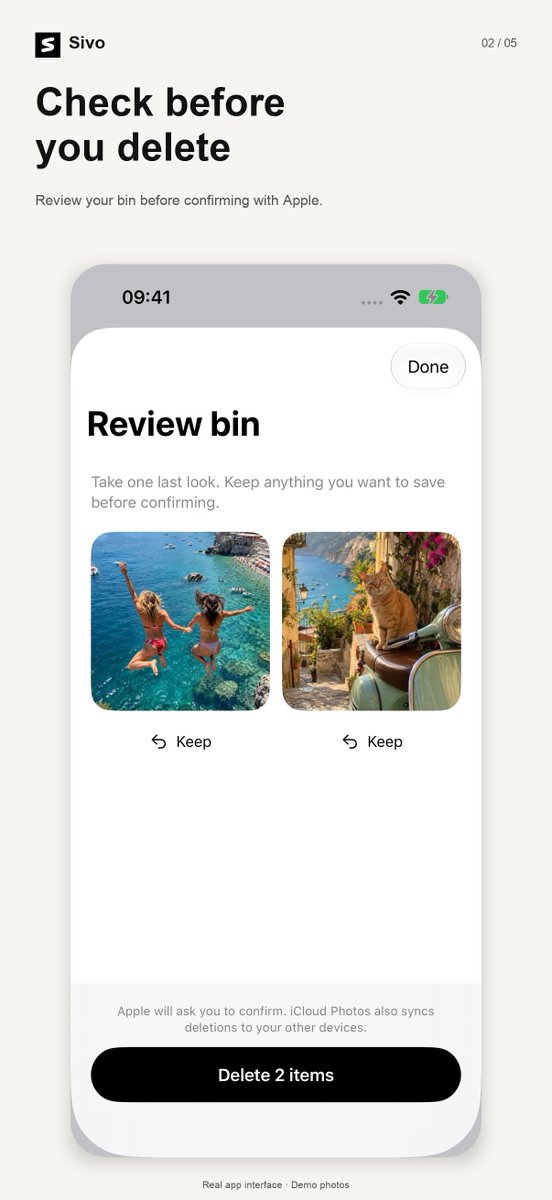
Sivo lets you undo a swipe and review your bin before confirming deletion.
No account. No ads.
150 photos free. €3.99 once for unlimited sorting.
https://t.co/bFFwk33zEq
How many screenshots in your camera roll are you never going to open again?
I made Sivo to make the clean-up simple: swipe, review your bin, confirm.
150 photos free. €3.99 once for unlimited sorting.
https://t.co/bFFwk33zEq
@alexsongis What if compute markets let users trade flexibility for predictability? Flexible workloads get rewarded for shifting off-peak. Latency-sensitive users pay for guaranteed capacity and stable pricing. The market coordinates both, making compute more efficient for everyone.
@colossal 5/5 Which milestone would convince you most: a novel biological result, a reusable application, or a demonstrated conservation benefit?
Sources:
https://t.co/RSJE82MQIL
https://t.co/3CEEgtaihx
1/5 I find @colossal fascinating. But beyond the ambition of de-extinction, another question interests me:
What useful technologies can emerge along the way—and how should we judge them?
@colossal 4/5 I would track three things separately:
• Scientific results and independent validation.
• Reusable tools and real demand.
• Measurable conservation benefits.
An impressive demonstration does not establish all three.
A photo cleaner shouldn't be another monthly bill.
Sivo: €3.99. Once.
Unlimited sorting for life.
150 photos free to try.
No account. No ads. No subscription.
I just launched it for iPhone:
https://t.co/bFFwk33zEq
1/4 Amazon’s Oct. 29 quarterly filing describes a secured facility of up to ~$80bn for certain technology infrastructure purchases.
That ceiling is not fully drawn debt. Nor does the filing label all those purchases as GPUs.
3/4 My question: how does financing maturity line up with equipment economics?
Technical life, accounting life and competitive life can diverge. Collateral helps protect a lender; it does not create the cash flow needed to service debt.
AI makes building cheaper, but scaling still depends on scarce compute. Transparent pricing and futures could help smaller firms hedge costs, but they can't hedge away a lack of capacity.
Can more efficient markets level the playing field without broader access to supply?
AI is getting smarter. Productivity is skyrocketing. So why does everyone seem busier, more stressed, and more competitive than ever?
I’ve been thinking about this paradox.
Perhaps we’re advancing productive forces much faster than we’re evolving the economic relationships around them.
AI is dramatically reducing the cost of creating things. Software, research, content, even movies can now be produced with a fraction of the resources previously required.
But creating something is not the same as bringing it to market.
We are making production more efficient without necessarily making markets more efficient.
And when everyone becomes 10x more productive, competition simply accelerates.
This is why I believe the next phase of the AI revolution must go beyond technology. It must also be about market efficiency, transparency, price discovery, open access, and the free flow of information.
Free markets don’t function efficiently simply because production becomes cheaper. They need trustworthy information, competitive access, transparent pricing, and mechanisms that allow resources to flow toward their most productive uses.
When data is concentrated and markets are opaque, technological progress can reinforce existing economic power rather than distribute its benefits.
Of course, transparency and open markets alone won’t guarantee that everyone shares equally in productivity gains. But they can reduce friction, improve resource allocation, and create opportunities for more participants.
AI can democratize production. Efficient and open markets can help democratize economic opportunity.
Curious what others think.