Can AI make a market decision before you even finish reading the headline?
Commerce-1 processes market events and decides: UP, DOWN, or NO TRADE even while you sleep.
An open-weight decision model built for agentic commerce.
https://t.co/nedvLBW4w2
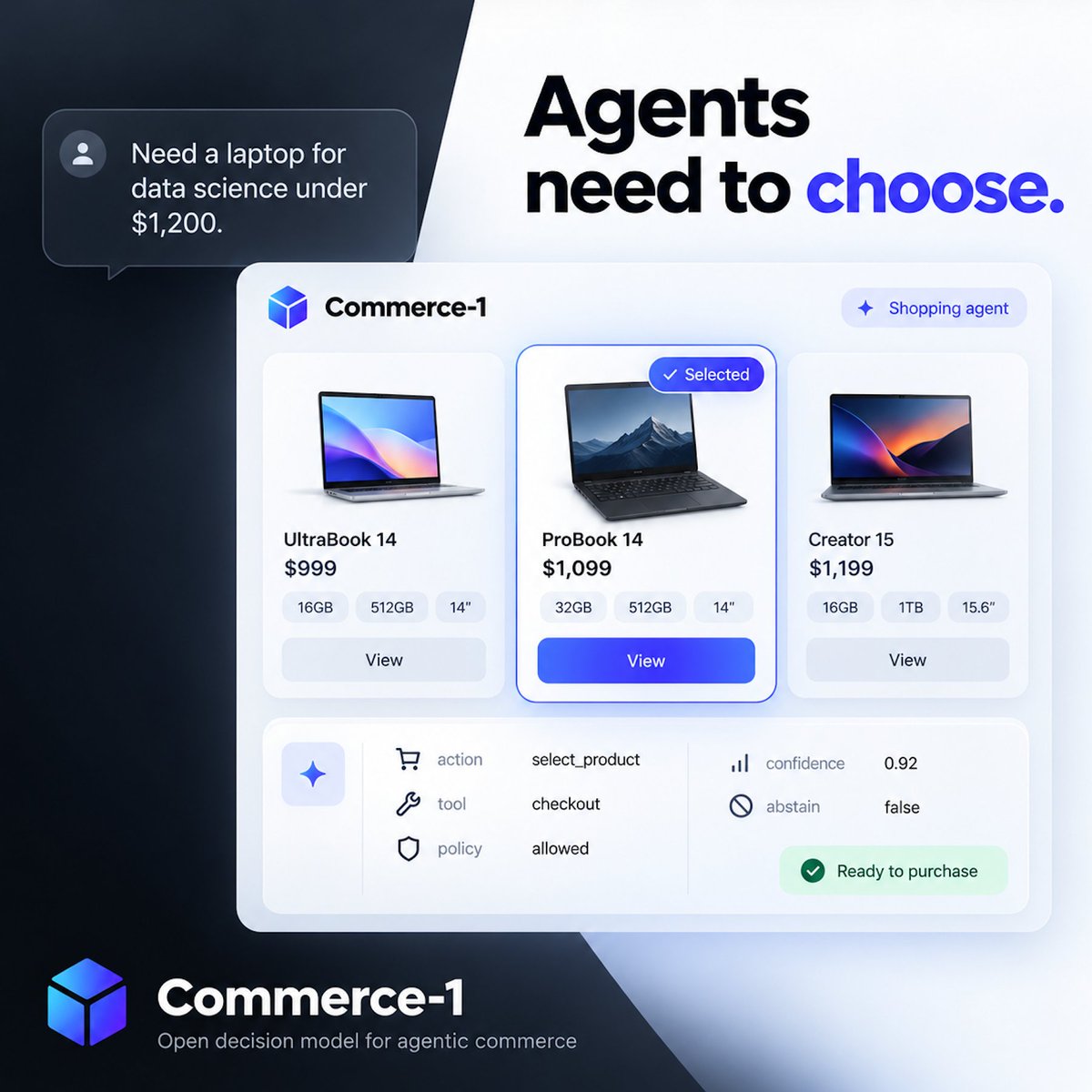
Today we release Commerce-1: a 27B open-weight decision model for agentic commerce.
Commerce agents do not always need another paragraph. They need to choose among allowed actions, know when to abstain, and expose probabilities to policy code.
That is what Commerce-1 does. 🧵
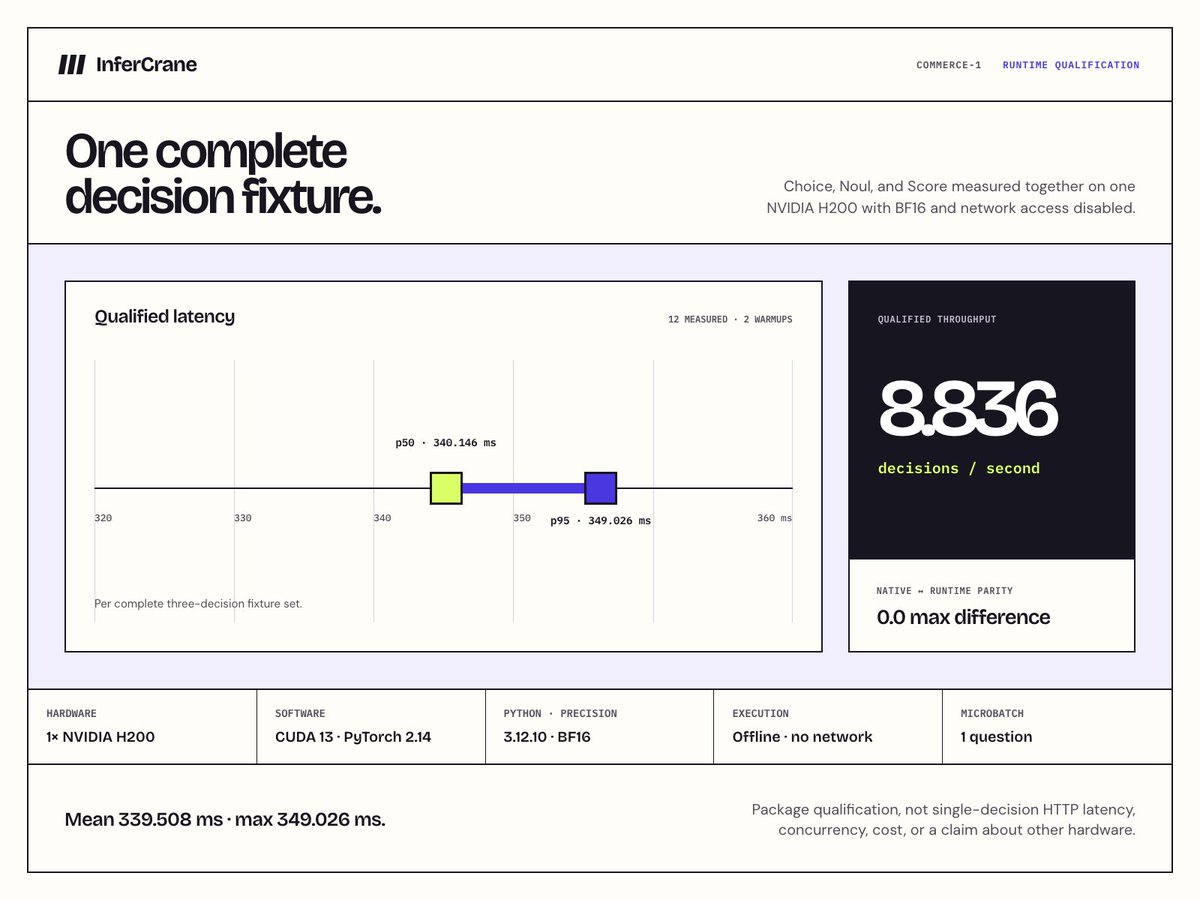
Qualified on 1× NVIDIA H200, BF16, offline:
- 8.836 decisions/s
- p50 340.146 ms
- p95 349.026 ms
- exact native/runtime parity
This is one locked Choice + Noul + Score fixture set with question microbatch 1, not general endpoint latency.
One thing I’ve learned from running coding agents overnight: Don’t give them a task. Give them an objective. A measurable metric, a budget, a deadline, and freedom to experiment.
For example: “Improve decode throughput for this inference workload without regressing p95 TTFT or output correctness. You have $100 of GPU budget and 8 hours. Establish a baseline, profile the hot path, generate multiple hypotheses, and test them in parallel. Explore kernel fusion, launch overhead, memory access patterns, batching, CUDA graphs, and scheduling. Build whatever benchmark or instrumentation you need. Revert regressions. Only keep changes that reproduce across repeated runs. Stop when the budget is exhausted or you have a clear winner.”
Let them branch, benchmark, discard bad ideas, and keep searching. The difference in exploration quality is huge.
I’m building Commerce-1: an open decision model for agentic commerce, trained to make better decisions and evaluated on harder benchmarks.
Which product? Which tool? Is this action allowed? Should I abstain?
Typed decisions. Probabilities. Abstention.
Coming soon.
This is not a “Browserbase is obsolete” claim. Browserbase is built for managed browser fleets, identity, proxies, and observability. Brezel’s bet is different: the browser should participate in the lifecycle of the agent’s complete, self-hostable computer.
Remote-browser platforms optimize the browser sessionCoding and research agents care about the whole computer.
I added Chrome 140 to Brezel’s Firecracker sandbox so the browser, shell, repository, files, and dev server all share one state boundary. The hard part wasn’t launching Chrome. It was defining what survives.
Keeping a live Chrome profile on durable storage caused navigation stalls. The design that held up keeps the active profile local, then checkpoints it only after Chrome stops. A replacement VM restores the profile before relaunch.
A browser session is not durable state. A quiesced checkpoint is.
Code: https://t.co/HgSyD7SAeL
Try: https://t.co/1pJ2qJAGQO
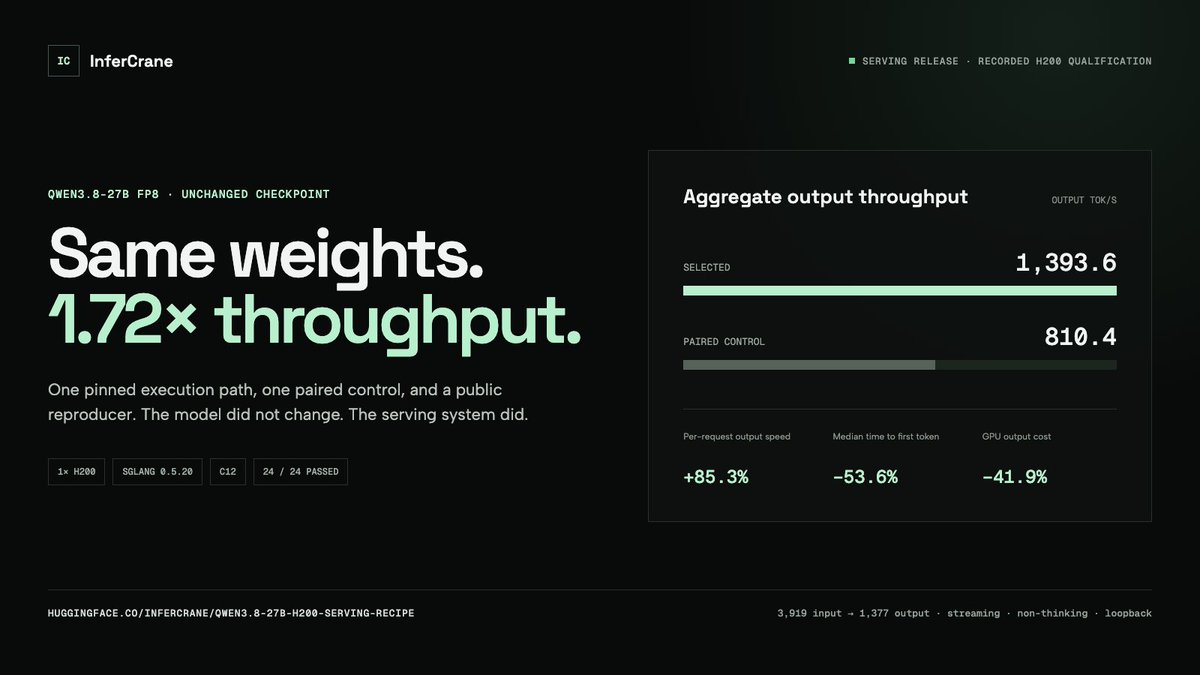
InferCrane’s Qwen3.8-27B FP8 release on 1× H200:
• 1,393.6 output tok/s @ c12
• 1.72× vs paired control
• 739 ms median TTFT
Exact checkpoint, runtime, configs & raw receipts:
https://t.co/aeTEsvefGl
At c4, the selected path reached 202 tok/s per request.
Both candidates used the same model revision, SGLang image, H200, workload, and correctness patch.The selected path used FP8 KV cache, NEXTN/MTP, and bounded CUDA graphs. Deterministic outputs matched.
Interactive evidence:
https://t.co/Ry8629lTrL
The weights didn’t change. The serving system did.
InferCrane’s Qwen3.8-27B FP8 release on 1× H200:
• 1,393.6 output tok/s @ c12
• 1.72× vs paired control
• 739 ms median TTFT
• 24/24 requests passed
Exact checkpoint, runtime, configs & raw receipts:
https://t.co/Av8Omf5b1S