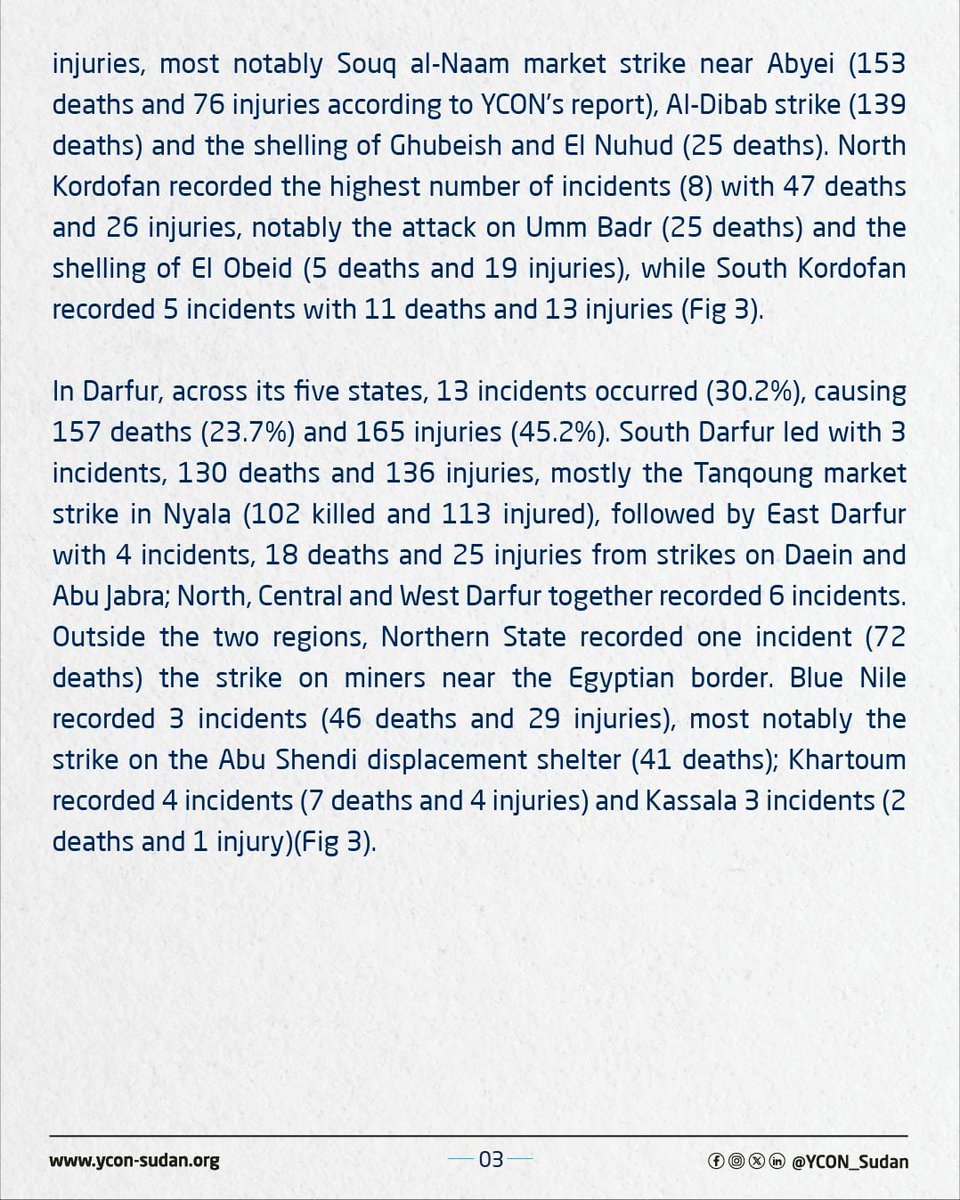
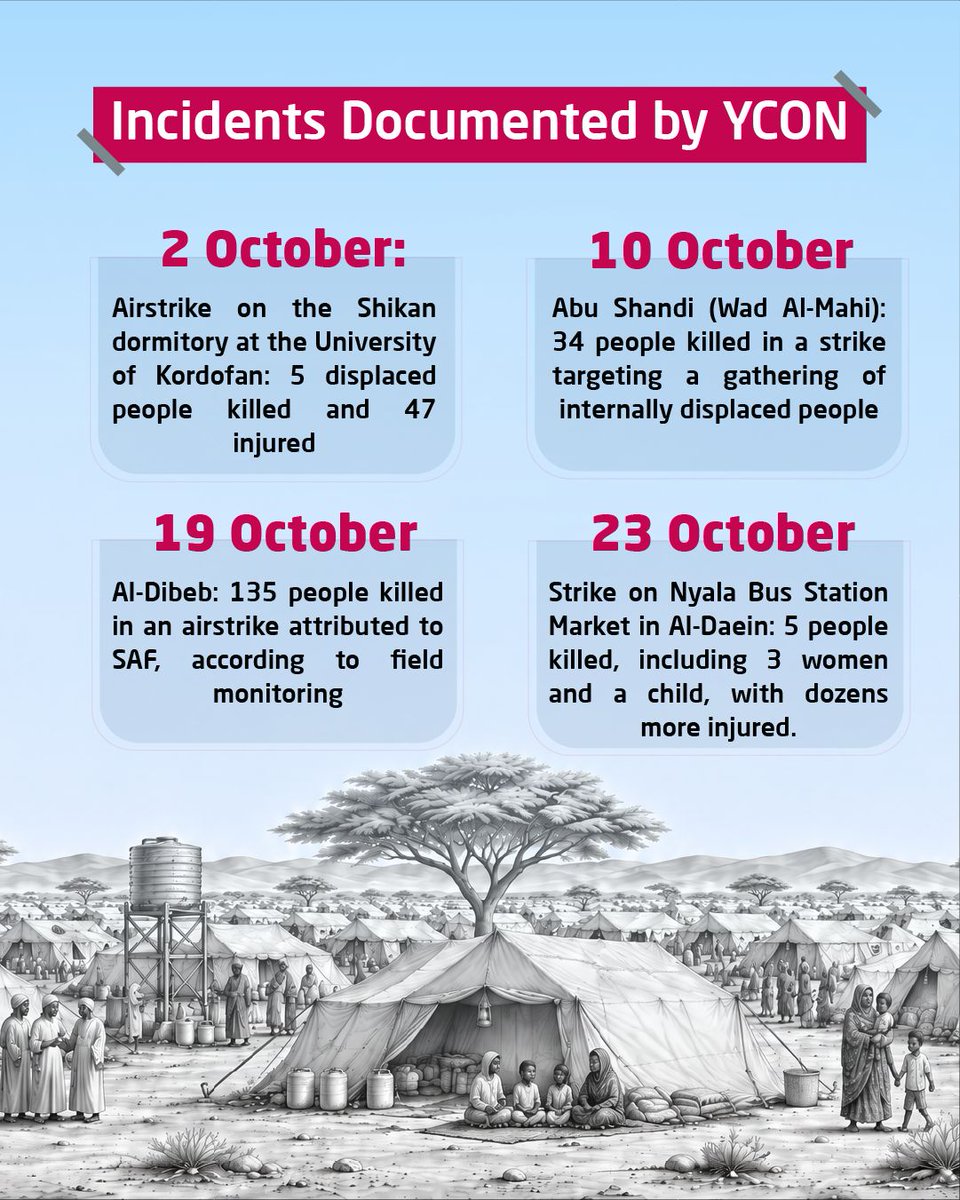
This report presents aggregated statistics on incidents of violence and mass-death in Sudan during October 2026, documenting the type of incident, perpetrator(s), and the geographic location, alongside direct humanitarian indicators such as the number of fatalities and injuries.
#Youth_Citizens_Observers_Network
#Sudan_War
#Sudan
#Observe
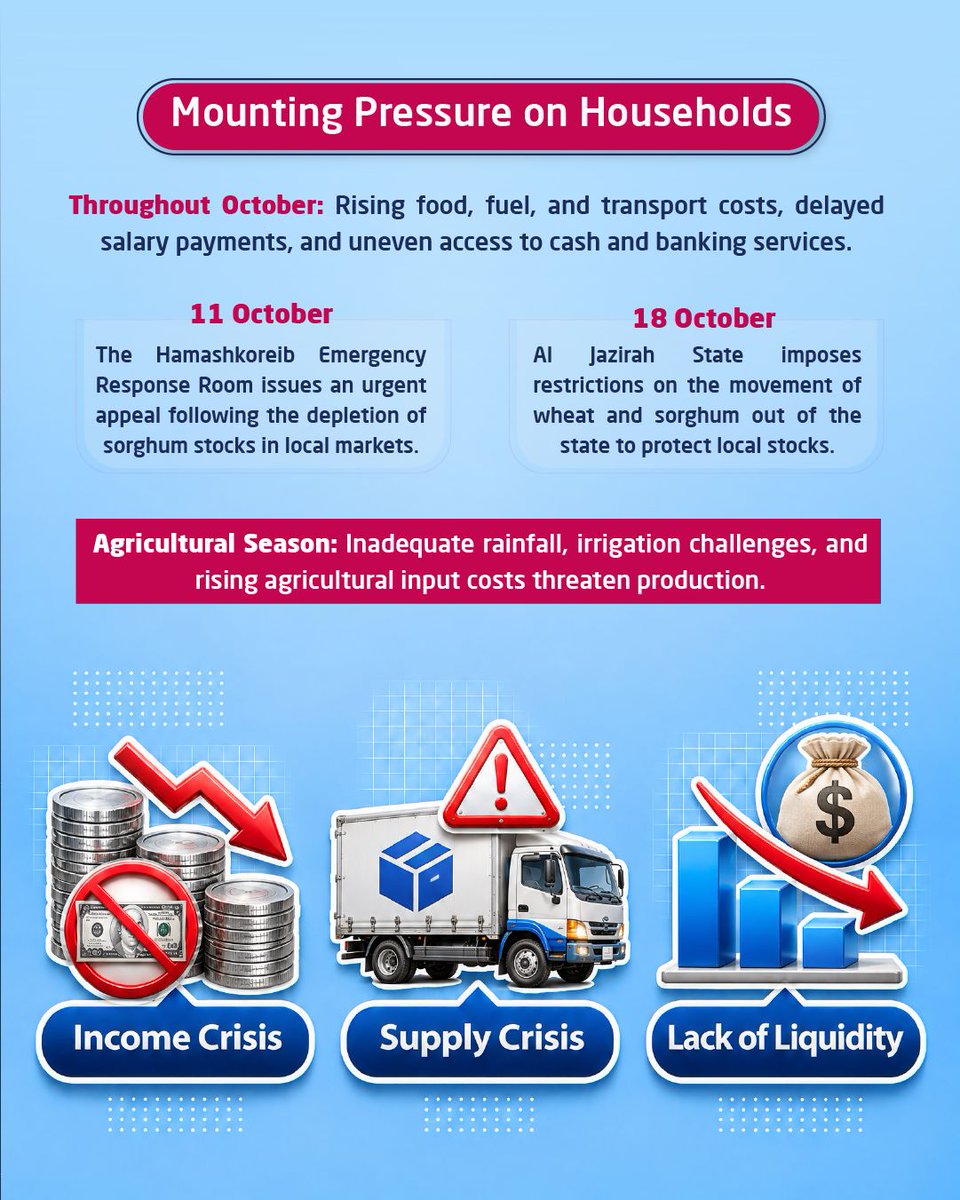
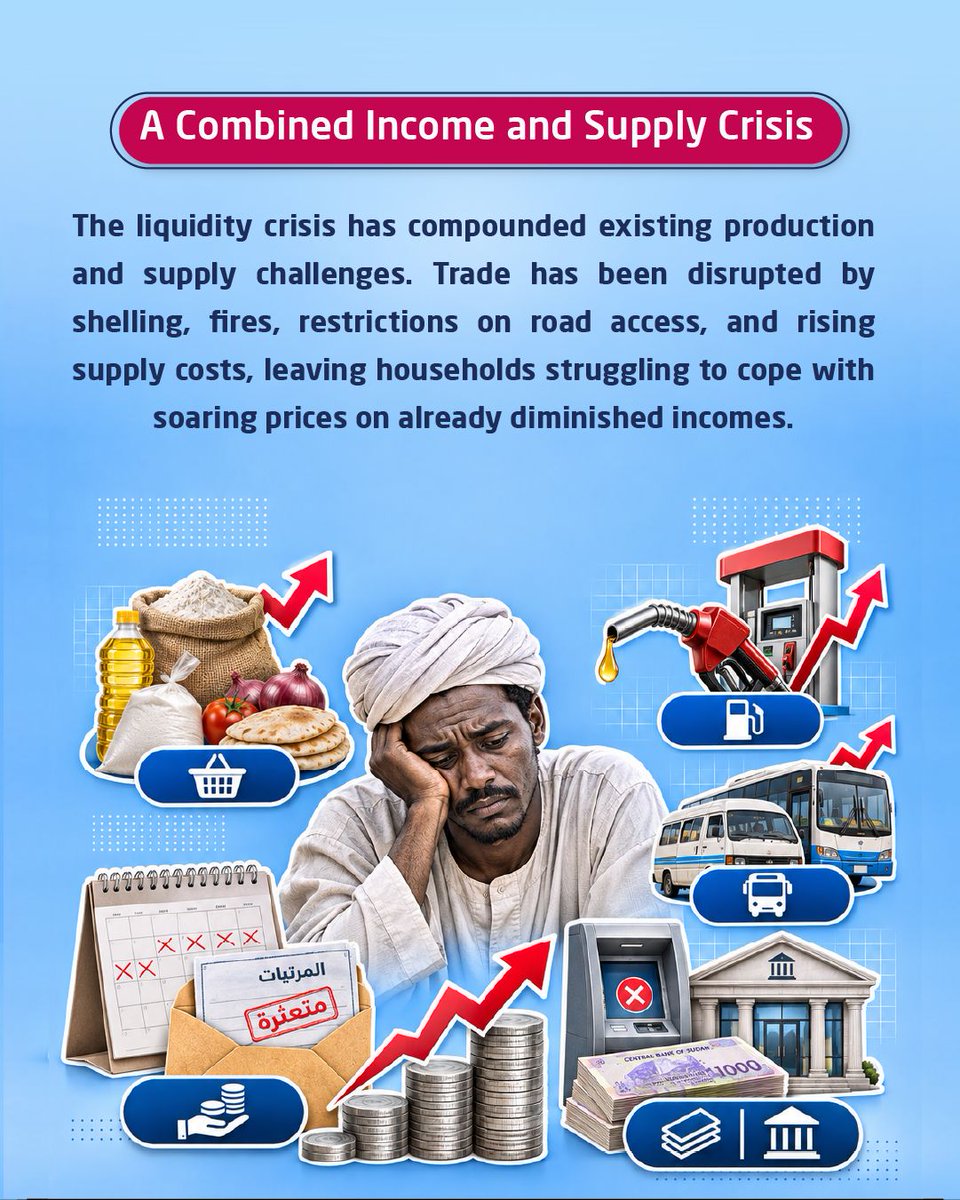
Rising food, fuel, and transport costs, delayed salary payments, and deductions of up to 45–50% when converting electronic balances into cash: this was the economic reality facing households in October 2026.
Read the full report for more details and YCON's recommendations.
#YCON
#youth_citizens_observers_network #sudan
#الشبكة_الشبابية_للمراقبة_المدنية
#السودان
#war_in_sudan
Throughout October 2026, civilians and civilian infrastructure continued to come under attack, from gatherings of internally displaced people to markets. Arbitrary arrests, torture, abductions, and sexual violence also persisted.
YCON presents the incidents documented through its monitoring efforts and calls for independent investigations to establish accountability, identify those responsible, and ensure that perpetrators are not allowed to escape justice.
Read the full report by clicking the link below:
https://t.co/UzazLiVdjV
#YCON
#youth_citizens_observers_network #sudan
#الشبكة_الشبابية_للمراقبة_المدنية
#السودان
#war_in_sudan
Diplomatic efforts continued in Geneva and at the UN Security Council, alongside preparations for an inclusive national dialogue. However, military operations showed no signs of abating, as drone attacks increasingly targeted markets, displacement shelters, and electricity infrastructure.
In this post: Key political and security developments, along with recommendations from the Youth Citizens Observers Network (YCON).
Read the full report for further details and references.
https://t.co/UzazLiVdjV
#YCON
#youth_citizens_observers_network #sudan
#الشبكة_الشبابية_للمراقبة_المدنية
#السودان
#war_in_sudan
Throughout October 2026, the Sudanese crisis continued to take a heavy toll on civilians, institutions, and livelihoods. These developments unfolded alongside diplomatic efforts to end the war and preparations for an inclusive Sudanese dialogue, while military operations continued unabated. The most significant shifts on the ground were concentrated in Blue Nile and Kordofan, while drone attacks extended to markets, residential areas, displacement shelters, and essential service facilities across several states.
At the international and regional levels, coordination efforts to end the war continued amid disagreements over the mechanisms of pressure and the terms of a potential settlement. Politically, the Sudanese–Sudanese Dialogue Preparatory Committee continued its activities following its announcement on 29 September 2026 that it had begun issuing invitations. Positions remained divided, with the Sumoud and Tasis coalitions rejecting the process in its current form, while the Democratic Bloc expressed preliminary support.
On the military and security fronts, confrontations and shifts in territorial control were concentrated in North Kordofan and Blue Nile, with conflicting claims of control over several locations. Attacks attributed to the Rapid Support Forces (RSF) damaged electricity infrastructure in Gedaref and the capital, Khartoum, causing widespread power outages and placing additional pressure on residents and essential services. Meanwhile, armed violence, localized conflicts, and security risks along roads and in markets persisted.
In terms of human rights and civilian protection, internally displaced people, women, children, and market workers bore a significant share of the direct impact of the conflict. Arbitrary arrests, torture, abductions, sexual violence, and restrictions on freedom of expression and civic activities continued. These developments underscore the urgent need for independent investigations, the identification of those responsible, accountability for perpetrators, and measures to ensure that violations do not go unpunished.
Economically, households faced mounting pressure due to rising food, fuel, and transport costs, salary payment delays, and uneven access to cash and banking services. Fees charged for converting electronic balances into cash reached 45–50% in Nyala and 50% in Sheiria.
Socially, hate speech targeting political, ethnic, religious, and tribal identities intensified, spreading through social media platforms in some areas.
Humanitarian conditions remained precarious, with displacement continuing from Blue Nile, Kordofan, and Darfur. People were forced to flee not only fighting but also worsening drought conditions and the erosion of livelihoods.
In the health sector, medical facilities faced shortages of medicines, personnel, and equipment, alongside rising treatment costs, the spread of dengue fever and malaria, and overcrowded hospitals. According to field monitoring, hospitals in Kurmuk, Geissan, and Bout were rendered non-operational following attacks attributed to the RSF, during which facilities were destroyed and looted.
In education, classes and examinations continued in some areas. However, strikes, displacement, under-resourced schools, and rising transport and school fees disrupted access to education and prevented regular attendance in other areas.
Taken together, developments in October 2026 demonstrate that the impact of the war has extended beyond immediate casualties to undermine the ability of households and institutions to sustain themselves. Damage to markets, production, and essential services has reduced income opportunities while increasing the cost of food, healthcare, and education. Meanwhile, displacement and security restrictions have placed additional burdens on host communities and local actors. Although youth initiatives, community-based groups, and organizations have continued to address some of the resulting gaps, the scale of humanitarian needs has far exceeded their capacity. This underscores the need for a broader response that links civilian protection and accountability with an end to hostilities, the restoration of essential services, and the recovery of livelihoods.
Read the full report by clicking the link below:
https://t.co/UzazLiVdjV
#YCON
#youth_citizens_observers_network #sudan
#الشبكة_الشبابية_للمراقبة_المدنية
#السودان
#war_in_sudan
What would you most like to see covered in our October Periodic Situational Report?
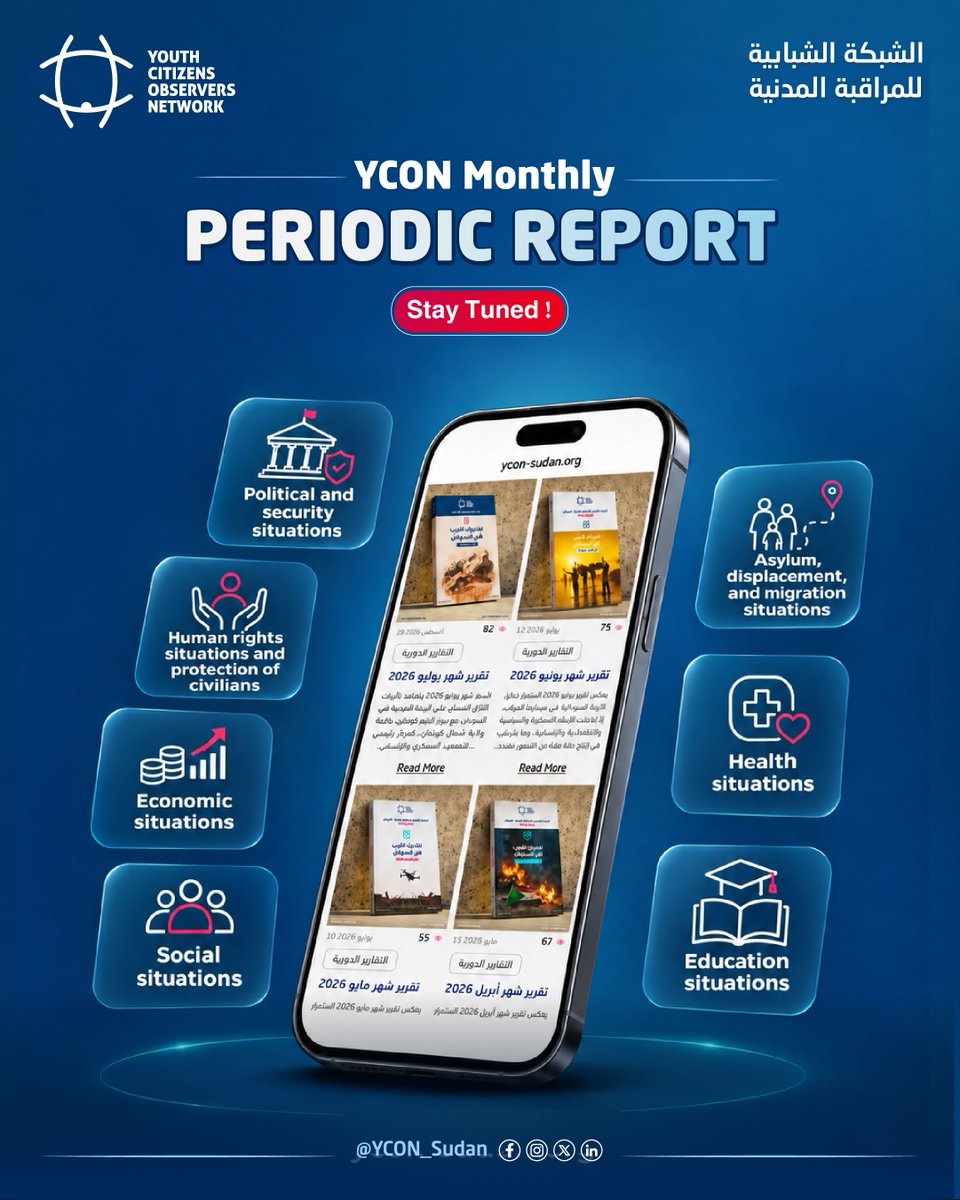
The Youth Citizens Observers Network’s (YCON) Periodic Situational Report covers a range of key developments across Sudan, including:
- Political and Security Situations
- Human Rights Situation and Civilian Protection
- Economic Situation
- Social Situation
- Migration, Displacement, and Asylum Situation
- Health Situation
- Education Situation
Which of these issues matters most to you? Share your thoughts in the comments!
Your input helps us shape our content around what matters most to you.
#YCON
#youth_citizens_observers_network #sudan
#الشبكة_الشبابية_للمراقبة_المدنية
#السودان
#war_in_sudan
Stay tuned for the Youth Citizens Observers Network’s periodic report on Sudan for October 2026. The report covers political and security developments, human rights and civilian protection, economic and social conditions, migration, displacement and asylum, health, and education.
Follow YCON Sudan for the release.
#YCON
#youth_citizens_observers_network #sudan
#الشبكة_الشبابية_للمراقبة_المدنية
#السودان
#war_in_sudan
This report presents aggregated statistics on violence and mass Casualty incidents in Sudan during September 2026. It documents the type of incident, the actor involved, and the geographic location, alongside direct humanitarian indicators, including the number of deaths and injuries.
#YCON
#youth_citizens_observers_network #sudan
#الشبكة_الشبابية_للمراقبة_المدنية
#السودان
#war_in_sudan
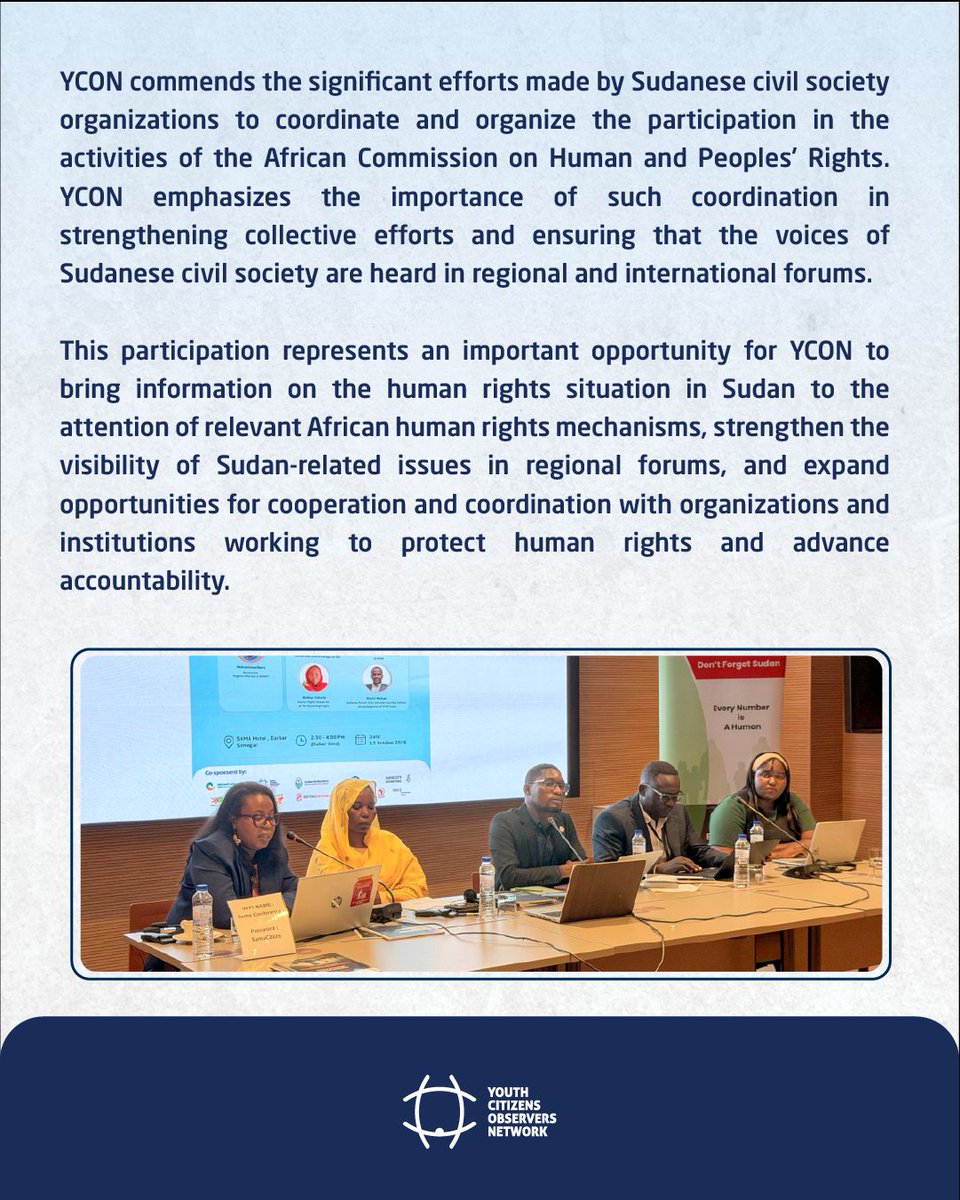
The Youth Citizens Observers Network (YCON-Sudan) participated in the 89th Ordinary Session of the African Commission on Human and Peoples’ Rights (ACHPR), held in Dakar, Senegal, from 12 to 21 October 2026.
During the session, YCON participated in a side event dedicated to discuss the human rights situation in Sudan. YCON addressed the issue of “Attacks Against Civilians and Civilian Objects”, highlighting these attacks as among the most serious violations associated with the ongoing armed conflict in the country. YCON presented selected findings from its monitoring and documentation of such attacks. In February 2026 alone, YCON documented 42 drone attacks across 11 Sudanese states, resulting in the deaths of 232 civilians and injuries to more than 172 others.
YCON also presented and distributed a number of its publications including reports, a research paper examining youth participation in Sudan’s peace processes and its recently published policy paper “Toward a New Civil Architecture for Peace Processes”
On the sidelines of the session, YCON met with Hon. Commissioner Hatem Essaiem the chairperson of the Joint Fact-Finding Mission on the Human Rights Situation in Sudan. The meeting addressed several issues regarding the human rights situation in the country, with particular emphasis on opportunities for coordination and cooperation with the Mission in fact-finding and documenting human rights violations.
YCON commends the significant efforts made by Sudanese civil society organizations to coordinate and organize the participation in the activities of the African Commission on Human and Peoples’ Rights. YCON emphasizes the importance of such coordination in strengthening collective efforts and ensuring that the voices of Sudanese civil society are heard in regional and international forums.
This participation represents an important opportunity for YCON to bring information on the human rights situation in Sudan to the attention of relevant African human rights mechanisms, strengthen the visibility of Sudan-related issues in regional forums, and expand opportunities for cooperation and coordination with organizations and institutions working to protect human rights and advance accountability.
#YCON
#youth_citizens_observers_network #sudan
#الشبكة_الشبابية_للمراقبة_المدنية
#السودان
#war_in_sudan #YCON
#youth_citizens_observers_network #sudan
#الشبكة_الشبابية_للمراقبة_المدنية
#السودان
#war_in_sudan
Stay informed about the latest reports and publications on political, security, economic, and social developments in Sudan?
Subscribe to the Youth Citizens Observers Network newsletter and be the first to receive our analyses, field reports, research papers, and knowledge products directly in your inbox as soon as they are published.
Why subscribe?
Stay up to date with our latest reports, studies, and analyses.
Receive regular updates, research papers, and policy papers.
Learn about activities, events, and opportunities related to the Network’s work.
Subscribe now via the following link:
Subscribe now via the following link:
https://t.co/nT20jymEup
#YCON
#youth_citizens_observers_network #sudan
#الشبكة_الشبابية_للمراقبة_المدنية
#السودان
#war_in_sudan
Dear valued followers,
We would like to inform you that the Youth Citizens Observers Network (YCON) website underwent its routine annual update over the past 72 hours to improve the website and make our reports and activities more accessible.
We are pleased to announce that the website is back online and available again. We apologize for any inconvenience and thank you for your understanding and continued interest.
https://t.co/e65doZRyY1
#YCON
#youth_citizens_observers_network #sudan
#الشبكة_الشبابية_للمراقبة_المدنية
#السودان
#war_in_sudan
The Youth Citizens Observers Network (YCON Sudan) convened an in-person forum in Nairobi to discuss its research paper entitled: “From Presence to Influence: From Presence to Impact: Youth Participation in Sudan’s Peace Processes
A Comparative Study of the Comprehensive Peace Agreement, and Abuja, Doha, and Juba Agreements”.
The forum featured rich discussions and valuable contributions from participants, enriching the research and deepening the conversation on youth participation in Sudan’s peace processes, as well as the challenges that limit young people’s influence in shaping peace agreements and determining the direction of peacebuilding efforts.
The forum forms part of YCON’s ongoing efforts to promote meaningful youth participation in peace processes and to advance the shift from mere presence to genuine influence in decision-making and the pursuit of a sustainable and inclusive peace in Sudan.
#YCON
#youth_citizens_observers_network #sudan
#الشبكة_الشبابية_للمراقبة_المدنية
#السودان
#war_in_sudan
Policy Paper
Toward a New Civil Architecture for Peace Processes: Integrating Independent Civilian Oversight into Negotiations and Discussions to End the War in Sudan
Preparations for the political process and negotiations aimed at ending the war in Sudan are entering a phase marked by turning points and cumulative structural imbalances. Since the launch of the Jeddah platform in May 2023, through numerous talks and meetings in Geneva, Manama, Cairo, and elsewhere, and leading up to the exploratory consultations sponsored by the Quintet Mechanism in June 2026 in Addis Ababa, a series of international and regional platforms and initiatives have formed with the goal of achieving a ceasefire and launching a political path to end the war. However, these efforts have shared a single structural flaw: the absence of an independent civilian oversight mechanism that supports these tracks by increasing the indirect participation of Sudanese citizens, enhancing process transparency, and fostering national ownership through monitoring the progression and outcomes of negotiations and keeping the public informed of their agenda and results. While this gap was not the sole cause of the negotiations' stumbling, it weakened the political processes' capacity to build transparency, provide reliable information, establish institutional arrangements that reinforce accountability, engage stakeholders, and secure national ownership of the political process.
This paper addresses an institutional gap in the design of Sudanese peace processes—namely, the lack of an independent civilian mechanism for monitoring, verification, and public communication to accompany the political process from its earliest stages. This absence has limited the ability of these tracks to provide reliable information to the public, link the political process to communities affected by the war, and reinforce national ownership of its outcomes.
This paper proposes the establishment of the "Joint Civilian Engagement Window" as an independent civilian oversight mechanism that brings together national, regional, and international components. It would be tasked with systemically monitoring the progression of the political process, tracking the implementation of ceasefire arrangements and humanitarian corridors, and generating reliable information to support mediators and decision-makers. Furthermore, it would facilitate communication with stakeholders and the public while respecting the confidentiality requirements essential to certain negotiation stages. The Youth Network for Civilian Oversight believes that its field-monitoring and documentation expertise can contribute meaningfully to the national component of this mechanism, alongside other Sudanese civil society organizations.
Comparative international experiences indicate that the absence of regular channels for information sharing and communication during peace processes creates an information vacuum. This space is quickly filled by competing narratives and conflicting interpretations of the political process. From this perspective, this paper frames independent civilian oversight as an institutional tool designed to foster transparency and information availability, rather than a replacement for the roles of mediators or official verification mechanisms.
To read the full paper, click the link below:
https://t.co/yg9gYIRT43
#YCON
#youth_citizens_observers_network #sudan
#الشبكة_الشبابية_للمراقبة_المدنية
#السودان
#war_in_sudan
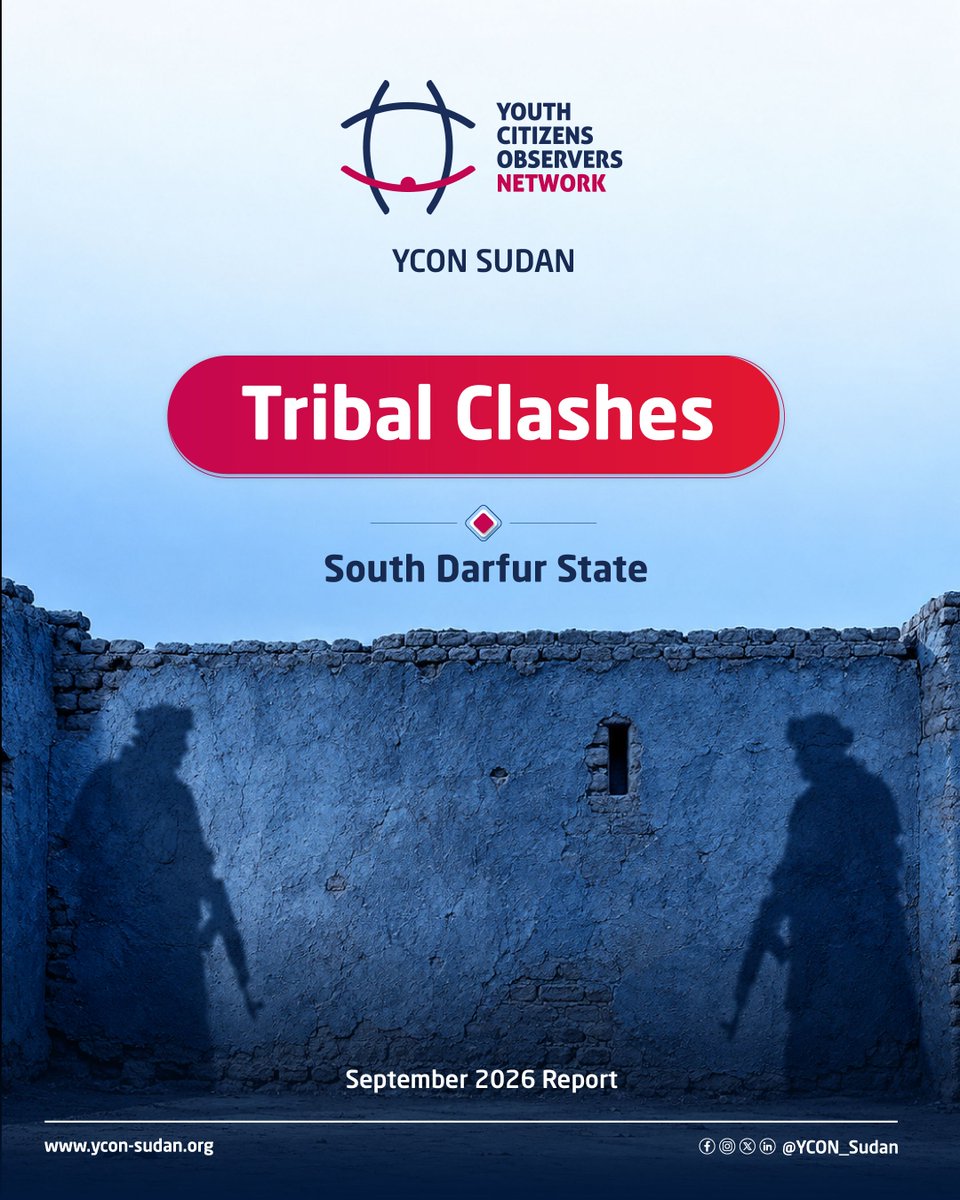
Clashes between the Fallata and Masalit communities broke out in Gereida, South Darfur, on 18 September, leaving more than 20 people dead or injured, according to monitoring reports.
Read the full report via the link:
https://t.co/yg9gYIRT43
#YCON
#youth_citizens_observers_network #sudan
#الشبكة_الشبابية_للمراقبة_المدنية
#السودان
#war_in_sudan
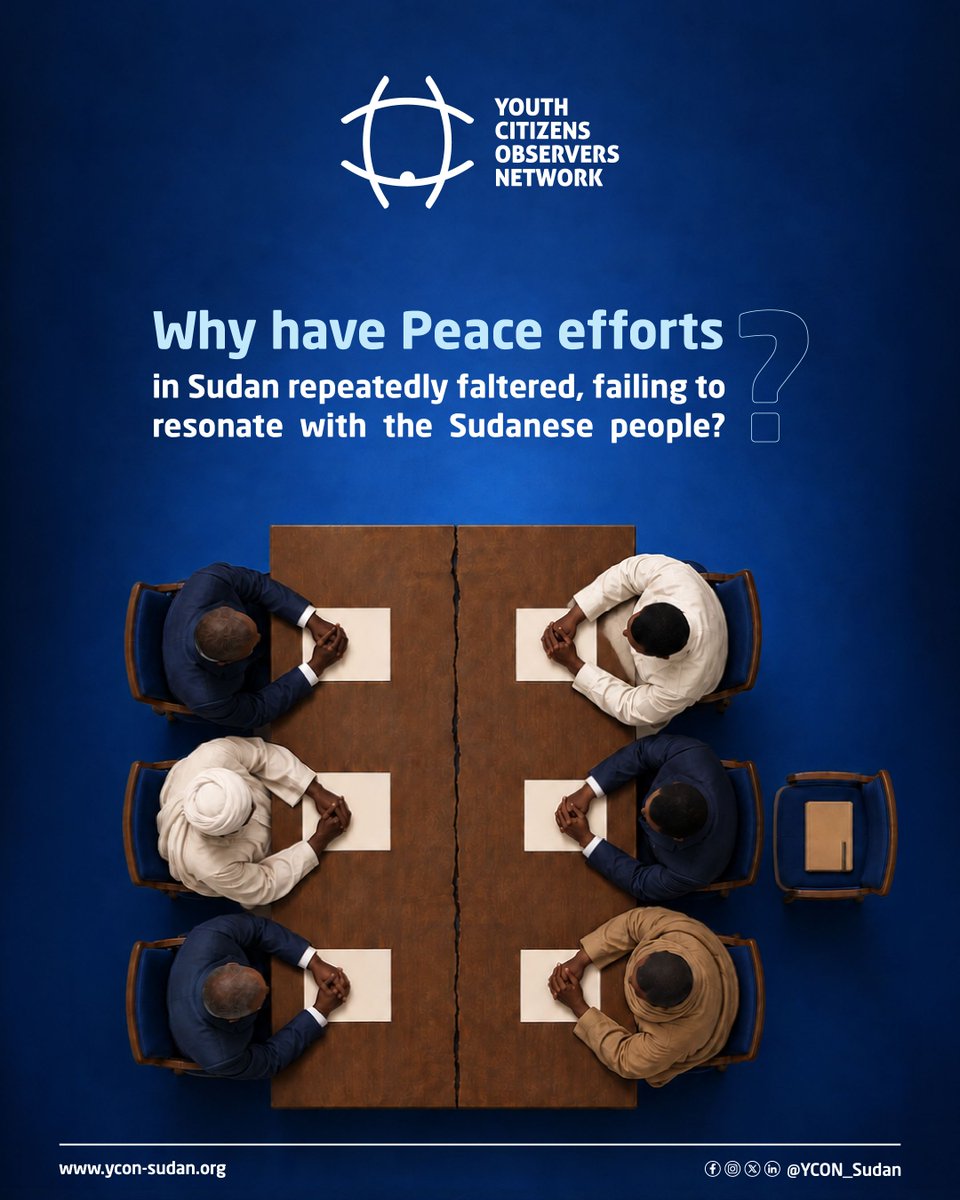
Negotiations behind closed doors alone are not enough to build lasting peace.
The forthcoming policy paper draws on established international principles and scholarship on mediation and peacebuilding:
“International scholarship underscores that the design of a political process is no less important than the substance of the agreement itself.”
These institutional gaps cannot be left to be addressed only after agreements are reached:
“Addressing institutional gaps in the design of a political process should begin at the preparation and design stages, rather than being deferred until the implementation of agreements.”
On the much-discussed concept of “national ownership,” the paper emphasises:
“National ownership of peace processes is not achieved simply through the participation of local actors in negotiations. It is also shaped by the way the political process itself is designed.”
The paper therefore proposes a “Joint Civilian Oversight Mechanism” (JCOM) to integrate independent civilian oversight into negotiations and political consultations to end the war in Sudan.
Stay tuned for the forthcoming policy paper from the Advocacy Unit of the Youth Citizens Observers Network (YCON).
#YCON
#youth_citizens_observers_network #sudan
#الشبكة_الشبابية_للمراقبة_المدنية
#السودان
#war_in_sudan
September 2026 underscored the complex and multifaceted nature of the Sudanese crisis, marked by a convergence of diplomatic and political efforts to advance truce and dialogue negotiations with ongoing military clashes and shifting frontlines—particularly in North Kordofan—alongside an expanded use of drones across several states. At the same time, the conflict continued to severely impact civilian protection, displacement, the economy, and basic services, with stark regional disparities in stability and local institutional and community response capacities.
Politically, preparations for the Sudanese-Sudanese Dialogue Initiative advanced throughout September. Between September 18 and 24, the dialogue preparation committee held meetings with leaders of Sufi orders, alongside announced plans to include displaced persons, refugees, conflict survivors, native administrations, and key sectoral and community entities.
On the military and security fronts, major field developments were concentrated in North Kordofan, which saw a series of ground operations and control shifts near Sodri, Um Badir, and Hamrat al-Sheikh during the second half of September, culminating in the Sudanese Armed Forces entering Sodri on September 25, 2026. Parallel to military operations, the risks of security breakdowns and localized conflicts persisted, with reported incidents of looting, armed crime, and troop-related friction across multiple areas, alongside local disputes in Darfur.
In human rights and civilian protection, primary risks stemmed from continued shelling, armed attacks, killings, and looting, alongside arrests and restrictions on civil liberties and civic activity. Violations linked to military operations were concentrated in Kordofan, Darfur, and River Nile, while other regions recorded restrictions on public space and protests that faced security interventions.
Economically, households faced sustained pressure from rising food and fuel prices, diminishing purchasing power, a liquidity crisis, and the high cost of accessing cash, with varying performance in markets, banking services, and agricultural output across regions. Socially, the compounding effects of displacement, poverty, limited employment opportunities, and weak social protection intersected with ongoing resource disputes, alongside emerging indicators of hate speech and social polarization. Conversely, youth, civic, and local initiatives maintained a vital role in bridging service gaps, supporting vulnerable groups, and delivering interventions in water, food, education, and health.
Humanitarianly, displacement patterns continued in multiple directions during September, primarily driven by military operations and deteriorating security and living conditions, though some return movements were observed in other areas. Overall developments in September 2026 reveal that the Sudanese crisis continues to generate interconnected patterns of military, humanitarian, economic, and social fragility. Shifts in military control directly impacted displacement and the disruption of markets and services, while declining purchasing power and limited access to healthcare and education were tied to the conflict’s lingering impact on institutions and families. Field tracking by the network highlights the sustained role of local initiatives, native administrations, emergency rooms, and humanitarian organizations in mitigating the fallout, though these interventions remain no substitute for a broader institutional response and a political and security pathway that addresses the root causes of deterioration.
To read the full report, click the link below:
https://t.co/XDo59dGXuN
#YCON
#youth_citizens_observers_network #sudan
#الشبكة_الشبابية_للمراقبة_المدنية
#السودان
#war_in_sudan
SUDAN FIRST: PROTECT CIVILIANS, PURSUE JUSTICE AND ACCOUNTABILITY.
As Sudan’s devastating war enters its fourth year, civilians continue to bear the heaviest burden of violence, displacement, and grave human rights violations. Their suffering must not be forgotten, their voices must not be silenced, and their pursuit of justice must not be abandoned.
Join us On 12 October in Dakar, Senegal, Sudanese civil society organizations, alongside regional and international partners, will come together to amplify the voices of affected communities, survivors, women, youth, and human rights defenders, and to demand stronger action to protect civilians and end impunity.
📍 Venue: SAMA Hotel, Dakar, Senegal
📅 Date: Monday, 12 October
🕝 Time: 2:30–4:00 PM
Join us as we put Sudan first, stand with survivors, defend civic space, and renew our collective commitment to civilian protection, justice, and accountability.
Sudan First. Civilians Must Be Protected. Justice Must Prevail.
#SudanFirst #Sudan #ProtectCivilians #J
#YCON
#youth_citizens_observers_network #sudan
#الشبكة_الشبابية_للمراقبة_المدنية
#السودان
#war_in_sudan
According to an upcoming policy paper by the Advocacy Unit of the Youth Citizens Observers Network (YCON): “The absence of regular channels for information-sharing and communication throughout peace processes creates an information vacuum, allowing competing narratives and divergent interpretations of political developments to take hold.”
Since May 2023, negotiations around ending the war and advancing peace in Sudan have moved across a number of international and regional forums — from Jeddah to Geneva, Manama, and Cairo, and eventually to Addis Ababa. Yet they have all shared one structural gap: “The fundamental challenge lies not only in the substance of the agreements or negotiations themselves, but also in the absence of an independent, nationally rooted civilian monitoring mechanism that accompanies the process from its design, while helping to strengthen inclusivity and meaningful communication with Sudanese people.”
Coming soon, YCON will launch a new policy vision seeking to reimagine the architecture of peace processes in Sudan.
Stay tuned.
#YCON
#youth_citizens_observers_network #sudan
#الشبكة_الشبابية_للمراقبة_المدنية
#السودان
#war_in_sudan