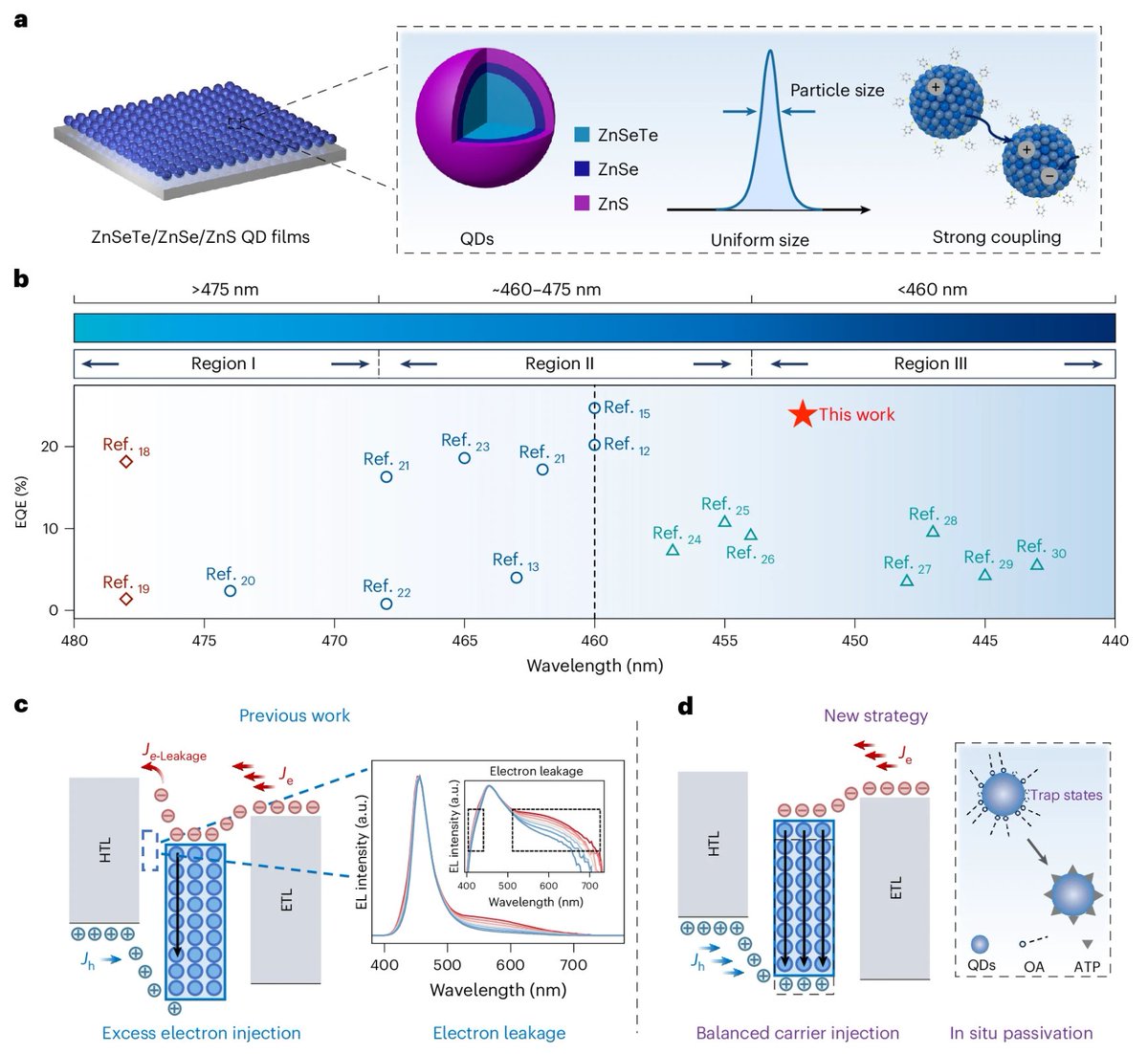
New Article online: Dipole-assisted functionalization enables long-range ordering of ZnTeSe quantum dots for efficient and stable deep-blue electroluminescence.
https://t.co/ro2aHdHjAI
The weird and wonderful properties of halide perovskites mostly come from one thing: the 6s² (or 5s²) lone pair on Pb²⁺ and Sn²⁺ at the B site, not from the organic cations or “soft lattice” alone. That lone pair: Mixes strongly with the halogen p orbitals and creates a high, very dispersive valence band, so you get light holes, good band alignment for photovoltaics, and often defect-tolerant behavior.
Makes valence band top antibonding, which flips the usual trends so the bandgap widens with temperature and shrinks with pressure.
Drives hidden local polar distortions and very anharmonic lattice dynamics, which give large ionic dielectric constants, unusually big positive thermal expansion, and low lattice thermal conductivity.
The main message is: if you want to understand why Pb/Sn halide perovskites are so special, you must start from the stereochemically active lone pair on Pb/Sn, and this same design motif (lone-pair cations in highly connected frameworks) is a good roadmap for discovering new high-performance semiconductors beyond the classic perovskites. See this paper:
https://t.co/Zef6mefQpw
Over 1 years preparation and revision. Finally it's online. Strategies for Stabilizing Metal Halide Perovskite Light-Emitting Diodes: Bulk and Surface Reconstruction of Perovskite Nanocrystals | ACS Nano https://t.co/PYB6VdkqZb
New in JACS! Chiral hybrid lead halides templated by L-nicotinium form distinct 1D & 0D motifs, exhibiting broadband emission and polarized light emission. Their optical activity is directly linked to the chiral organic cation and halide sublattice. https://t.co/qoF9asfLLW
There is still some room for compositional engineering of perovskite nanocrystals, yielding peculiar optical properties, see our latest report.
👇
Highly Emissive Colloidal Nanocrystals of a “2.5-Dimensional” Monomethylhydrazinium Lead Bromide | Journal of the American Chemical Society https://t.co/o8W9Gbchnt
A big improvement in copper iodide scintillators👍👍
Solution processed hundred-micron scale vertical growth of low-symmetrical zero-dimensional metal halide for high-performance X-ray imaging
https://t.co/Z9eWiG6yhc
Bidentate Lewis Base Ligand-Mediated Surface Stabilization and Modulation of the Electronic Structure of CsPbBr3 Perovskite Nanocrystals | Journal of the American Chemical Society https://t.co/KQYU9qrWPD
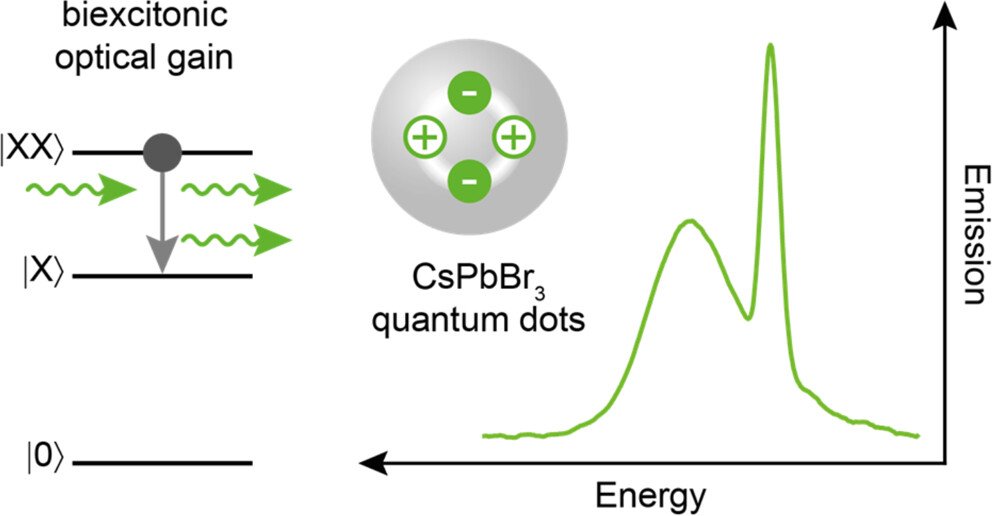
Interested in optical gain and ASE in perovskite Quantum dots, and want to understand the underlying gain mechanism? Look no further!
Read all about in our recent paper on Biexcitonic Optical Gain in CsPbBr3 Quantum Dots!
@ACSPhotonics : https://t.co/IXjw8WSGgg
Congratulations to Javier Pérez-Ramírez @catalysis_eth (D-CHAB), Maksym Kovalenko @mvkovalenko (D-CHAB) and Gisbert Schneider (D-BSSE, D-CHAB) who are among the Highly Cited Researchers 2024 selected by @Clarivate !
https://t.co/r1G3oYaYgU
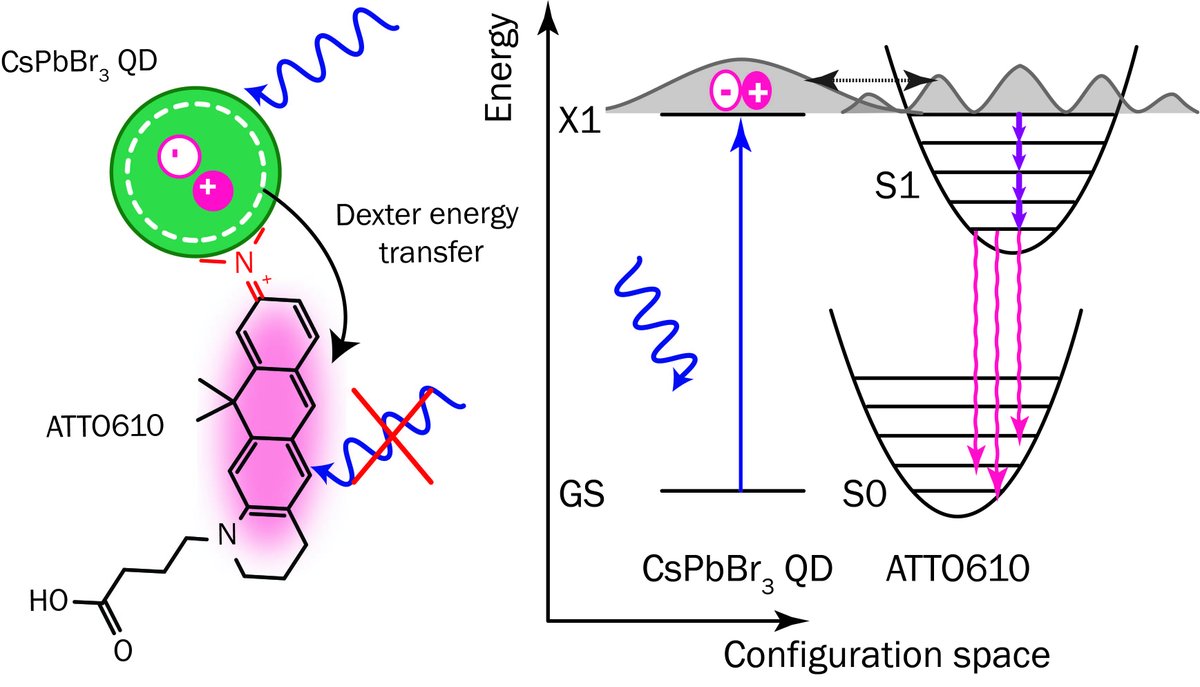
Does energy transfer from quantum dots to dye molecules require FRET (and therefor spectral overlap)? No, not when using very closely-bound dye molecules with efficient Dexter energy transfer!
Read all about it @angew_chem : https://t.co/tFE9sT7NsS
With @ivaninfante76