What's coming next? The future isn't arriving all at once. Let's explore it together.
Exploring AI, energy, climate, robotics, and the trends shaping tomorrow.
@flowersslop Kind of agree. Without a few modern conveniences, a lot still looks like 2005. But real ASI will rebuild the physical world just as fast; If we are in the dawning of ASI, that lag probably won’t last long.
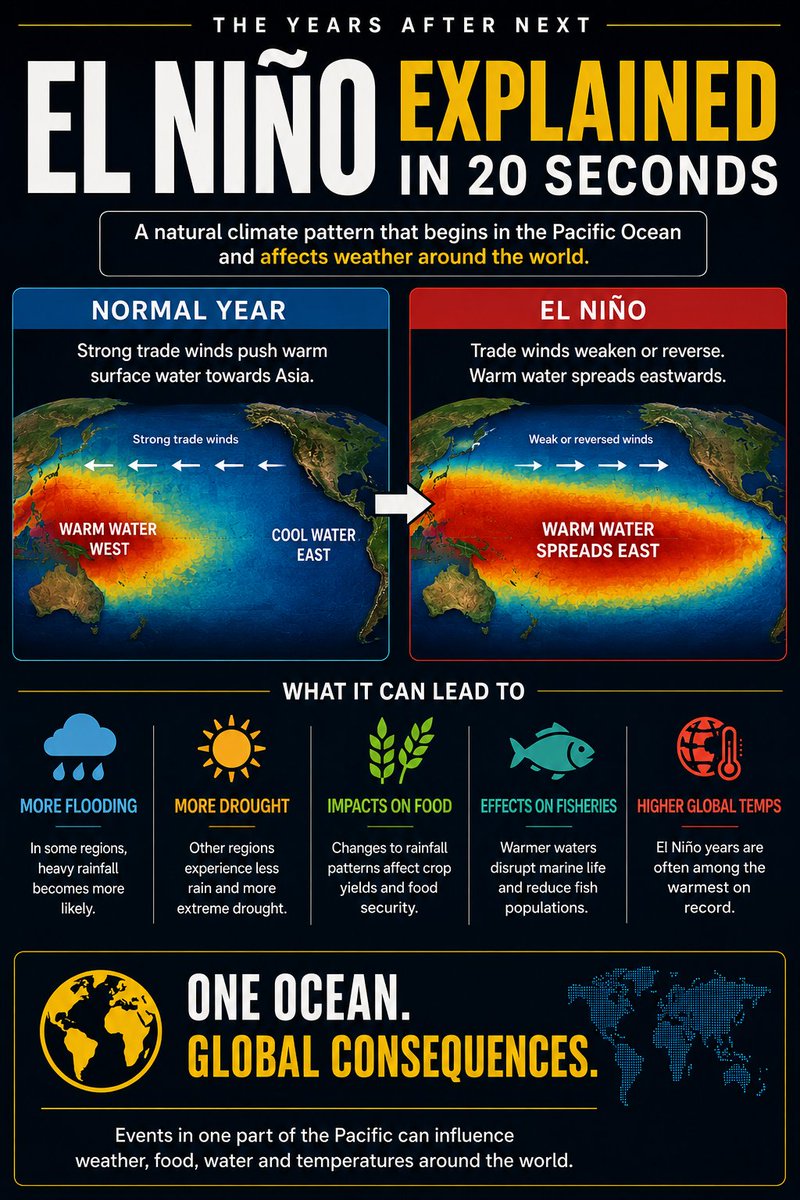
🌊 El Niño explained in 20 seconds.
El Niño isn't a storm, a hurricane, or caused by climate change.
El Niño is a natural climate pattern that begins in the Pacific Ocean.
Normally, strong trade winds push warm surface water towards Asia and Australia.
This leaves cooler water near the west coast of South America.
During an El Niño event, those winds weaken.
The warm water spreads back across the Pacific, releasing more heat into the atmosphere and changing weather patterns around the world.
The effects can include:
☔ More flooding in some regions
🔥 More drought in others
🌾 Changes to crop yields and food production
🐟 Disruption to fisheries and marine ecosystems
🌍 Higher global temperatures
El Niño doesn't cause every extreme weather event.
But it can increase the likelihood of certain weather patterns occurring worldwide.
One of the most important forces shaping global weather starts with a change in ocean temperatures thousands of miles away.
🌎 One ocean. Global consequences.
☄️One of the year's best meteor showers has officially returned.
The Perseid meteor shower is now active as Earth passes through debris left behind by Comet Swift-Tuttle, sending tiny fragments into our atmosphere at around 59 km/s (37 miles/s).
The result?
Bright streaks of light racing across the night sky.
☄️ Peak viewing is expected on August 12–13, and this year a New Moon means darker skies and better viewing conditions.
Under ideal conditions, you could see up to 100 meteors per hour.
No telescope needed.
Just find a dark spot, look up, and remember:
These "shooting stars" are actually tiny pieces of a comet burning up high above Earth.
The Perseid meteor shower might peak on August 12–13, but you can see shooting stars for at least 2 weeks either side of the peak.
@chamath Keep renting generic tools and you’ll keep getting generic outcomes.
The companies that win the next decade will treat their unique processes as IP and build around them.
Everything else is just an expensive approximation.
This is real!
A spacecraft orbiting Mars captured NASA’s Curiosity rover as a tiny bright blue speck on the surface.
The image was taken by the HiRISE camera on the Mars Reconnaissance Orbiter.
That little cyan dot is a car-sized robot exploring another world, over 140 million miles away.
Still one of the most mind-blowing views of our presence on Mars.
@NASA@NASAJPL
What hits you hardest about this?