[Guangxi Villagers Wield Knives to Halt Forced Land Seizure; Developers Escape Only After Signing Guarantee (2026.11.07)]
On November 7, in Longgui Tun, Zhe'ai Village, Yancha Township, Longlin Various Nationalities Autonomous County, Baise City, Guangxi, the local government and developers forcibly occupied villagers' land to install wind turbines. Upon hearing the news, villagers arrived at the scene armed with knives to stop the construction, nearly sparking a violent clash. Ultimately, the developers were only able to leave safely after publicly drafting a written guarantee, promising not to carry out any further construction without the villagers' consent.
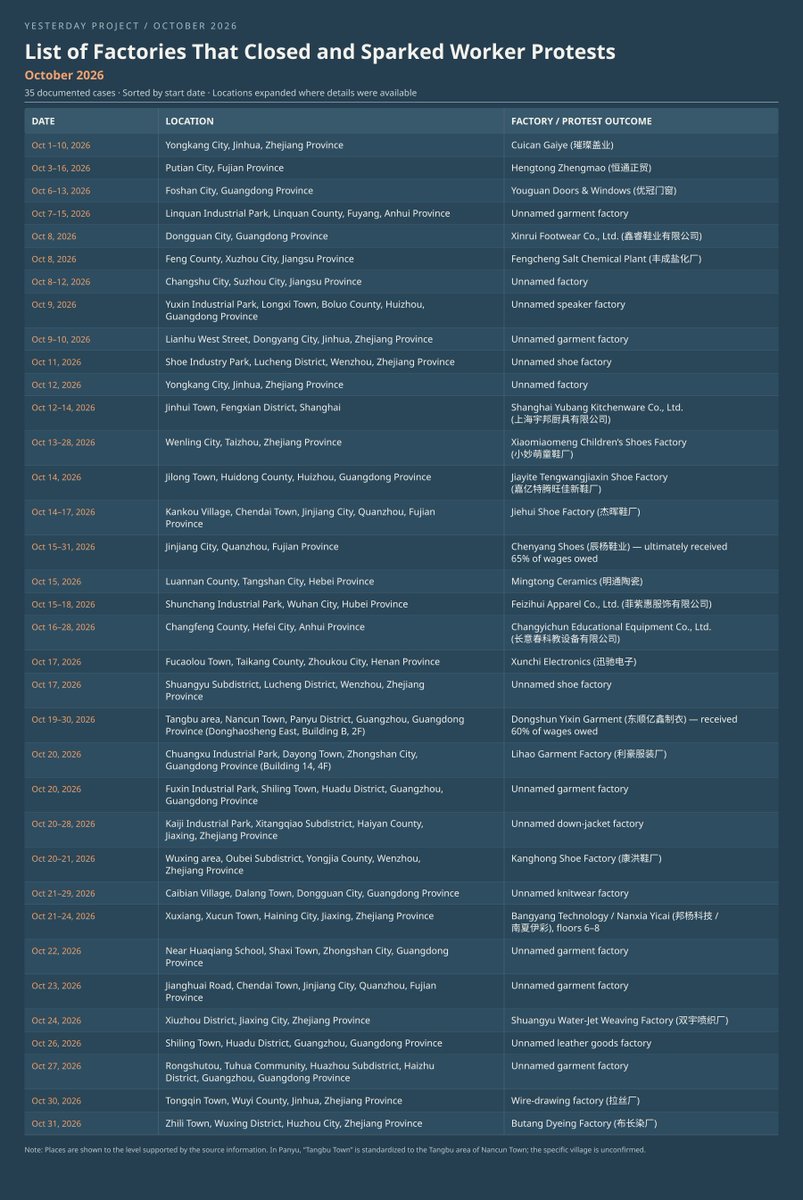
“35 Manufacturing Factories Closed, Sparking Worker Protests (October 2026)”
In October 2026, the Yesterday Project documented 35 cases in China in which manufacturing factories closed and workers protested. Each was a small factory with around 100 employees. Zhejiang and Guangdong accounted for 23 cases, about two-thirds of the total. Shoe, garment, textile, and leather factories accounted for 23 cases, more than 60%. Sixteen protests lasted more than two days; the longest lasted 17 days. Outcomes were documented in only two cases, and workers recovered only 65% and 60% of the wages owed, respectively.
Regional distribution: Zhejiang and Guangdong accounted for 23 of the 35 documented factory closures and protests over unpaid wages—about two-thirds of the total. Cases clustered in several manufacturing hubs: Jinhua had 4 (including 2 in Yongkang); Guangzhou had 4 (including 2 in Shiling, Huadu); Wenzhou had 3 shoe-factory cases; and Jinjiang, Quanzhou, had 3. Zhongshan, Dongguan, and Huizhou had 2 each.
Industry distribution: Shoe, garment, textile, and leather factories accounted for 23 cases, more than 60% of the 35 total. Garment factories, including knitwear and down-jacket factories, and shoe factories were the two largest categories, with 20 cases combined. Shoe-factory cases were concentrated in Wenzhou (3) and Jinjiang (2); garment-factory cases were concentrated in Guangzhou (3) and Zhongshan (2).
Timing and duration: By start date, mid-October (the 11th–20th) was the busiest period, with 17 cases. There were 9 cases each in the first and last thirds of the month. New protests were recorded almost every day. Nineteen cases had records for only one day; 16 lasted two days or more.
Outcomes: Outcomes were recorded in only 2 of the 35 cases. In both, workers recovered only part of the wages owed:
Chenyang Shoes, Jinjiang, Quanzhou: after 17 days of protest, workers received 65% of the unpaid wages.
Dongshun Yixin Garment, Panyu, Guangzhou: after 12 days, workers received 60%.
Both were among the longest-running cases. Outcomes were not recorded for the other 33 cases.
Data notes:
This report covers only the 35 cases in the list; the actual number may be higher.
Duration is calculated inclusively, counting both the first and last dates. “One-day record” means only that the protest was documented for one day; it does not mean that it ended that day.
Industry is classified mainly by factory name. Cuican Gaiye, which makes insulated cups, was verified and classified as hardware; Nanxia Yicai was verified as a garment factory. Three cases—those identified only as “a certain factory” or whose industry could not be determined from the name, including Hengtong Zhengmao—are classified as unclear.
Breaking: Man in Shaanxi Uses Excavator to Demolish Government Building (2026.11.09)
At noon on November 9, in Fengdong New City, Xixian New Area, Shaanxi, a man drove an excavator into the Fengdong New City Government Service Center and demolished the entrances and exterior façades of several buildings. Government staff fled in panic, and no one dared to intervene. Special police were seen at the scene. The cause of the incident and the man’s identity remain unknown.
[Xi'an Taxi Drivers Rally to Demand Fee Reductions; Protesting Driver Exposes "Rent-Seeking" Scheme (2026.11.02)]
On November 2, drivers of privately-owned taxis affiliated with Qicheng Taxi Company in Xi'an, Shaanxi Province, held a rally at the company's entrance, chanting slogans to demand fee reductions. According to one of the protesting drivers, there are over 4,000 privately-owned taxis in Xi'an that have been forced by transport authorities to officially register under various taxi companies. These companies not only extract an annual management fee of approximately 6,000 RMB per vehicle, but also force drivers to purchase their cars at prices over 20,000 RMB above market value. The driver pointedly noted that the management fees alone generate over 24 million RMB annually citywide, adding that everyone knows perfectly well whose pockets this massive sum ultimately enters, though they usually dare not speak out.
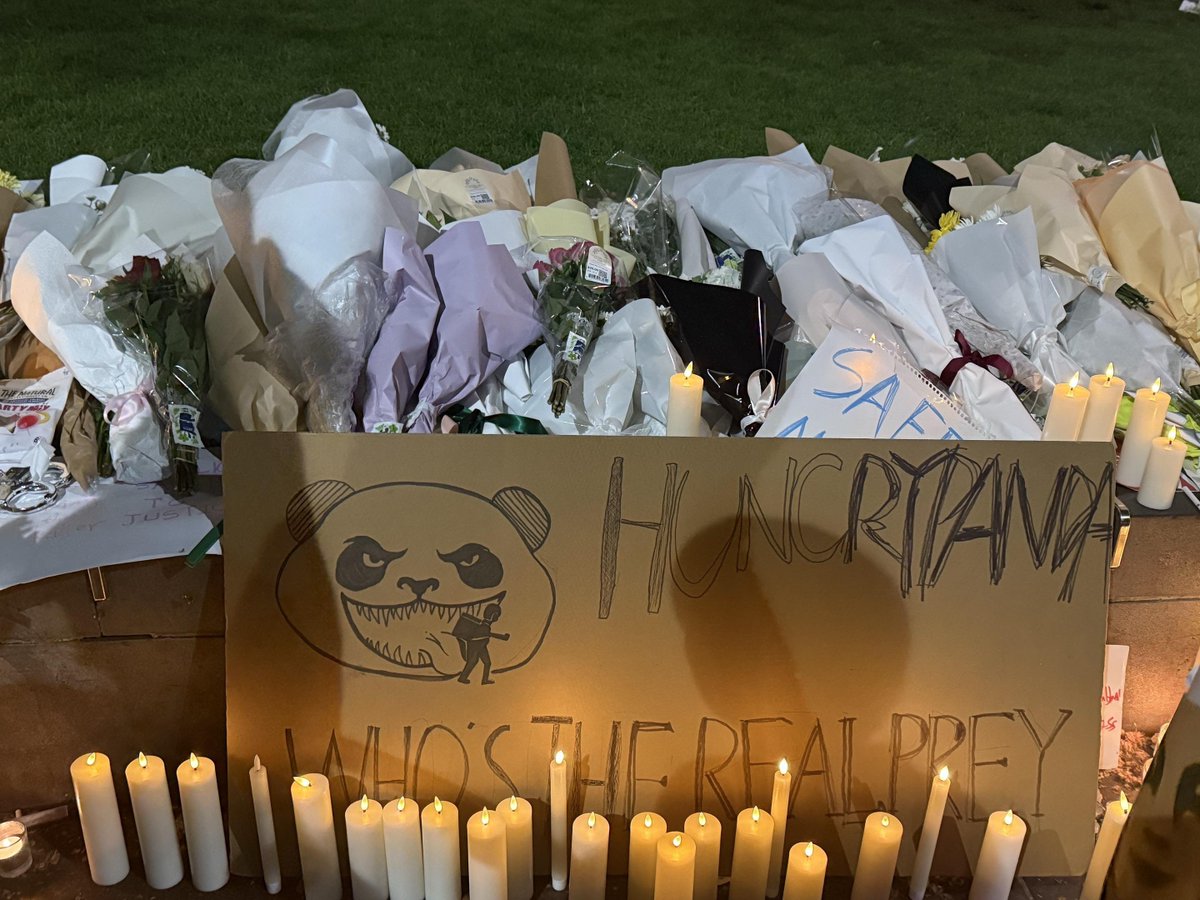
Mourners Condemn HungryPanda at Vigil for Slain Melbourne Delivery Rider (Nov. 7, 2026)
In Melbourne, Australia, mourners at a vigil for slain Chinese delivery rider Feng Jianming put up a protest sign bearing the HungryPanda logo. It read: “HungryPanda must take responsibility for the death of rider Feng Jianming. HungryPanda is the only food delivery platform that deducts pay from riders when an order is lost or spilled. Had the rider not been trying to protect the food, he would not have been killed in an impulsive attack.”
At around 8 p.m. on November 6, Feng, a 47-year-old Chinese national who delivered for HungryPanda, was working in central Melbourne when he found a man damaging his delivery e-bike. During the confrontation and argument that followed, the man pulled out a knife and stabbed Feng in the heart. Feng died of his wounds that night. Police later arrested the 51-year-old suspect.
The killing quickly sparked fierce anger among local delivery workers and the Chinese community. Protesters and fellow riders said that while mainstream Western delivery platforms in Australia treat lost or stolen orders as an operating cost, HungryPanda has long docked the pay of riders who lose or spill orders. They argued that shifting these losses onto the lowest-paid workers left riders afraid to back down in the face of danger on the street, trying to save the food and avoid a penalty, and that this ended in bloodshed.
Forced Demolition in Zhenxiong, Yunnan Drives Homeowner to Jump From Bridge; Angry Villagers Surround Government Personnel (November 5, 2026)
On November 5, in Tianshengqiao Village, Yanyuan Town, Zhenxiong County, Zhaotong, Yunnan, local authorities forcibly demolished a house that villagers were building, driving the owner to jump from a bridge in protest. The demolition sparked strong anger among local villagers, who surrounded the demolition crew for hours to demand an explanation.