$YEW is live on @ponsdotfamily
CA: 0x120c7793dfeaec2ecc7be24ac4b5d9cde3aec11f
A Mastercard that spends tokenized stocks. Your shares keep market exposure until the terminal says Approved.
Stake for zero protocol fee, up to +6pp LTV, and no fee on lending yield at top tier.
40% of stock-lane fees buy and burn.
https://t.co/rVjaas2QxM
Zero or Double.
Every purchase under $25 carries an option most cards do not offer: pay nothing at all.
Switch the toggle on. Each transaction flips a coin against a shared pool.
Zero: pool covers it entirely.
Double: you pay twice, surplus funds the next Zero.
Every flip burns card tokens regardless of outcome. Expected value across the pool holds at one. Pool funds itself through the same users drawing from it.
This function is off by default.
CoinGecko tracked $393 billion in monthly tokenized TradFi volume in June 2026. Eighteen months earlier that number was $3.46 billion.
Every dollar of it is in trading infrastructure. Binance and OKX were built to move positions between holders, not to help with a grocery purchase at a terminal.
The $393 billion represents a user base that already holds tokenized stocks. Spending layer does not exist for them yet.
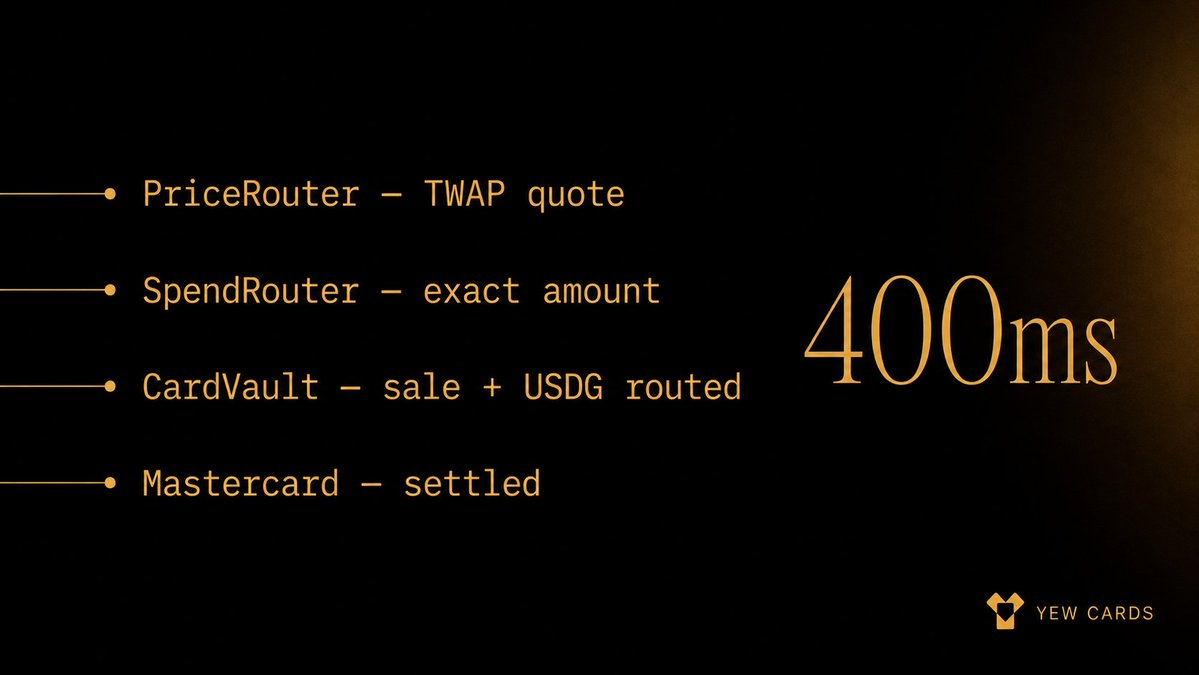
When you swipe, four things happen before the terminal prints a receipt.
PriceRouter pulls a TWAP quote for the position.
SpendRouter calculates the exact token amount needed.
CardVault executes the sale and routes USDG to the issuer.
The issuer settles with Mastercard.
This runs at 0.05 gwei with sub-second finality on Robinhood Chain. No bridge, no cross-chain message. Stock token and stablecoin settlement live on the same chain.
Your position stays in your vault, earning yield, until the terminal asks for payment.
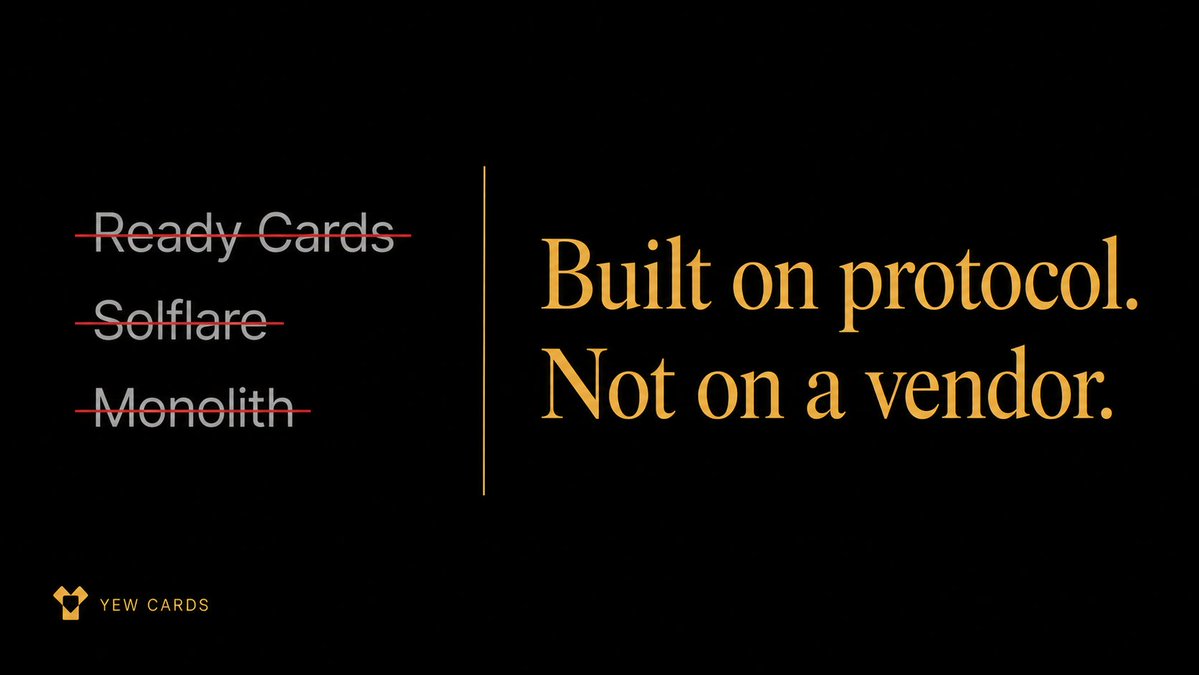
Ready Cards. Solflare. Monolith. Every major crypto card shutdown follows the same pattern.
The product rents infrastructure from a third-party issuer or BaaS provider.
When that vendor loses its banking partner or runs out of runway, every product built on top goes dark simultaneously. Users find out the same morning the founders do.
The fix is not complicated. Settlement needs to run at the protocol level. Custody needs to stay with the user. The card rail needs to be a network, not a startup with 18 months of runway.
@RobinhoodApp is that network. Yew Cards is built on top of it, not on top of a vendor.
More stocks now fund the card.
TSLA, MSFT and NVDA join AAPL. All at 0.90% taken at the swipe, all sold as an exact slice when you pay.
Deposit any of them, watch Spending Power update in dollars, keep the position until the terminal asks for it.
https://t.co/j4pa6LqIhp
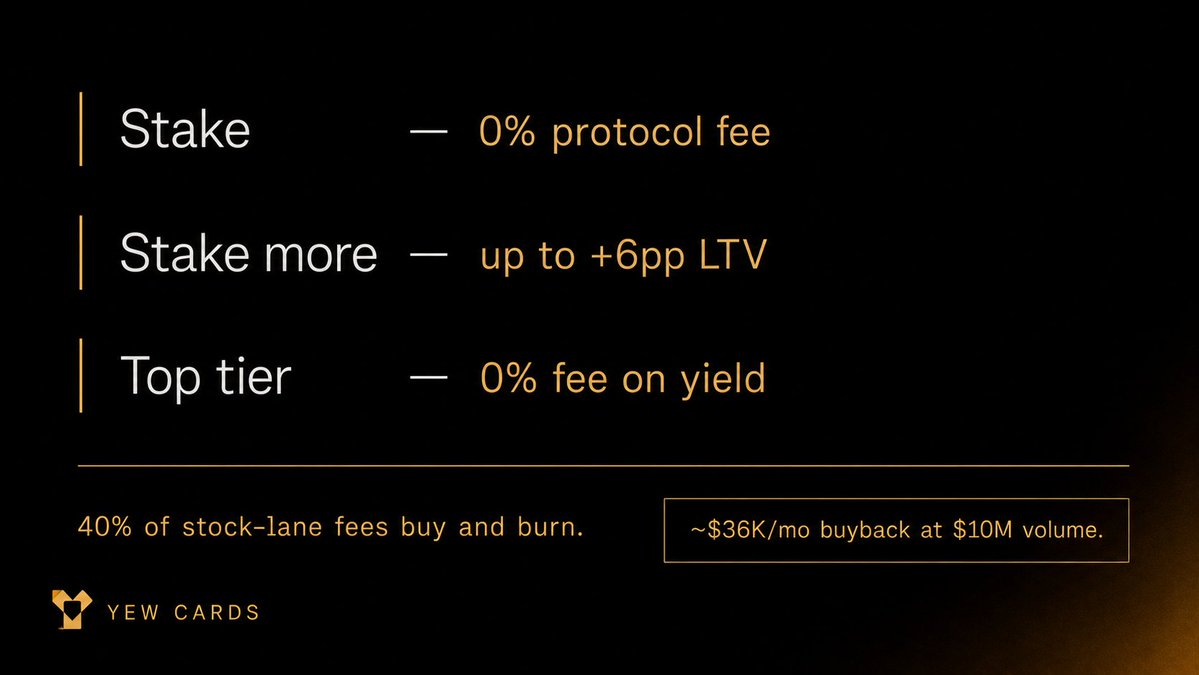
The $YEW token does three things.
Stake it: protocol fee on spending drops to zero.
Stake more: LTV rises up to six points, so the same portfolio unlocks more Spending Power.
Top tier: zero performance fee on lending yield.
Forty percent of stock-lane fees buy the token and burn it.
https://t.co/UcvfTjMnXg
$YEW is live on @ponsdotfamily
CA: 0x120c7793dfeaec2ecc7be24ac4b5d9cde3aec11f
A Mastercard that spends tokenized stocks. Your shares keep market exposure until the terminal says Approved.
Stake for zero protocol fee, up to +6pp LTV, and no fee on lending yield at top tier.
40% of stock-lane fees buy and burn.
https://t.co/rVjaas2QxM
A Mastercard backed by tokenized stocks.
Deposit AAPL, NVDA or TSLA into your vault. See Spending Power in dollars. Swipe.
The exact slice needed sells at that moment. Everything else stays in position.
Your current debit card earns 0% on the balance in it.
Yew Cards routes idle balances into lending by default.
$USDG goes into Morpho via Robinhood Earn at roughly 7% APY. Stock token positions supply lending markets at whatever utilization supports.
You hold a yield position that also swipes.
Three tiers, named after the yew bow:
Stave is the blank cut from the trunk. No stake required, $100 free-lane daily, base LTV across positions, 10% performance fee on Rings yield.
Longbow is the finished weapon. Stake the card token. Daily free-lane rises to $1,000, LTV improves by three percentage points across all position bands, Rings performance fee drops to 5%.
Warbow pulls 160 pounds. Stake more. $10,000 daily free-lane, six extra LTV percentage points, zero performance fee on yield. Rings income lands entirely in your address. Zero or Double odds shift to 58/42 in your favor.
Each tier reads without a manual.
Getting a Yew Card takes only four steps:
Connect your EVM wallet and sign in.
KYC runs through the card issuer: a standard identity check handled on their side, separate from the protocol.
Once cleared, a virtual Mastercard appears in your account within minutes.
Deposit Stock Tokens into your CardVault.
Spending Power shows in USDG at 90% of face value for major equity positions.
Turn on Rings if you want idle balances earning in lending while they wait. From there, pay at any Mastercard terminal globally.
Physical card ships on request. The virtual card covers every online purchase and Apple Pay merchant from day one.
@Vladtenev, Robinhood CEO, called tokenized stocks a freight train that cannot be stopped.
NYSE and NASDAQ co-signed that view earlier this year. CoinGecko reported $393 billion in monthly TradFi volume across six exchanges in June alone, up from $3.5 billion eighteen months ago.
All of it sits in trading accounts earning nothing and spending nowhere.
A card that spends those stocks at point of sale has not existed until now.
MetaMask Card converts your ETH to fiat before the purchase lands.
https://t.co/TE1b93GEyQ gates its useful tiers behind staking their native token. Nexo charges interest on the credit line sitting under your position.
Yew Cards starts from a cleaner premise. Stock tokens sit in your vault as equity-linked instruments until the exact moment of sale.
Stablecoins and stock positions both route into lending markets and earn yield while they wait.
No pre-conversion or mandatory token stake to access the core product. Your competitors built workarounds and called them features.
Yew starts where those workarounds end.
CoinGecko published a 22-page report this week alongside MEXC. Eighteen months of data across six major exchanges.
Tokenized TradFi assets on crypto exchanges grew 366%, from $1.41 billion in January 2025 to $6.59 billion by June 2026.
Monthly trading volume across those platforms rose from $3.46 billion to $393.15 billion in the same window.
US stocks overtook precious metals as the largest category in June, with monthly volume up 337% to $189.84 billion, driven by semiconductor stocks and SpaceX IPO speculation.
None of that volume is spendable.
Every dollar of tokenized stock on Binance or OKX exists for trading. Converting a position into a purchase at a real terminal requires steps those platforms were never built to handle.
Yew Cards is coming soon to let you spend!
https://t.co/9ERE2oboZp