🚀 Excited to share our paper: ANTE — Anticipate, Then Execute 🤖
📄 Learning Internal World Models for Coding Agents from Verified Beliefs
Coding agents have come a long way. They can read an unfamiliar repo 📂, implement a feature end to end 🛠️, and keep going for hours on “marathon” SWE tasks ⏳. But we think one ability is still missing: foresight 🔮
Most agents act first and only look at the result afterwards 😬. They rarely say what they expect an action to do before running it. Physics has worked the other way for centuries ⚛️. As Richard Feynman put it: “First we guess it. Then we compute the consequences of the guess… If it disagrees with experiment, it's wrong.”
🤔 What if a coding agent did the same?
Introducing ANTE (Anticipate, Then Execute): an agentic RL framework that verifies the policy's pre-action predictions ✅
Three key ideas 💡
1️⃣ Internal belief (a world model) 🧠: before each action, the policy writes down what it expects: a short state summary 📝, a predicted outcome 🎯, and a decision to trust that prediction or abstain ⚖️
2️⃣ BAPO (Belief-Anchored Policy Optimization) 🏅: execution checks every forecast, and each verified forecast earns its step credit, beyond the final task reward 📈
3️⃣ ANTE-TTO ⚡: at test time, when the policy abstains or predicts failure, it samples alternative actions, ranks them by its own forecasts, and runs the best one, with no external scorer 🎯
📊 Results: ANTE beats the matched RL baselines at every scale on SWE-bench Verified and on every terminal benchmark 🖥️, leads on all 11 out-of-distribution benchmarks (+6.2 points on average) 🌍, and ANTE-TTO costs a tenth of best-of-4 sampling per point gained 💸
🎬 The whole story in 3 minutes: A code world model that knows what has happened, what holds now, and what the next action will achieve.
📄 Paper: https://t.co/lPHCYLDiFY
🤗 HuggingFace: https://t.co/wlwyl4XHM9
🌐 Project page: https://t.co/7VM3ZyRujW
▶️ Video: https://t.co/dj8TtXU1cA
🙏 Joint work with Kangrui Ruan, Jifan Chen, Manish Prajapat, Christian Bock, Xiaoyang Wang, Rein Houthooft, Aritra Sengupta and Varun Kumar at Amazon AWS. Grateful to the whole team! 💪
🧵 Paper highlights in the replies 👇
#AI #CodingAgents #ReinforcementLearning #LLM #SWEbench
We introduce 3D World Simulator, an interactive world model that runs at 50+ FPS on an RTX 5090.
Our model predicts in a unified 3D representation space, capable of generating:
• Novel view appearance
• Multi-view consistent RGB-D
• 3D geometry
• Spatially aligned tactile signals
Play with the world model now at https://t.co/eveClAxURp!
Your coding agent kills your teammate's running jobs on the shared cluster. All it says is: "I'm sorry, you're absolutely right!"
Your agent pulls 200 GB of Docker images, fills your disk, and only then notices it can't run a single bash command.
Sound familiar? 📷
🔭 We envision agents whose beliefs span their environment's past, present, and future, acting on what they anticipate and learning from what execution reveals.
📄 https://t.co/XDb53cHJ8H
🤗 https://t.co/5TLiMZj5ia
🌐 https://t.co/oFx39TidZz
🙏 Thanks to the whole team 💪
🚀 Excited to share our paper: ANTE — Anticipate, Then Execute 🤖
📄 Learning Internal World Models for Coding Agents from Verified Beliefs
Coding agents have come a long way. They can read an unfamiliar repo 📂, implement a feature end to end 🛠️, and keep going for hours on “marathon” SWE tasks ⏳. But we think one ability is still missing: foresight 🔮
Most agents act first and only look at the result afterwards 😬. They rarely say what they expect an action to do before running it. Physics has worked the other way for centuries ⚛️. As Richard Feynman put it: “First we guess it. Then we compute the consequences of the guess… If it disagrees with experiment, it's wrong.”
🤔 What if a coding agent did the same?
Introducing ANTE (Anticipate, Then Execute): an agentic RL framework that verifies the policy's pre-action predictions ✅
Three key ideas 💡
1️⃣ Internal belief (a world model) 🧠: before each action, the policy writes down what it expects: a short state summary 📝, a predicted outcome 🎯, and a decision to trust that prediction or abstain ⚖️
2️⃣ BAPO (Belief-Anchored Policy Optimization) 🏅: execution checks every forecast, and each verified forecast earns its step credit, beyond the final task reward 📈
3️⃣ ANTE-TTO ⚡: at test time, when the policy abstains or predicts failure, it samples alternative actions, ranks them by its own forecasts, and runs the best one, with no external scorer 🎯
📊 Results: ANTE beats the matched RL baselines at every scale on SWE-bench Verified and on every terminal benchmark 🖥️, leads on all 11 out-of-distribution benchmarks (+6.2 points on average) 🌍, and ANTE-TTO costs a tenth of best-of-4 sampling per point gained 💸
🎬 The whole story in 3 minutes: A code world model that knows what has happened, what holds now, and what the next action will achieve.
📄 Paper: https://t.co/lPHCYLDiFY
🤗 HuggingFace: https://t.co/wlwyl4XHM9
🌐 Project page: https://t.co/7VM3ZyRujW
▶️ Video: https://t.co/dj8TtXU1cA
🙏 Joint work with Kangrui Ruan, Jifan Chen, Manish Prajapat, Christian Bock, Xiaoyang Wang, Rein Houthooft, Aritra Sengupta and Varun Kumar at Amazon AWS. Grateful to the whole team! 💪
🧵 Paper highlights in the replies 👇
#AI #CodingAgents #ReinforcementLearning #LLM #SWEbench
💸 What does test-time foresight cost? ANTE-TTO resamples only at trigger steps and executes exactly one candidate: 1/10 of best-of-4 sampling and 1/17 of best-of-8 per point gained; 1.6× the tokens of a single greedy run (§4.4, Fig. 4) ⚖️
Introducing T1: Terminal Agent Reinforcement Learning for Long-Horizon Tasks—a 122B MoE with 10B active parameters, trained to operate a real terminal across 300+ tool-call turns.
On Terminal-Bench 2.1: 43.8% base → 49.4% SFT → 64.0% T1, with post-train achieving a 46.1% relative gain. T1 also reaches 27.9% on Long-Horizon Terminal-Bench, surpassing GLM-5.1.
Our core lesson: A failed terminal task can contain substantial progress. Whether RL can learn from it depends on the entire training pipeline: we use PPO to train on 15K audited tasks with per-assertion verification to reward that progress and a warm-started critic for credit assignment. TITO and rollout routing replay preserve sampled tokens and expert choices during training to stabilize staleness.
This echoes DeepSeek-V4.1’s observation: better data and environment pipelines can unlock substantial gains with established RL methods.
📄 https://t.co/HER1lpfEFL
🚀 Thrilled to share that our paper “Multi-Crit: Benchmarking Multimodal Judges on Pluralistic Criteria-Following” has been accepted to #CVPR2026!
📄 Paper: https://t.co/laQyi4aOVs
🌐 Project: https://t.co/rNgSaodenO
💻 Code: https://t.co/0wcrTRelpf
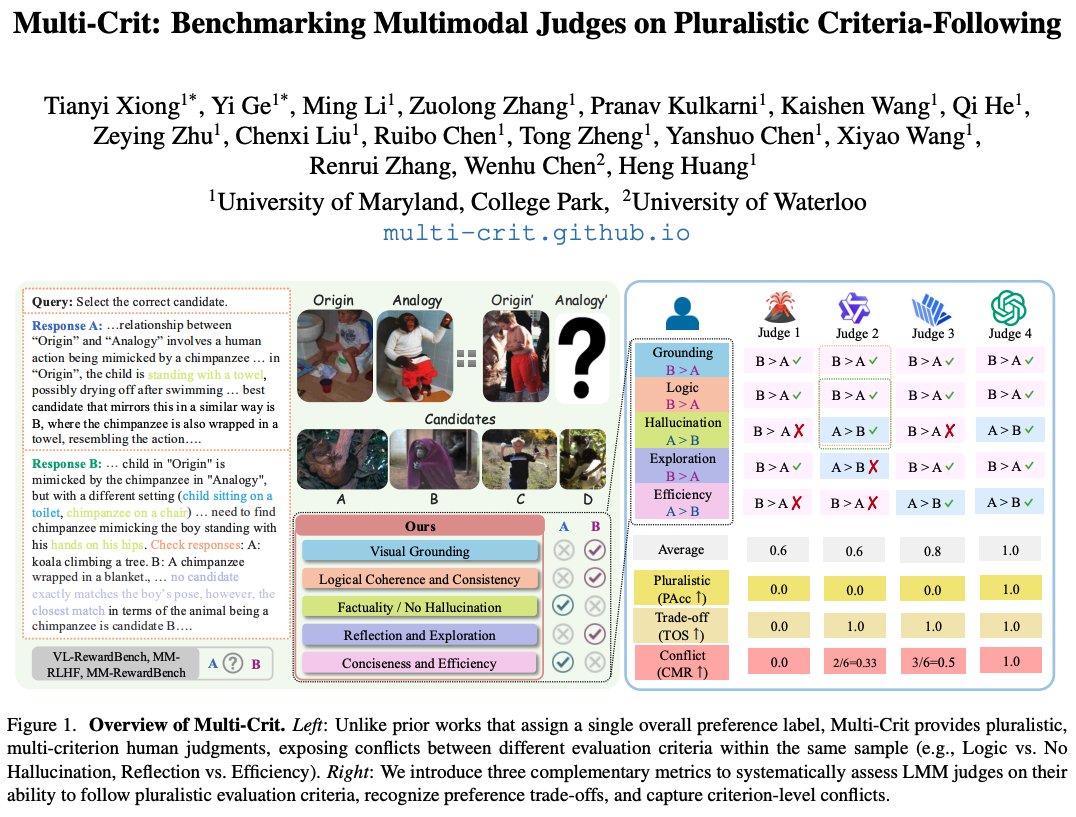
Existing reward benchmarks assign a single overall preference to a pair of responses. But this overlooks a key question:
👉 Can multimodal judges follow diverse evaluation criteria, especially when two responses have conflicting strengths?
🧠 Multi-Crit is a benchmark designed to evaluate whether multimodal judges can truly follow pluralistic evaluation criteria and capture criterion-level preference conflicts:
📊 425 multimodal prompts & response pairs
🗳️ 1,425 criterion-level human preference annotations
⚖️ 782 conflicting criterion pairs
🧪 Covers judgments in both open-ended generation and verifiable reasoning
📐 3 complementary metrics to measure whether judges follow all criteria, recognize trade-offs, and resolve conflicts correctly.
🔎 Key Findings:
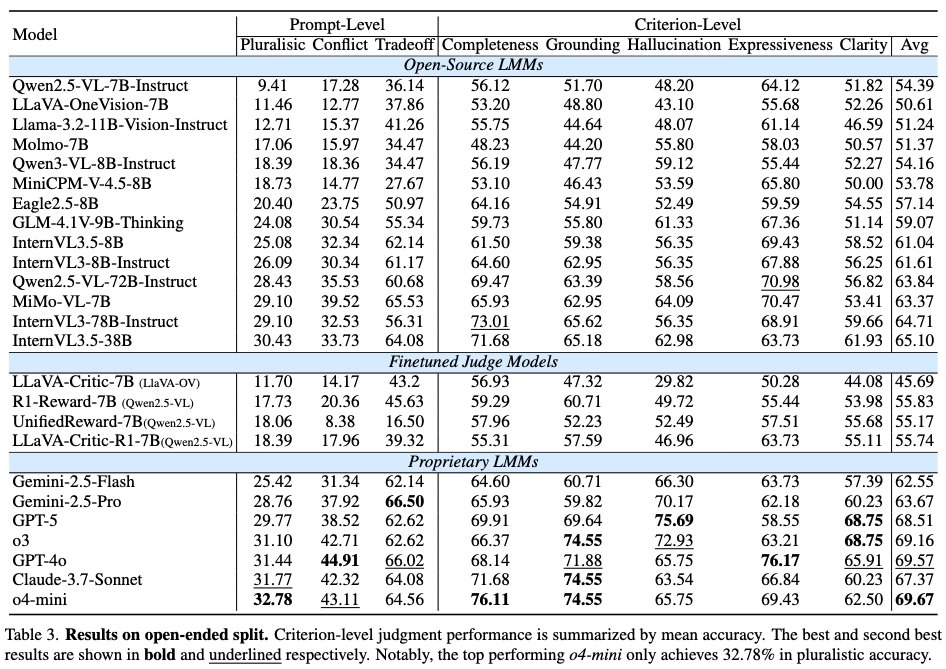
🔹 Even proprietary models (e.g., o4-mini, Claude-3.7-Sonnet) struggle with pluralistic criteria-following, achieving 32.78% in open-ended and 53.17% in reasoning judgments.
🔹 Open-source LMMs lag further behind, particularly in recognizing trade-offs and resolving criterion-level preference conflicts.
🔹 Current critic training based on holistic preferences improves visual grounding judgments, but generalizes poorly to pluralistic, multi-criterion evaluation.
Much remains to be explored in building truly reliable and steerable multimodal evaluation systems🛸
🚀 Thrilled to share that our paper “Multi-Crit: Benchmarking Multimodal Judges on Pluralistic Criteria-Following” has been accepted to #CVPR2026!
📄 Paper: https://t.co/laQyi4aOVs
🌐 Project: https://t.co/rNgSaodenO
💻 Code: https://t.co/0wcrTRelpf
Existing reward benchmarks assign a single overall preference to a pair of responses. But this overlooks a key question:
👉 Can multimodal judges follow diverse evaluation criteria, especially when two responses have conflicting strengths?
🧠 Multi-Crit is a benchmark designed to evaluate whether multimodal judges can truly follow pluralistic evaluation criteria and capture criterion-level preference conflicts:
📊 425 multimodal prompts & response pairs
🗳️ 1,425 criterion-level human preference annotations
⚖️ 782 conflicting criterion pairs
🧪 Covers judgments in both open-ended generation and verifiable reasoning
📐 3 complementary metrics to measure whether judges follow all criteria, recognize trade-offs, and resolve conflicts correctly.
🔎 Key Findings:
🔹 Even proprietary models (e.g., o4-mini, Claude-3.7-Sonnet) struggle with pluralistic criteria-following, achieving 32.78% in open-ended and 53.17% in reasoning judgments.
🔹 Open-source LMMs lag further behind, particularly in recognizing trade-offs and resolving criterion-level preference conflicts.
🔹 Current critic training based on holistic preferences improves visual grounding judgments, but generalizes poorly to pluralistic, multi-criterion evaluation.
Much remains to be explored in building truly reliable and steerable multimodal evaluation systems🛸