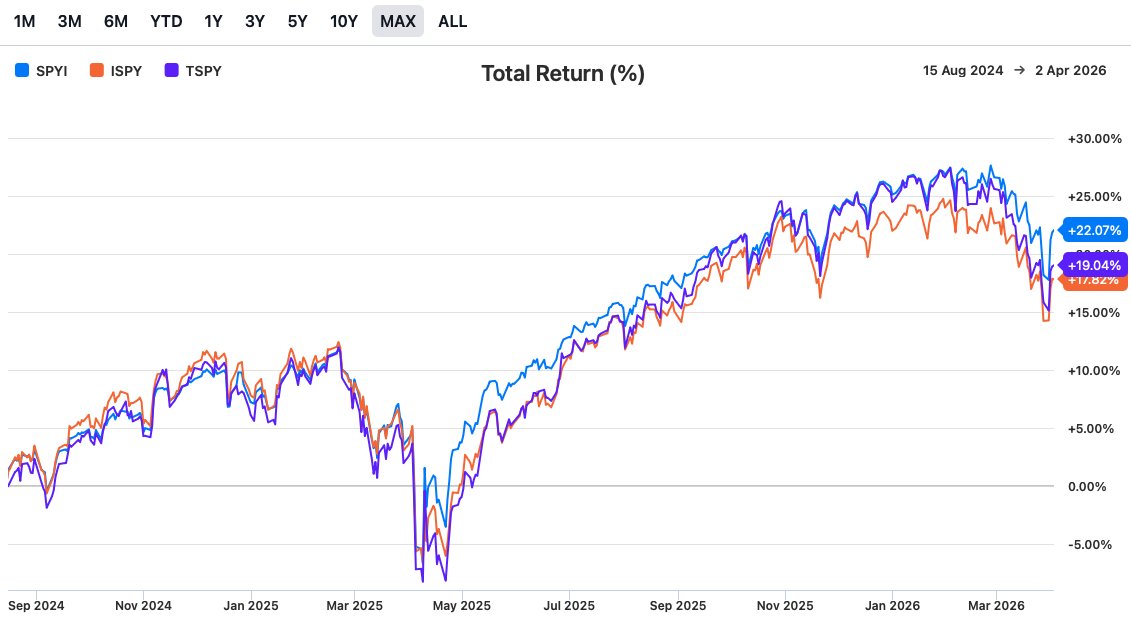
Everything has its tradeoffs.
$ULTY: 85% yield, -15% NAV
$YMAX: 45% yield, -9% NAV
$QQQI: 14% yield, +10% NAV
$BTCI: 28% yield, +14% NAV
Pulling back the curtain over the last 6 months reveals a few things:
1. All of these funds do well in bull markets (each beat $VOO over the same time period)
2. Reinvesting dividends is crucial for YieldMax
3. Volatility cuts both ways
If the S&P 500 is down 20%, expect these funds to be down 25-30%.
Either way, it's fantastic that products like this exist and it's changing the game for people who want to live financially free out of their portfolio.
Three things to plan for before investing in a high yield fund:
1. When to enter
2. What to do with distributions
3. When to exit
Everything else is noise.
I heard a friend say he'd be happy to own 6 different covered call ETFs on SPY because they all have a slightly different strategy.
I think it's too complex.
If they're just doing covered calls, the difference is pretty negligible. Why not do some digging up front, pick your favorite one, and move on with life?
An important question to understand in income investing:
Do you need your principle to appreciate?
If you do, you either need to invest in lower yielding funds or have a plan for reinvesting distributions to maintain your NAV.
There's this notion that we're running out of time.
It's not hard to see why...
AI tools are replacing workers at scale.
Companies are choosing profits over people.
The physical implementation of AI has begun.
All roads are leading to the same place.
Here's how I think about my different investment accounts 👇🏼
Roth IRA: Safe diversified Vanguard funds. Max out every year I'm eligible
Traditional IRA: Cherry on top of Roth. Leftover 401k match from previous jobs. Tracks the market ($VOO)
Taxable: Balance cash flow & growth. Take risks but don't blow up the account.
This approach has helped me earn more than $VOO in up markets and lose less than $VOO in down markets.
One underrated aspect of investing in income ETFs is you can dial in your allocation.
Can I run options myself?
Absolutely.
But 1 contract on SPY locks up $65,000 per trade.
That is way too big a percentage of my portfolio.
With $SPYI, I can confidently allocate the exact percentage I need without needing a million dollar portfolio.
Will a higher VIX equate to higher returns in income ETFs?
I don't believe they will.
When VIX is high, there's mass uncertainty, like we saw with Liberation Day last year when the market dropped 12%.
And when your underlying drops, so does your NAV.
The extra premium you get for high volatility isn't enough to make up the difference.
I'm not fully convinced we're out of this bear market.
Bought some portfolio insurance this afternoon just in case things don't pan out as expected.
I hope it doesn't come into play, but now I'm prepared regardless of what the markets do.
Right now is the best time to be an income investor.
You can make money on the way up, on the way down, and everywhere in between. The tools are there - you just have to know how to use them.
Five years ago, this wasn't accessible to everyday investors.
@randrewcworth@WOLF_Financial It was definitely worth tuning in!
It’s great to hear different takes on how people are using these funds and what they see in the markets
I’ll be there again next time 👌🏼
My $0.02 on the market today:
While it's great to see we've clawed back from the abyss, the short-term RSI is showing we're close to overbought and we're still well within the downtrend zone.
From what I can see, the Iran-US Conflict can still cause more pain. The recent news of Iran's new regime president is positive. But as the saying goes, "it ain't over until the fat lady sings."
And she ain't singing yet.
After all, it is April 1st, so don't be fooled 😉