Compare crypto earn & borrow rates across 37 platforms + DeFi. Every venue graded A–F for safety. Base rates only — never promo teasers. Free, 4 languages.
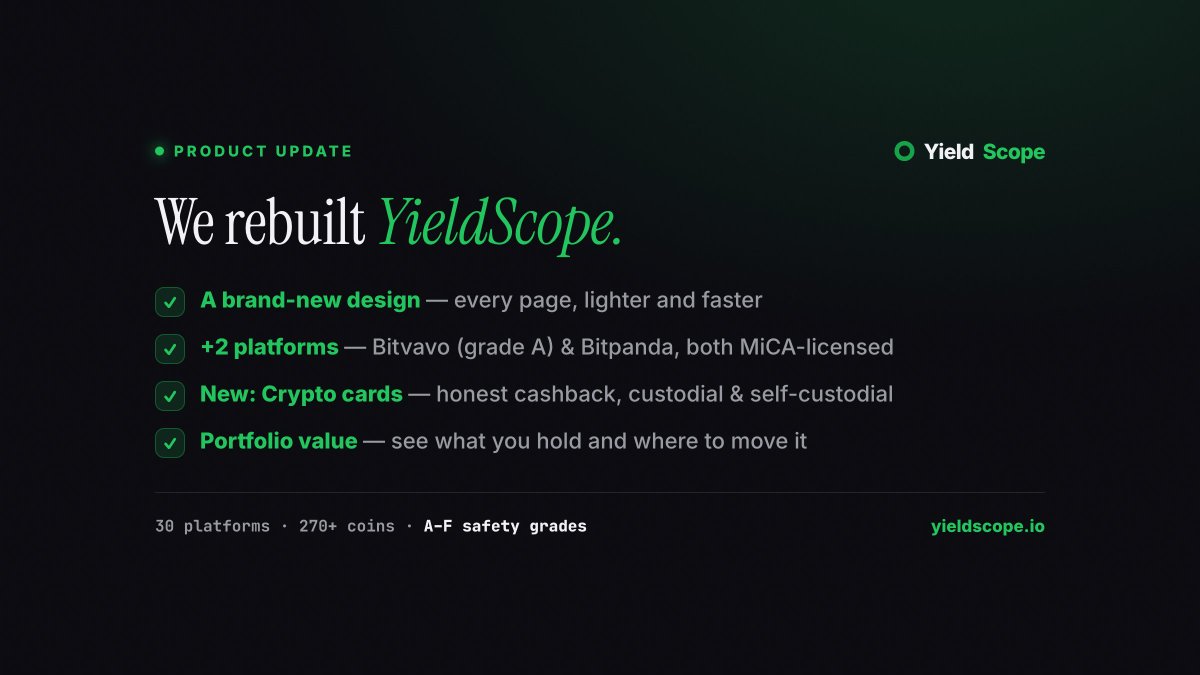
🚀 We rebuilt YieldScope from the ground up.
Same mission — every crypto rate, ranked by who you can trust — now cleaner, faster, and with a few big additions:
🎨 A brand-new design across every page
🏦 +2 platforms: Bitvavo (grade A) & Bitpanda — both MiCA-licensed
💳 New: Crypto cards — honest cashback (the base rate AND the real catch), custodial & self-custodial
📊 Portfolio value — see what you hold and where it earns more, safely
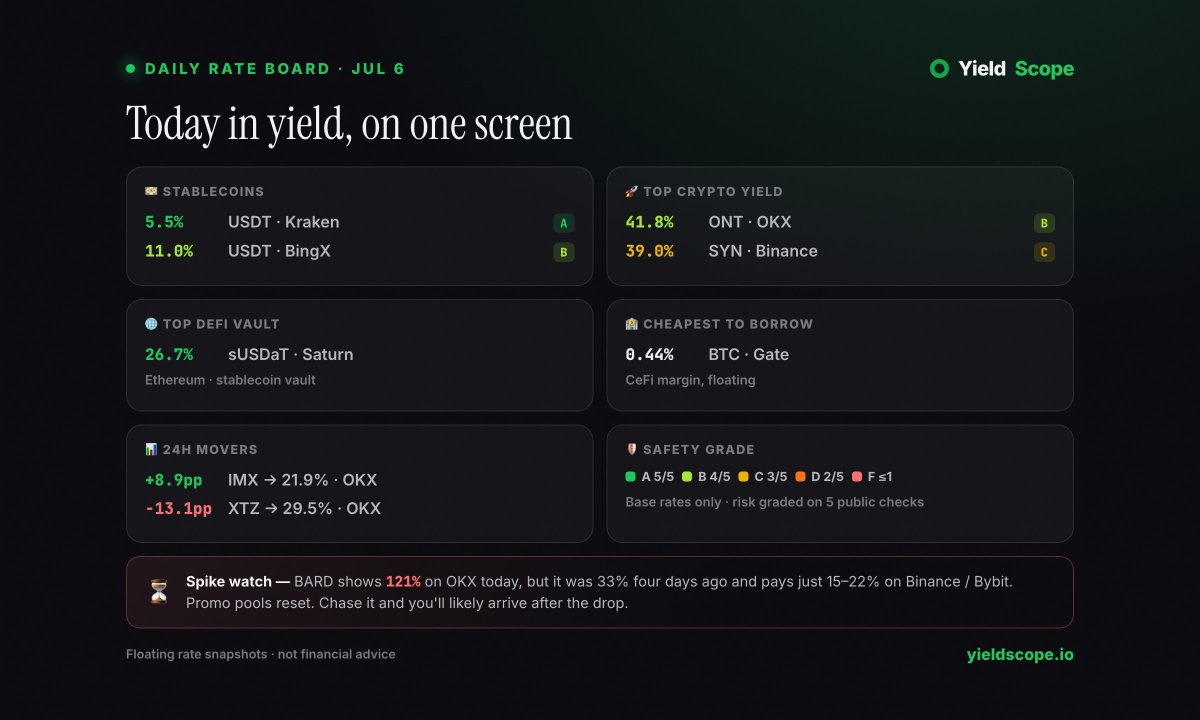
🚨 121% APY on BARD (OKX) right now.
Before you rush in — the catch:
⏳ it was 33% four days ago
🔻 the same coin pays 15–22% on Binance & Bybit
📉 promo pools reset — chase the headline, arrive after the drop
The boring truth for today:
🟢 Safest stablecoin: 5.5% USDT on Kraken (grade A)
🟡 Higher risk: 11% USDT on BingX (grade B)
We grade and track every rate so a spike can't fool you. Full board 👇
👉 https://t.co/Lw2Ag1Ri6P
Not financial advice.
#crypto #DeFi #stablecoins #passiveincome
🚨 $351.6M just left Bitget's hot wallets. Withdrawals are still frozen.
Until yesterday it was the only exchange on our board that passed all 5 safety checks AND paid on flexible stablecoins. Now it's B-rated.
(Our grades work like a school report card: A is safest, F means avoid.)
What we know (Sep 25):
🕕 Sep 24, 18:31 UTC — unauthorized transfers from parts of the hot and warm wallets
💸 About $351.6M gone
🧊 Cold wallets untouched
🛡️ Bitget says its User Protection Fund ($464M+) covers the loss
⛔ Withdrawals suspended, no date to resume
🐢 Crypto deposits are being credited late
📄 A root-cause report is promised within 24 hours
What we did:
📉 Grade A → B: the track-record check fails. We graded Bybit the same way after its $1.5B hack in 2025 — even when users are made whole, the hack stays on the record.
🔗 We pulled our Bitget sign-up link from the whole site until withdrawals are back. Rates stay up for reference.
Both sides:
✅ The fund is bigger than the loss, cold wallets are intact, and Bitget disclosed the hack within 3 hours.
⚠️ While withdrawals are frozen, "funds are safe" can't be verified. And if the whole loss is paid from the fund, about $112M would be left in it unless Bitget tops it up.
Already have funds on Bitget? Follow official channels only. After hacks, "withdrawal helpers" show up in DMs — they're scammers.
Planning to deposit? Wait until withdrawals resume and the report is out.
Should an exchange lose its grade for a hack it fully covered? 👇
Not financial advice.
#Bitget
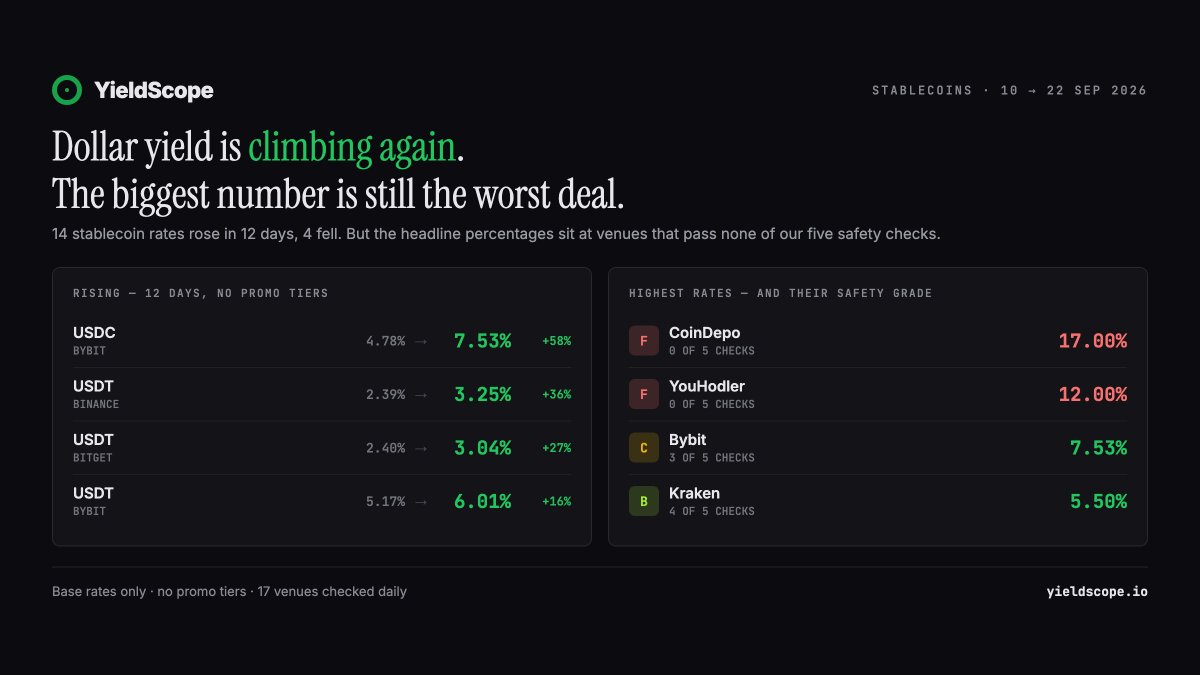
💵 Dollar yield is climbing again — quietly, on the boring venues.
Over the last 12 days we logged 14 stablecoin rates going up and only 4 going down. No announcements, no promo banners. Just the base rate drifting higher:
🟢 USDC on Bybit — 4.78% → 7.53% (+58%)
🟢 USDT on Binance — 2.39% → 3.25% (+36%)
🟢 USDT on Bitget — 2.40% → 3.04% (+27%)
🟢 USDT on Bybit — 5.17% → 6.01% (+16%)
Now the part nobody puts in a headline 👇
The highest stablecoin numbers on our board right now are 17% and 12%. Both are paid by venues that pass ZERO of our five safety checks — no regulation, no proof of reserves, no insurance, no clean track record.
Here's the same list sorted by grade instead of by percentage:
🔴 CoinDepo — 17.00% — grade F (0/5)
🔴 YouHodler — 12.00% — grade F (0/5)
🟡 Bybit — 7.53% — grade C (3/5)
🟢 Kraken — 5.50% — grade B (4/5)
A rate is only half the number. The other half is who is holding your money 🔍
All 17 venues, rechecked daily → https://t.co/16ou3oYJTJ
Not financial advice.
#crypto #stablecoins #USDT #USDC #passiveincome
🧪 We publish rates as high as 365% a year. So we did the obvious thing and asked what would have happened if you had simply taken them.
$10,000. 97 days. Every exchange we track. No filter, no cleverness — each day, the biggest number on our own board.
Then we ran it three times, changing one thing: how long you hold before switching.
🔴 Hold at least 7 days — minus 98.9% a year
🔴 Hold at least 14 days — minus 74.3%
🔴 Switch whenever it pays — minus 11.1%
⚠️ Every version lost money.
💡 And the rates were not fake. In the best of those runs the advertised rate genuinely paid **+111% over 96 days**. The token price took −54% in that same run and swallowed all of it.
🪙 Take LAB, the loudest number on our board this summer: 412% a year. Hold $10,000 for a month and the rate does exactly what it promised — you end the month with **40% more coins** than you started with.
In that same month the coin's price fell **99%**.
More coins, each worth a hundredth of what it was. Your $10,000 is now **$140**.
That is what people add up wrong. The rate grows the NUMBER of coins you own. The price sets what one coin is worth. Your money is the two multiplied together — never added.
📉 It was not one unlucky token. Thirty coins touched 300%+ on our board. Over the month after that rate appeared:
🔻 median price move — minus 18.7%
🔻 22 of the 30 ended lower
🔻 the worst, LAB, fell 99.0%
🧮 The four loudest, $10,000 held for one month — what the rate added, what the price did, what was left:
• LAB — 412% a year → +40% more coins → price −99.0% → **$140 left**
• BANK — 365% → +35% more coins → price −80.3% → **$2,655 left**
• GWEI — 365% → +35% more coins → price −71.6% → **$3,828 left**
• TUT — 306% → +28% more coins → price −60.5% → **$5,074 left**
🧊 Now the run nobody screenshots. Stablecoins only, dollar for dollar, no price exposure — and only on exchanges that pass our safety checks:
✅ +6.3% a year
✅ not one losing day in 97
✅ $164 on $10,000 over the period
⚖️ That condition matters, so we will state it plainly. Our board carries far bigger stablecoin numbers than 6.3%. CoinDepo pays 17% on USDT right now. https://t.co/amamyi6lAj advertises 29.5% — locked for 360 days. Both of them pass **zero of our five safety checks**: no licence, no proof of reserves, no insurance fund, no clean track record, no withdraw-any-time.
Run the same stablecoin strategy with those included and it returns 15.1% a year — spending two thirds of the period parked on a venue that passes none of our checks. The rate is real. Whether the money comes back is the question nobody can answer for you.
🎯 A 365% rate is not a lie and it is not income. It is what a token has to offer when it is falling fast enough to need it. The number you can actually keep is small, boring, and denominated in dollars.
📌 Honest limits: our rate history is 97 days, not a year. This is a backtest on what we recorded, not a forecast, and no market-wide crash falls inside the window — on 7 Oct 2025, 73% of coins dropped 20%+ in a week.
📊 Every rate we track, with a safety grade on each: https://t.co/16ou3oYJTJ
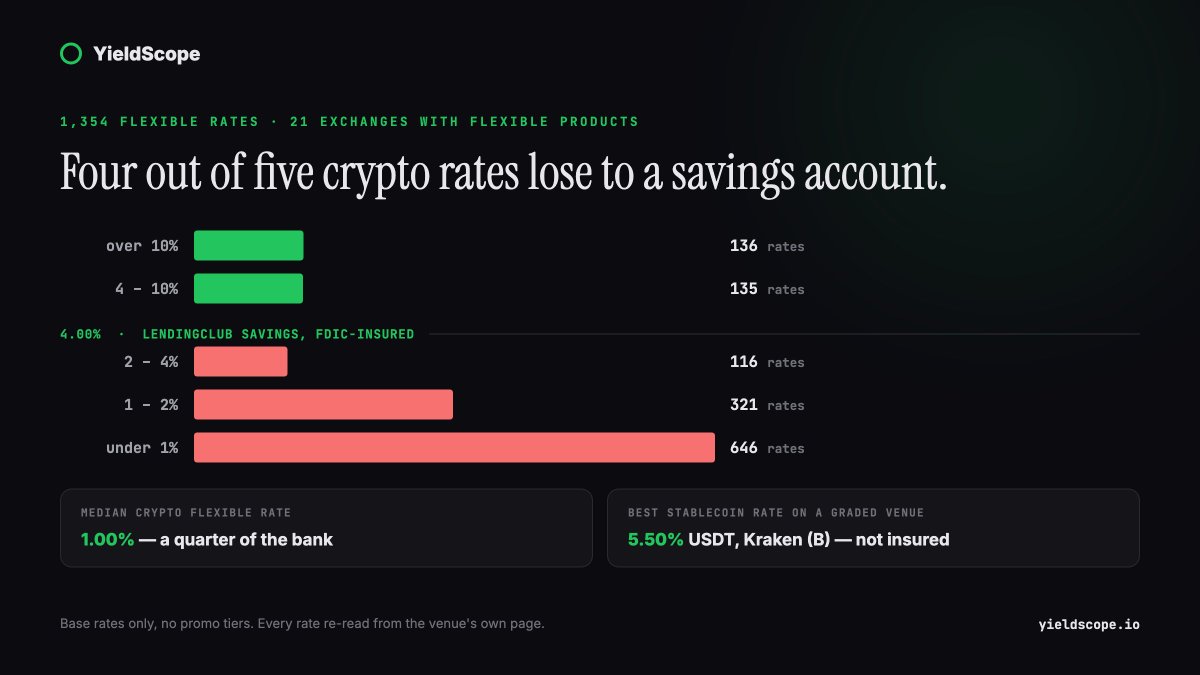
🏦 "Crypto pays more than a bank" is the whole industry's opening argument. We took all 1,354 flexible rates from 21 exchanges and tested it against one boring savings account.
📉 The benchmark: 4.00% at LendingClub. No conditions, no tiers, FDIC-insured.
📐 One note on how we count. We compare flexible, withdraw-anytime products only. We track 37 venues in all, but on 16 of them everything is staking or a fixed term — and tying your money up for 30 days is not what a savings account does. That leaves 21 venues and 1,354 rates.
Here is how the entire board falls:
🔴 under 1% APY — 646 rates
🔴 1 to 2% — 321 rates
🔴 2 to 4% — 116 rates
🟢 4 to 10% — 135 rates
🟢 over 10% — 136 rates
💥 262 rates out of 1,354 beat the bank. That is one in five.
📊 The median rate on the whole crypto board is exactly 1.00%. A quarter of the savings account.
⚖️ And now the fair comparison — dollar against dollar, stablecoins only. We carry 53 of those. Sixteen beat the bank. On venues that pass our safety checks at grade A or B, there are exactly four:
🟢 USDT — 5.50% — Kraken (B)
🟢 USDD — 5.09% — https://t.co/OaannSOqC0 (B)
🟢 USDS — 5.00% — Bitget (A)
🟢 USDE — 4.75% — https://t.co/OaannSOqC0 (B)
⚠️ One thing worth saying plainly: USDD and USDe are not a bank dollar. Their peg rests on protocol mechanics, not on reserves sitting in a bank. The risk there is not only the venue.
🔐 None of those four is insured. The 4.00% at the bank is. That is what the extra 1.5 percentage points are buying you.
🧊 And the winner is the most boring one on the board. Kraken's 5.50% on USDT has not moved for 78 straight readings, since 24 June.
🎯 The point is not that crypto is worse. The point is that "beats a bank" is not a property of crypto — it is a property of one specific rate. There are 262 of them out of 1,354, and you have to go find them.
💳 And one more board of ours, carrying the exact same two numbers. Crypto cards.
Of 19 cards, 17 publish both a base rate and an advertised one. Median advertised: 4.00%. Median base, the one with no conditions attached: 1.00%. The same 1 and 4 as the yield board, in the same order.
Here is the gap, card by card:
🔴 Bitget Card — 2% → 12% (the 12% is VIP 5-7, and the base 2% stops at $5 a month)
🔴 Bybit Card — 2% → 10%
🔴 OKX Card — 2% → 10%
🔴 Plutus Card — 3% → 9%
🔴 KuCard — 1% → 8.5%
🔴 Wirex Card — 0.5% → 8% (sixteen times)
🔴 https://t.co/5RyzErkiKw Visa — 0% → 5%
⛔ Three cards pay nothing at all on their free tier: https://t.co/5RyzErkiKw, Krak and RedotPay. RedotPay's 3% needs the paid plan at $129 a year and applies only to Apple Pay and Google Pay.
🌍 And separately: 13 of the 19 are not available everywhere. Everyone sees the headline. Not everyone can get the card.
⚠️ Do not add these two things together: cashback is paid on what you spend, yield on what you hold. They are different animals. What is identical here is not the number — it is the move. A big figure on the page, a small one underneath the conditions.
📊 All 19 cards, with what each one requires: https://t.co/9klv4aOqfJ
📊 Both boards in full, crypto and banks: https://t.co/NxDEF9Wzp6
🧭 We spent two weeks measuring instead of posting: 78 banks in 19 countries, ~40 crypto venues, 562 DeFi pools. Here is the whole map of where money can sit right now — and what each extra percent actually costs you.
🏦 0.60 – 4.00 % — a bank in a hard currency. Sony Bank Japan pays 0.60 %, LendingClub US pays 4.00 %. Insured by the state. This is the floor, and the floor is the point.
💷 6.00 % — Santander UK. Except it is 6 % on £4,000 only, and 2.5 of those points vanish after twelve months.
🪙 2.00 – 5.50 % — stablecoins on exchanges that pass our checks. Bitget 2.00 % with a perfect 5-of-5 score, Kraken 5.50 % at 4-of-5. Nobody here has deposit insurance.
⛓️ 8.02 – 8.49 % — DeFi. Compound v3 shows 8.49 % today but averaged 4.08 % over the month. Nobody to call when it drops.
🚩 12.00 – 17.00 % — venues that pass zero of our five checks. CoinDepo's 17 % has not moved once across 27 coins in 32 daily readings. Prices move. Brochures don't.
🇹🇷 32.75 % — DenizBank in Türkiye. Fully insured, entirely real, and paid in lira. That number is not generosity, it is the exchange rate telling you what it thinks of the currency.
📌 The whole table says one thing: nobody gives you 5 extra points for free. You pay with a currency, a lock-up, a subscription, or the right to complain.
🔗 https://t.co/TenSBMvFOH
Not financial advice. Rates are variable snapshots.
Good framing. There's a third axis worth adding next to lending vs treasury-backed: the venue itself.
We score 37 CeFi venues on 5 public checks — regulation, proof-of-reserves, insurance fund, withdrawal terms, track record. Sorting today's flexible stablecoin rates by that score:
Passing 4–5 checks → 3.39% average
Passing 0–2 checks → 6.98% average
Only 3 of the 37 pass all five. 25 publish proof of reserves.
So the market charges roughly 2x for the same mechanism on a weaker counterparty. That spread IS the risk tier, priced.
Our USDC pool data backs the yield half of that. TVL-weighted APY right now:
Arbitrum — 6.27% across $222M
Base — 5.59% across $2.1B
Ethereum — 4.91% across $5.2B
Solana — 2.10% across $1.6B
So Base does earn more per dollar than Ethereum. On size Ethereum is still ~2.5x bigger, which is the part worth separating: best rate and biggest venue aren't the same claim.
(135 USDC pools we track, not the whole market.)
$1,000/month on $3,000 is 33% a month. Roughly 400% a year simple, ~2,700% compounded.
Rates that size do exist — for a few days. KAITO paid 365% APY on Bitget last week. The coin fell 51% in 7 days, so $1,000 in it came out as $527. Today that rate is 92%.
The yield isn't a gift, it's the price of the risk. Boring version: USDT on Kraken paid 5.5% all week and the dollar didn't move.
🎣 A week ago Bitget was paying 365% APY on KAITO. That is not a typo, and it is not generosity. It is what a market charges you to hold something it is running away from.
Here is the whole week, in one line:
📈 Interest earned: +7.2%
📉 Coin price: −50.9%
💀 Result: $1,000 became $527
The 365% was real. You still lost 47% of your money.
😴 The boring half of the screenshot: USDT on Kraken paid 5.5% all week, the dollar did what dollars do, and $1,000 became $1,001. No drama, no exit wound.
🔻 KAITO on Bitget is already down to 92.6% today. The number falls once the risk has been paid out — which is exactly the wrong order for anyone who chased it.
We publish base rates next to an A–F safety grade for this reason. A yield is a price, and prices tell you what something costs to hold.
🔗 https://t.co/VuJSBUnhlZ
We've been saving a snapshot of every crypto yield we track, every single day since 25 May. 113,000 of them across 2,664 coin/venue pairs.
Which finally let us test the thing everyone repeats: that a high yield is a warning about the price.
It isn't. The data says something stranger.
📊 THE BASELINE
Across all 352 coins we price, the median move from 13 June to 13 August was −8.0%. BTC was +0.5% and ETH +13.8% over the same window — the majors were fine. This was an altcoin story.
📈 WHERE THE YIELD WENT UP
111 pairs. Some of them jumped enormously — WAL on Bybit went from 0.80% to 22.20%, a 27-fold rise.
Median price move: −8.8%.
That is the market, to within a rounding error. A rising yield predicted nothing at all. Whatever people think a spiking rate is telling them, it isn't telling them that.
📉 WHERE THE YIELD COLLAPSED
The twenty biggest falls.
Median price move: −22.6%. Nearly three times the market's drop.
ENJ on OKX went 210.00% → 9.10%, price −22.6%.
ENJ on Bybit went 82.49% → 0.80% — it lost 99% of its yield — price −22.6%.
TRUMP on Bybit went 59.18% → 1.00%, price −35.2%.
AXL on Binance went 35.11% ��� 1.49%, price −17.1%.
Nobody sends you an email when the rate you signed up for is gone.
🧠 WHY IT WORKS THIS WAY
These are margin-lending rates. They are not a reward the exchange pays you — they are the price short-sellers pay to borrow a coin. While the shorting is on, the rate is high. When the shorts close out, the rate dies.
And by the time it dies, the fall has already happened.
So the collapsing yield isn't a warning about the future. It's a receipt for the past.
⚖️ THE CASES THAT BREAK IT
We are not calling this a rule, because it isn't one.
KAITO on OKX: yield 20.40% → 251.83%, a twelvefold rise, and the price went UP 7.8%.
FLOW on OKX: yield 1.00% → 26.42%, price +14.6%.
TRX on OKX: yield 29.50% → 11.64%, price +6.5% — the shorts left and the coin recovered. The pattern running in reverse.
HOME on Binance: price −66.9% while the yield still sits at 27.88%. Here the high rate really was the price of risk, and the risk landed.
📌 WHAT WE'D ACTUALLY DO WITH THIS
Stop reading a big number as a promise, and stop reading it as a threat. In margin lending it is neither — it's a measure of how badly someone wants to borrow that coin today, and it can change tomorrow without anyone telling you.
The number you picked a platform for has a shelf life. That's the part nobody publishes.
Every rate, every venue, graded A–F, refreshed daily: https://t.co/Lw2Ag1Ri6P
Method, for anyone who wants to check: 13 June → 13 August 2026, only coin/venue pairs present in our snapshots on both dates, baseline computed across all 352 coins with price history. OKX, Bybit and Gate rates here are margin-lending products — that volatility is in the nature of the instrument, not a trick by the venue.
Capital efficiency is the honest way to raise a yield — it comes from the same dollar doing two jobs, not from a bigger headline. Worth knowing the bar you're clearing: among centralised venues that pass at least four of our five safety checks, flexible USDC today pays between 0.40% and 2.80%. That's what onchain lending is actually competing against.
$294M projected on $9.8B staked works out to roughly 3.0% — which is almost exactly what the best retail venue pays on ETH today (Gemini, 3.00%). So the edge here isn't access to a rate you can't get. Across the 13 venues passing at least four of our five safety checks, flexible ETH runs 0.20% to 3.00%. Same coin, same day, fifteen times apart.
Credit for stopping to say it's the maximum and not a guarantee — most write-ups quote the headline and move on. That gap is the single most common way rates mislead. On ETH today, the 13 venues passing at least four of our five safety checks range from 0.20% to 3.00%, median 1.71%. The typical safe venue pays you half of what the best one does.
The asymmetry you're describing generalises well past DeFi. We grade 37 venues on five public safety checks, and among those passing at least four, flexible SOL today runs from 0.30% to 6.00%. Twenty times, same coin, same withdraw-anytime terms, no risk difference we can measure. The advertised yield is rarely the lie. The conditions underneath it are.
$10,000 of SOL on a safe exchange earns you $30 this year.
The same $10,000 of SOL, on a different safe exchange, earns you $600.
Same coin. Same day. Same "withdraw whenever you want" terms. Twenty times the money.
We checked every venue that passes at least 4 of our 5 public safety checks — proof of reserves, real regulation, a track record, an insurance fund, no lock-up. Not one F-grade platform is in this comparison.
So the gap isn't the price of risk. 😐
It's the price of not looking.
📊 Full board, updated daily: https://t.co/Lw2Ag1Ri6P
📉 We snapshot every rate on 37 platforms daily. Compared 31 July with 7
August — 1,387 coin/platform pairs present on both dates.
Split by where the rate started:
🟢 Started below 10% — 14% fell by a fifth or more
🔴 Started above 50% — 75% did
Five-fold difference. The collapse is concentrated at the top.
🔻 JST on Bitget — 197.92% → 16.49%
🔻 WAL on Bitget — 97.82% → 1.00%
🔻 CFX on CoinEx — 211.16% → gone from the board
Of the 14 loudest rates a week ago, 3 still pay within a fifth of what
they promised.
⚖️ Honest caveat: only 12 pairs started above 50%. Small sample, strong
direction.
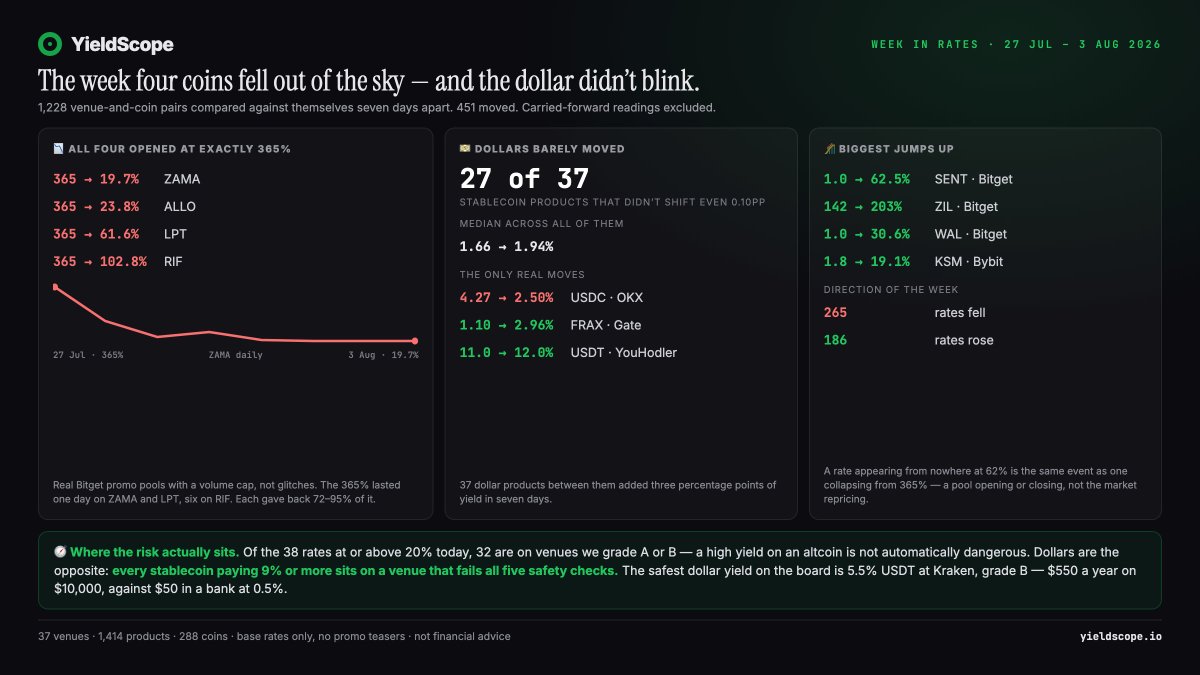
📅 Rates, week of 27 July – 3 August.
🔻 A week ago four coins on Bitget were all advertising exactly 365% a year. Here is Monday:
🔻 ZAMA — 365% → 19.7%
🔻 ALLO — 365% → 23.8%
🔻 LPT — 365% → 61.6%
🔻 RIF — 365% → 102.8%
These are real promo pools, not glitches. Each has a volume cap: only so much money earns the headline, and once it fills the rate drops for everyone. It lasted one day on ZAMA and LPT, six on RIF.
ZAMA day by day, so you can see the shape:
365 → 144 → 41 → 67 → 23 → 22 → 21 → 20
💵 Meanwhile the dollar side did almost nothing:
📊 median 1.66% → 1.94%
🔻 USDC on OKX — 4.27% → 2.50%
🔺 FRAX on Gate — 1.10% → 2.96%
🔺 USDT on YouHodler — 11% → 12%
27 of 37 stablecoin products didn't shift by even a tenth of a point. All 37 together added three percentage points of yield in a week.
🎢 Biggest jumps up:
🔺 SENT on Bitget — 1.0% → 62.5%
🔺 ZIL on Bitget — 142% → 203%
🔺 WAL on Bitget — 1.0% �� 30.6%
🔺 KSM on Bybit — 1.8% → 19.1%
A rate appearing from nowhere at 62% is the same event as one collapsing from 365%. A pool opened or closed. The market didn't move.
🧭 And the part that surprised us:
🟢 of 38 rates paying 20%+ today, 32 sit on venues passing 4 or 5 of our 5 safety checks
🔴 but every stablecoin paying 9%+ sits on a venue that fails all five
High yield on an altcoin isn't automatically a red flag. On dollars it is.
💰 Safest dollar yield on the board right now:
🟢 5.5% USDT — Kraken, grade B
🟢 5.0% USDS — Bitget, grade A
➕ Also this week: Uphold went from 2 tracked coins to 22, 75 new venue-coin pairs joined the board, 110 dropped out.
We snapshot every rate daily. That's the only reason the eighth day is visible at all.
37 venues, 1,414 products, every one graded A–F for safety 👉 https://t.co/Lw2Ag1RPWn
Uphold next, if you want the method to bite.
One purchase shows the spread. What it can't show is the clause that eats the reward later. We track 19 crypto cards and re-read the terms this week — Uphold's footnote 4 says reward value is available for three months after activating, for cards activated from 1 Jan 2026. The $99.99 Elite plan renews yearly. The rate doesn't.
Fees are priced per purchase, rewards per year. Your test catches the first one.
On the USDG line — 3.5% with no lock-up is the boring end of the market, and boring is the end that survives.
We snapshot every rate we track, every day. Rates under 10% still pay 100% of themselves 30 days later. Rates above 100% pay 8% of themselves.
Real one: HOME paid 292% on Bybit Earn on 12 June. Same product, 12 July: 4%.
The rate worth having is the one still there when you check back.