Shares of VCX were so in demand for a chance to own a piece of Anthropic that the shares reached 25x the NAV. Who in their right mind would buy a share of a company at 25x NAV?
The value of the holdings in $VCX are held at estimated fair value. They value their holdings by:
- primary input: last funding round valuation
- secondary input: comps in the public market
The marks are review quarterly by the valuation committee, and sometimes with third party input.
The last round for Anthropic was in Feb at $380B valuation. Databricks last funding round was also in Feb at $134B in valuation.
Relative to the rounds before that, it was growth of 107.7% and 34%, respectively. Or in $ terms, $183B and $100B.
However, a 25x valuation implies that Anthropic and Databricks will be worth, collectively, 7.1T.
Yes, you read that correctly.
$VCX NAV as of the end of March was ~$18.90. The last price of VCX was $121, for a premium of 540%. Who would have thought that opening up private equity to public investors would result in carelessness?
$VCX Epic collapse as expected. Latest NAV was still $18.97 as of March 31st. SpaceX dollar value inside the old NAV: 5% × $18.97 = $0.95/share. That's at the $800B valuation. Marking that position up only brings the NAV up by $1.18 to $20.15.
Even marking up Anthropic to a $1.5T, a stretch valuation, only takes the NAV to ~$32, meaning the shares are 3x an updated (and likely lofty) valuation of the NAV.
We're still well above the NAV at a 5x premium.
$DXYZ The latest 'discovery' on playing Anthropic, is also backing off from its higher levels but is much more reasonably priced. It also has a nice cash bucket for further investment.
$VCX Not surprisingly, this Anthropic backdoor proxy is dropping. Even if you apply a $2T valuation to Anthropic, not out of the realm of possibilities but definitely rich, the NAV only rises to $59. The current price of $234 is still 4x that level.
Our comments on PSUS in today's Daily Note published on https://t.co/6zGHxuEoj8.
Pershing Square USA $PSUS debuted yesterday on the NYSE. The share price fell by more than $9 to $40.90. That is already a large discount to the $49 cash per share NAV of 16.5%.
Shares of Pershing Square $PS trading roughly flat at $24.20 ($25 IPO price). That is below the $10B valuation that it saw in the last third party pre-IPO financing round.
The discount on could be management fee related with a 2.0% annual expense ratio. A 2% fee is typically associated with a 20%+ discount to NAV.
Looking SRH Total Return $STEW, formerly the Boulder Growth & Inc (BIF), which has a management fee of 1.02%, trades at a -21% discount. The portfolio is largely the same today as it was when it was $BIF, with a large position in Berkshire Hathaway $BRKB.
Thus, I think the discount is warranted given the higher fee. I do think you could see a bounce today as investors who wanted to get in on the IPO and didn't get in for whatever reason, buy. But then I suspect we could see this thing settle around a -15% discount.
For those interested, it will be interesting to see the performance of the NAV over the next several quarters and beyond. That will dictate a lot. But the big problem for the fund is the last of a distribution. Most CEF investors want yield - regardless of where it comes from (RoC, dividends, interest, etc). It doesn't matter. Even tech equity CEFs are yield-focused. I think that is a large reason why the fund went to an immediate discount.
Not sure blaming retail investors, the very people your new fund is aimed at, is the best approach. $PSUS
"Retail investors don't know how to invest in IPOs."
https://t.co/Qa9UNgCYAE
$GLD has given up all the gains that it achieved over the last month. The correlations on it are all over the place but it appears rising real yields have hit it.
$GLD has given up all the gains that it achieved over the last month. The correlations on it are all over the place but it appears rising real yields have hit it.
JPMorgan View:
· Cross Asset Views – Keep a bullish stance in risk assets, stay fully invested and hold but reduce hedges in equities and credit. We expect Momentum and Quality to continue outperforming. The emergence of Anthropic’s Mythos has helped reignite the bullish AI trade. We prefer Quality Growth and the AI upstream themes, broadening from Mag7 into AI winners (JPRAID30 Index). Beyond US, country wise we favour EM Asia Tech (Taiwan, Korea, China Tech), Japan and energy exporters (Australia and Brazil). In Korea, we raise our base case KOSPI target to 7000, putting it among our top preferred markets in the region.
Fundrise Growth Tech ($VCX) / Destiny 100 ($DXYZ)
I've been following this fund as it converted from a private interval fund to a publicly traded closed-end fund. A CEF is the appropriate wrapper for this kind of fund given the illiquidity of the underlying holdings. The fund is similar to DXYZ, the Destiny 100 private equity CEF.
The advantage that VCX holds Anthropic, which is highly coveted at this point. Overall portfolio quality is much higher in VCX. This is what has driven up the premium to NAV in VCX to astronomical levels. DXYZ trades at a premium to the Dec 31, 2025 NAV of about 51% but if you adjust the NAV for a potential increase as of March 31, 2026, the premium actually becomes a discount.
The largest driver of DXYZs valuation change is the largest position, SpaceX, has been marked higher to the $800B valuation. Should it achieve a $2T valuation like is rumored when it IPOs in June, then the NAV would be significantly higher- $50.49 per share or a 41% discount.
VCX reports its NAV quarterly based on third party valuations, recent funding rounds for the underlying companies, and other inputs - though latest funding rounds are the main driver.
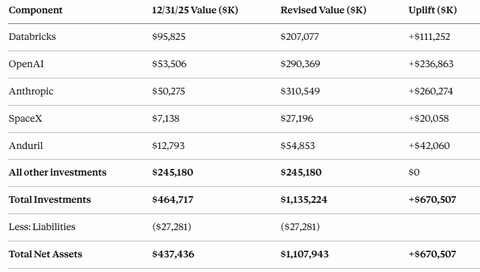
Using a revised valuation for Databricks, OpenAI, Anthropic, Anduril, and SpaceX, all of whom have recently done a new funding round, the value of the assets in the fund increases significantly. This is just the top 5 holdings and keeping the remaining holdings stagnant.
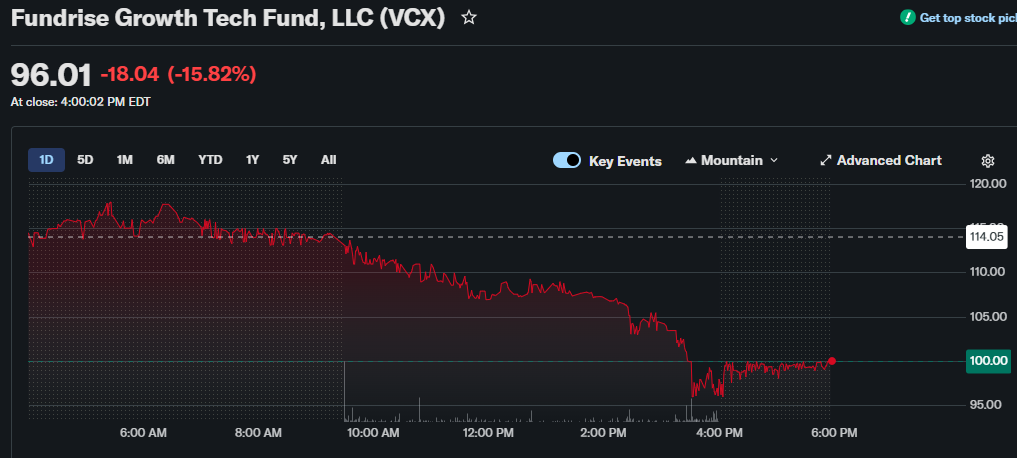
That moves the NAV per share from $15.46 to $39.15. With the latest market price of $96, it is still a 145% premium to NAV. However, that NAV is growing extremely fast so to expect these shares to trade at that level or even a discount to that level, is not reasonable.
The key driver will be new rounds or secondaries for these companies before they IPO. If we don't see any additional valuations of these companies, that will obviously stall the NAV growth until the IPO date.
For those looking to gain access to the top pre-IPO private equity companies, DXYZ is a good buy here and watch VCX for it to fall a bit further. It could be a good buy.
The Fundrise Innovation fund $VCX is reporting an insider affiliate sale of a significant amount of shares into the open market.
This is not the issuance of new shares which I've seen posted in various places on X and on forums. In other words, this isn't dilution.
It is an existing shareholder - typically an insider or affiliate - notifying the SEC of their intent to sell shares they already own into the open market under Rule 144.
VCX files Form 144 to sell 28.3M shares | VCX SEC Filing - Form 144
https://t.co/7bOBnSPbU3
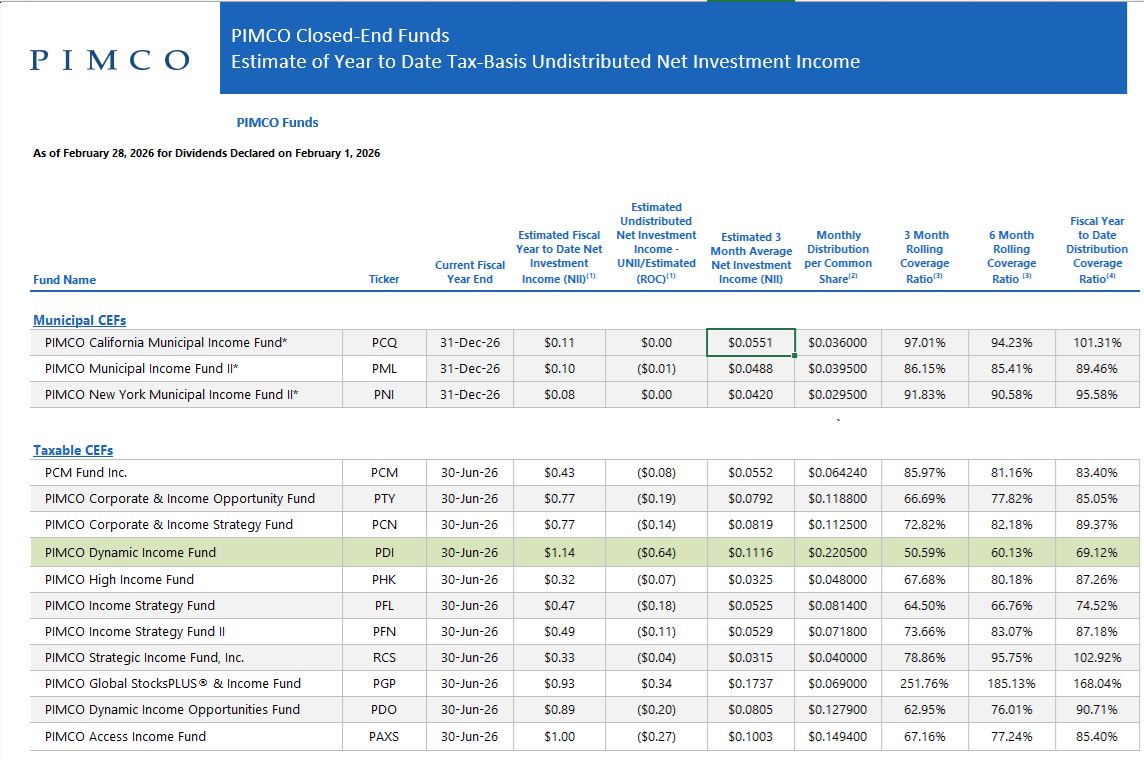
Recently released our PIMCO update with the semi-annual reports. Premiums are some of the cheapest in years - $PTY is in the 5th percentile of premium/discounts of all time meaning that 95% of the time, the premium is higher. $PDI is near the 25th percentile on premium/discounts.
PTY down to a 5% premium but with the NAV trending higher, we expect the price to rise faster expanding the premium.
$PDI coverage ratio was 50% in the February report with UNII at -64c. But this report doesn't tell the whole story.....
PDIs yield is 15.30% which is obviously not sustainable unless you have a perpetual motion machine.
$VCX Taking advantage of the ridiculous premium to NAV to sell more shares and raise more capital (and earn more fees).
VCX filed a Form 144 reporting proposed sales of 28,300,000 shares of Common Stock for sale on the NYSE with an effective date of 04/14/2026. The filing lists Jefferies LLC as the broker and shows multiple prior sell trades by Fundrise Innovation Fund, LLC between 03/25/2026 and 04/13/2026
Just one of the games these private credit sponsors play with the NAV. The other, which I hope Gundlach discusses, are these "risk-adjusted" metrics they market their funds.
When they (the fund managers) get to pick the volatility, a Sharpe ratio, or any risk-adjusted ratio, is complete garbage and borderline fraudulent.
“PIK magic”: borrower cannot make interest payment. It defaults.
Lenders don’t want to admit defaults.
They book interest as paid that wasn’t.
They increase loan principal by the interest defaulted on.
They keep the loan value at par.
NAV goes up the more loans default.
Voila!