Witness expansion: A unified framework for analytical and measurable mixed-state resource detection: This work presents a path towards making witnesses for various quantum resources better.
https://t.co/8UBT01tJtf
Quantum information science aims to harness different kinds of quantum resources to accomplish specific information-processing tasks. These resources also play an increasingly important role in addressing fundamental questions concerning quantum phases and dynamics. Therefore, developing powerful and practical methods for identifying and detecting quantum resources is of great significance, with applications ranging from #benchmarking quantum devices to understanding the fundamental structure of quantum theory.
In this work, we propose witness expansion, a unified framework for constructing nonlinear criteria for detecting quantum #resources that are associated with a well-defined group of free unitaries. These criteria apply to both pure and mixed quantum states and are based on polynomial functions of the target state, which can be estimated experimentally using multiple copies of the state and evaluated analytically in certain physical models. We show how several well-known resource-detection quantities naturally emerge from our framework, including the l_2 norm of coherence, partial-transpose moments for #entanglement, stabilizer entropy for #nonstabilizerness (quantum #magic), and #fermionic antiflatness for fermionic non-Gaussianity.
Beyond recovering these existing structures, our framework also yields new criteria for detecting qubit and qudit magic states, substantially enhancing witness-based detection capabilities. In addition, it gives, to the best of our knowledge, the first analytical criterion for detecting mixed-state fermionic non-Gaussianity with respect to the convex hull of pure fermionic Gaussian states that remains nontrivial for arbitrary numbers of qubits, demonstrating the broad applicability and conceptual unifying power of the framework.
Warm thanks to Yifan Tang, Chengkai Zhu, Yuzhen Zhang, Zi-Wen Liu, Ingo Roth, Otfried Gühne, Xin Wang, and Zhenhuan Liu for the wonderful collaboration.
Measurement-induced non-commutativity in adaptive fermionic linear optics
We show that mid-circuit measurements of fermions with internal degrees of freedom can induce the equivalent of "magic" to free fermionic circuits and render them classically hard to sample.
https://t.co/r7rZBcyLHL
Fermionic linear optics (FLO) with Gaussian resources is efficiently classically simulable. We show that this is no longer the case for such quantum circuits for fermions with internal degrees of freedom, equipped with #midcircuit number monitoring and classical feedforward. In our architecture, the measurement record routes the selected blocks into a fixed-order Bell-fusion pairing geometry.
On the level of classical description, this implies realizing a situation in which the permutation sum no longer collapses to a single determinant or Pfaffian. Each post-selected branch expands as a signed sum of path-ordered products of typically non-commuting dressed blocks, and branch amplitudes are matrix elements of the resulting non-commutative trace polynomials. Numerically, we observe Porter-Thomas statistics as the output distribution and a rapid growth of the minimal order-respecting matrix product operator bond dimension. These results thus establish mid-circuit measurement-induced non-commutativity as a route to #samplinghardness for noninteracting #fermions under reasonable complexity assumptions, without introducing coherent two-body interactions into the FLO evolution.
Warm thanks to Chenfeng Cao and Yifan Tang for the wonderful collaboration.
Optimal randomized measurements for a family of nonlinear quantum properties:
We answer how non-linear quantities can be estimated with the same standards as expectation values in classical shadows.
https://t.co/6e3fWUyL0p
Quantum learning encounters fundamental challenges when estimating nonlinear properties, owing to the inherent linearity of quantum mechanics. Although recent advances in single-copy randomized measurement protocols have achieved optimal sample complexity for specific tasks like state purity estimation, generalizing these protocols to estimate broader classes of nonlinear properties without sacrificing optimality remains an open problem.
In this work, we introduce the observable-driven randomized measurement (ORM) protocol enabling the estimation of Tr(𝑂𝜌^2) for an arbitrary observable 𝑂—an essential quantity in quantum computing and many-body physics. We establish an upper bound for ORM’s sample complexity and show its optimality for observables with a large trace-norm, including Pauli and local observables, closing a gap in the literature. For these observables, ORM admits an efficient implementation with Clifford circuits. Numerical experiments validate that ORM requires substantially fewer state samples to achieve the same precision compared to classical shadows. Additionally, we introduce a braiding randomized measurement protocol for multiple low-rank nonlinear observables, reducing circuit complexities in practical applications.
Warm thanks to Zhenyu Du, Yifan Tang, Andreas Elben, Ingo Roth, and Zhenhuan Liu for the wonderful collaboration.
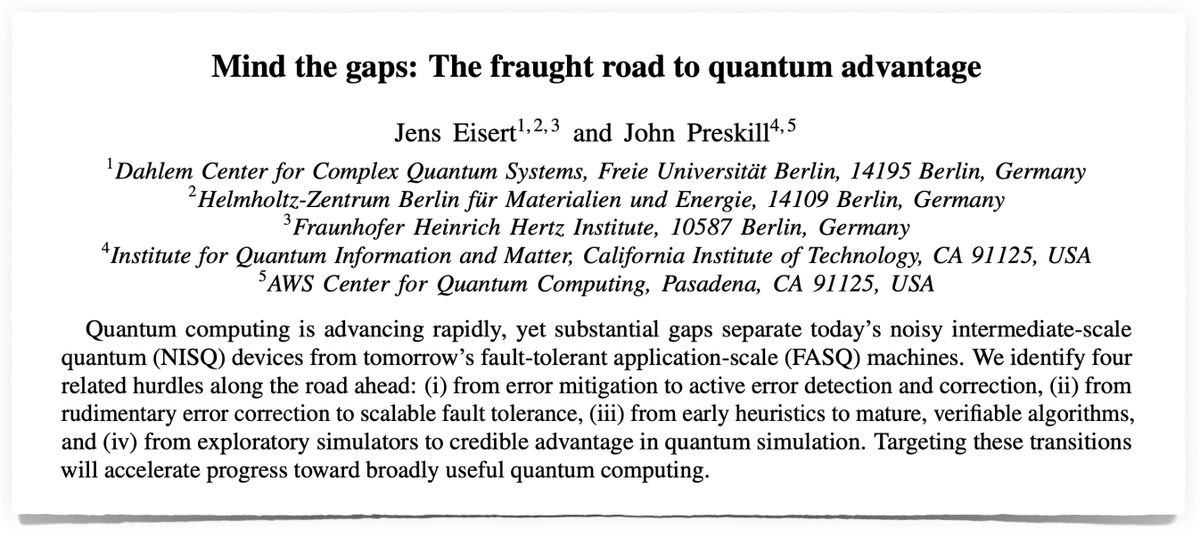
When and how will quantum computing broadly benefit humanity? Despite exhilarating recent progress, we still don’t know. Here my friend Jens Eisert and I assess the current status and the challenges ahead. We are optimistic about the quantum future, but there’s a lot of work to do.
https://t.co/cTbXNSd9c6
Over the recent weeks and months, @preskill and I sat down to think about where we are in quantum computing. While the noisy intermediate-scale quantum (#NISQ) era — a term coined by John in 2018 — is just unfolding as we speak, the time seems right to look ahead to the next steps to come.
https://t.co/aSWIa4Z6CA
In this perspectives article, we try to sketch the fraught road to quantum advantage — the path toward fault-tolerant, application-scale quantum (#FASQ) computers. There are several gaps ahead of us, and we try to faithfully and honestly hint at how one may be able to "mind those gaps", and suggest a few important intermediate steps along the way.
I have been impressed by the ease and efficiency with which we have been able to put this together. Warm thanks to John for the great collaboration and wonderful team work.
Prof. Chen Ning Yang, a world-renowned physicist, Nobel Laureate in Physics, Academician of the Chinese Academy of Sciences, Professor at Tsinghua University, and Honorary Director of the Institute for Advanced Study at Tsinghua University, passed away in Beijing due to illness at the age of 103. His life stands as a timeless chapter in human history—one that shines not only for China but for the global community of thinkers and innovators. His legacy will live on forever.
Optimal randomized measurements for a family of non-linear quantum properties
https://t.co/4qew0arfHG
#Quantumlearning encounters fundamental challenges when estimating #nonlinear properties, owing to the inherent linearity of quantum mechanics. Although recent advances in single-copy randomized measurement protocols have achieved optimal #samplecomplexity for specific tasks like state purity estimation, generalizing these protocols to estimate broader classes of non-linear properties without sacrificing optimality remains an open problem.
In this work, we introduce the observable-driven randomized measurement (ORM) protocol enabling the estimation of Tr(Oρ^2) for an arbitrary observable O - an essential quantity in #quantumcomputing and #manybodyphysics. ORM achieves this by decomposing the observable O into dichotomic observables and extracting the information of each eigenspace through randomized measurements with block-diagonal unitaries.
We establish an upper bound for ORM's sample complexity and prove its optimality for all Pauli observables, closing a gap in the literature. Furthermore, we develop simplified variants of ORM for local Pauli observables and introduce a braiding #randomized measurement protocol for fidelity estimation, both of which significantly reduce #circuitcomplexities in practical applications. Numerical experiments validate that ORM requires substantially fewer state samples to achieve the same precision compared to classical shadows.
Warm thanks to Zhenyu Du, @YifanTang1999, @AndreasElben, Ingo Roth, and @liu_zhenhu77178 for the productive collaboration.