🇲🇾 Making cryptocurrency simpler—powered by @Binance | Real-time updates, practical tips, and how-to guides | A gifted trader—feel free to send me a DM! 💛
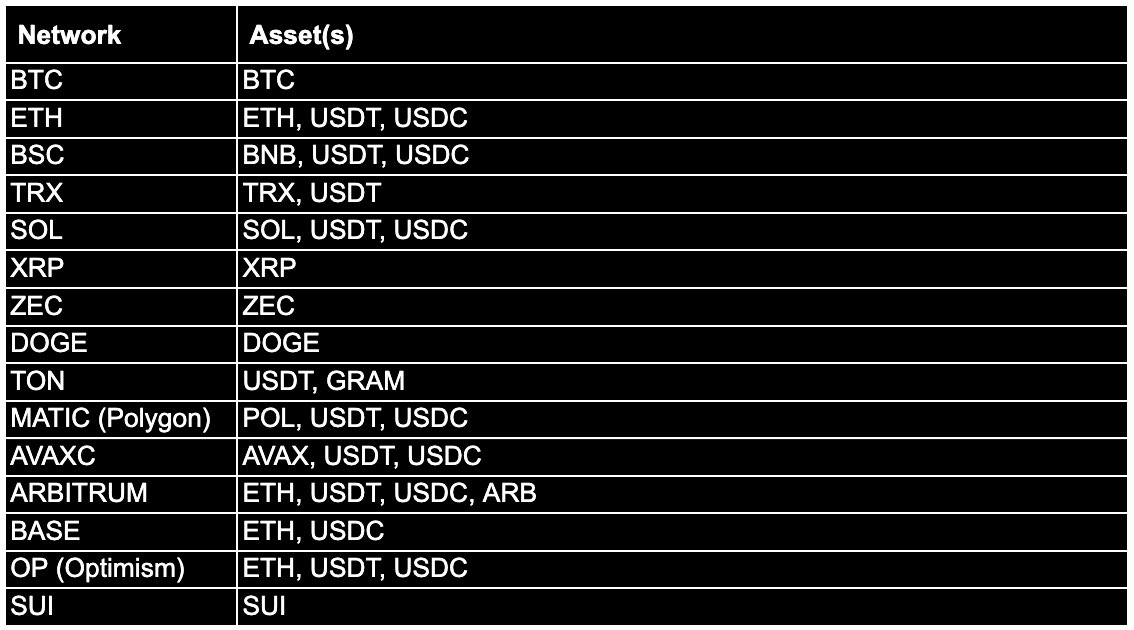
💁🏻♀️We continue to make progress restoring the withdrawal services and will reopen withdrawals for the assets listed below, beginning at 04:00 (UTC).
Not all listed assets will become available at once. Reopening will roll out progressively across the assets as security and readiness checks are completed. Deposit services remain open.
Binance is preparing to resume phase one of withdrawals on 2026-11-01 between 06:00 and 09:00 (UTC).
The first batch open for withdrawal covers 15 currencies across the 15 networks shown in the chart. Wallets for other currencies are still undergoing repeated security audits and perimeter checks which will be prioritized based on the platform's market cap, locked funds, and user base. The remaining tokens are being processed as quickly as possible. Thank you for your support and understanding💁🏻♀️
Withdrawal Update
Withdrawals have now been restored for the following assets and networks:
- Ethereum Network: USDC, USDT, ETH
- BNB Smart Chain (BSC): USDC, USDT, BNB
We will continue to restore additional assets and networks in phases following the completion of our security checks. Further updates will be shared through official Binance channels.
There is a cheap romance in the crypto world: the base layer is trustlessly neutral, censorship-resistant, and code is law. But when something actually goes wrong, BTC's underlying protocol has no freeze button, and the odds of recovering the $3.3 billion in Bitcoin at the hacker's address are too slim. What actually stopped the losses in the early hours and filled the hole was the centralized layer that so many people disdain as "not decentralized enough": stablecoin issuers froze nearly $3 billion in dirty funds, Binance coordinated on-chain to freeze another roughly $3 billion, and then it paid out of its own pocket to buy back every asset users were supposed to have, not a cent less.
This is the first layer of Binance's professionalism: it accepted the cost of the layer it occupies and did not pass that cost on to users. After the incident, Binance stated plainly that it would "bear the financial losses from this asset theft, not users." It had reserved more than $6.34 billion in corporate funds, of which more than $5 billion was already held in the same types of affected tokens. In less than 48 hours it had backfilled about 90%, and all ten major tokens reached 100% full reserve backing. Compare that with Mt. Gox, where users waited ten years, or FTX, where user assets were simply misappropriated and wiped out. In Binance's case, the victim was essentially only the platform itself: user balances were untouched, the platform used its own funds and SAFU to fill the hot wallet hole, and then used proof of reserves to let users verify on-chain for themselves.
The second layer of professionalism: it knows what it can do and what it cannot do, and it draws that line clearly. Binance did not claim it would recover all $6.3 billion. It said about $3 billion had been frozen, that it was continuing to coordinate tracing, and that it would use corporate resources to cover the confirmed shortfall. For stablecoins, issuers have freeze authority, so the recovery path is clear; for native assets like BTC that cannot be frozen on-chain, it admitted that "recovery prospects are slim" instead of making grand promises. Compensation is compensation, recovery is recovery, and the two proceed in parallel without being conflated.
The third layer: turning "after the fact" into "before the fact." During the withdrawal suspension, Binance revoked authorizations on affected addresses, audited terminals and signing systems, cleaned up high-risk EIP-7702 permanent authorizations, and mandated hardware MFA and zero-trust isolation. The attack entry point was traced to a compromised operations device, and Binance did not package this as "force majeure." It admitted that the investigation found "more than one point of intrusion" and promised to publish a complete technical post-mortem. Co-CEO Richard Teng said withdrawals "will not go live before passing strict testing." Between "fast" and "right," this time it chose the latter.
Binance sits in the upper layer, and this incident is the answer it submitted for the layer it occupies. At the moment user assets were threatened, it chose to intervene, using $6.3 billion in corporate funds and a SAFU mechanism established back in 2018 to prove why it deserves to be placed in the "has rescue" layer.
Professionalism is not "never being breached." In a world with human operations, networked hot wallets, and internal network permissions, the defender against top-tier APT attacks is always in the passive position of "guarding every door." Professionalism is: after the door is kicked open, do you have a plan, do you have the money, do you have the courage to put the loss on your own books, and do you have the ability to let users open their accounts the next day and see not a single number missing. Binance this time did all four.
#BNB #BTC
Saw a few discussions about size of hack, why impact to bitcoin price is small, etc. 👇
$6.3 billion is the biggest in USD terms, but not in BTC terms. MtGox was 650,000 BTC!
Other important numbers to consider:
% of bitcoin (in relation to BTC total supply), ie, market impact. MtGox is big there again at 5%+.
Number of users impacted, and % of user assets impacted. MtGox (the largest CEX at the time) and FTX (not small) were all near 100% of users and their asseets.
Most important: Who is impacted? Does the platform cover it all? (only one victim), as in recent two CEX cases and Binance.
Obviously, still a major disaster for the industry, Binance (and me). It hurts, but we survive.
Most importantly, we protect our users.
(image from @MatthewRoszak)
Service Update
Deposits remain unaffected and continue to operate as normal.
Withdrawals remain paused while our team completes a security revamp of the withdrawal service and its related addresses. We expect to resume within 48 hours, and will update with further details.
The incident stems from multiple factors. Our security team is tracing the full attack path through the compromised computer which may be the entry point of the incident. A comprehensive report with the root cause will follow.
We will continue to share updates through official Binance channels.