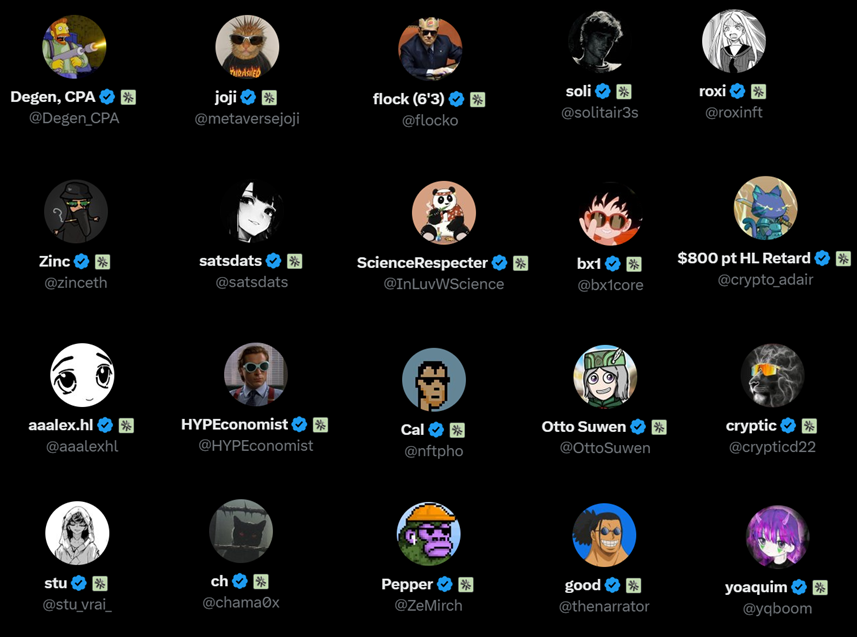
If USD 5k worth of tokens was all it took for a KoL to sell their souls, you need to re-think whether they are real content creators or audience farmers.
https://t.co/x7tua4A9PW
Here are the @TroveMarkets badge holders (some have since been removed).
These “gentlemen” (apparently for money and with minimal due diligence) were promoting this project for Hyperliquid community.
@Azeem7236 Not at this stage. Most perp dexes are just extracting value. And imo worth nothing.
Actively looking for newer things but tbh there's too huge of a brain drain amongst crypto projects.
.@Backpack said its Anthropic token led DEX volume in the first days after the IPO.
I checked the onchain data to find everything that actually happened.
They're right about leading, but there's more to it.
A thread🧵.
The disconnect between where $GLXY trades and what I believe this company is worth has only gotten wider.
We’re executing, our fundamentals are strong, and I believe the market is significantly undervaluing what we’re building.
That’s why I’m leaning in and buying more $GLXY today.
Deposits and withdrawals are back to normal following the deactivation of Guardian Mode by the Lighter Security Council.
More details on what happened: https://t.co/HLIw6E7UdO
@HyperliquidX's IOC speed-bump mechanism has a flaw. Normally designed to protect makers in the interests of a more liquid market, it breaks down in periods of high activity. When blocks become full, pending modifies and cancels queue up for later blocks, so their latency increases. However, IOCs behave as though they have a separate blockspace dedicated for them, and their latency barely budges. You can see this in the lower left chart, showing latency of different order types during 19 activity bursts.
The result is that under relatively modest load (25-30k tps), IOC + 8 bps (priority fee) orders can pick off resting liquidity before it has a chance to get out the way. Meanwhile, under higher load (35-40k tps), even IOCs without any priority fee can pick off resting liquidity.
This, in my opinion, is antithetical to the ethos and design of the ALO and cancel prioritization mechanism and needs investigation by the team. It exists to reduce toxicity from HFT takers, and is breaking down precisely when most needed.
It may also be exploitable. If IOCs really are insulated from the congestion affecting cancels and modifies, a malicious user could spam orders, delaying makers’ cancels while their own IOCs go through, and taking the liquidity left stale.
One single example that occurred on AVAX today caused 1.3M$ of volume to be adversely selected for a total loss of ~13k$ over the subsequent 10 seconds. This affected us materially. Faced with such episodes of adverse selection, spreads and liquidity are undoubtedly worse than they could be otherwise.
Would appreciate if anyone with a contact at HL could share this with the team.
@user_starcraft2@choffstein@HypeStrat They charge 3% pa btw. That's 1.2M p.a .
It seems cheap because you get an out of the box exchange with deployable liquidity and distribution.
Would cost way more to spin up secured infrastructure + liquidity yourself