Was digging into how ChatGPT renders citations. Instead of wasting tokens on markdown links, it streams invisible Unicode PUA characters (U+E200) to trigger UI badges.
Open-sourced the exact frontend pipeline we replicated: https://t.co/NgLtcpUf41
WorldReasoner is now open-source! Dive into the code and benchmark here:
GitHub: https://t.co/a8Qu4Glhov
Thanks to @Eric_chamoun@ZifengDing6@vlachos_nlp
(4/4)
How to test agent forecasting without data contamination?
Isolate them in a temporal sandbox⏳
Introducing WorldReasoner: a new framework that restricts agents to simulated historical dates to test genuine reasoning over time-bounded evidence
https://t.co/vi1iN6BrpX (1/4)
WorldReasoner evaluates beyond final-answer accuracy. Inside the sandbox, agents must retrieve pre-resolution evidence and optionally build causal event graphs. We score them on probability calibration, evidence quality, and reasoning against hindsight reference graphs.🔍 (2/4)
“I want to build X.”
What needs to happen first?
Behind every scientific contribution is a pathway of enabling methods, datasets, tools, models, ideas, and prior work.
We introduce SciPaths to study whether LLMs can predict these pathways. 🧬🧭
🚀Check out our new paper (https://t.co/AtDkFrc0Im)!
Why multi-agent debate often fails for LLMs? We learn from human debate and reveals the limitations: low diversity, no confidence signals.
We fix both and show this turns debate from a martingale into a strict submartingale.
Experience-wise, it's become a pretty mature productivity tool. I basically depend on it now for my daily work, research, writing docs, and coding demos.
Check it out here https://t.co/NgLtcpUf41
Looking for contributors~
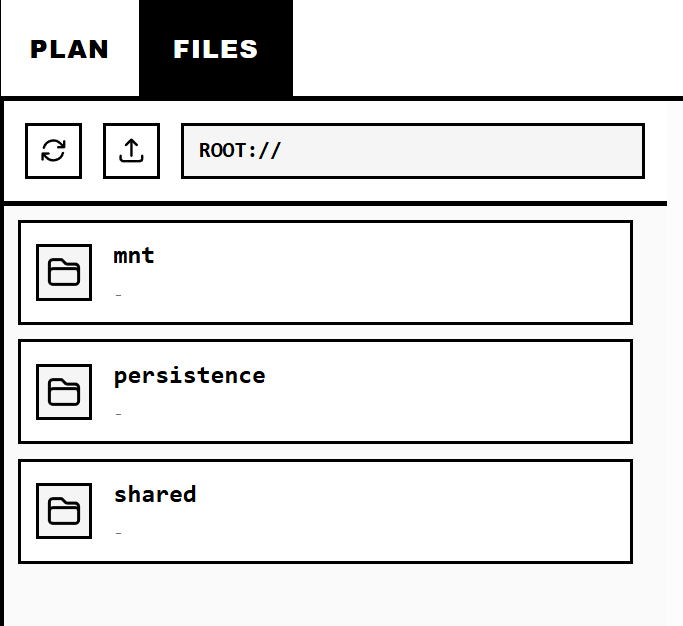
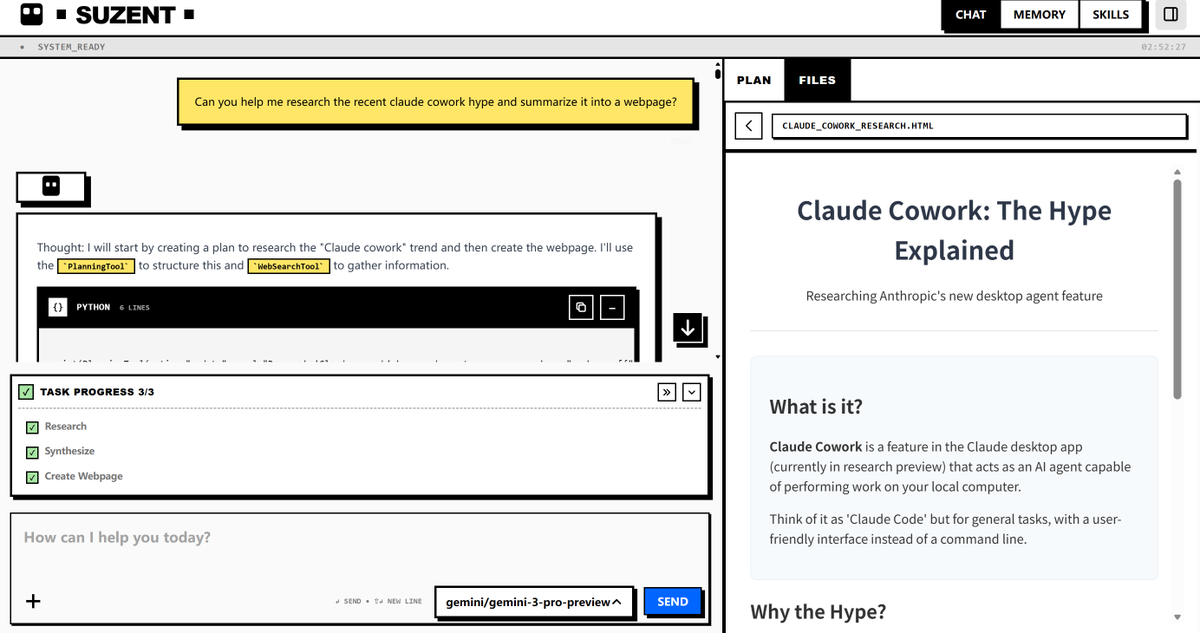
So, I've finally open-sourced the Deep Research + Cowork project I've been working on for the last few months: Suzent.
It fuses all the Agent experience I've gathered over the last 2 years (plain English: I stitched everything I know into it).
https://t.co/NgLtcpUf41
#agent
It fills the gaps left by cloud tools (like global memory, cross-conversation workspaces, and a full-platform sandbox [Windows needs WSL2]).
It doesn't just remember your habits; it lets you pick up a task (and files) you were working on a long time ago.
Compared to Claude Cowork, Suzent feels more like a digital extension of yourself that truly belongs to YOU.
It focuses on Long-term Memory, Data Sovereignty, and Local Usage.
Of course, it wouldn't exist without suggestions from friends, inspiration from open-source giants, and even some patient, guiding conversations with closed-source products.
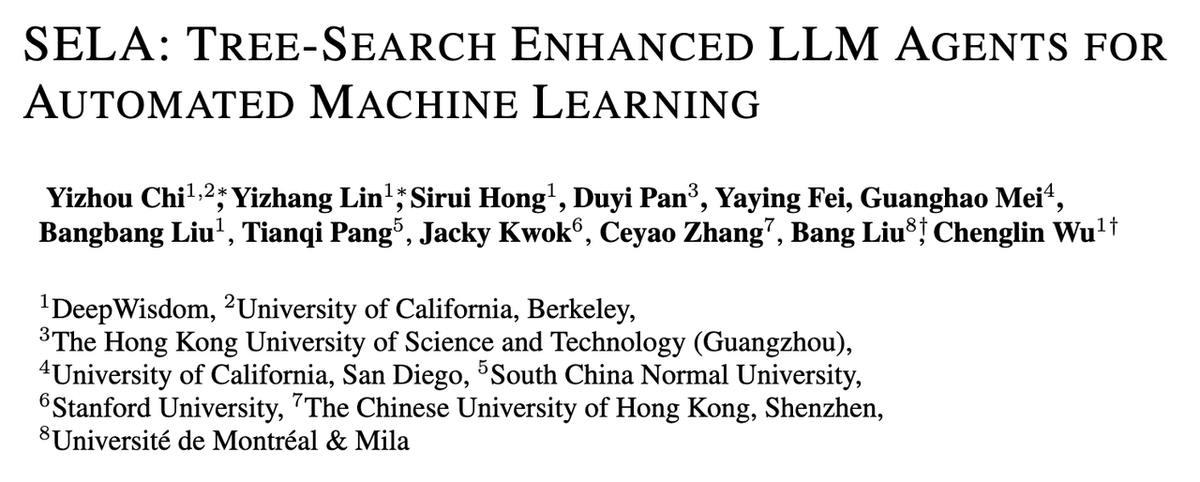
🌟 Excited to open-source SELA, a powerful experimentation system integrating MCTS with LLM agents. Across 20 datasets, SELA achieves a 75% win rate against AIDE (OpenAI's top pick in MLE-Bench) and beats traditional AutoML methods developed over years.
💻 Code: https://t.co/dIjSaXnoii
📄 Paper: https://t.co/8j5DLpNr9N
🎉 Really excited to share SELA!
I started about a year ago exploring MCTS + LLM reasoning... Now we've even shown agents can master ML experimentation through systematic search & learning.
Thanks to all collaborators who made this possible!
🤖 Can an AI agent design another AI?
🌟 Yes. SELA uses MCTS to design AI, achieving SoTA performance on 20 machine learning datasets. It can learn from past designs and experiments to create better AIs. It's fully open-source.
🚀 Try SELA yourself
📄 Paper: https://t.co/8j5DLpMTkf
💻 Code: https://t.co/pSDAhB4kAJ
Cool! This work is very similar to ours published a couple of months ago.
https://t.co/b9swWuTuh9
Really glad to see the idea shown effective in different tasks!
Also wonder what the performance would be like with larger llama or gpt4
"Accessing GPT-4 level Mathematical Olympiad Solutions via Monte Carlo Tree Self-refine with LLaMa-38B"
From 25.47% to 45.49% in GSM-Hard 🤯
Also noting in this regard, the head of Deepmind said last year that augmenting LLMs with Monte Carlo Tree Search may be the fastest path to AGI
📌 This paper introduces the MCT Self-Refine (MCTSr) algorithm, which integrates Large Language Models (LLMs) with Monte Carlo Tree Search (MCTS) to enhance performance on complex mathematical reasoning tasks like Olympiad-level problems. The key problem being addressed is the accuracy and reliability challenges faced by LLMs in strategic and mathematical reasoning.
📌 MCTSr constructs a Monte Carlo search tree through iterative processes of Selection (using an improved Upper Confidence Bound formula to balance exploration-exploitation), self-refine (the LLM generates feedback to guide refining an answer), self-evaluation (the LLM scores the quality of the refined answer), and Backpropagation (propagating the refined answer's value back through the tree).
📌 The self-refine process uses a multi-turn dialogue prompt where the LLM first generates a critical comment on the current answer, then refines the answer guided by that comment. The self-evaluation scores an answer from -100 to 100 and applies constraints like strict scoring standards and suppressing perfect scores to improve reliability.
📌 Backpropagation updates a node's Q value (estimated answer quality) by averaging its current Q value and the max Q value of its child nodes. Candidate nodes for further expansion are selected based on criteria like number of child nodes and child Q values exceeding the parent's.
📌 Experiments demonstrate MCTSr significantly improves success rates on datasets like GSM8K (up to 96.66% with 8 rollouts vs 74.07% zero-shot), MATH (58.24% overall with 8 rollouts vs 24.36% zero-shot), and Olympiad-level benchmarks like AIME (11.79% with 8 rollouts vs 2.36% zero-shot). Performance scales with number of rollouts.
📌 Compared to closed-source LLMs like GPT-4, MCTSr with LLaMA-38B achieves comparable results, showing it can boost reasoning capabilities of smaller open-source models. The paper concludes MCTSr is a robust and promising approach for complex mathematical reasoning with LLMs.
📝Presenting ThoughtSculpt - a general reasoning & search approach for tasks with decomposable outputs. Leveraging Monte Carlo Tree Search, it surpasses existing methods across diverse tasks! (1/N)
arxiv: https://t.co/b9swWuTuh9
ThoughtSculpt is a general method that doesn't require too much prompt engineering and is easy to apply to different challenges that may require continuous thought iteration such as open-ended generation, multi-step reasoning, and creative ideation. (5/N)
We find that our method, using MCTS, displays better performance than using a naive DFS and SOTAS in scenarios where the tasks are complex and difficult to greedily improve their solutions (4/N)


![YizhouChi's tweet photo. It fills the gaps left by cloud tools (like global memory, cross-conversation workspaces, and a full-platform sandbox [Windows needs WSL2]).
It doesn't just remember your habits; it lets you pick up a task (and files) you were working on a long time ago. https://t.co/0zu6l86ZBy](https://pbs.twimg.com/media/G-_qQvpXwAI8DCy.png)




![YizhouChi's tweet photo. It fills the gaps left by cloud tools (like global memory, cross-conversation workspaces, and a full-platform sandbox [Windows needs WSL2]).
It doesn't just remember your habits; it lets you pick up a task (and files) you were working on a long time ago. https://t.co/0zu6l86ZBy](https://pbs.twimg.com/media/G-_qQvrWEAAfF3x.png)