Did Microsoft bet on the wrong AI?
One of the most common criticisms of @Microsoft right now is simple.
“They bet on the wrong AI.”
Microsoft owns roughly 27% of @OpenAI's for-profit entity.
When ChatGPT exploded onto the scene, that investment looked brilliant.
Microsoft suddenly had front-row access to the most advanced AI models in the world.
They quickly integrated those models into Azure and across their entire product suite.
The narrative became clear.
Microsoft had positioned itself at the center of the AI revolution.
But the story has become more complicated.
Over the past year several other players have emerged.
@AnthropicAI's Claude models have become extremely competitive.
Google’s @GeminiApp continues improving rapidly.
Open-source models are advancing much faster than many people expected.
And new companies like @MistralAI, @cohere, and @xai have entered the space.
Suddenly the assumption that OpenAI would dominate AI forever started looking less certain.
Which created a new narrative.
“What if Microsoft backed the wrong horse?”
It’s a fair question.
But it also misunderstands what Microsoft was actually trying to accomplish.
To understand this, rewind five years.
Back then, the AI landscape looked completely different.
Anthropic didn’t exist yet.
Mistral didn’t exist.
xAI didn’t exist.
@deepseek_ai didn’t exist.
And Google was never going to give Microsoft access to its best models.
If Microsoft wanted to participate in advanced AI development, there were very few options.
OpenAI was essentially the only viable path.
So Microsoft made a strategic decision.
They secured a deep partnership with the one organization pushing the frontier of large language models.
At the time it looked risky.
Today it looks obvious.
But the real objective wasn’t necessarily to pick the permanent winner of AI.
The objective was to guarantee Microsoft would have a seat at the table when AI arrived.
And that strategy worked.
AI arrived.
Microsoft had access.
Once the ecosystem expanded and more models appeared, the dynamics changed.
Now the AI landscape is much more competitive.
But that actually benefits Microsoft in some ways.
Because Microsoft doesn’t necessarily need one model to dominate.
They just need access to good models.
And today they have access to many.
Inside Azure, customers can already choose between multiple models through Microsoft’s model marketplace.
In other words, Microsoft’s long-term advantage might not be owning the best AI model.
It might be something else entirely.
Something that matters more once AI becomes widely available.
And that “something” has to do with how software is actually used inside organizations.
Because there’s a deeper shift underway that could fundamentally change Microsoft’s business model.
@satyanadella hinted at it in a recent interview.
And when he said it, most people didn’t fully appreciate what it implied.
Tomorrow I want to walk through the comment.
Because if he’s right…
some of the most valuable software products in the world may start to look very different.
Nasdaq +8%. Microsoft -23%.
Something’s off.
In the past six months the Nasdaq is up about 8%.
Meanwhile $MSFT is down roughly 23%.
That’s a strange divergence for one of the most important companies in the index.
Normally when a megacap tech company sells off like that, something obvious broke. Revenue collapsed. Margins fell. A product failed. Management lost credibility.
But none of that has happened.
In fact, Microsoft’s last quarter looked very strong.
Revenue grew 16% year over year.
Operating profits increased 20% year over year.
Those aren’t numbers you typically associate with a stock falling a quarter of its value.
Which creates an interesting question.
If the business is still growing strongly…
why is the market acting like something is wrong?
There are a few theories floating around.
One explanation is simply valuation compression.
Microsoft had become expensive during the AI boom. When expectations get stretched far enough, even strong results can disappoint investors.
Another explanation is AI competition fears.
Microsoft was very early to partner with OpenAI and integrate generative AI into its products. That was initially seen as a massive advantage.
But over the past year the landscape has changed quickly.
Google launched Gemini.
Anthropic’s Claude has gained a lot of attention.
Open-source models are improving rapidly.
Suddenly the narrative shifted from “Microsoft owns the future of AI” to “maybe everyone will have good AI.”
And when the technology becomes more competitive, the question becomes less about who invented AI and more about who actually captures the economics.
There’s another concern investors have started talking about.
Microsoft’s cloud backlog.
Roughly 45% of Microsoft’s cloud backlog is tied to OpenAI workloads.
That sounded great during the AI boom.
But lately there’s been growing speculation that OpenAI may have made commitments for compute capacity that could be difficult to fully fund.
If that happens, it raises an uncomfortable possibility.
What if Microsoft built massive infrastructure expecting AI demand that arrives more slowly than anticipated?
Again, none of this means Microsoft is in danger.
No serious investor thinks Microsoft is going away.
But something more subtle could be happening.
The market may be starting to question whether future growth will match expectations.
And expectations for Microsoft have become extremely high.
For example, one of the most talked-about AI products inside the company is Copilot.
Copilot was pitched as a revolutionary productivity tool that would transform the way people use software.
But today the paid penetration rate is only around 3%.
That’s… surprisingly low.
For comparison, even Tinder has a higher percentage of paid users.
Which raises a difficult question.
If one of the most hyped AI productivity products in the world only converts 3% of users to paid… what does that say about the near-term monetization of AI?
Now, none of this means the AI opportunity isn’t real.
Azure cloud revenue is still growing very quickly - about 39% growth last quarter.
But there’s another dynamic developing that could complicate the story.
Something that has happened before in technology.
And when it happened the last time, it created a decade where Microsoft’s stock went nowhere.
Tomorrow I want to show you something that most investors misunderstand about Microsoft’s AI strategy.
Because despite the concerns, the company may have made a very clever move years ago - one that ensured they wouldn’t be locked out of the most important technology shift in decades.
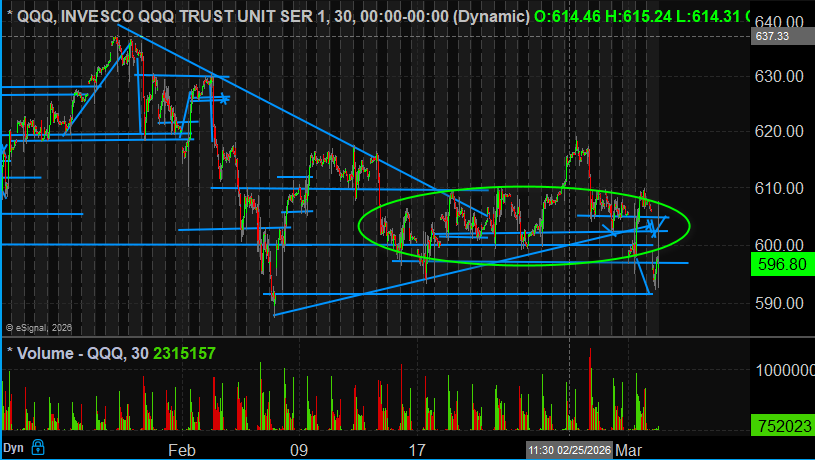
$QQQ spent the past two weeks between 600/610 (90% of the time).
with this morning's gap into the february low my focus is on whether it now begins to consolidate below 600...
Unfortunately, AI will be used for violence against humans. That feels inevitable.
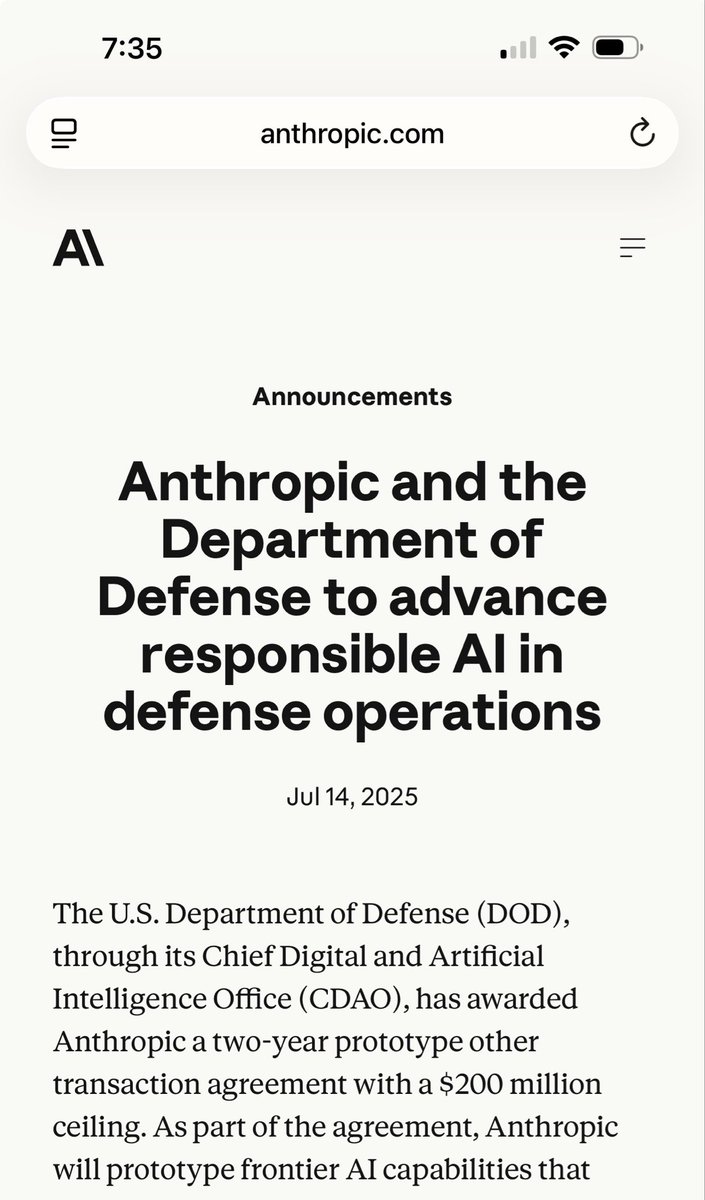
Anthropic announcing that they will not allow their technology to be used by the Pentagon was a smart strategic move. It positions them to say they didn’t want their technology used for military purposes—even if, at some point, they are pressured or compelled otherwise.
Meanwhile, the Pentagon will argue that if the U.S. doesn’t develop or use advanced AI systems, other countries will gain a strategic advantage. That dynamic makes the outcome feel inevitable.
Still, Anthropic’s stance demonstrates their desire, their willingness to draw a line, and their underlying values.
Bought $NVDA on @Coinbase today.
Sold it to rotate into another stock… and now the funds are missing from my wallet.
Apparently they’re “waiting to clear.”
Not a great look, Coinbase. 🤨
as an investor in tesla for almost a decade i follow Elon very closely and usually he is fairly open about long term biz plans.
but with respect to SpaceX he completely obfuscated the long term ambitions. he emphasized again and again it was about rural broadband. but in reality the goal was to acquire 5G spectrum and disrupt telecom as much as possible.
As part of our $600B commitment, Mac mini will be produced in the US for the first time later this year!
We're accelerating our progress even further— producing more AI servers and opening an all-new Apple Advanced Manufacturing Center for hands-on training.
Everyone thinks the Supreme Court just stopped tariffs.
They didn’t.
They stopped using the wrong lever.
It’s like telling a mechanic:
“Don’t use a screwdriver as a hammer.”
So now he grabs… an actual hammer.
Some emergency tariffs disappear → headlines scream relief.
Then broader, cleaner, legally stronger tariffs replace them.
Less chaos in law.
More certainty in enforcement.
Paradox:
Markets celebrate… the thing that enables bigger tariffs.
This wasn’t a rollback.
It was a software update.
Supreme Court just dropped the gavel on Trump’s big tariff plan, 6–3.
But here’s the kicker: two of Trump’s own picks from his first term, Gorsuch & Barrett, refused to go along with it. That’s not just news, that’s tectonic. They didn’t just chip away at the policy. They demolished it.
In a world where loyalty is currency, the Court just reminded us it deals in law instead. And everyone’s still trying to figure out what that means next.