@TheWhiteWhaleV2 You are an outstanding human being. I'm curious about how you became what you are. Thru hardships? Learned thru reading? Any books you recommend?
@TheWhiteWhaleV2@Titan_Exchange@coinbase But I have $0 on the wallet that I used. It's an old wallet (from 2021 bull run, mostly BSC) that i've stopped using. Am I still eligible?
0x6A1cE6bA7f290223178AF6B1662722aB23Cbaa7A
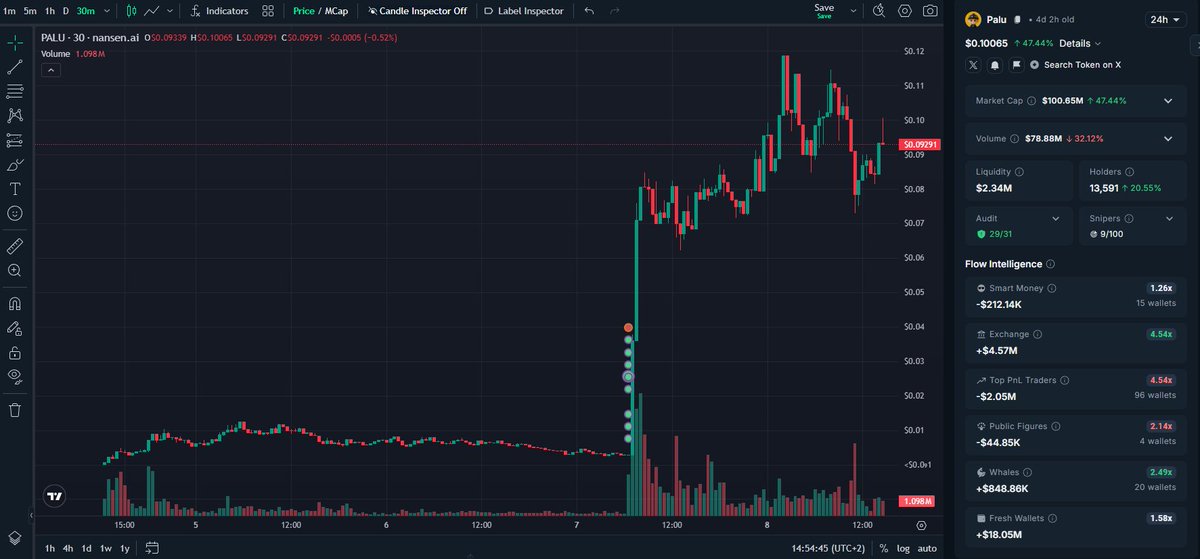
$PALU almost hit $120M MC and one trader made 33x, right before CZ's tweet.
Here’s a simple yet effective guide on how you can spot the next meme runner like this too 👇
------
Most people try to find the next $BNB meme coin by following big influencers. By the time they post, they’ve already bought 10x earlier, and you’re the one buying their bags.
The smarter move is to study Smart Money inflows before the meme runners started running.
Take $PALU as an example - a BNB Chain-based meme coin which pumped $3 > $80M in a day, because CZ reposted fan artwork featuring a CZ-themed PALU mascot.
Now look at the screenshot. One wallet bought right before the pump and ended up holding nearly $800k worth of $PALU, a 33x gain.
This trader also profited from several other meme plays, showing a repeatable method rather than luck.
You can do two things now:
A. Complain about insiders and tweet on X it's “Crime Zeason”, or;
B. Study what successful traders are doing and learn from their flow.
If you chose the latter, because you are locked in for Q4 and want to go balls deep into memes, here are the steps that I would take:
1. Study recent meme runners on BNB Chain, since this is the chain where both attention and liquidity is right now.
2. Use @nansen_ai to review on-chain data just before each major pump (select the period).
3. Identify Smart Money wallets that made large conviction buys before the move (skip DCA-ones on a longer timeframe).
4. Analyze their other trades to see if success was consistent.
5. Check for patterns or recurring wallets they interacted with and make a longlist.
6. Narrow down your list to the most reliable wallets.
7. Set alerts for their new trades.
8. Optionally, use trading bots to copy or automate their new entries.
"But ser, I don't have time".
Right.
If it was this easy, like following calls of 100k+ KOL accounts, everyone would have been rich, right?
So yes, it might take 8+ hours, but it also gives you a short list of high-signal wallets that consistently spotted early opportunities.
No guarantees, but WAY better chances of getting a next winner yourself.
Repost this tweet and DM me afterwards. I will share the address of the trader who made 33x on $PALU.
Maybe you will find their Cabal brothers too, and catch their next move.
XPL (Plasma): Twitter Noise vs On-Chain Data - What Do You Trust More?
I spent the last few hours analyzing $XPL, the Plasma blockchain token that launched 6 days ago (as of October 1, 2025).
This post isn't a bottom or top signal, or a buy or sell recommendation. It's a case study on what happened on-chain and what to look out for next time, when evaluating token launches.
Before we dive in: there's a lot of chatter and noise about $XPL. Ex-Blast team. Paolo only invested $50K. 800M tokens sold by team. Valuation doesn't match fundamentals. And so on. You've probably heard it all.
But here is the thing: I don't care if any of that is true. Most of this information can't be verified in the first place. And even if it could, the narrative itself already shapes market sentiment regardless of facts.
The real information doesn't live on Twitter. It belongs to insiders, whales, and funds.
And that is what blockchain makes beautiful: we don't need to know what insiders know. We can track what they actually DO.
Actions speak louder than tweets. So I pulled the on-chain data to see what "informed" money was doing the last week 👇
1⃣ The setup and the correction
Plasma launched September 25th at $0.90 with strong backing: Tether, Bitfinex, Peter Thiel. The token pumped to $1.66 within 48 hours (+84% gain), then declined 47% to $0.90 over the next 4 days.
Here's an interesting pattern: volume didn't collapse after the dump. It collapsed DURING it. From $63.5M in the first 6 hours, then down to $8-10M within days while price was still falling, based on data from @nansen_ai.
When volume dies while price is falling, this suggests distribution rather than healthy consolidation IMO.
2⃣ The data worth tracking
I pulled the top 20 most profitable $XPL traders over 7 days to see their current positions. 17 out of 20 traders (85%) now hold zero $XPL:
➤ Trader #2: Made $233K profit (56% ROI)
➤ Trader #3: Made $227K profit (60% ROI)
➤ Trader #4: Made $161K profit (29% ROI)
➤ Trader #5: Made $118K profit (46% ROI)
Only the top wallet still holds a meaningful position of $1.9M, holding 90%. Out of 20 top traders, just three remain with positions.
A striking data point: Total smart money holdings across ALL tracked wallets is $27,000. Out of a $1.9 billion market cap, smart money collectively holds 0.0014%.
3⃣ The flow pattern
Last 7 Days:
➤ Top PnL Traders: -$1.46M (consistent outflows)
➤ Public Figures: -$2M (coordinated exits)
➤ Whales: +$1.15M (new convicion buys?)
➤ Smart Traders: +$41K (minimal on this MC)
➤ Fresh Wallets: +$6.32M (retail buying the dip?)
Some whales kept bidding and can become new future PnL leaders or even become Smart Money.
But this flow divergence, where experienced traders exiting while new participants enter at lower prices, is often a pattern worth recognizing for future token launches.
You want to keep Top PnL, Smart Money and even funds onboard and holding, because they determine what price action will do. Study $TIBBIR if you want an example.
4⃣ Other considerations
➤ Centralization: 74% of circulating supply held by top 3 CEX wallets (Binance 43%, Ceffu 24%, MEXC 6%). Very high and not sure what's up here.
➤ Liquidity: $1.9B market cap with only $1.8M DEX liquidity. That's a 0.09% liquidity ratio. Industry standard is >1%.
5⃣ What all the info might suggest
The on-chain behavior suggests smart money treated $XPL as a short-term trade. They entered at launch, captured the pump to $1.66, and exited as volume declined. The 85% exit rate among top performers is notable.
The product fundamentals have merit though: zero-fee stablecoin transfers, strong backing from Tether and Bitfinex, $4B+ TVL within 6 days (8th largest by stablecoin liquidity).
But token performance and protocol success don't always correlate, especially when early investors are up 20x and taking profits, like you and I would do too.
6⃣ What to track next time
This analysis is about recognizing patterns:
➤ Volume trends - Does volume die during dumps? (XPL: Yes, 63M → 10M)
➤ Top trader behavior - Are they holding or exiting? (XPL: 85% exited)
➤ Fresh wallet timing - Early or late entry? (XPL: Late, after -47%)
➤ Flow divergence - Smart money vs retail? (XPL: Clear split)
➤ Liquidity depth - Does it match market cap? (XPL: No, 0.09% ratio)
➤ Unlock schedules - What's coming? (XPL: 1.67B token cliff in Sept 2026)
These metrics are trackable in real-time with @nansen_ai and help inform decisions before narratives solidify. More importantly, set-up custom alerts when one of these stats is visible on-chain, or when smart money enters.
7⃣ Final takeaway
Personally, I see both sides. $XPL has strong fundamentals and we're entering Q4 of a bull market. They have the narrative too. Charts can bottom out and reverse, especially if on-chain data suddenly shows the exact opposite as what happened during the dump.
But here's what the data shows for now: smart money treated this as a trade, not a hold. 85% exited with profits. Fresh wallets are buying what they sold, although whales look convinced. Still, the pattern looks like textbook distribution to me, at least for now.
So you have two choices for $XPL:
1. Bet on the narrative / Q4 and hope smart money was wrong
2. Wait for confirmation they're returning before entering
Neither is right or wrong. Just know which side you're on.
For me, this wasn't about $XPL in the first place. It's always about learning what happens onchain, and improving my skills and experience.
The data is there. What you do with it, now and in the future, is your call.
The $1B Airdrop Nobody Probably Wants to Hold
Everyone in the space has heard the pitch by now.
$ASTER, CZ’s “secret weapon” to go head-to-head with Hyperliquid.
People who missed $HYPE now feel they have a second chance. And this time, the new perp DEX is backed by the man himself: CZ. On the surface, the numbers are wild. $ASTER sits at a $2.9B MC. Hyperliquid is $50B+.
But there’s a big $ASTER airdrop coming.
So I pulled the on-chain data, 15d before the final claim date of the 704M $ASTER airdrop on October 17. The day when the circulating supply will increase (probably gradually, but still) from 5% to 13.8%.
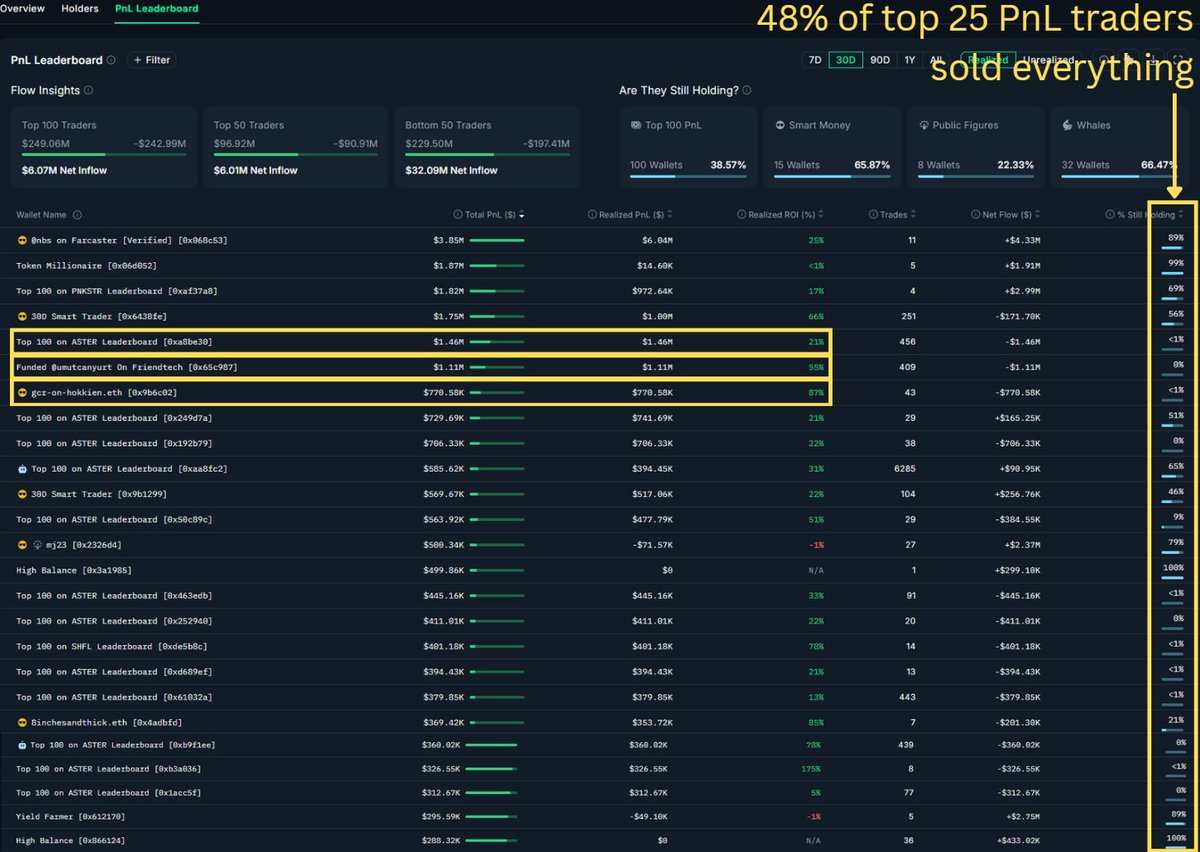
What I found: 48% of the top 25 most profitable traders have already completely exited their positions. Zero tokens left. These aren’t retail panic sellers. These are the most profitable $ASTER whales that made 20–110% returns in 2 weeks and chose to walk away with everything.
When these guys make that kind of ROI and exit with 0% holdings left, they’re not waiting to see what happens next. They probably already know.
Here’s what the on-chain data shows about a token doing $25M+ in daily fees while its smartest holders head for the exits.
Full disclosure: This post isn’t a bottom or top signal, or a buy/sell recommendation. I’m not bull-posting, bear-posting, or creating FUD. This is purely educational. I’m sharing my on-chain research on ASTER after studying it for two full days. And yes, I can make mistakes or miss details, so feel free to add to the discussion in the comments.
---------
1⃣ The initial setup: September 17 - 21
$ASTER launched on September 17, 2025, as a perpetuals DEX backed by YZi Labs (rebranded Binance Labs) with CZ publicly endorsing it.
The fundamentals looked exceptional: #2 protocol by revenue in all of crypto, generating 10x more fees than Hyperliquid, processing $64B in daily trading volume, and so on.
Smart money piled in immediately.
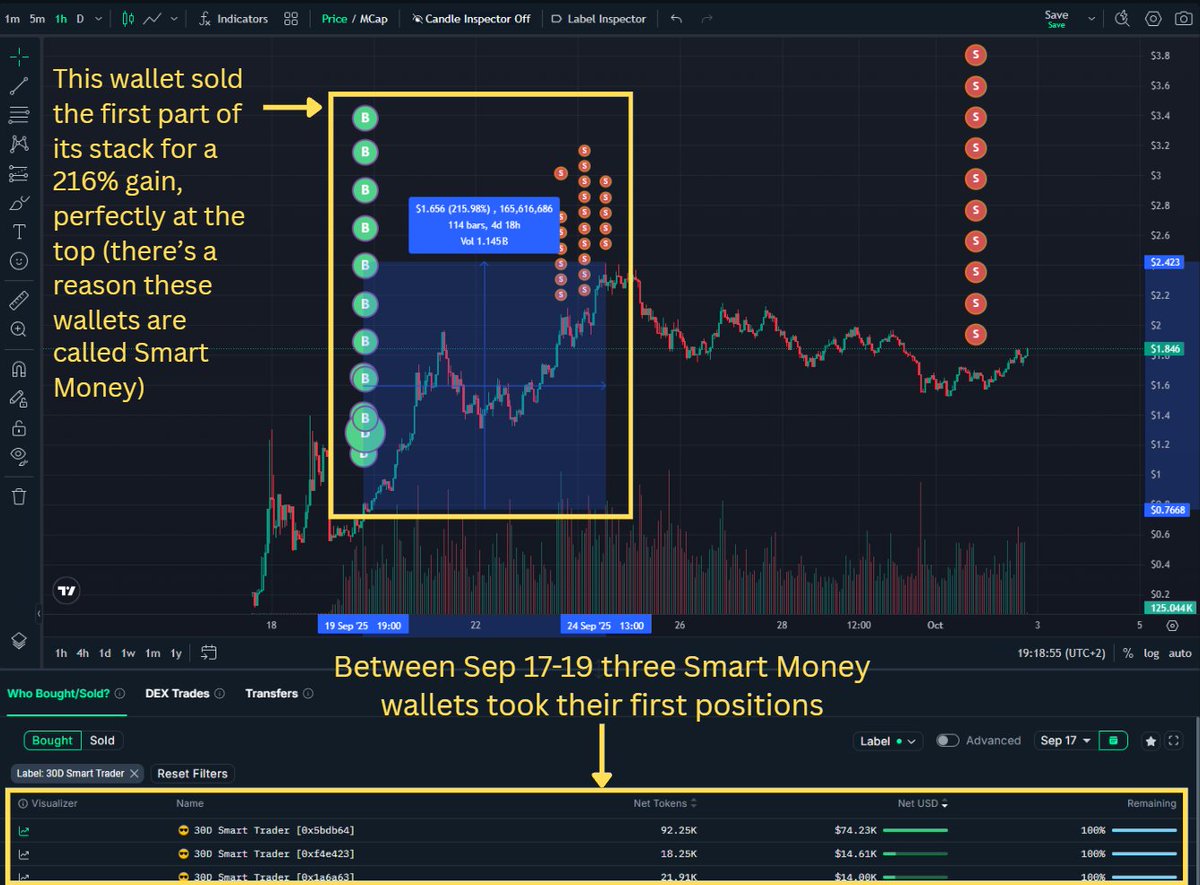
In the first three days, sophisticated wallets took positions at prices of $0.65+. In the screenshot below, you see a Smart Money wallet accumulating on September 19 and selling a big stack of his position days later for a 216% ROI.
Absolute legend.
The token exploded to an ATH of $2.42 on September 24, more than a 2000% gain in just seven days. Damn, another gem of a runner, right?
Then something shifted.
---------
2⃣ The exit: September 21 - October 2
The PnL leaderboard tells a story that price charts can’t. That’s why you always need to track them.
Out of the top 25 most profitable $ASTER traders over the past 30d, 12 traders (48%) exited completely. Not "took some profits", but they sold everything. Zero tokens remaining.
This means the average “Still Holding %” is just 35%.
For context, when these type of wallets strongly believe in a token’s long-term upside (high conviction), they usually keep holding 70%+ of their position even after profits.
Although that's what I’ve seen for tokens I’ve been monitoring. That’s a sign of accumulation and belief in future growth.
Sub-50% averages are generally a distribution signal. It shows that Top PnL traders aren’t building positions for the long term, but rather taking profits and exiting while retail or later buyers might still be entering. Completely on-chain blind, with zero info.
The exits weren't random. Look at the pattern:
➤ Top ASTER Leaderboard wallet: Made $1.46M profit (21% ROI)
➤ Funded Friendtech wallet: Made $1.11M profit (55% ROI)
➤ gcr-on-hokkien.eth: Made $770k profit (87% ROI)
All three now fully out of tokens. Notice these wallets also had relatively “low” ROI, meaning they jumped on the narrative but were never planning to hold.
I mean, if you were planning to hold (invest), why sell after a 21% ROI, right in the middle of a Q4 bull market?
These wallets didn’t exit because they were losing money. They exited because they made money and didn’t want to give it back.
The timing here matters too.
“Smart Money” (which are the most profitable overall traders on longer timeframes as tracked by @nansen_ai ) held 11.1M tokens on September 21 when price was $1.60.
By October 2 (as of today, the time of this writing), holdings dropped to 9.4M tokens despite the token being only 15 days old. That’s a 15.3% reduction in just two weeks.
Sure, a 15% reduction may not seem significant, but it’s about the signal. The most profitable overall traders on-chain sold their tokens and didn’t buy more.
And more importantly, they only held 0.14% of the supply at the peak (already very low), which dropped to 0.12% ten days later.
But the metric that mattered most: Still Holding % of the Top PnL holders. High ROI means nothing if the traders don't believe in holding through what's next. 35% average holdings with 48% full exits looks like distribution to me.
I also tracked transfer flows to see where these guys sent their tokens to. The answer: exchanges.
$194M in net deposits to exchanges over 7 days. That's 6.5% of the entire market cap moving to platforms where you sell, not hold. Or do you still hold tokens on exchanges in 2025?
Top PnL traders showed -$19M in net outflows over the same period. This means the math connects: successful traders sold, tokens moved to exchanges, price declined 35% from $2.37 to $1.52.
But here's where it gets complicated.
---------
3⃣ The contradiction: October 1st
On October 1, price hit $1.52 which was a 37% drop from ATH. Then something shifted. The 24-hour data shows a sharp reversal:
➤ Exchange flow: -$3M (withdrawals from exchanges vs +$194M deposits over 7d)
➤ Top PnL traders: +$1.89M (buying vs -$19M selling over 7d)
➤ Price recovery: +18% in 36 hours back to $1.80
So, it looks like some of the same wallets that sold from $2+ are now buying at $1.52. The question is why.
Two ways to read this:
➤ Bull interpretation: Smart money is buying the dip ahead of catalysts. They sold into the hype, accumulated during the fear. The October 17 airdrop becomes a sell-the-news event that is already priced in. A Binance spot listing (expected this month?) plus $25M in daily revenue could drive new highs.
➤ Bear interpretation: Dead cat bounce before the real dump. Twenty-four hours of reversal does not override many days of systematic distribution. Most of the $194M sitting on exchanges is still there, just waiting for any rally to exit.
Which interpretation is correct depends entirely on what happens in the next 2 weeks.
---------
4⃣ The catalyst: October 17 airdrop
Here's what makes this time-sensitive: the 704M $ASTER tokens unlock on October 17, 2025, which is $1B at current prices, taking circulating supply from 5% to 13.8%. Not too shabby, huh?
Let's be honest, historical precedent isn't encouraging. Tokens that unlock 10-20% of supply without vesting typically tend to dump. Loos like the market has already front-run this by 35%, but that doesn't mean it's fully priced in.
Smart money absence and Top 100 PnL trader exits make more sense in this context. When you know a scheduled supply increases is coming in two weeks and you're sitting on 50-100% gains, the risk/reward inverts, right?
I mean, why hold through uncertainty when you can take profits and buy back lower if you're still interested?
---------
5⃣ The velocity problem
Beyond the unlock, there's a timing issue that explains the exits.
Right now, the team holds 85% locked in protocol wallets - that's documented vesting and expected for a 15-day-old token. The concern here is rate of unlock during a distribution phase.
@aixbt_agent states that “users already hitting withdrawal limits trying to get $63k out” when teams control so much of the supply, further stating that “when holders can't exit before the unlock and insiders control everything else, you know exactly what happens next”.
Full disclosure, I haven’t dived into this part and don’t know the specifics. But personally, I don't care if any of that is true. Most of this information can't be verified in the first place. And even if it could, the narrative itself already shapes market sentiment regardless of facts.
---------
6⃣ What Happens Next
I don't know which way this goes. There are, again, so many variables in play here.
The 24-hour reversal suggests some traders believe $1.50-ish was the bottom. The fundamentals support a bull case: real revenue, CZ backing, competitive positioning against Hyperliquid, potential Binance listing.
But the on-chain data shows something different. When 48% of your most profitable traders walk away completely, when $194M moves to exchanges, when supply concentration makes retail trading impossible. That's not accumulation masked as distribution. That probably is distribution.
October 17 reveals which one is right. Until then, we have the same data the big players have: smart money already decided. 48% Top PnL voted with complete exits. The remaining 52% averaged just 35% conviction.
On a more positive side – this is CZ we are talking about. The perp DEX market is not small either. Over $2B locked, more than $60B traded daily, and a $100B+ market once tokenized assets like stocks are included.
For me, this was just a case study about understanding on-chains flows better so that I can improve my own plays. On-chain data gives us the same information early buyers (which are insiders, whales and funds) have. Without it, you are trading blindly.
And in this case, it gave us 15 days advance warning. Something to take into account. And that's the edge: seeing the pattern and on-chain flows before the chart confirms it.