You are looking at one of the most deliberate sightlines on Earth.
Start at the Louvre and look west. A single straight line runs for roughly five miles (8 kilometers), through the Tuileries Garden, across the Place de la Concorde, up the Champs-Élysées, through the Arc de Triomphe, and out to the skyscrapers of La Défense.
The French call it the Axe Historique, the Historic Axis. It started small, as a garden path lined up with the setting sun. Then king after king, and later emperors and presidents, kept building on that same line instead of starting a new one. Nobody ever bent it.
Here is the part almost nobody notices. The Louvre itself sits about six degrees off from the true axis. Instead of fixing that when they built the Grande Arche two centuries later, engineers tilted the Grande Arche by that same six degrees, in the opposite direction, on purpose. Two buildings, three hundred years apart, quietly lining up across five miles of Paris.
Twice a year, the sun sets in perfect line with the Arc de Triomphe when you look down the Champs-Élysées. Parisians have a name for it: Parishenge.
It is a bit like standing at the Lincoln Memorial and looking straight down the Mall to the Capitol, except this line is older, longer, and nobody planned it in one sitting. It grew that way over centuries and somehow never went crooked.
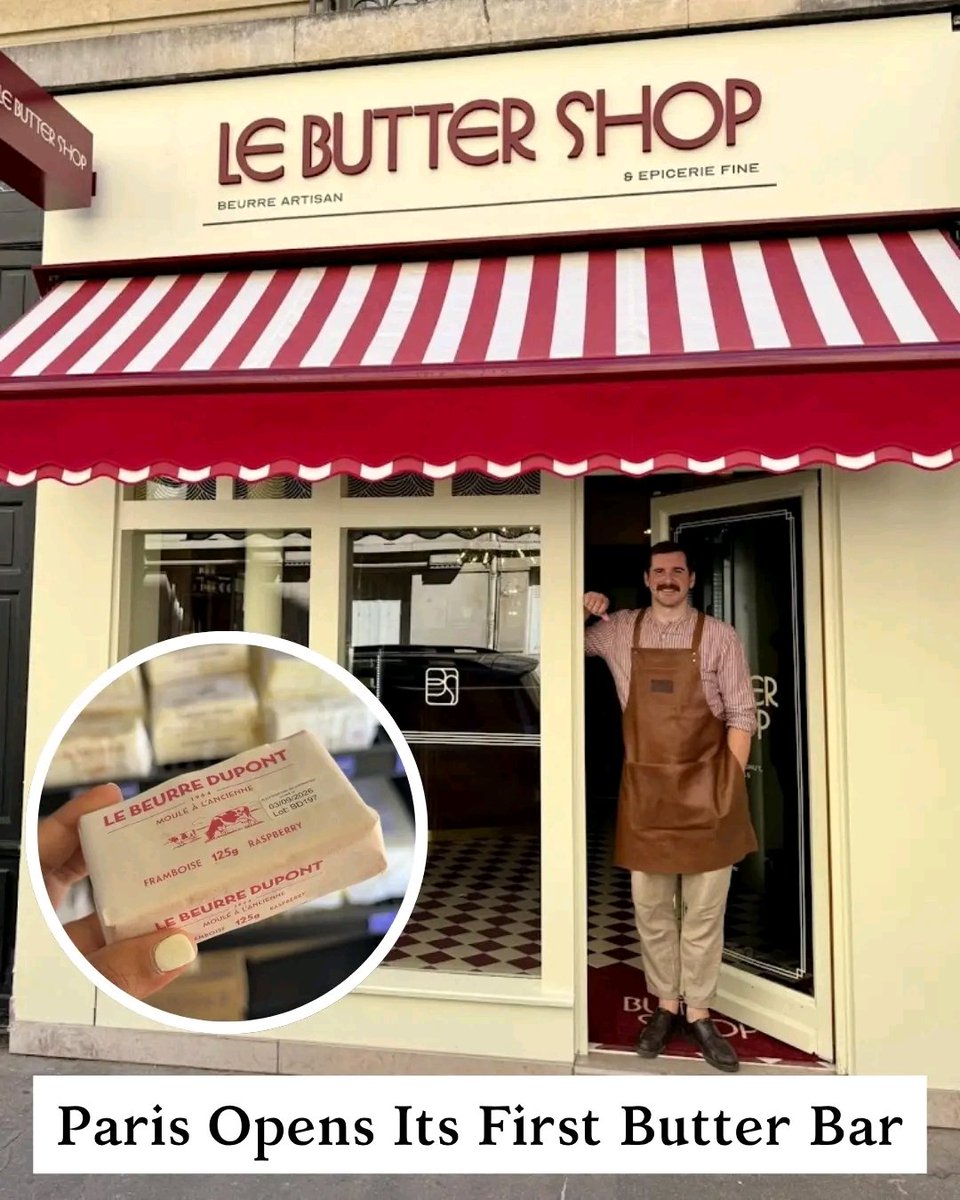
Paris now has its first shop dedicated entirely to butter, and it just opened in the 15th arrondissement.
The shop is called Le Butter Shop, and it was opened by Erwan Leo, who already ran a wine tasting business in the same neighborhood. Instead of stocking the one French butter brand most people have heard of, he deliberately chose smaller, harder to find producers, including Échiré, Beillevaire, Beurre Dupont, and Isigny Sainte-Mère. Around 30 varieties are on offer, from classic salted butter to seaweed, black truffle, and yuzu.
Visitors are invited to taste the butter on its own before buying, the same way you would taste wine or cheese. It sounds unusual, but the shop treats butter like a genuine gourmet product rather than something you just grab at the store.
The shop also solves the one problem every visitor worries about: getting the butter home in one piece. Le Butter Shop vacuum-seals every purchase for the trip, and insulated cooler bags are available for longer travel. Since butter counts as a liquid for airport security, it needs to go in checked luggage rather than a carry-on, but packed properly, it holds up fine for the flight home.
In November 1872, Claude Monet looked out from a hotel window over the harbor of Le Havre and painted the sunrise breaking through the morning haze. He gave the canvas a simple, almost throwaway title: Impression.
The painting first went on public view in April 1874, at an independent exhibition organized by Monet and a group of friends, including Renoir, Degas, and Pissarro, who had grown tired of being rejected by the official Paris Salon. Critic Louis Leroy attended, mocked the show in a review titled "The Exhibition of the Impressionists," and singled out Monet's hazy little harbor scene as proof that these artists were painting mere sketches rather than finished work.
The insult didn't stick the way Leroy intended. The painters embraced the label, and Impressionism became the name for one of the most influential movements in art history.
The painting itself had a rockier road than the movement it inspired. Sold for 800 francs in 1874, resold for a fraction of that after its owner went bankrupt, and eventually donated to the Musée Marmottan Monet in 1940, where it was first exhibited in 1946. In 1985, thieves stole it in a daylight robbery; it was recovered five years later and has hung back on the museum's walls ever since, alongside the world's largest collection of Monet's work, including the water lily paintings shown here.
This is the 69 bus, and it might be the cheapest sightseeing tour in Paris.
The route runs from Champ de Mars, right by the Eiffel Tower, to Gambetta, near Père Lachaise Cemetery, about 37 stops end to end. Along the way it passes the Musée d'Orsay, crosses the Seine near the Louvre, stops by Hôtel de Ville, and continues through the Marais toward Bastille before finishing near Père Lachaise, the cemetery where Chopin, Oscar Wilde, Édith Piaf, and Jim Morrison are buried.
It also gets you close enough to hop off and walk to a few extra spots. The quays along the route sit just steps from Île Saint-Louis.
The whole ride takes well under an hour, and it costs the same as any single metro or bus ticket in Paris.
It was never designed as a tourist route. It is a regular city bus that happens to run past a surprising number of landmarks, because so much of central Paris sits close to the Seine.