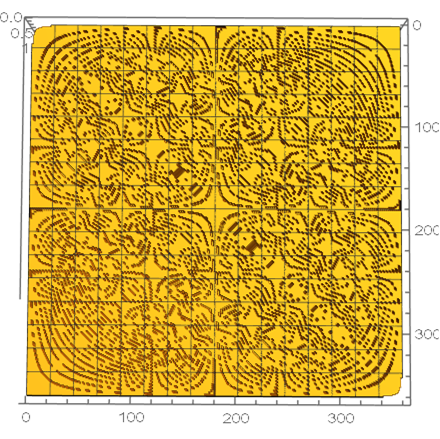
Amazing—the complex Jacobian Conjecture apparently disproved by an AI-generated counterexample.
Advice: we should really be looking for some new, deep, original human mathematics somewhere—and fast. 😶🌫️
@ericweinstein I love Holdsworth - can't name one "song" by him. He is a guitar virtuoso - it's not like you hum a song like ohh...that's "let it be". But if you hear him playing - you know its him.
Today is Feynman’s birthday — a perfect day to remember one of the most beautiful bridges in modern mathematics: the Feynman–Kac formula.
It turns Feynman’s “sum over paths” intuition into a rigorous stochastic statement: certain PDEs can be solved by averaging over Brownian paths.
Physics → probability → analysis.
Tomorrow I’ll have the honor of speaking at the Geometric Functional Analysis and Probability Seminar at the Weizmann Institute on Variations of the Hardy Z-function and Dyson Brownian Motion — from new approximations of Z(t) to GUE statistics.
Looking forward to it.
📄 New paper now online:
“A New Variational Approach for the Numerical Location of Hardy Z-Function Zeros on the Real Line”
I introduce a variational framework that deforms the zeros of the Riemann–Siegel core into those of the Hardy Z-function, reframing the Riemann Hypothesis as a non-linear optimization problem.
Journal of Computational and Applied Mathematics (Elsevier)
https://t.co/MCNp6fFTv3
"The art of peace consists in defeating your adversaries spiritually by making them realize the folly of their actions. The Way of a Warrior is to establish harmony" (Morihei Ueshiba - The art of peace - Letter 91)
Riemann’s 1859 paper is often read as a breakthrough in number theory. I think it’s more than that—it’s a manifesto for a new mathematical worldview.
At the time, complex analysis was a cutting-edge tool. Riemann’s move was radical: don’t study primes directly; study the zeta function, and in particular its zeros—purely analytic objects. Suddenly, prime questions become spectral and geometric.
There’s a common belief in math: hardness is conserved—hard in number theory means hard everywhere. Riemann seems to disagree. With the right tool, difficulty doesn’t just move; it can be reshaped.
This matters today. Montgomery’s pair correlation was long viewed as a deep arithmetic problem, expected to require heavy prime input. My work suggests that once the right variation space for Z(t) is identified, the problem shifts into dynamics, ergodic theory, and probability.
A common objection is: “If it’s about zeta, it must be about primes.” Riemann already taught us otherwise. Some questions tied to primes are better understood through analytic or dynamical structure.
Progress sometimes comes not from pushing harder—but from seeing differently.
Why do the zeros of the Riemann zeta function follow GUE statistics, like eigenvalues of random matrices?
This is the content of Montgomery’s Pair Correlation Conjecture—verified numerically for decades, but long considered a mystery:
zeta is completely deterministic, random matrices are
not.
My recent work resolves this from within the theory of Z(t) itself.
The key idea is to embed Z(t) into a natural analytic variation space coming from its approximate equation. Inside this space there is a distinguished “real hall” where zeros remain real and simple—an analytic analogue of a random matrix ensemble.
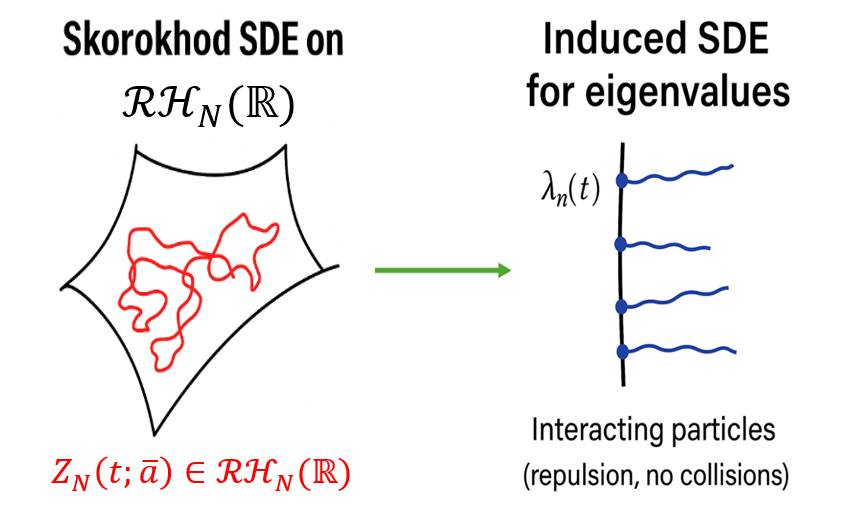
Brownian motion on the coefficients induces stochastic motion of the zeros:
first-order terms behave like independent noise,
second-order terms create Coulomb (logarithmic) repulsion.
This produces Dyson Brownian Motion internally, and universality then forces GUE statistics.
GUE behavior is not imported from random matrices — it emerges intrinsically from the Z-function itself - for the first time!
See: https://t.co/FltNGBmnQP
Beyond whether the abc “proof” via IUT is ultimately correct (still far from broadly settled), I think there’s a deeper issue: what mathematics should look like.
In the last ~30 years we’ve drifted toward extreme formalism. Rigor is vital, but when the machinery becomes so heavy that the global architecture of an argument isn’t communicable—even to top experts—that’s a warning sign. Not “wrong,” necessarily, but unstable.
I suspect the next swing will be back toward a more classical balance: keep full rigor, but demand a clear conceptual spine that can be explained and shared.
#Mathematics #NumberTheory #abcConjecture #MathCulture #MathPhilosophy #RigorVsIntuition #IUT
https://t.co/Wwb4WcCzty
Just watched this great intro on random matrix theory & the “three coincidences” (nuclear spectra, chaotic billiards, zeta zeros) and the Montgomery–Dyson GUE story for zeta:
🎥 https://t.co/G65tKgF99o
My recent work attacks this from the zeta side: building finite-dimensional “A-variation spaces” for the Hardy Z-function where a constrained Brownian motion in parameter space induces Dyson Brownian motion (β=2) on the zeros → an internal mechanism for GUE-type stats. 📄 https://t.co/FltNGBmnQP
Some thoughts about AI and human mathematics.
We are at a strange moment. AI systems can already manipulate symbols, search the literature, generate lemmas, and even write decent looking proofs. At the same time, human mathematicians still spend years struggling with a single problem.
If academic institutions align themselves completely with volume, metrics, and safe incrementalism, they give up their only real advantage. Their purpose is not to out compete machines in number of papers, but to be the place where human mathematics is allowed to exist and grow.