One of the nice things about not having to "work" for your bags is that you can tell projects and devs to their face what you really think about their decisions. I’m glad I’ve never had a referral or a public position I needed to defend. I’m here for fun, so you can call me a psycho.😂
reset my ranges and going to report results a little differently
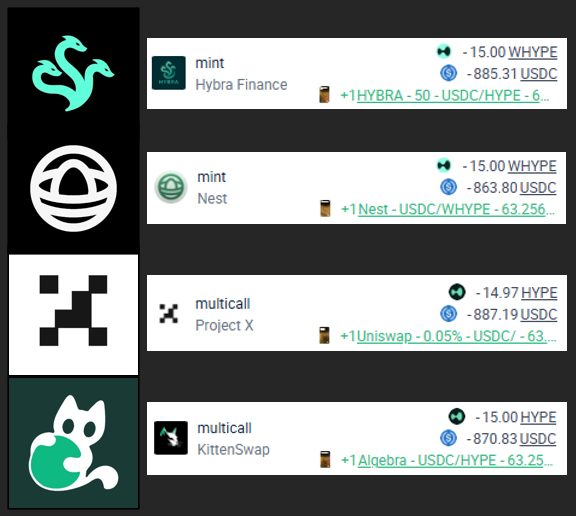
putting in 15 $HYPE + ~$875 USDC into a
$63.25 --> $71 range
since @NestExchange, @KittenswapHype, and @HybraFinance provide the yield in emissions, i'm going to claim + swap into USDC on a regular basis
will report both "stated yield" and "claimed yield" metrics
stated yield - what the protocol is showing me
claimed yield - total USDC after all the swaps
same with @prjx_hl - will claim my yield in base:0x833589fcd6edb6e08f4c7c32d4f71b54bda02913
i'm choosing USDC instead of $HYPE because it's simpler
I also actually LP on Ramses myself, but judging a protocol solely on a static emissions-to-fees ratio is a flawed analysis. Nest handles significantly more volume and has smashed a 50x because the market prices utility, not basic spreadsheet metrics.
The whole thesis revolves around the HYPE Engine, people are locking $NEST to accumulate $HYPE, which is why there's an unprecedented 86% lock rate. This and market demand completely neutralizes the inflation argument. With $24M in TVL and $478M traded in the last 30 days, that’s a 20x liquidity turnover, meaning the capital is working harder here than anywhere else on the chain. As long as volume backs it up, buyers aren't footing a bill, they are pricing in actual growth and liquidity depth
Emissions don't tell the whole story without looking at demand. Nest is up nearly 50x in months because the market is easily absorbing that supply. As long as trading volume and protocol growth back it up, capital inflows outpace the print. The market prices assets based on liquidity and growth, not just an isolated emission sheet
Seeing some confusion in the @NestExchange Telegram chat about the difference between the HYPE Engine and the HYPE Engine Vault (HEV). They sound almost identical but do completely different things.
-The HYPE Engine
It’s basically locked $NEST from the Genesis allocation that the protocol uses to vote, grab trading fees, and buy $HYPE. Its only job is to funnel those $HYPE rewards back to real users who are locking up new veNEST (at the moment 👀).
-The HYPE Engine Vault (HEV)
If you drop your veNEST here, it does all the heavy lifting for you. The vault automatically votes every week, collects trading fees, and compounds them into more locked $NEST (veNEST) without you paying gas or lifting a finger.
The $HYPE kicker:
Because the auto-compound is constantly growing your locked $NEST balance, your weight increases every single week. This automatically qualifies you for an even bigger slice of the weekly $HYPE rewards coming from the Engine as you are locking new $NEST.
The catch: To stop people from just farming and dumping, those autocompounding rewards come with a trade-off, any new compound triggers a strict, new 6-month lock on your capital.
Thoughts on @prjx_hl cash drop
First off thank you to the team. The bar is incredibly low as far as HyperEVM airdrops go, but just returning straight cash to early users is so much better than dropping a useless governance token that goes to zero.
At the same time though, I think this is an interesting case study as to why @Uniswap forks are fundamentally doomed.
In order to get this cash drop, I earned ~$1m in LP fees, and $135k went to @prjx_hl as they have a 14% take rate. So the cash drop is effectively just a 10% rebate of what they made. Effective take rate down to 12.6%.
Assuming that 12.6% take rate remains with the ongoing USDC rewards they are doing, why would I continue to LP here over @NestExchange (the HyperEVM @AerodromeFi metaDex equivalent)? You're selling the same volatility in the same range but getting paid more to do so.
This is the fundamental flaw with all @Uniswap forks and why I'm long $AERO and $NEST. You can't have a take rate to support a token (and @prjx_hl is wisely choosing not to do so) AND be the best place to LP. LP's will choose to migrate to where they get 100% of LP fees over 87.4%.
This is on top of the fact that only earning fees off being short realized vol means that longer tail pairs can't attract liquidity in the same way emissions can incentivize. This will become increasingly important as more spot RWAs come on chain.
Liquidity will flow to where the highest rewards are, volume will get routed to where the best liquidity is, and value accrues to $AERO and $NEST.
The privacy mistake 90% of people make on-chain (and how to fix it). 👇
Using one wallet for everything is an opsec nightmare. If you interact with dApps, farm on DeFi, mint NFTs, and fund that same wallet from a KYC exchange, you are building a perfect public map of your net worth and identity.
On-chain analytics tools can link your entire financial history in seconds. If just one protocol you used gets exploited or leaks data, your whole setup is compromised. The solution? Wallet compartmentalization.
You need to treat your wallets as isolated silos with zero on-chain links between them. A standard setup should look like this:
-Cold Wallet: The vault. Never touches dApps, never signs smart contracts. I use it to store 80% of my Bitcoin I will never send it to any of my battle wallets.
-DeFi / Ecosystem Wallets: Mid-tier wallets for trusted protocols. I take this a step further: one wallet per chain. If I’m farming on a specific network, that wallet holds the capital for it. If I lose conviction or want to rotate, I bridge the funds to the next chain and start playing there.
-Burner Wallets: Hot wallets used for new protocols, high-risk mints, or airdrop farming. If it gets drained, who cares.
The hardest part of this strategy is funding the gas. If you spin up a clean burner wallet but send ETH to it from your main address to pay for transactions, you just linked them forever on Etherscan. The pricavity is gone.
This is why features like @Rabby_io's GasAccount are great for UX. You can deposit stablecoins into a gas balance and trade on a clean wallet without needing native tokens (like ETH) sitting in it first.
But where do you get the USDC to fund it? Always use a direct CEX withdrawal. If you are buying via OTC, demand that they send the funds straight from a centralized exchange wallet. Never route it from another personal address. If you transfer USDC from your main on-chain wallet to fund the GasAccount, you’ve just exposed the link between your accounts. The on-chain trail ends at the exchange withdrawal, and you start completely fresh.
But there’s an off-chain privacy catch. If you use the exact same Rabby GasAccount to pay for both your main wallet and your "anonymous" burner, Rabby’s backend knows they belong to the same person. If their database ever leaks, your map is exposed.
To make this 100% anonymous:
Create a completely separate user profile in Rabby. For that you need to create a completely separate browser profile and install a fresh Rabby instance there.
In a multi-chain world, privacy doesn't happen by default anymore, you have to architect it yourself. Fragmenting your digital footprint is the only way to protect both your capital and your anonymity.
The flywheel of the "trust me bro, Google does this."
Apparently, nuking the token price for an "acquisition campaign" is the DeFi equivalent of Silicon Valley CAPEX. It’s not a crash, it’s just "strategic dilution" to grow the pie.. 😅
Having an extra ~$180M in annual revenue is obviously bullish.
But the real bullish part is not just the number.
It is Coinbase and Circle putting their weight behind Hyperliquid.
USDC becoming the aligned quote asset means two of the most important regulated crypto companies are now economically and strategically incentivized to support Hyperliquid’s growth, reputation and regulatory positioning.
The revenue matters, but the institutional backing may matter even more.
Hyperliquid