Hey, Yonathan here 👋
They say it’s never too late to start — so here I am 😁
Sharing my first project in progress: Lumina ✨
An AI journaling app that turns scattered thoughts into insights and supports personal growth.
Let’s see where this takes us.
Another one.
Today's read is about How Postgres Implements MVCC
tip: If you stumble across a really good article on a topic, don’t just stop there, chances are the author has a goldmine of other great posts often times so do check their blog site.
@joeksluis building a small Pg HA/replication controller.... bootstrapping standbys, monitoring WAL replication, and experimenting with failover/election and rewiring nodes after a primary dies. I’m at the fencing prevention part now, so your piece landed at the perfect time :)
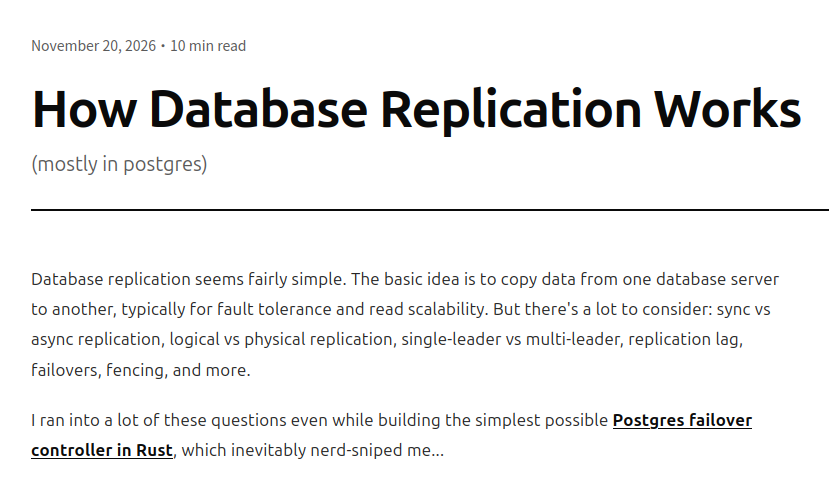
Finished my article on how database replication works
I tried to explain the principles behind replication while touching on a wide range of topics (physical vs logical replication, replica lag, replication slots, sync vs async replication, failovers, etc)
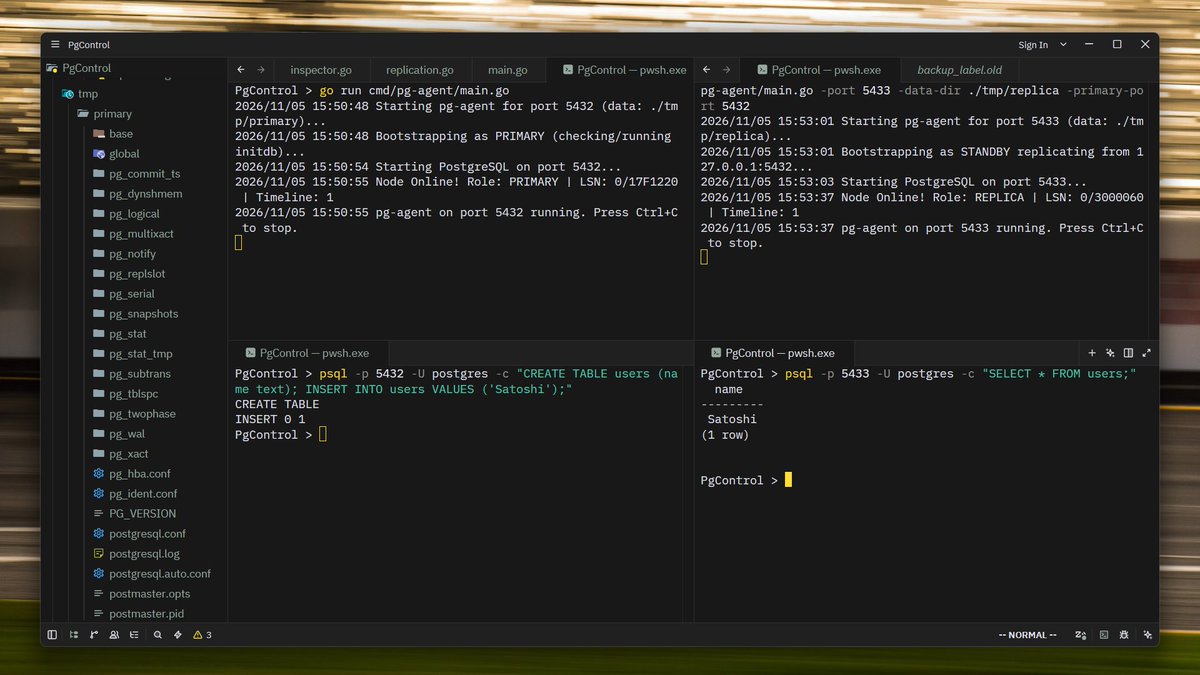
Building PgControl (an autonomous Postgres cluster manager)
a 3-node HA topology running on identical daemon binaries, automatically electing a primary and streaming transactions across replicas with zero manual intervention.
Hermes-Janus for @NousResearch
A temporal state engine for Hermes:
• Fork branches to test edits in isolation
• Instant rollback if an agent breaks code
• Run tournaments to test & auto-merge winners
• Zero-dep SHA-256 CAS engine
#HermesHackathon
How do you ship fast while not breaking the database?
Most of the principles are decades-old ideas in reliable infrastructure. The key with agents is exposing them as primitives in just the right ways.
My talk from AIE this summer (YouTube link below)
Failover cannot be an afterthought.
It is, fundamentally, how you create reliable databases in the face of inevitable server and network failures.
How we designed them in Neki ↓
https://t.co/a09ggS1UOi
forgot to share the video demo for this one!
so here, 1 YAML spec compiles into Proto + REST metadata, runs both transports over shared Go logic, and rejects a breaking wire change against the baseline when I mutate a field type.
pure build-time contract safety in Go.