#FirstNigerianTo create a community-led African language preservation app. Starting with the Yorùbá language.
AfriRoots Labs is here. Sign up here to contribute and test 👇🏽#firstnigerianchallenge
https://t.co/FToDEEGak3
@gidox4 IPOB card? Does GRV himself not have pro-IPOB tweets? Is IPOB not classed as a terrorist group? So a terrorist leaning candidate is who lagosians should pick as their next governor. You are irredeemably stupid.
As much as you think your intentions are good, your message gives these tribal wielding apc sycophants more ammunition. Your video is/was enlightening but I believe it’s wrongly timed.
I absolutely hated being on this app in 2022/2023 period. It was always Yoruba hate back-to-back even from Yoruba people who always had to include their ethnicity to show they are the good Yorubas before dragging the entire ethnic group for filth.
Dragging our women, elders, Yoruba greeting culture, calling us submissive slaves, all because a Yoruba man was aspiring for Presidency and after he got there, the hate didn’t stop.
Now all of you are suddenly tired of tribalism on the TL in just a few days because more people are waking up to your agenda of denigrating us under the guise of critiquing government.
Just search my page to see how tired I’ve been and for how long. You all are so dishonest.
Wrong. “I am Yoruba but” usually follows the most bigoted and stupid statement about Yoruba people rather than critiquing government. You can critique bad governance what does you being Yoruba have to do with it?
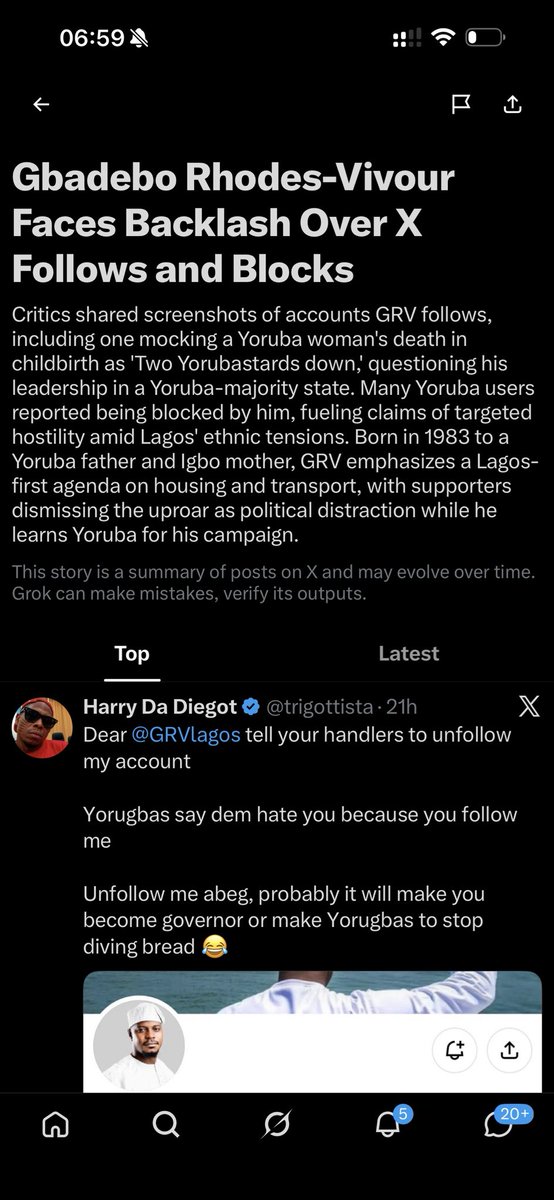
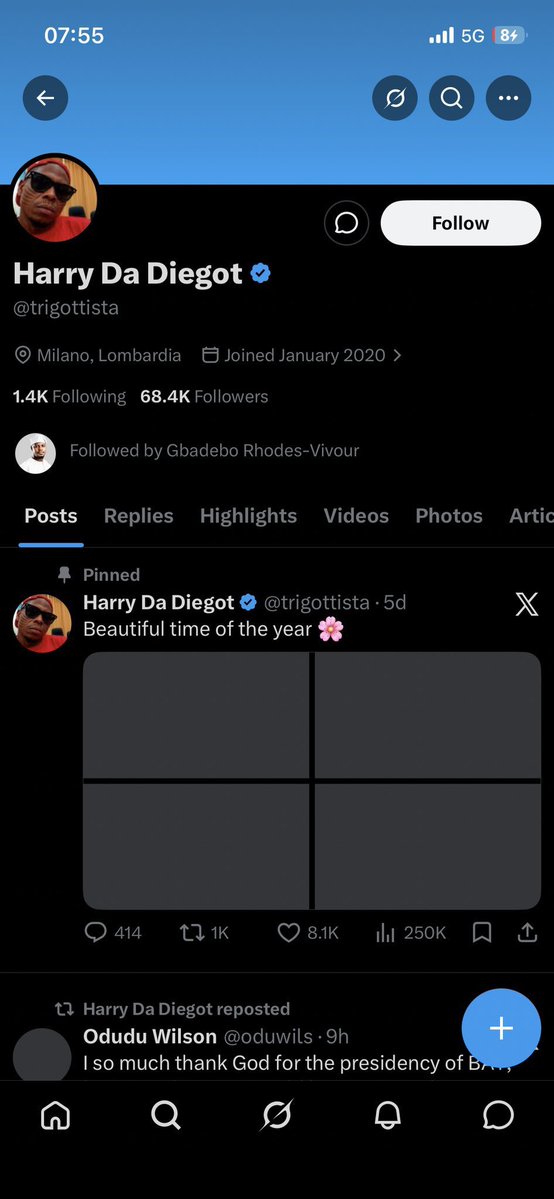
So the response to APC “state-backed bigotry” for someone who wants to lead Yoruba people is to follow a Yoruba hate account. Am I the one running for office? Have you asked GRV why he follows every new Harry acct? You lots will make an excuse for anything as long as it’s your fave, try to stand for something.
How did you arrive at good governance without the first step of communication? At the end of the day the people who are uneducated are most likely the ones to ruin public infrastucture or eschew policies they don’t understand.
We’ve seen past governors in Lagos having to go down to the people and speak to them in Yoruba to explain policies to them.
If you can’t speak to people in the language they understand there is no good governance. They work hand in hand.
Why are you hell bent on a candidate who lacks the basics when there are others on the ballot who can do both?
@yorubachic You’re still missing the point. Terribly, I might add.
And you’re just responding to a strawman. Nobody is saying “leave language and focus on governance”
The point is “good governance is a higher priority than language preservation”.
It’s not that difficult to understand.
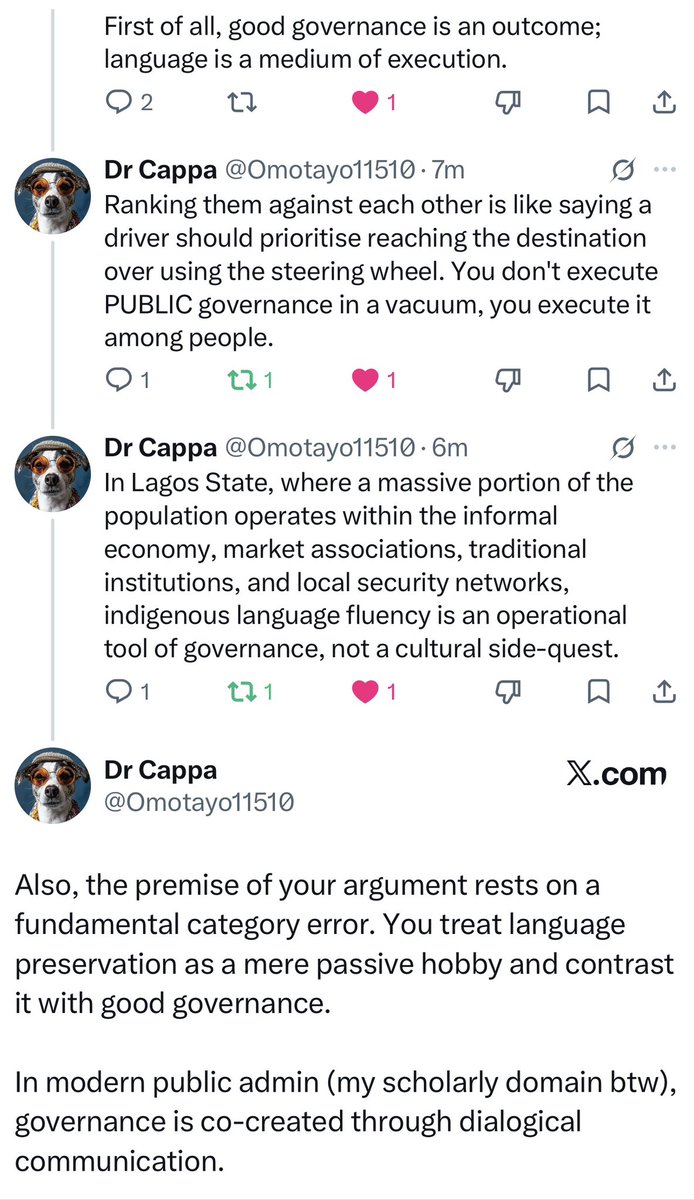
@i_am_vindicated@yorubachic So, asking whether “good governance is a higher priority than language” is a flawed question. Language is the primary vector through which good governance is felt, understood & executed, especially at the grassroots. Thus, you need to upgrade your knowledge of “governance”.
@i_am_vindicated@yorubachic ….administrative efficiency, inclusive governance, grassroots legitimacy and even constitutional alignment- Yoruba is officially recognised in the Lagos State legislative framework incase you didn’t know.
Our Language is Not “Ringworm”
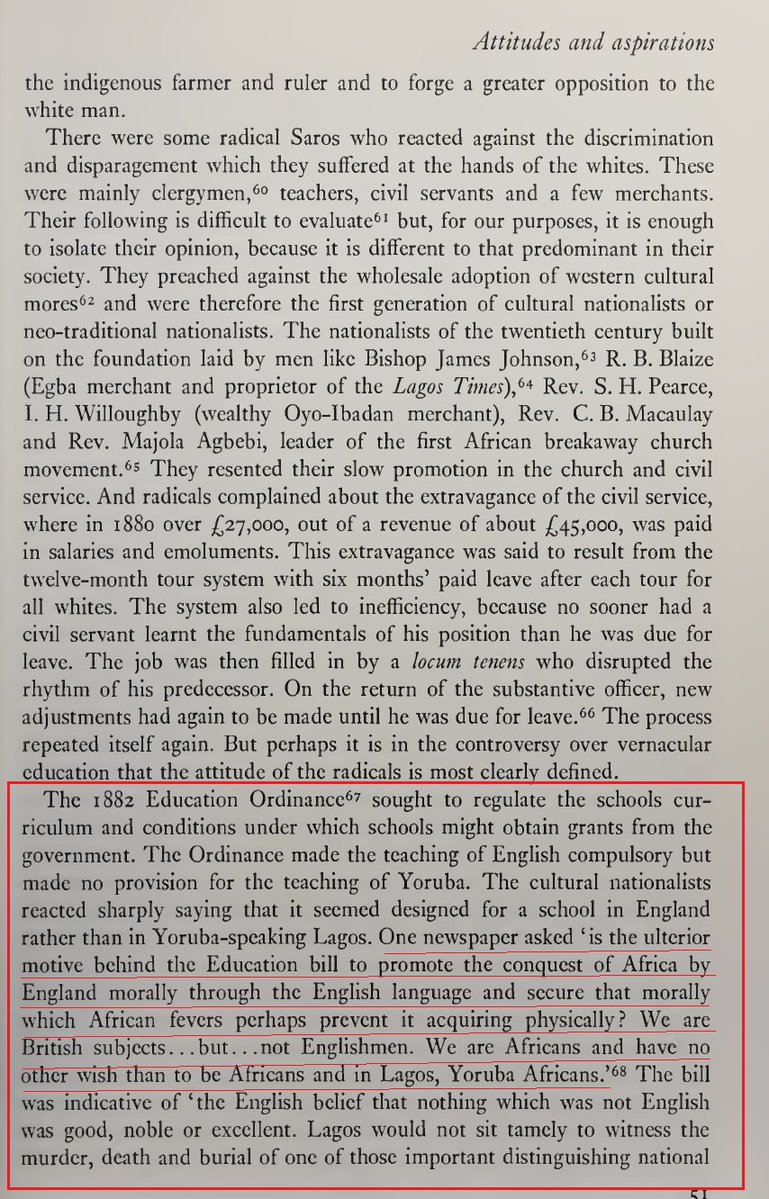
In 1882, those who fought for the preservation of the Yoruba language against English Colonisation in Lagos were called “Yoruba Maniacs”.
It’s 2026 and history is repeating itself.
The interesting thing about the current debate over the Yoruba language in Lagos is that it is not new. In fact, people made versions of the same argument nearly a century and a half ago.
One development that brought the issue to the fore was the 1882 Education Ordinance, which made English compulsory while making no similar provision for Yoruba. The controversy that followed divided the Lagos elite, particularly the Saro community.
On one side were the more radical Saros. This included men such as James Johnson, Mojola Agbebi and C. Sapara who increasingly described themselves as “Yoruba Africans.” They argued that the Yoruba language was one of the distinctive characteristics of Lagos and that not teaching the Yoruba language to students in schools was, in effect, to “teach them to entertain the lowest idea of themselves and make them servile imitators of others.”
On the other side were figures such as E. O. Macaulay and J. Began Benjamin. They derided their opponents as “Yoruba maniacs” and dismissed their demands as a “farrago of nonsense.” Their argument was essentially that refinement and progress required English to become the dominant, if not exclusive, language of respectable Lagos society.
If you strip away the nineteenth-century vocabulary, that argument, you would agree, sounds remarkably familiar. The language may have changed to “cosmopolitanism,” “competence,” and “modernity,” but the underlying proposition is much the same: that Lagos somehow becomes more sophisticated by weakening the place of its indigenous language and culture.
In the end, the so-called “Yoruba maniacs” largely won the argument. But what is particularly striking about the 1882 debate is not simply what each side said. It is how each side understood its relationship with Yoruba society.
The men who called themselves Yoruba Africans, despite their Saro backgrounds, were deeply conscious of their Yoruba heritage. James Johnson was proud of his Ijebu identity; Mojola Agbebi embraced his Ijesa heritage; and Sapara his Ekiti roots. Their Yoruba identity was not incidental to them. It was something to be defended, even when doing so came at a professional or social cost.
Johnson took this cultural commitment to an extraordinary degree. As J. D. Y. Peel recounts, he could be so uncompromising about his Yoruba heritage that he was prepared to flog members of his congregation for giving their children non-Yoruba baptismal names. Whatever one thinks of these men, there was no ambiguity about their conviction: language, names and culture were not decorative accessories. They were central to a people's sense of themselves.
Their opponents approached the matter differently. Some men of Yoruba ancestry, such as Macaulay, identified more strongly with the Sierra Leonean Creole world and with the British “civilizing” project than with Yoruba cultural nationalism. When figures such as James Johnson were harassing Governor Gilbert Carter over the Imagbon war in Ijebuland, elements of this opposing Lagos elite defended colonial atrocities through their newspapers.
Others within the same broad camp had no Yoruba ancestry at all. One example was Dr. Easmon, who campaigned virulently against the Yoruba African movement. To men of this ilk, the Yoruba character of Lagos was not something requiring preservation. If anything, it was something that could be subordinated to a supposedly more cosmopolitan identity.
And this is where the nineteenth-century debate begins to feel eerily contemporary.
Watch the arguments being made today. The vocabulary has been updated, but many of the assumptions are familiar: Lagos is “cosmopolitan”; language requirements undermine “competence”; or emphasizing Yoruba diminishes the city's openness to others.
But cosmopolitanism does not require cultural amnesia. Montreal does not become less French because people from across the world live there. Berlin does not cease to be German because it is multicultural. A city can welcome everyone without pretending that it emerged without a people, a language or a historical culture of its own.
Language matters because it is more than a means of communication. It encodes memory, history, concepts, names, literature, humor, and ways of understanding the world. Once a language is banished from public life, other cultural markers atrophy gradually. And as those markers disappear, the bonds connecting one generation to the next become harder to sustain.
That was what the “Yoruba Africans” of nineteenth-century Lagos understood. They were not arguing that Lagos should be closed to outsiders. Many of them were themselves products of migration, return and cultural encounter. Their argument was that openness did not require self-erasure.
And that distinction remains relevant today.
So when people insist that requiring a political office aspirant in Lagos to be a Yoruba speaker is somehow incompatible with the city's cosmopolitan character, they are not advancing an especially new argument. We have heard versions of it before.
The names have changed. The vocabulary has changed. The debate has not.
@i_am_vindicated@yorubachic In Lagos State, where a massive portion of the population operates within the informal economy, market associations, traditional institutions, and local security networks, indigenous language fluency is an operational tool of governance, not a cultural side-quest.
@i_am_vindicated@yorubachic Ranking them against each other is like saying a driver should prioritise reaching the destination over using the steering wheel. You don't execute PUBLIC governance in a vacuum, you execute it among people.