@ston_fi How you can give your vote on STONfi 👇
1,Open Telegram on your phone/computer.
2,Click/tap this link: https://t.co/aZ5IQPi8wW
3,The bot will ask you to choose a category select "DeFi Protocol of the Year"
4,Then,select /type https://t.co/d06xyFeyyq as your vote.
I asked @trymira a simple question:
How can one idea become quality content without jumping between five different tools?
The response was actually interesting.
Mira isn’t just about generating text.
You can start with a rough idea, work on the hook, turn it into a thread or script, create visuals, generate video or audio, search for trends, and even stay consistent with reminders.
For Web3 creators, I think that matters.
Because sometimes the hardest part isn’t finding an idea.
It’s taking that idea from
I should post about this
to
This is actually worth reading.
And when you have to move between different tools for every little step, you lose time and sometimes even lose the original thought.
Having more of that workflow in one place can remove some of that friction.
I’m still exploring @trymira , but this is the part that caught my attention.
Less time fighting with tools, More time thinking, creating, and sharing useful ideas.
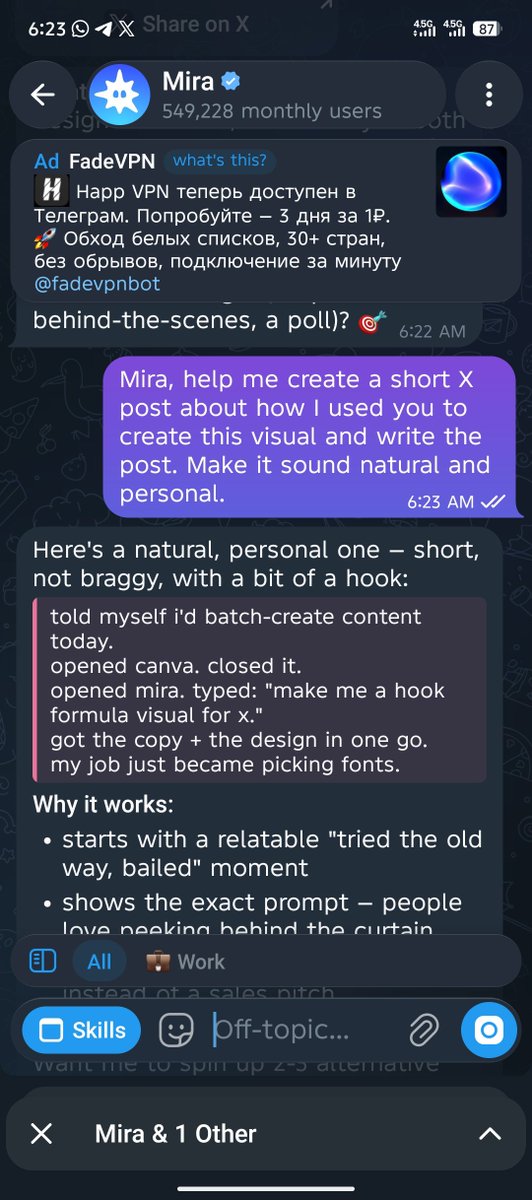
I wanted to create a simple piece of content for X but I didn’t want to spend too much time going back and forth between different tools.
So I tried Mira.
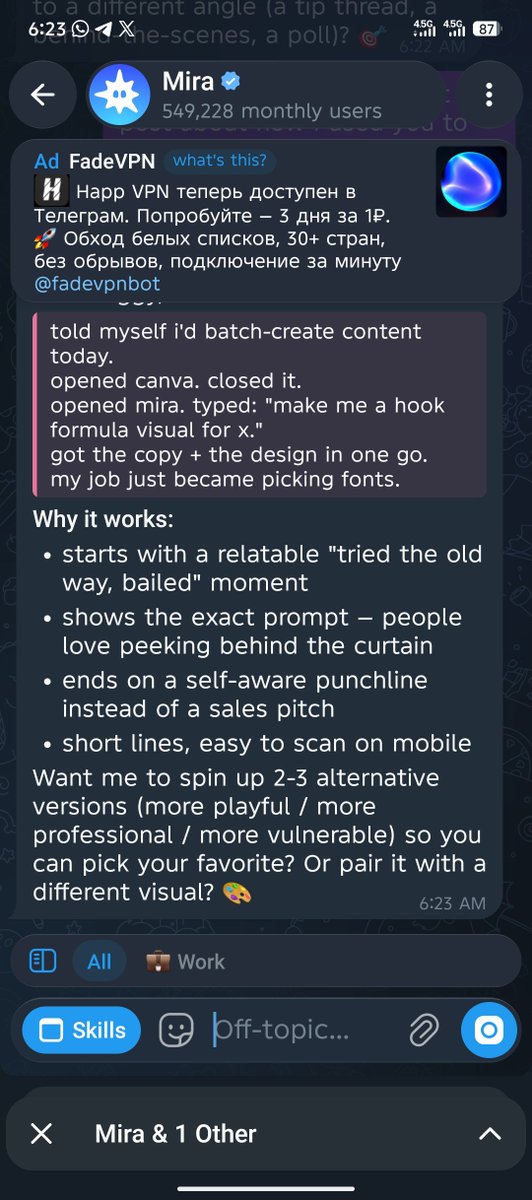
I gave Mira a simple prompt asking it to help me create a hook formula visual for X. It came back with the copy and the visual direction together, then I asked it to turn the experience into a natural post.
What surprised me most was how quickly I went from a simple idea to something I could actually post.
This is the kind of AI workflow I’m starting to enjoy less time figuring out the tools, more time focusing on the idea.
Still exploring what Mira can do, but this was a good first experience.
@trymira
FROM WEB1 TO WEB3 002
Web2 — When the Internet Became Social
Let’s continue from where we stopped.
Web1 was simple.
You opened your computer.
You went online.
You found a website.
You read something.
Then you left.
You were basically a visitor.
But then the Internet started changing.
Websites became more interactive.
Suddenly, you could create an account.
Upload a picture.
Write something.
Leave a comment.
Share a video.
Talk to someone you've never met.
And just like that…
the Internet stopped feeling like a library.
It started feeling like a community.
Welcome to Web2.
Think about how you use the Internet today.
You wake up.
You check X.
You scroll through Instagram.
Maybe you watch YouTube.
You comment on something.
You repost a post.
You send someone a DM.
You create content.
You might even build a business entirely online.
That's Web2.
You don't just consume anymore.
You participate.
And that was a huge change.
Someone sitting in a small room with nothing more than a phone could suddenly reach thousands or even millions of people.
A writer didn't necessarily need a newspaper.
A musician didn't necessarily need a major record label.
A small business didn't need a huge advertising budget.
If people liked what you created, they could follow you.
Your audience could grow.
Your community could grow.
And the Internet became a place where ordinary people could actually create value.
That's why Web2 is often described as:
Read + Write.
You read what others create.
And you create something for others to read.
Simple.
But there was a catch.
A pretty big one.
Most of the platforms we use are controlled by companies.
You might build a huge following on a platform.
But you don't own the platform.
You might create amazing content.
But the platform decides the rules.
You might spend years building your audience.
But your account can still be restricted, suspended or changed by someone else.
And then there's your data.
Think about how much information you give these platforms without even thinking about it.
What you watch,
What you like,
What you search,
Who you follow,
What you click,
Where you spend your time,
All of that can become valuable.
So Web2 gave us something incredible:
Participation.
But it also created another question:
Who actually owns the value being created?
You create the content,
Users build the community,
Creators bring the attention,
But the platform often controls the infrastructure.
It's almost like building a shop inside someone else's mall.
You can make the shop successful.
You can bring thousands of customers.
But the mall owner still makes the rules.
And that question started getting people thinking differently.
What if you could actually own your digital assets?
What if your identity wasn't completely tied to one platform?
What if communities could organize themselves without depending entirely on a central company?
What if you could send value across the Internet without needing a bank sitting in the middle?
And most importantly
What if the Internet could give users more ownership?
That's where Web3 enters the story.
But we shouldn't rush there yet.
Because there's one important piece of the puzzle we need to understand first.
Bitcoin.
Before people were talking about DeFi, NFTs, DAOs and all the other Web3 stuff
Bitcoin came along with a surprisingly simple idea.
What if money could work on the Internet without a central authority controlling it?
That question opened a completely different chapter of the Internet.
And that's where we're going next.
Next: Bitcoin the experiment that changed how we think about digital ownership.
Farming Is More Than Just APR
A high APR can catch your attention, but it shouldn’t be the only reason you enter a farm.
With @ston_fi , there are a few things worth checking before providing liquidity:
What am I putting in?
What am I earning?
How long do the rewards last?
Are my LP tokens locked?
And what are the risks?
Right now, @ston_fi has active farms for STON/USDT, JETTON/USDT, JETTON/GRAM and STORM/GRAM.
Some have boosted rewards, while the LP tokens aren’t locked.
For example, the STON/USDT farm has up to a 2× APR boost for eligible STON stakers until August 31.
But the reward is only one part of the picture,
Token prices can move, Impermanent loss is real, Farming conditions can change.
That’s why I like the idea of taking a closer look before jumping in.
@ston_fi gives you the opportunity to farm, but understanding the pool and the risks is still on you.
Don’t just chase the biggest number.
Know what you’re earning, Know what you’re risking,
Then make your move.
DYOR
There’s something about @ston_fi ranking #4 among 100 TON apps that caught my attention,
It’s not even the ranking,
It’s the 14,000+ financially active wallets.
That number tells a bigger story.
These aren’t just wallets sitting there. People are actually coming back to swap, explore DeFi and use their assets while still keeping control of them.
And honestly, that matters.
TON bringing more users onchain is one thing.
Giving those users a reason to actually stay and use DeFi is another.
That’s where @ston_fi becomes interesting.
If people can easily go from simply holding assets to actually using them without giving up custody, DeFi starts feeling less like something only crypto natives understand.
TON is growing.
Now the real question is:
What will all these new users actually do once they arrive?
I think this is where the next part of the story gets interesting.
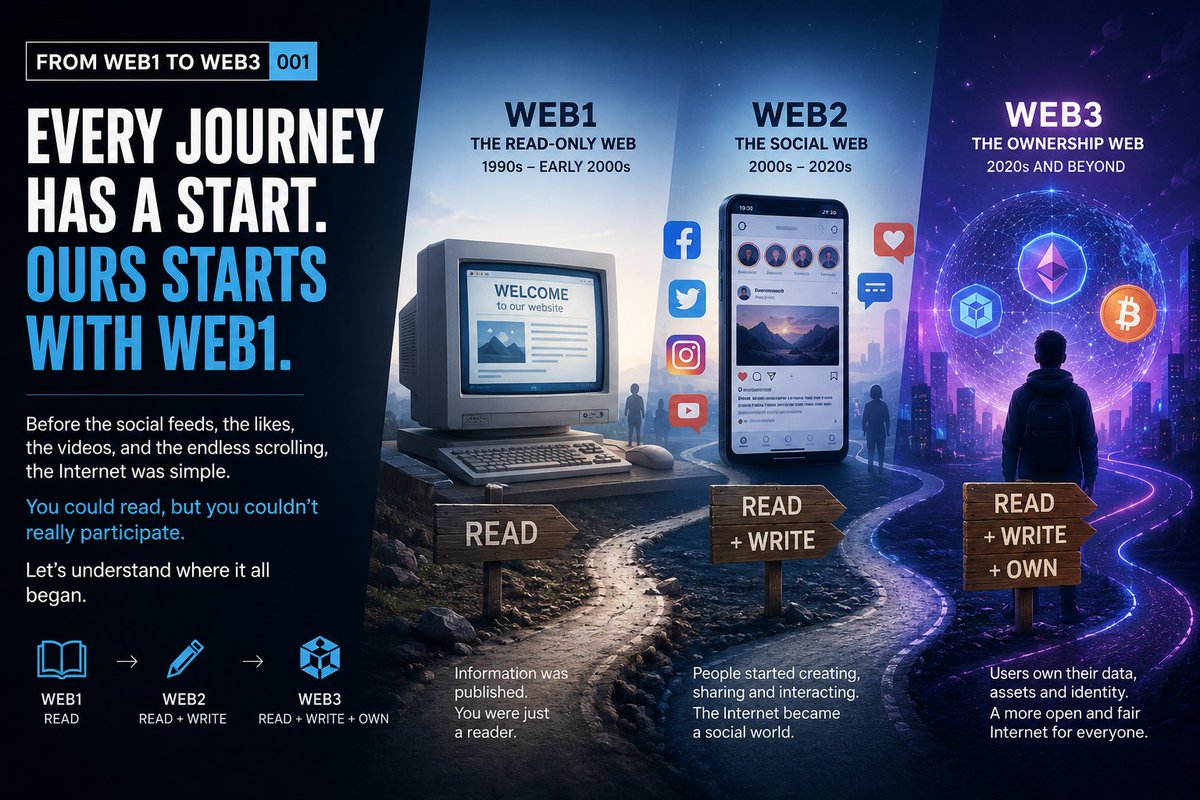
FROM WEB1 TO WEB3 001
Let’s go back
Way back
Before crypto
Before Bitcoin.
Before X, Instagram, TikTok, YouTube and Telegram.
Before the Internet became the place where we spend hours every day.
There was Web1.
Imagine sitting in front of a computer in the early days of the Internet.
You open your browser
You type in a website
The page loads
You see some text
Maybe a few pictures
You read the information…
and that's pretty much it.
No scrolling through endless feeds.
No comments.
No likes.
No reposts.
No “GM” on X. 😂
You were there to consume information.
That's the simplest way to understand Web1.
You could read, but you couldn't really participate.
Web1 was mostly made up of static websites.
Someone created a website
They published information
You visited it
You read it
Then you moved on
Think of it like a massive digital library.
The books are everywhere.
There is a huge amount of information.
But you're mostly just a visitor
You can open the book
You can read it
But you're not the one writing in it.
That's why people often call Web1 the “read only web.”
And honestly, that was already a massive revolution.
Think about what the Internet changed.
Information that once required a newspaper, library, television, phone call or physical visit could suddenly be available through a computer.
A small business could put itself online.
A university could publish information.
A writer could create a website.
A company could tell the world who they were.
The Internet was connecting people to information in a way the world had never seen before.
But something was missing.
You.
Not you as a reader.
You as a contributor.
Imagine reading an article and having something to say.
In today's Internet, you'd probably comment.
Maybe quote the post.
Maybe make a video about it.
Maybe turn it into a meme.
Back then?
You mostly just read it.
The Internet was still largely a one way street.
Someone publishes.
You consume.
Someone builds the website.
You visit.
Someone controls the content.
You read it.
Then things started changing
Websites became more interactive
People could create accounts.
Upload pictures
Write posts
Share videos
Comment
Like
Follow
Build communities.
Suddenly, the Internet wasn't just a library anymore.
It was becoming a social world.
And that was the beginning of Web2.
Web2 changed the role of the average Internet user.
You weren't just reading anymore.
You were creating.
You were posting.
You were sharing.
You were building an audience.
And that changed the Internet forever.
But it also created a new question:
If users are creating all this value, who actually owns it?
That's a question that will eventually take us to Web3.
But don't jump ahead yet.
We're going step by step.
First, we understand Web1.
Then we'll understand Web2.
Then we'll see why people started talking about Web3.
The journey is simple:
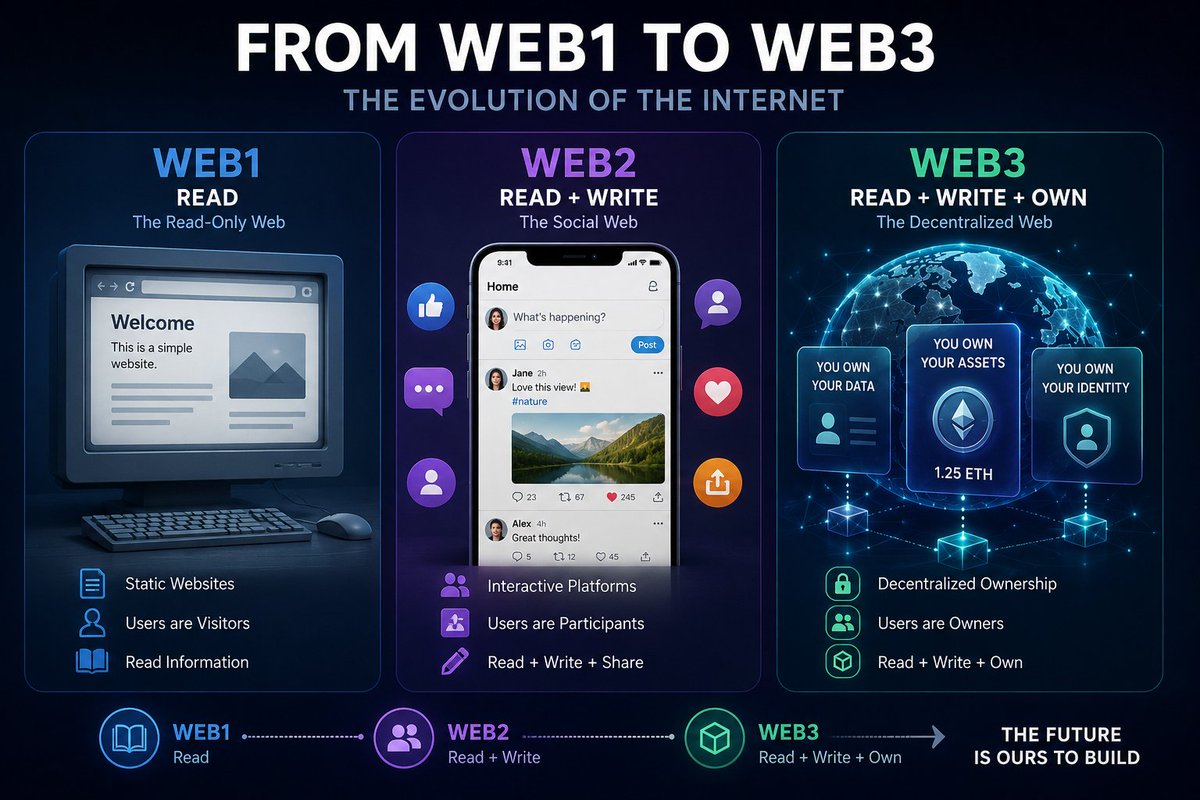
Web1 → Read
Web2 → Read + Write
Web3 → Read + Write + Own
And that's where our story begins.
Next: Web2 how the Internet stopped being a library and became a social world.
https://t.co/4ZeC9PFTVa
The live have been started I’m genuinely curious to hear what comes out of this conversation.
Gram Wallet could bring millions closer to TON, but the bigger question is what happens after they arrive.
What are builders expecting?
What will people actually build?
And how will projects like @ston_fi help turn that new access into real DeFi activity?
These are the conversations I’m here for.
The wallet is the beginning. The real story is what we build around it.
@ston_fi Can’t wait to hear the outcome.
Gram Wallet may open the door to TON, but what builders create next and where @ston_fi fits in could be the real game changer.