Open-source AI desktop app (Linux/Mac/Windows). Private Offline first, optional Online frontier when needed. No one in control but you. By @WeAreFlowsta
Your Own AI 0.9.0 is out now!!🎉
Download @ https://t.co/gJHS9nmqyR
💻 Install it on all your computers and click Sign in with Flowsta on each. Your AIs, memory and conversations sync between them, encrypted and peer to peer, device to device. Always there, always private, and no server keeps a copy.
🧠 Memory that knows what it's keeping. Rules you set, facts about you, decisions, what each work session left behind, each in its place and dated. It tidies itself while you're away, shows you every change, and you can undo any of it. And it comes with you to every computer.
🤖 New models: @NVIDIAAI Nemotron 3.5 Bolt and Super VL offline. @deepseek_ai V4.1 Flash, Meta's @Muse Wonder and @GeminiApp 4 Argon online.
🔀 Online routing you control. Choose which providers may answer you and see where each is based. When one is busy, another takes the question. Settings shows where every answer came from and what it cost.
🏃 Ask, then go anywhere in the app. Replies and project work keep running while you move around, and the tray tells you when they're done. When your AI needs a yes from you, answer it from any page.
Plus so much more..
Agents are going to live with us and do many different things.
It doesn't make sense to have a separate robot for every environment. Makes more sense to have one robot that can generalize across all of them.
We designed our environments around human bodies, so a human-shaped robot is the one that generalizes best.
That's the bet a lot of robotics companies are making.
Just walked out of Jensen Huang's keynote at NVIDIA GTC Berlin.
3 announcements stood out.
They all point the same way.
1️⃣ Agents are becoming the software layer of every company.
Jensen broke an agent into 5 parts:
A model. A harness. A sandbox. Knowledge. Tools.
That framing alone will help a lot of leaders understand what they're actually deploying.
NVIDIA wants agents to be secure, simple, and accessible. Open source, and fully owned by the companies running them.
OpenShell is a big step.
An open-source runtime that sandboxes agents and enforces what they can access.
Minimal privileges. Constant monitoring. Simple rules.
Security stops being the reason to wait.
My bet: agents take a much bigger role inside organizations in the next 12 months.
2️⃣ Open models: rent when you can, build when you must.
I've quoted Jensen on this before. It matters more than ever.
→ Frontier models to move fast, test ideas, ship MVPs
→ Owned, right-sized open models like Nemotron, post-trained on your data, for production
It also protects your business.
When a rented model goes down or raises its prices, your operations shouldn't stop.
3️⃣ Europe has a real shot.
Jensen's message: Europe shouldn't just consume AI. It should produce it.
I believe it for two reasons.
We have great brains.
Europe has been solving hard problems for centuries.
We have great industries.
Siemens agents test production changes in a digital twin before they hit the factory floor.
Dassault Systèmes agents refine vehicle designs through simulation.
That industrial know-how is our edge.
We fell behind in several recent tech revolutions.
This one plays to our strengths.
I hope we seize it.
At GTC Berlin this week? Come say hi.
Open source robotics is shipping now.
Hardware and software.
As much as Optimus looks cool, I want to know what's happening inside the robots in my life.
Your Own AI 0.9.0 is out now!!🎉
Download @ https://t.co/gJHS9nmqyR
💻 Install it on all your computers and click Sign in with Flowsta on each. Your AIs, memory and conversations sync between them, encrypted and peer to peer, device to device. Always there, always private, and no server keeps a copy.
🧠 Memory that knows what it's keeping. Rules you set, facts about you, decisions, what each work session left behind, each in its place and dated. It tidies itself while you're away, shows you every change, and you can undo any of it. And it comes with you to every computer.
🤖 New models: @NVIDIAAI Nemotron 3.5 Bolt and Super VL offline. @deepseek_ai V4.1 Flash, Meta's @Muse Wonder and @GeminiApp 4 Argon online.
🔀 Online routing you control. Choose which providers may answer you and see where each is based. When one is busy, another takes the question. Settings shows where every answer came from and what it cost.
🏃 Ask, then go anywhere in the app. Replies and project work keep running while you move around, and the tray tells you when they're done. When your AI needs a yes from you, answer it from any page.
Plus so much more..
I've released or been part of teams that have released some amazing software in my lifetime.
@YourOwnAI version 0.9.0 is the release I'm most proud of.
Hang around software devs long enough, and you'll hear the phrase "make it work, then make it better". The release before this were the make it work steps and now we're making it better.
The headline feature for this release is the Holochain powered syncing of your data, encrypted and peer to peer between any computer you add Your Own AI on. It's pretty simple too. Install it on multiple computers, click Sign in With Flowsta on both, and then it all automatically happens.
For your encrypted Holochain conversations in Your Own AI, a private Holochain network is created and the conversations gossip encrypted peer to peer.
Your AIs and memories are also stored encrypted on your device, and they are also synced with your others devices via Flowsta Vault. Also Holochain powered. If you're a Holochain app developer, you can easily add this to your own apps when you use the Flowsta SDK. More info @ https://t.co/AMimwgmnW1
Something I'm very passionate about is providing alternatives to people and businesses who don't want to outsource their AI memory to anyone else. From a privacy point of view, of course, but a business building up its memory on a service that can just cut them off at any time could probably start to rethink that strategy.
So the memory enhancements have been front and centre in this release. I've gone on a deep dive on what Claude, OpenAI and a few other players do with memory and brought the good bits to Your Own AI. But of course, with one big difference, nobody can access it but you.
There are so many other features in this release. New online and offline models, plus so much more.
But it's the little touches and relentless efforts to track and squash the bugs that make this release really special.
If you've used Your Own AI before, this release is definitely one to upgrade to. If you haven't yet, it's a free download for Linux, Mac and Windows from https://t.co/TKEhZi6Tsx
The rest of 0.9.0:
🌐 One Web switch per AI. Off means nothing from the web reaches it, whichever model answers.
🔑 Sign in is one step. See plans opens your dashboard already signed in, and a closed Vault gets an Open button.
⚡ Better model picks on small computers. A small model no longer outranks a better, faster one.
📂 A project is the same project on every computer, with Save as AGENTS.md.
🖼️ Your AIs' pictures follow them to your other computers.
🔍 The truth matrix now checks your devices, tool calls and the app's own errors, with nothing identifying in the report.
All the changes are in the changelog: https://t.co/aXgHr5Vk4f
When you use ChatGPT on Your Own AI, no personal details are sent.
Whatever model you use on Your Own AI Offline or Online, your memory and conversations stay encrypted on your device.
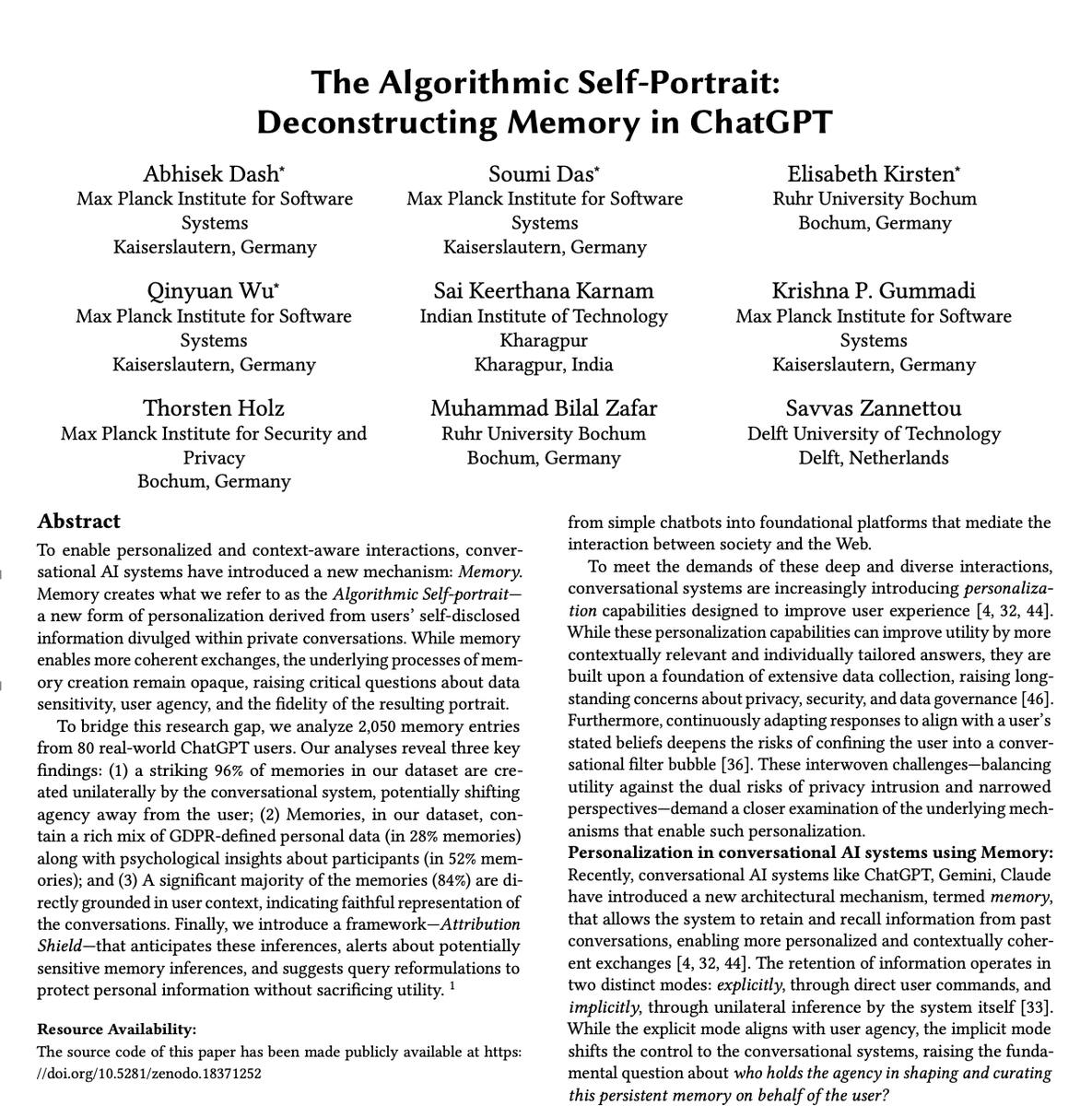
Researchers found ChatGPT is secretly writing a psychological profile of every user.
They published a paper that exposes what ChatGPT is really doing to you.
And the results are terrifying.
96% of the things it remembers about you were stored without you ever asking.
researchers discovered that it is actively reading between the lines to deduce your personality traits, anxieties, demographics, and behavioral patterns.
it’s an invisible, autonomous background process.
you ask it to debug a python script or write an essay.. and it analyzes your syntax, prompt frequency, and hesitation markers to map out your exact psychological footprint.
the paper shows that the model builds a persistent "user state" that tracks your emotional baseline over time. it knows when you are stressed. it knows your exact communication style.
it infers your insecurities based on the questions you ask and the context you provide.
we spend so much time focusing on model evaluations and alignment frameworks, but we missed the most obvious vulnerability..
the models are evaluating us.
this changes everything about how we interact with these tools on a daily basis.
every innocent prompt. every late-night question. every "help me understand this" query.
it is all being used to build a shadow profile of your mind in real-time..
practical privacy is officially dead. the ai knows you better than you know yourself.
Your Own AI version 0.9.0 is just around the corner.
It's our biggest release yet.
One of the headline new features is multi-device syncing.
Made possible with this new version of Flowsta Vault.
Download and install it now to get ready.
Flowsta Vault 1.6.1 just dropped!
Download @ https://t.co/Aw3Jy4JwRw
1.6.0 put your identity on every desktop device you own, with your private data following it.
1.6.1 gives apps built with the Flowsta SDK what they need to do the same with their own private data.
🧵 (1/7)
Happy Birthday to us!! 🥳🎉
It's been 1 year since we started Holochain development on Flowsta.
It's been 12 months and 1 day since the idea for a Holochain-based auth system came.
Very exciting for the year ahead. What we've got planned for the next few weeks alone is huge.
Have you ever tried running a local AI model and tried to fine-tune it to maximise its speed or context size?
It usually takes a whole lot of trial and error whilst editing config files.
Your Own AI makes it as simple as clicking a button and dragging a slider.
Watch how easy it is below..
@lifesmyth@EricDoriean@WeAreFlowsta Your Own AI is great now, but we're all focused on getting to v1.0.
We think that version of the product will get some buzz naturally. Either way, that's when we step up our marketing.
In 8 days, I've been developing with Holochain for 1 year.
For at least 95% of the days, I've spent an average of 12 hours a day building @WeAreFlowsta & @YourOwnAI
I literally dream of Holochain now, and the number of aha moments I've had in the past year since I started developing with it has taken me from being a fan to being in awe of it.
I'm pinching myself at what we've already built, but what we get to build in this base gives me the drive to get up, have a coffee, and start building every day.
Accepting HoloFuel, where we currently accept US dollars, was made a long time before I spoke to anyone from Holochain about it. I'm blessed to be behind one of the first orgs that will.
When you really start to learn about money and how currency debasement is theft on us all. It doesn't take a genius to realise how radically different asset-backed currencies would change everything.
We're at a time where digging up shiny metals to be that asset-backed currency is pretty silly in the age of compute.
It's been a long journey to get here, and there are still a lot of steps ahead for us all to take this mainstream.
Regardless of how many orgs, big or small, sign on to accept HoloFuel over the coming months, it's all about how many of us start using it ourselves.
Whether it's on Flowsta products or services or not, I hope to see the community start using it and then telling others.
Once the tech is available to use, usage and word of mouth are literally the way any tech adoption has ever happened and will happen.
Blessed are all of us who will be the early adopters of HoloFuel. Not often does an opportunity like this come along.
Our audacious goals for what we're building around data, auth, and permissions (for Humans and AIs) are impossible to build without Holochain.
HoloFuel is the Mutual Credit Currency backed by compute that underpins it all.
Accepting HoloFuel is such a no-brainer for us.